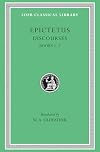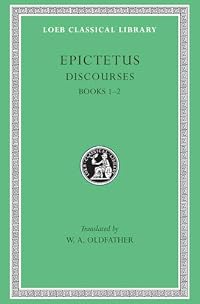
Discourses, Books 1-2
by Epictetus
On This Page
Description
The ne plus ultra of Stoicism, Discourses outline clear-cut principles of right conduct and true thinking, offering secular thinkers a mode of reasoning that dismisses the strictures of absolutism and emotionalism in exchange for a more peaceful and productive life. The Discourses report wide-ranging discussions between Epictetus and his students.Tags
Recommendations
Member Reviews
This book provides the foundation for stoicism. Epictetus remains the best source for understanding this philosophical approach to living and being in this world.
The Discourses of Epictetus are a series of extracts of the teachings of the Stoic philosopher Epictetus written down by Arrian c. 108 AD. There were originally eight books, but only four now remain in their entirety, along with a few fragments of the others. In a preface attached to the Discourses, Arrian explains how he came to write them:
I neither wrote these Discourses of Epictetus in the way in which a man might write such things; nor did I make them public myself, inasmuch as I declare that I did not even write them. But whatever I heard him say, the same I attempted to write down in his own words as nearly as possible, for the purpose of preserving them as memorials to myself afterwards of the thoughts and the freedom of speech show more of Epictetus.[1]
The Discourses are unlikely to be word-for-word transcriptions and are probably written-up versions of Arrian's lecture notes. The books did not have a formal title in ancient times. Although Simplicius called them Diatribai (Discourses),[2] other writers gave them titles such as Dialexis (Talks),[3] Apomnêmoneumata (Records),[4] and Homiliai (Conversations).[5] The modern name comes from the titles given in the earliest medieval manuscript: "Arrian's Diatribai of Epictetus" (Greek: Αρριανου των Επικτητου Διατριβων).
Cf. http://en.wikipedia.org/wiki/Discourses_of_Epictetus show less
I neither wrote these Discourses of Epictetus in the way in which a man might write such things; nor did I make them public myself, inasmuch as I declare that I did not even write them. But whatever I heard him say, the same I attempted to write down in his own words as nearly as possible, for the purpose of preserving them as memorials to myself afterwards of the thoughts and the freedom of speech show more of Epictetus.[1]
The Discourses are unlikely to be word-for-word transcriptions and are probably written-up versions of Arrian's lecture notes. The books did not have a formal title in ancient times. Although Simplicius called them Diatribai (Discourses),[2] other writers gave them titles such as Dialexis (Talks),[3] Apomnêmoneumata (Records),[4] and Homiliai (Conversations).[5] The modern name comes from the titles given in the earliest medieval manuscript: "Arrian's Diatribai of Epictetus" (Greek: Αρριανου των Επικτητου Διατριβων).
Cf. http://en.wikipedia.org/wiki/Discourses_of_Epictetus show less
Ratings
Members
- Recently Added By
Author Information

312+ Works 10,525 Members
Epictetus (A.D. 55-A.D. 135) taught in Rome until the year 94, when Emperor Domitian banished philosophers from the city. In exile, he established his school of philosophy where his distinguished students included Marcus Aurelius, author of the Meditations.
Some Editions
Series
Belongs to Publisher Series
Loeb Classical Library (131)
Common Knowledge
- Canonical title
- Discourses, Books 1-2
- Disambiguation notice
- This work is Books 1 and 2 of Epictetus's Discourses. Should not be combined with Epictetus's Discourses as a whole or any variant thereof, such as Books 1-4 and/or fragments.
Classifications
Statistics
- Members
- 330
- Popularity
- 95,589
- Reviews
- 2
- Rating
- (4.29)
- Languages
- English, French, Greek (Ancient)
- Media
- Paper, Ebook
- ISBNs
- 11
- UPCs
- 1
- ASINs
- 4