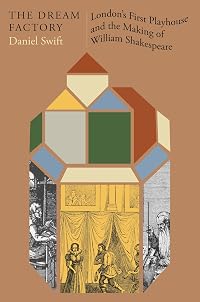
The Dream Factory: London’s First Playhouse and the Making of William Shakespeare
by Daniel Swift
On This Page
Description
"How Shakespeare became Shakespeare: a riveting tale of London's first playhouse and the people--actors, writers, builders, investors--who built the Theatre"-- Provided by publisher.Tags
Recommendations

























Member Reviews
Daniel Swift's The Dream Factory was a genuine pleasure to read. A million years ago in college, I double majored in Drama and English, so I've read plenty of books about Shakespeare. What makes The Dream Factory such a pleasure is that it's not so much about Shakespeare. Instead, it explores the nuts and bolts of putting on plays for the general public—which was an innovation at the time.
Swift approaches Elizabethan theater not as an art form, but as a profession. Profession in that ordinary (for the time) forming of a guild, determining what level of apprenticeship/learning is required before one becomes a full-fledged member, the challenge of earning a living when the theaters were closed pretty much every summer due to plague, the show more splitting of profits, and the logistics of building a physical theater. That question of building a physical theater is what leads Swift into the comparison of theater companies with guilds. The early theaters were built by craftsmen who were members of a guild of their own, and a significant proportion of those going into theater as a profession started out on the physical, nuts-and-bolts end of things.
Swift points out that just as apprentices' work was the property of their masters until the apprenticeship was completed, playwright's work was not their own, but was sold to an acting company or a publisher that then owned the work and licensed or printed it as desired, so companies and publishers made money, playwrights, not so much.
Swift also examines the way Shakespeare was a sort of apprenticeship that gradually moved into mastery. Early on, Shakespeare co-wrote plays with more experienced and well-know playwrights or wrote plays by himself that made use of familiar, popular tropes of the time. Swift sees this process of collaboration and imitation as a solid starting point for a playwright-apprentice: Shakespeare first learns to shape his voice to others' and that gives him a range of voices that he can use, combine, and modify later for his own purposes.
There's much more in The Dream Factory, but I hope this gives you enough of a sense of what Swift is doing. He's looking at the ordinary, workaday life of Shakespeare's world rather than treating Shakespeare as an artist in the way we now conceive of such an identity. If you're at all interested in the history of theater or English literature, this is a must-read title.
I received a free electronic review copy of this title prom the publisher via Edelweiss; the opinions are my own. show less
Swift approaches Elizabethan theater not as an art form, but as a profession. Profession in that ordinary (for the time) forming of a guild, determining what level of apprenticeship/learning is required before one becomes a full-fledged member, the challenge of earning a living when the theaters were closed pretty much every summer due to plague, the show more splitting of profits, and the logistics of building a physical theater. That question of building a physical theater is what leads Swift into the comparison of theater companies with guilds. The early theaters were built by craftsmen who were members of a guild of their own, and a significant proportion of those going into theater as a profession started out on the physical, nuts-and-bolts end of things.
Swift points out that just as apprentices' work was the property of their masters until the apprenticeship was completed, playwright's work was not their own, but was sold to an acting company or a publisher that then owned the work and licensed or printed it as desired, so companies and publishers made money, playwrights, not so much.
Swift also examines the way Shakespeare was a sort of apprenticeship that gradually moved into mastery. Early on, Shakespeare co-wrote plays with more experienced and well-know playwrights or wrote plays by himself that made use of familiar, popular tropes of the time. Swift sees this process of collaboration and imitation as a solid starting point for a playwright-apprentice: Shakespeare first learns to shape his voice to others' and that gives him a range of voices that he can use, combine, and modify later for his own purposes.
There's much more in The Dream Factory, but I hope this gives you enough of a sense of what Swift is doing. He's looking at the ordinary, workaday life of Shakespeare's world rather than treating Shakespeare as an artist in the way we now conceive of such an identity. If you're at all interested in the history of theater or English literature, this is a must-read title.
I received a free electronic review copy of this title prom the publisher via Edelweiss; the opinions are my own. show less
Daniel Swift's deftly written, engaging rescue of this playhouse from comparative obscurity...will deservedly be read by many who love theatre, but don't know about The Theatre.
Ratings
Members
- Recently Added By
Author Information

8+ Works 254 Members
Classifications
- Genres
- Literature Studies and Criticism, Poetry, History, Nonfiction, General Nonfiction
- DDC/MDS
- 792.0942144 — Arts & recreation Recreation, sports, and performing arts Stage presentations modified standard subdivisions History, geographic treatment, biography; Description, critical appraisal of specific theatres and companies Europe England & Wales London North London
- LCC
- PN2596 .L7 .T49 — Language and Literature Literature (General) Literature (General) Drama Dramatic representation. The theater Special regions or countries
- BISAC
Statistics
- Members
- 51
- Popularity
- 595,044
- Reviews
- 2
- Rating
- (4.00)
- Languages
- English
- Media
- Paper, Audiobook, Ebook
- ISBNs
- 2
- ASINs
- 2