On This Page
Description
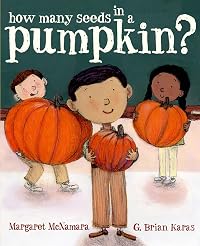
Charlie, the smallest child in his first grade class, is amazed to discover that of the three pumpkins his teacher brings to school, the tiniest one has the most seeds.Tags
Recommendations












Member Reviews
Here is an adorable picture book for curious kids, which explores skip counting and estimation in a fun pumpkin-themed classroom experiment. This book makes a wonderful read-aloud companion to any math or science curriculum, and it's a fun way to reinforce counting skills at home. "How many seeds are in a pumpkin?" Mr. Tiffin asks his class as they gather around the big, medium, and small pumpkins on his desk. Robert, the biggest kid, guesses that the largest one has a million seeds; Elinor, sounding like she knows what she's talking about, guesses the medium one has 500 seeds; and Anna, who likes even numbers better than odd ones, guesses that the little one has 22. Charlie, the smallest boy in the class, doesn't have a guess. Counting show more pumpkin seeds is messy business, but once the slimy job is done, to everyone's surprise, the smallest pumpkin has the most seeds! As Charlie happily exclaims, "Small things have a lot going on inside of them." show less
"How many seeds are in a pumpkin?" Mr. Tiffin asks his class as they gather around the big, medium, and small pumpkins on his desk. Robert, the biggest kid, guesses that the largest one has a million seeds; Elinor, sounding like she knows what she's talking about, guesses the medium one has 500 seeds; and Anna, who likes even numbers better than odd ones, guesses that the little one has 22. Charlie, the smallest boy in the class, doesn't have a guess.
Counting pumpkin seeds is messy business, but once the slimy job is done, to everyone's surprise, the smallest pumpkin has the most seeds! As Charlie happily exclaims, "Small things have a lot going on inside of them."
Counting pumpkin seeds is messy business, but once the slimy job is done, to everyone's surprise, the smallest pumpkin has the most seeds! As Charlie happily exclaims, "Small things have a lot going on inside of them."
When Mr. Tiffin brings three pumpkins to school one day, his students all have different ideas about which one will contain the most seeds. Robert, the biggest boy in the class, believes that the largest pumpkin will naturally have the most. Charlie, who is the smallest boy in the class, isn't sure what to think. Everyone is in for a surprise, however, when the pumpkins are cut open, and the seeds scooped out and counted...
Chosen as one of our October selections over in The Picture-Book Club to which I belong, where our theme this month is "Harvest-Time and Pumpkins," How Many Seeds in a Pumpkin is an engaging seasonal read, one that combines mathematical concepts with a sweet story about accepting who we are, and valuing everyone, no show more matter how small. Although I wouldn't describe it as a particular favorite, I did appreciate the fact that McNamara was fairly non-didactic in her incorporation of the latter into her story. Recommended to young pumpkins lovers, especially those who worry about being a little small for their age. show less
Chosen as one of our October selections over in The Picture-Book Club to which I belong, where our theme this month is "Harvest-Time and Pumpkins," How Many Seeds in a Pumpkin is an engaging seasonal read, one that combines mathematical concepts with a sweet story about accepting who we are, and valuing everyone, no show more matter how small. Although I wouldn't describe it as a particular favorite, I did appreciate the fact that McNamara was fairly non-didactic in her incorporation of the latter into her story. Recommended to young pumpkins lovers, especially those who worry about being a little small for their age. show less
There are a few different reasons why I like this book. Firstly, it had a great deal of mathematics incorporated into the writing, making it a useful book for teaching concepts such as estimation and counting in a relatable way for students. The teacher in the book went over how you cannot tell how many seeds are inside a pumpkin, but there are clues that can be used to estimate. The number of ridges and color orange were said to be good indicators. Using clues and indicators is a strategy students can use when they have to estimate. Additionally, aside from the math, the story had a meaningful message behind it. It pushed readers to think about the bigger issue aside from counting pumpkin seeds. The story brought up that bigger show more pumpkins don’t necessarily have more seeds, and therefore you can’t judge the inside based on physical appearance. This message applies to people, but the author was able to use pumpkins as the subject matter to broaden perspectives. The main purpose of the story was to aid students in learning how to count and estimate, but the main message was that you cannot judge something based on its outside appearance. show less
Mr. Tiffin's class conducts an experiment that involves guessing which of three pumpkin will have the most seeds: big, medium, or small? After the seeds are extracted, the students are left with three empty pumpkins, three full bowls, and twenty messy hands! The children counting the seeds of the biggest pumpkin group their seeds in pairs. The seed counters of the medium sized pumpkin separate their seeds into groups of five. Charlie, the protagonist who happens to be the smallest kid in his class, is put in charge of counting the seeds of the smallest pumpkin; he puts the seeds in groups of ten. Charlie is teased by a peer for having the pumpkin with the least amount of seeds, but the students realize they are mistaken after counting show more the most seeds in the smallest pumpkin. The story ends with Mr. Tiffin expressing the heart of the story: "Small things can have a lot going on inside of them." Although this story doesn't have the most riveting plot, it is a good book to read when teaching estimation, counting, and grouping, especially in the fall season. show less
This adorable book is a great read during the Fall season when pumpkins are at their best. I would highly recommend any class that is learning about grouping to read it. The main character, Charlie, doesn’t like lining up to go into school because the students line up from tallest to shortest, and he is always in the back. During his math class the students guess how many seeds are in each pumpkin, decide how they are going to count them (by 2’s, 5’s or by 10’s) and then count away. Charlie ends up with the smallest pumpkin and is a bit discouraged when he is pushed to count the seeds by 10’s. However, with some effort he and the class realize that the smallest pumpkin has the most seeds! The story ends with the class show more realizing that small things have a lot to them, just like Charlie. show less
In my opinion, this is a interesting and fun book to read about math around halloween. I liked this book because it is a creative way to teach estimation in a 3rd or 4th grade classroom. It explained the concept in a way that would keep the readers interested. It asked questions that the readers could answer and make predictions about the story. I also liked the illustrations in the books. They provided visuals to the reader that helped explain the math concepts. For example, one of the concepts being taught was counting in twos, fives, and tens; and the illustration had pictures of the pumpkin seeds grouped into two, fives, and tens. The purpose of this story is to teach estimation, counting by grouping, and random facts about show more pumpkins. This book makes learning math engaging and gave facts about pumpkins which could be related to halloween to gain the readers interest around halloween season. show less
Members
- Recently Added By
Lists

Youth: Seasonal
56 works; 1 member
Author Information

All Editions
Awards and Honors
Series

Common Knowledge
- Canonical title
- How Many Seeds in a Pumpkin?
Classifications
Statistics
- Members
- 1,021
- Popularity
- 25,655
- Reviews
- 42
- Rating
- (4.21)
- Languages
- English, French, Korean
- Media
- Paper, Ebook
- ISBNs
- 8
- ASINs
- 5