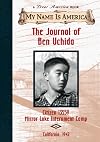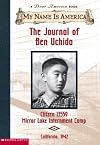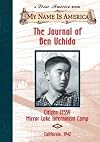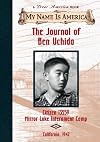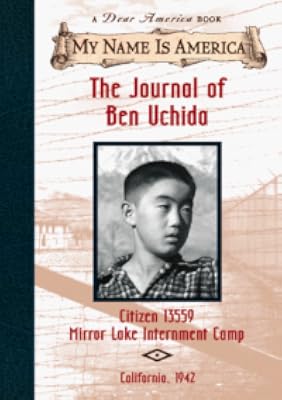
The Journal of Ben Uchida: Citizen 13559, Mirror Lake Internment Camp, California, 1942
by Barry Denenberg
My Name is America (6), My Story, Dear America Collections (My Name Is America: WWII Era, 1942)
On This Page
Description
Twelve-year-old Ben Uchida keeps a journal of his experiences as a prisoner in a Japanese internment camp in Mirror Lake, California, during World War II.Tags
Recommendations


























Member Reviews
Told in simple, clear prose, this journal follows Ben from the morning of December 7, 1941 through his journey to Mirror Lake (Manzanar) internment camp. Ben is honest and forthright, greeting the injustice with humor and a stalwart resilience. He expresses anger through levity, and only a few moments does his fear and anger appear in his words. Ben uses Baseball to cope – losing himself in the game. Without realizing it, he makes keen observations of the people around him. He often remarks on event that he doesn’t know the significance of, but that the reader will.
Other reviewers have remarked on the lack of historical accuracy in the slang and language. This is partially correct. At the same time, we don’t tend to use slang in show more diaries (not that I’ve seen) and the event described are accurate. The prose is simple and clear, and suitable for elementary-age readers. It is an excellent starting place for discussions about civil liberty, the injustice of racism, and what it means to be a citizen. Worth reading. show less
Other reviewers have remarked on the lack of historical accuracy in the slang and language. This is partially correct. At the same time, we don’t tend to use slang in show more diaries (not that I’ve seen) and the event described are accurate. The prose is simple and clear, and suitable for elementary-age readers. It is an excellent starting place for discussions about civil liberty, the injustice of racism, and what it means to be a citizen. Worth reading. show less
After reading [b:The Fences Between Us: The Diary of Piper Davis, Seattle, Washington, 1941|7886561|The Fences Between Us The Diary of Piper Davis, Seattle, Washington, 1941 (Dear America)|Kirby Larson|https://i.gr-assets.com/images/S/compressed.photo.goodreads.com/books/1328837952l/7886561._SX50_.jpg|11103189], I wanted something raw and more angry... and it exists, published eleven years prior in the "My Name is America" boy diary equivalents. While also not an #ownvoices book, Barry Denenberg at least recognizes that the story of Japanese American incarceration should be told through the eyes of those forcibly removed from their homes- not a bystander. Ben Uchida is a salty, sarcastic 12 year old who is upset with the situation but show more also feels powerless (in gallows humor, mentioning that they might never leave). With the perspective of a Japanese American kid, we see his father get taken without any word where he is or when they'll hear from him. We see them have to sell/find what to do with their belongings over a week's notice. We get the annoyance and frustration over every part of this. I shouldn't keep comparing the two, but Kirby Larson's Piper just doesn't capture the feelings around this because frankly, Piper doesn't really care as much because it doesn't directly affect her.
Per the epilogue- why isNaomi's future husband Caucasian ? There's no in-text hints for that so it seems out of nowhere (unless like Kirby's Betty Sato we're making [a:Jeanne Wakatsuki Houston|86883|Jeanne Wakatsuki Houston|https://images.gr-assets.com/authors/1216938312p2/86883.jpg] proxies). And, it only makes me speculate more about Ben.
The historical section does a broad look at Asian American discrimination, including the Chinese Exclusion Act (and thus why Japanese labor was needed but also why they could bring families) and additional legislation re: the 1924 Asian exclusion act and later legislation on quotas per country. This would be a good intro for children to broader Asian American history, along with [b:Journal of Wong Ming-Chung: A Chinese Miner, California, 1852|25263|Journal of Wong Ming-Chung A Chinese Miner, California, 1852 (My Name is America)|Laurence Yep|https://i.gr-assets.com/images/S/compressed.photo.goodreads.com/books/1389824883l/25263._SX50_.jpg|2894578]. show less
Per the epilogue- why is
The historical section does a broad look at Asian American discrimination, including the Chinese Exclusion Act (and thus why Japanese labor was needed but also why they could bring families) and additional legislation re: the 1924 Asian exclusion act and later legislation on quotas per country. This would be a good intro for children to broader Asian American history, along with [b:Journal of Wong Ming-Chung: A Chinese Miner, California, 1852|25263|Journal of Wong Ming-Chung A Chinese Miner, California, 1852 (My Name is America)|Laurence Yep|https://i.gr-assets.com/images/S/compressed.photo.goodreads.com/books/1389824883l/25263._SX50_.jpg|2894578]. show less
A fictional journal of a boy before and during his internment during WWII that I definitely recommend using this with middle school students as a supplement to their social studies unit on WWII. The sentence structure and vocabulary are just right for my student population, and the narrator is REALISTIC--he sounds like my kids.
Conflicts include the father being taken away to be interrogated for over a year, the rest of the family being sent to god knows where, life in the internment camp, getting father back a zombie, having a friend get involved in baseball gambling and then throwing a game, having a roommate who has been separated from his wife in Japan who worries throughout the book only to finally find relief when he receives show more letter indicating that she and his daughter are safe at his brother's house in Hiroshima.....
They boy reports about the problems and the benefits in a seemingly honest way, and I did get a better sense of life in the camp than when I read a nonfiction book about Japanese Internment in my middle school library.
My issue with the text is this: The author writes in near-perfect, grammatically sound sentences that still captures this middle-school voice. For example, he'd say that this know-it-all kid is "half Japanese, half Jerk" and when he's talking, Ben "tried not to puke." So, I could see the narrator being a normal kid. I know that my students can't write with perfect punctuation, and I'm so THANKFUL that the author chose to write with the standards of proper English anyway, at no expense, even though it's a "journal." The problem is, just like in the Diary of a Wimpy Kid series, the author uses improper grammar as far as pronoun usage goes, which angers me! Why? Why? Why? (Example: "Me and Naomi went to the mess hall") This kind of error is so pervasive in this country that soon the correct syntax "Naomi and I went to the mess hall") will sound completely foreign. I want my students to read more SO THAT they will be exposed to proper grammar, usage, mechanics, and spelling. Since the author chose not to use real-life lack of punctuation and a bunch of spelling errors, my only guess is that these authors (Denenberg & Jeff Kinney) really don't know better. I assume that they themselves don't know how to use the correct pronoun in a sentence with a compound subject or direct object.
I have noticed that the word "till" as a shortened version of "until" is now commonly used and accepted. It's in my son's basal readers AND in countless books that I've read in the last month. Will it be acceptable, pretty soon, to start saying "Me and him are best friends" ? While I will perpetually cringe, I suppose it will make my job easier (I don't really mean that).
I implore the editors of this book series (Dear America) to publish no more books without correcting these errors!
Overall, a good text to peddle to your students for educational purposes (at the expense of your grammar lessons). It even includes some nonfiction historical background at the end of the book for which I am enthusiastically envisioning the possibilities. show less
Conflicts include the father being taken away to be interrogated for over a year, the rest of the family being sent to god knows where, life in the internment camp, getting father back a zombie, having a friend get involved in baseball gambling and then throwing a game, having a roommate who has been separated from his wife in Japan who worries throughout the book only to finally find relief when he receives show more letter indicating that she and his daughter are safe at his brother's house in Hiroshima.....
They boy reports about the problems and the benefits in a seemingly honest way, and I did get a better sense of life in the camp than when I read a nonfiction book about Japanese Internment in my middle school library.
My issue with the text is this: The author writes in near-perfect, grammatically sound sentences that still captures this middle-school voice. For example, he'd say that this know-it-all kid is "half Japanese, half Jerk" and when he's talking, Ben "tried not to puke." So, I could see the narrator being a normal kid. I know that my students can't write with perfect punctuation, and I'm so THANKFUL that the author chose to write with the standards of proper English anyway, at no expense, even though it's a "journal." The problem is, just like in the Diary of a Wimpy Kid series, the author uses improper grammar as far as pronoun usage goes, which angers me! Why? Why? Why? (Example: "Me and Naomi went to the mess hall") This kind of error is so pervasive in this country that soon the correct syntax "Naomi and I went to the mess hall") will sound completely foreign. I want my students to read more SO THAT they will be exposed to proper grammar, usage, mechanics, and spelling. Since the author chose not to use real-life lack of punctuation and a bunch of spelling errors, my only guess is that these authors (Denenberg & Jeff Kinney) really don't know better. I assume that they themselves don't know how to use the correct pronoun in a sentence with a compound subject or direct object.
I have noticed that the word "till" as a shortened version of "until" is now commonly used and accepted. It's in my son's basal readers AND in countless books that I've read in the last month. Will it be acceptable, pretty soon, to start saying "Me and him are best friends" ? While I will perpetually cringe, I suppose it will make my job easier (I don't really mean that).
I implore the editors of this book series (Dear America) to publish no more books without correcting these errors!
Overall, a good text to peddle to your students for educational purposes (at the expense of your grammar lessons). It even includes some nonfiction historical background at the end of the book for which I am enthusiastically envisioning the possibilities. show less
Ben’s cynical eye sees through the hypocrisy of the situation they are all in but he does his best under the circumstances, coping with the absence of his father, befriending little Jimmy who misses his mother, and participating in the camp baseball league. Not deeply told but a good overview of what internees had to put up with: disintegration of families, losing their sense of selves, bitterness, prejudice, hopelessness, etc.
I thought I would like this book a lot more than I did. It's not that it's a bad book -- it's a very good book and I learned quite a bit, I just think I was expecting too much of it. That seems to be might pitfall with a lot of books. That said, it was still good and I still enjoyed and for a young boy in the correct age group I can see them loving the book. Over all good and would recommend it. 4 out of 5 stars.
Reviewed July 2005
I love these books, they may have too many coincidences in them at times like Mr. Tashima being so worried about his wife and daughter throughout the book then at the near end he is happy to hear that they are safe with relatives in Hiroshima. But these things are important to young readers to understand all the history of that era. And boy is there lots of history here. Told through the eyes of an intelligent child you learn lots. I would recommend this series to anyone who enjoys history of would like to understand this time better. After reading something like this you can expand your knowledge by reading further leaving you with some groundwork to build on. This story was so heartbreaking at times. Other times it show more was really wonderful to see the spirit of humans, managing to make the best of things during the worst of times. Flowers, gardens, baseball games, graduations ect.... I was very sad to read the mention of the man stepping off the train wearing his WWI uniform. This man had fought as an American and was still imprisoned. Also helpful were the pictures and history. Mirror Lake is Manzanar Camp in real life.
12-2005 show less
I love these books, they may have too many coincidences in them at times like Mr. Tashima being so worried about his wife and daughter throughout the book then at the near end he is happy to hear that they are safe with relatives in Hiroshima. But these things are important to young readers to understand all the history of that era. And boy is there lots of history here. Told through the eyes of an intelligent child you learn lots. I would recommend this series to anyone who enjoys history of would like to understand this time better. After reading something like this you can expand your knowledge by reading further leaving you with some groundwork to build on. This story was so heartbreaking at times. Other times it show more was really wonderful to see the spirit of humans, managing to make the best of things during the worst of times. Flowers, gardens, baseball games, graduations ect.... I was very sad to read the mention of the man stepping off the train wearing his WWI uniform. This man had fought as an American and was still imprisoned. Also helpful were the pictures and history. Mirror Lake is Manzanar Camp in real life.
12-2005 show less
This story follows Ben and his family after they are forcefully removed from their home in San Francisco and exported to an internment camp in central California. The struggle to adjust to a barren new environment, keep their identity, family and sense of self (being both Japanese and American) brings depth and emotion to the book.
Members
- Recently Added By
Lists

Learning history through first-person, young adult, historical fiction one
188 works; 4 members

Favorite Childhood Books
1,646 works; 518 members

Books That Changed Our Perspective
423 works; 168 members
Author Information

29+ Works 13,884 Members
Awards and Honors
Series


Work Relationships
Is contained in
Common Knowledge
- Canonical title
- The Journal of Ben Uchida: Citizen 13559, Mirror Lake Internment Camp, California, 1942
- Original publication date
- 1999
- People/Characters
- Ben Uchida
- Important places
- Mirror Lake Internment Camp, California, USA; California, USA
- Important events
- World War II (1939 | 1945); World War II, Pacific Theater (1941-12-07 | 1945-09-02); Japanese-American Internment (1942 | 1945)
- First words
- My name is Ben Uchida.
- Last words
- (Click to show. Warning: May contain spoilers.)I'm thinking of organizing a MAYBE-MAYBE group.
Classifications
Statistics
- Members
- 805
- Popularity
- 34,328
- Reviews
- 14
- Rating
- (3.75)
- Languages
- English
- Media
- Paper
- ISBNs
- 4
- ASINs
- 1