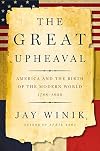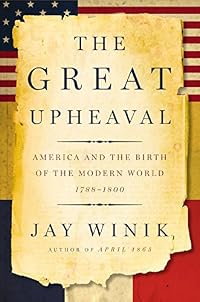
The Great Upheaval: America and the Birth of the Modern World, 1788-1800
by Jay Winik
On This Page
Description
It is an era that redefined history. As the 1790s began, a fragile America teetered on the brink, Russia was a vast imperial power, and France plunged into revolution. But in contrast to the way conventional histories tell it, none of these events occurred in isolation. Here, historian Winik shows how their fates combined to change the course of civilization. Here is a savage world war, the toppling of a great dynasty, and an America struggling to survive at home and abroad. Here, too, is show more the first modern holy war between Islam and a resurgent Christian empire. And what a cast of characters: Washington and Jefferson, Louis XVI and Robespierre, Catherine the Great, John Adams, Napoleon, and Selim III. With powerful echoes for the international chaos that confronts the globe today, we see an arc of revolutionary fervor stretching from Philadelphia and Paris to St. Petersburg and Cairo--with fateful results.--From publisher description. show lessTags
Recommendations
















Member Recommendations
Member Reviews
Jay Winik gives adjectives a real workout in this entertaining but hyperbolic account of the events roiling the end of the 18th Century, focused mostly on the French Revolution but also on the American Revolution and the empire building of the Russians. (He doesn't manage to make much of a connection among the three except that (a) these were exciting times all over and (b) the parties concerned were all paying some attention to what was going on elsewhere. Catherine, however, was rather isolated and moreover fixated on the Ottoman Empire and getting a warm water port on the Black Sea. And Winik completely omits the influence of England's Revolution of 1688 - still very much on the minds of her colonists - but presumably unimportant for show more not having occurred in the twelve years or three countries Winik is covering.)
In long strings of clauses laden with excess verbiage, Winik describes the history of the times by recounting the “unmitigated horror,” the “momentous decisions,” the “dreaded specter,” the “clarion call” -– you get the idea. His clauses sometimes sound like personals ads: “incorrigibly flawed yet ironically suited,” “inspired yet quixotic,” “uncommonly brave yet psychologically frail.”
Triteness is not a barrier to Winik – he has no qualms about describing “golden shores," "quickening pulses," or "words dripping with emotion”; nor about exclaiming that “behind this legend was a man” who was "of fabled status," or “it was a fateful day,” but "it was not to be". Alliteration also has great appeal in his tour of the adjectives: “audaciously assumed,” “terrible toll,” “defiantly demanded,” “frenzied fighting.” But where he waxes most florid in his verbal outpourings is in the tales of war: “ghastly massacre,” “blood flowed like rivers,” “bestial fighting,” “crushing defeat,” “murderous enemy,” “brutally decapitated” (is there a non-brutal decapitation?).
Evaluation: When I wasn’t rolling my eyes, for the most part I was enjoying the stories. A blow-by-blow account of the lead-up to the guillotining of Louis XVI and Marie Antoinette may not be among the most important aspects of the French Revolution, but it sure makes for good drama. Likewise, the story of Catherine the Great’s suppression of a peasant revolt amid the complications of her love affair with Grigory Potemkin is quite interesting. So I would, in fact, recommend this book for a diverting romp through an important time for global politics, even though you'll want to keep a few pillows around you to punch while you read. show less
In long strings of clauses laden with excess verbiage, Winik describes the history of the times by recounting the “unmitigated horror,” the “momentous decisions,” the “dreaded specter,” the “clarion call” -– you get the idea. His clauses sometimes sound like personals ads: “incorrigibly flawed yet ironically suited,” “inspired yet quixotic,” “uncommonly brave yet psychologically frail.”
Triteness is not a barrier to Winik – he has no qualms about describing “golden shores," "quickening pulses," or "words dripping with emotion”; nor about exclaiming that “behind this legend was a man” who was "of fabled status," or “it was a fateful day,” but "it was not to be". Alliteration also has great appeal in his tour of the adjectives: “audaciously assumed,” “terrible toll,” “defiantly demanded,” “frenzied fighting.” But where he waxes most florid in his verbal outpourings is in the tales of war: “ghastly massacre,” “blood flowed like rivers,” “bestial fighting,” “crushing defeat,” “murderous enemy,” “brutally decapitated” (is there a non-brutal decapitation?).
Evaluation: When I wasn’t rolling my eyes, for the most part I was enjoying the stories. A blow-by-blow account of the lead-up to the guillotining of Louis XVI and Marie Antoinette may not be among the most important aspects of the French Revolution, but it sure makes for good drama. Likewise, the story of Catherine the Great’s suppression of a peasant revolt amid the complications of her love affair with Grigory Potemkin is quite interesting. So I would, in fact, recommend this book for a diverting romp through an important time for global politics, even though you'll want to keep a few pillows around you to punch while you read. show less
Wow, what a book! I just finished reading The Great Upheaval: America and the Birth of the Modern World, 1788-1800 by Jay Winik. As in all of the Jay Winik books I have read, the other two being April 1865: The Month That Saved America and 1944: FDR and the Year That Changed History, they are dedicated titularly to very narrow periods of history. Of course this it is impossible to avoid straying outside those bounds, but this book is more faithful to the boundaries than the other two. Perhaps this is unfortunate for reasons I'll outline.
The Great Upheaval focuses on the American and French Revolutions and the bloody final days of Catherine the Great, Czarina of Russia. These countries' evolution during this period of time in large part show more foreshadowed their futures. America at that time was a fragile republic clinging to the Eastern third of the modern United States. France and Russia were, as of 1788 well-established empires on the verge of implosion. What is remarkable is how their changes during this period foreshadow modern eras in these countries, but regretfully the author passes of the opportunity, other than through tantalizing hints, to explore this. In Winik's defense the book was copyrighted in 2007, before Putin had evolved into the modern-day Czar and monster that he is. The book makes glancing references to the fact that even in the early 1790's, as France began its hellish descent into the Terror, people were already talking about moving to America, and some were actually doing it or trying to.
To use an expression attributed to Mark Twain, History Doesn't Repeat Itself, but It Often Rhymes. This book is a major commitment to read. It was well worthwhile, particularly for a history buff like myself. It did not take me two months to read; I read two other books in between. show less
The Great Upheaval focuses on the American and French Revolutions and the bloody final days of Catherine the Great, Czarina of Russia. These countries' evolution during this period of time in large part show more foreshadowed their futures. America at that time was a fragile republic clinging to the Eastern third of the modern United States. France and Russia were, as of 1788 well-established empires on the verge of implosion. What is remarkable is how their changes during this period foreshadow modern eras in these countries, but regretfully the author passes of the opportunity, other than through tantalizing hints, to explore this. In Winik's defense the book was copyrighted in 2007, before Putin had evolved into the modern-day Czar and monster that he is. The book makes glancing references to the fact that even in the early 1790's, as France began its hellish descent into the Terror, people were already talking about moving to America, and some were actually doing it or trying to.
To use an expression attributed to Mark Twain, History Doesn't Repeat Itself, but It Often Rhymes. This book is a major commitment to read. It was well worthwhile, particularly for a history buff like myself. It did not take me two months to read; I read two other books in between. show less
History that reads as a novel. Taking three focal points, American Revolution, French Revolution and the Russian failed attempt into liberalization, the book weaves together the story lines. The book has a very high BPP, bodies per page, one of highest I've read in awhile.
Winik ties together the events in early US history, the French Revolution and the initially liberal but eventually reactionary government of Catherine the Great. He does a good job of showing how interrelated all of these events were and that the world at that time was more "global" than you might think. A little bit of US cheer leading(certainly a bigger fan of Hamilton than I am), but when you consider the outcomes of the 3 systems it is hard to argue that it isn't mostly deserved.
In "The Great Upheaval," Winik's thesis is that the political events in Russia, France, and America during the time period of 1788-1800 were not isolated incidents. Rather, the political world at this time was more global than once thought, resulting in individuals playing key roles in events on both continents. For example, Winik describes Jefferson's role in both the shaping of America, as well as his support of the initial stages of the French Revolution. Other impotant historical figures discussed include Catherine, Adams, Washington, Kosciuszko, Louis XVI, Lafayette, and many others.
Although Winik painstakingly recounts the events and actions of these three countries during these 12 years, at times they seem removed from one show more another. He writes one chapter at a time about each country, with each chapter being approximately 5 years. Thus each chapter furthers the country's storyline independent from the other countries. This method forces the reader to interconnect the storylines of the three countries on your own. It is not until the last chapter (and Epilogue) that the events in each country are directly connected within the chapter.
I did appreciate how Winik showed that the same negative revolutionary ideas that commanded the French Revolution were also at times evident in America and Russia as well. The only reason that America and Russia did not share the same fateful fate as the French was a result of leadership.
Overall, I thought it was a fascinating read, especially if you are interested in the background behind the great events of the late 18th century. I would recommend this book to anyone who would like a new perspective on this time period as well. show less
Although Winik painstakingly recounts the events and actions of these three countries during these 12 years, at times they seem removed from one show more another. He writes one chapter at a time about each country, with each chapter being approximately 5 years. Thus each chapter furthers the country's storyline independent from the other countries. This method forces the reader to interconnect the storylines of the three countries on your own. It is not until the last chapter (and Epilogue) that the events in each country are directly connected within the chapter.
I did appreciate how Winik showed that the same negative revolutionary ideas that commanded the French Revolution were also at times evident in America and Russia as well. The only reason that America and Russia did not share the same fateful fate as the French was a result of leadership.
Overall, I thought it was a fascinating read, especially if you are interested in the background behind the great events of the late 18th century. I would recommend this book to anyone who would like a new perspective on this time period as well. show less
Reads really quickly, more like a novel than history, and intricately links political and philosophical thinking across America, France, and Russia to make the point that society was global even back then, though communications were slower. Drives home the connections between American and European unrest during this period and the shaping of these nations.
Very informative. Provided a lot of information about America, France, and Russia during the late 18th century.
Members
- Recently Added By
Author Information

6+ Works 3,193 Members
Jay Winik, one of the nation's leading historians, is renowned for his gifted and creative approaches to history. He is the author of The New York Times and #1 bestseller April 1865 (2001), which received wide international acclaim and became an award-wining documentary on the History Channel, watched by 50 million viewers. The Great Upheaval: show more America and the Birth of the Modern World 1788-1800 (HarperCollins, 2007), was a New York Times bestseller and a Best Book of the Year for both USA Today and the Christian Science Monitor, as well as a main selection of the Book of the Month club and the History Book club. In the UK it was also selected for the prestigious Financial Times list of best books of the year. Winik was in 2013 the Historical Advisor to the National Geographic Channels, and among a number of projects, worked on an epic six-part history of the 1980s with the renowned, award-winning Nutopia film company, which premiered to critical acclaim in over 100 countries. Frequently asked to write or speak about Presidential Leadership and Abraham Lincoln, Winik recorded a series of 14 lectures on the Civil War for the Barnes and Noble Great Lectures series, and he is one of the lead authors of Presidential Leadership: Rating the Best and the Worst of the White House (Wall Street Journal Books, 2004); What Ifs? Of American History: Eminent Historians Imagine What Might Have Been (Putnam, 2003); BookNotes on American Character (PublicAffairs, 2004); I Wish I¿d Been There: Distinguished Historians Travel Back In Time, (Doubleday, 2006); and Abraham Lincoln: Great American Historians on our 16th president (Public Affairs/C-SPAN, 2008). Born in Connecticut, Winik is a graduate of Yale College, and holds an M.Sc. with distinction from the London School of Economics and a Ph.D. from Yale University. Represented by Michael Carlisle in New York City, and the Washington Speakers Bureau, he is a member of the Council on Foreign Relations, is an elected Fellow of the Society of American Historians, and served or serves on the Governing Council of the National Endowment for the Humanities, a presidential appointment, as well as the boards for American Heritage magazine and the journal, World Affairs; he is also a trustee or advisory board member of a number of non-profit boards, including National History Day, the Civil War Preservation Trust; Ford¿s Theatre; The Abraham Lincoln Bicentennial Commission; The Lincoln Legacy Project, the Washington Tennis and Education Foundation; the Lincoln Forum; and earlier the Potomac School, and the Advisory Council of the James Madison Book Award. He is a nominator for the largest prize in the humanities, the $1.5 million John W Kluge award. He has also provided advice to the National Constitution Center in Philadelphia, and was a juror for the prestigious George Washington book prize in 2008, and a recommender for the Heinz awards. His latest book, 1944: FDR and the Year That Changed History (Simon & Schuster 2015) made it to the NY Times Bestseller List. (Bowker Author Biography) show less
Awards and Honors
Distinctions
Common Knowledge
- People/Characters
- George Washington; Thomas Jefferson; Louis XVI, King of France; Catherine the Great
- Important places
- Paris, France; St. Petersburg, Russia; Philadelphia, Pennsylvania, USA; Moscow, Russia
- Important events
- French Revolution; American Revolution; the terror
Classifications
- Genres
- History, Nonfiction, General Nonfiction
- DDC/MDS
- 973.4 — History & geography History of North America United States Constitutional period (1789-1809)
- LCC
- E310 .W56 — History of the United States United States Revolution to the Civil War, 1775/1783-1861 By period 1789-1809. Constitutional period Diplomatic history. Foreign and general
- BISAC
Statistics
- Members
- 850
- Popularity
- 31,782
- Reviews
- 10
- Rating
- (3.90)
- Languages
- English
- Media
- Paper, Audiobook, Ebook
- ISBNs
- 14
- ASINs
- 14