
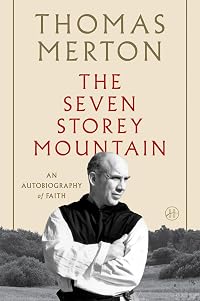
The Seven Storey Mountain
by Thomas Merton, Evelyn Waugh (Preface)
On This Page
Description
From one of the 20th century's best-loved Christian writers comes this extraordinary spiritual testament. Thomas Merton was a man who experienced life to its fullest in the world before entering a Trappist monastery. In this memoir, he recounts his spiritual quest, one that led to his conversion to Catholicism.Tags
Recommendations










Member Recommendations
Member Reviews
Well, I read this yonks ago, probably in my twenties, and I cannot tell you how differently I perceive it now. The essentials are still there; Merton's absolute commitment to self exploration,into trying to understand the consequences of the unbridled, unacknowleged dark side of "man"kind. Therein, in this usage of "man"kind, lies an unbridgeable abyss between us. Merton saw himself as a man among men and he never once enlarges the scope beyond "man"kind. It's all unconscious on his part and I think, until recently men could imagine that they were including everyone in the term, but they weren't, in my twenties I accepted that notion, but I don't now because I know I, as a woman, was not included. The exclusion is implicit with never a show more whisper of woman as equal, if in nothing else, in spiritual questioning and striving. This is made ever more so concrete by the fact that Merton uses almost exclusively, when discussing his spiritual journey, imagery of struggle and battle and war and conquest. That was, of course, the context of his life and has been of men (and women, as far as we know, not by choice) for thousands of generations. If it weren't for the exquisite reading of Sidney Lanier I'm not sure I could have continued. These days I'm back in the office of shrink and we work at reframing, which I find hard to do. Instead of saying "Sorry your cat died" I have to learn to say, "My condolences" or "I'm sorry for your loss" neither of which come easily to me as they appear to avoid the heart of what the person before me is suffering. My point? That seeing and describing spiritual searching as a battle, limits and cripples the search into a struggle of will and sin and endurance. If how you frame yourself in the world matters, then seeing it as a battle is going to make your problems worse, I suspect, not to mention exciting and dramatic. I came away this time, still full of admiration for Merton who now and then pops out a remark that is so profound you can barely keep your balance, while at the same time filled with a new compassion for him as well as a sense that his struggle is not mine. There is tangentially the fact that this was a brutal abridgement of a much longer book, so someone else decided what to focus on which could have something to do with my response. **** show less
This book is essentially Thomas Merton's autobiography of his early life through the time of his conversion to Catholicism and entry into a monastery. Aside from being an interesting story, there are a few additional insights to be gained from this book that make it extraordinary. For example, at the end of the book Merton talks about how vices can also be manifested in spiritual forms. It's through his own self reflection that he discovers how a person may display pride over spiritual accomplishments. While the spiritual versions of these sins are disguised as good, they're just as corrupting to the soul as the other forms. Insights like these make the book worth reading and throughout the book Merton also feels like someone worth knowing.
Two things in Shannon’s note in this edition propelled me to begin this book. First, Merton may have been a product of or perhaps even drawn to the post Reformation, pre Vatican II arrogance of the Church that led it to promote an exclusionary, limiting interpretation of the Gospels. And what attracts and emboldens him to believe and profess his faith through our shared body of the Church? Second, how does the issuance of a human child ever in our faith get deemed something so horrific as to be revealed only in a “tell-all” version of his life, how can it reasonably be labeled a “disaster” for him and the unmarried women?
I’d like to read a forward written perhaps in the pen of the ‘disastrous’ child. A man, especially a show more religious one, who avoids the privilege of knowing, acknowledging, and supporting his own blood cannot, in my opinion, be trusted to carry the full message of Christ. No child in a classroom, a boardroom, or the theatre of life would or should ever imagine having to introduce themselves as a bastard, a disaster, a secret, or the unwanted product of a so-called aspiring Man of God. Women, mothers certainly do not and cannot hide from such accomplishments, i.e. bringing a life into this world. So I would call his posture in reference to this child a “social abortion” and no less and perhaps more unfortunate that a bona fide abortion. What is it exactly that is so secret, disastrous, or so shameful about a child born as to warrant being rejected by the Franciscan Order or public opinion or him? This escapes me entirely.
I expect to read in the remainder of Merton’s book of someone who is preoccupied with scrubbing his earthly life dry of the pitfalls of everyday humanness. Why bother? There is no sin so original, after all, other than that of Adam and Eve, that anyone should imagine they have invented, a frailty so novel that they can’t be forgiven or make amends. To run from one’s own ‘failures’ so assuredly while pursuing a Christ-like life, then, it seems to me, is a profound disservice to the gift of being human and accessing the grace of God in the first place.
I’ll update my review. If I can finish his missive. Lord, give me strength. show less
I’d like to read a forward written perhaps in the pen of the ‘disastrous’ child. A man, especially a show more religious one, who avoids the privilege of knowing, acknowledging, and supporting his own blood cannot, in my opinion, be trusted to carry the full message of Christ. No child in a classroom, a boardroom, or the theatre of life would or should ever imagine having to introduce themselves as a bastard, a disaster, a secret, or the unwanted product of a so-called aspiring Man of God. Women, mothers certainly do not and cannot hide from such accomplishments, i.e. bringing a life into this world. So I would call his posture in reference to this child a “social abortion” and no less and perhaps more unfortunate that a bona fide abortion. What is it exactly that is so secret, disastrous, or so shameful about a child born as to warrant being rejected by the Franciscan Order or public opinion or him? This escapes me entirely.
I expect to read in the remainder of Merton’s book of someone who is preoccupied with scrubbing his earthly life dry of the pitfalls of everyday humanness. Why bother? There is no sin so original, after all, other than that of Adam and Eve, that anyone should imagine they have invented, a frailty so novel that they can’t be forgiven or make amends. To run from one’s own ‘failures’ so assuredly while pursuing a Christ-like life, then, it seems to me, is a profound disservice to the gift of being human and accessing the grace of God in the first place.
I’ll update my review. If I can finish his missive. Lord, give me strength. show less
I'm happy to say that after looking forward to reading this book for a long time it did not disappoint my expectations. This book is the unlikely story of a man of the world deciding to convert to Catholicism and then become a Trappist monk. Further defying logic the book became a best-seller and it's author perhaps the first celebrity-monk of the modern age. I like the book because Merton's thoughts and struggles parallel my own thoughts and struggle on my faith journey. I also enjoy reading about Merton in the places I'm familiar with such as New York City and Cambridge, England. I will have to disagree with Merton based on personal experience that Catholic schools do not prevent bullying among children.
Favorite Passages
Many times it show more was like that. And in a sense, this terrible situation is the pattern and prototype of all sin: the deliberate and formal will to reject disinterested love for for the purely arbitrary reason that we simply don't want it. We will seperate ourselves from that love. We reject it entirely and absolutely, and will not acknowledge it, simply because it does not please us to be loved. Perhaps the inner motive is that the fact of being loved disinterestedly reminds us that we all need love from others, and depend upon the charity of others to carry on our own lives. And we refuse love, and reject society, in so far as it seems, in our own perverse imagination, to imply some obscure kind of humiliation (p. 26).
People seem to think that it is in some way a proof that no God exists, if we have so many wars. On the contrary, consider how in spite of centuries of sin and greed and lust and cruelty and hatred and avarice and oppression and injustice, spawned and bred by the free wills of men, the human race can still recover, each time, and can still produce men and women who overcome evil with good, hatred with love, greed with charity, lust and cruelty with sanctity. How could all this be possible without the merciful love of God, pouring out His grace upon us (p. 142)?
When it comes to accepting God's own authority about things that cannot possibly be known in any other way except as revealed by His authority, people consider it insanity to incline their ears and listen. Things that cannot be known in any other way, they will not accept from this source. And yet they will meekly and passively accept the most appalling lies from newspapers when they scarcely need to crane their necks to see the truth in front of them, over the top of the sheet they are holding in their hands (p. 187).
I did a fair amount of reading that might be called "spiritual" although I did not read spiritually. I devoured books making notes here and there and remembering whatever I thought would be useful in my argument -- that is, for my own aggrandizement, in order that I myself might take these things and shine by their light, as if their truth belonged to me (p. 253-4).
Experience has taught me one big moral principle, which is this: it is totally impractical to plan your actions on the basis of a vast two-columned list of possibilities, with mortal sins on one side and things that are "not a mortal sin" on the other--the one to be avoided, the other to be accepted without discussion. Yet this hopelessly misleading division of possibilities is what serves large numbers of Catholics as a whole more theology (p. 265).
Catholics are worried about Communism...but few Catholics stop to think that Communism would make very little progress in the world, or none at all, if Catholics really lived up to their obligations, and really did the things Christ came on earth to teach them to do: that is, if they really loved one another, and saw Christ in one another, and lived as saints, and did something to win justice for the poor (paraphrase of a talk by Catherine de Hueck Doherty, p. 373). show less
Favorite Passages
Many times it show more was like that. And in a sense, this terrible situation is the pattern and prototype of all sin: the deliberate and formal will to reject disinterested love for for the purely arbitrary reason that we simply don't want it. We will seperate ourselves from that love. We reject it entirely and absolutely, and will not acknowledge it, simply because it does not please us to be loved. Perhaps the inner motive is that the fact of being loved disinterestedly reminds us that we all need love from others, and depend upon the charity of others to carry on our own lives. And we refuse love, and reject society, in so far as it seems, in our own perverse imagination, to imply some obscure kind of humiliation (p. 26).
People seem to think that it is in some way a proof that no God exists, if we have so many wars. On the contrary, consider how in spite of centuries of sin and greed and lust and cruelty and hatred and avarice and oppression and injustice, spawned and bred by the free wills of men, the human race can still recover, each time, and can still produce men and women who overcome evil with good, hatred with love, greed with charity, lust and cruelty with sanctity. How could all this be possible without the merciful love of God, pouring out His grace upon us (p. 142)?
When it comes to accepting God's own authority about things that cannot possibly be known in any other way except as revealed by His authority, people consider it insanity to incline their ears and listen. Things that cannot be known in any other way, they will not accept from this source. And yet they will meekly and passively accept the most appalling lies from newspapers when they scarcely need to crane their necks to see the truth in front of them, over the top of the sheet they are holding in their hands (p. 187).
I did a fair amount of reading that might be called "spiritual" although I did not read spiritually. I devoured books making notes here and there and remembering whatever I thought would be useful in my argument -- that is, for my own aggrandizement, in order that I myself might take these things and shine by their light, as if their truth belonged to me (p. 253-4).
Experience has taught me one big moral principle, which is this: it is totally impractical to plan your actions on the basis of a vast two-columned list of possibilities, with mortal sins on one side and things that are "not a mortal sin" on the other--the one to be avoided, the other to be accepted without discussion. Yet this hopelessly misleading division of possibilities is what serves large numbers of Catholics as a whole more theology (p. 265).
Catholics are worried about Communism...but few Catholics stop to think that Communism would make very little progress in the world, or none at all, if Catholics really lived up to their obligations, and really did the things Christ came on earth to teach them to do: that is, if they really loved one another, and saw Christ in one another, and lived as saints, and did something to win justice for the poor (paraphrase of a talk by Catherine de Hueck Doherty, p. 373). show less
The Seven Story Mountain, published in 1948, is the autobiography of Thomas Merton, which he completed when he was only 31 years old. The book recounts the spiritual and intellectual journey that led Merton not only to espouse the Roman Catholic faith, but to become a Trappist monk. The Trappists are among the most severe of all Catholic orders, living very abstemiously, with complete submission to the will of their superiors, and, pursuant to their vows of silence, scarcely speaking at all.
Merton was an accomplished prose writer and a respectably competent poet. He forewent a fairly successful secular literary career to become the best known and best selling “Catholic” author of his generation. In later life, while remaining show more devoutly Catholic, he explored, analyzed, and praised eastern religions, particularly Buddhism.
The title of The Seven Story Mountain refers to Dante’s description of Purgatory, up through which Virgil must struggle and climb to reach Paradise. Presumably, Merton viewed his early life as his own purgatory.
The version of Catholicism that forms the back story of the book is rather dated—it happens to be the version I was taught in the 1950s. It is full of devotion to the saints: in Merton’s case, special devotion to The Virgin and to the Little Flower (St. Therese of Lisieux, whom he considers “the outstanding saint of the 19th century”). His devotion to the Virgin manifested itself in a rather extreme view that sanctity comes to man only through her: “God has willed that there be no other way.” !!!
In addition, it includes some truly perverse views of man’s condition in the universe. For example Merton writes:
“…man’s nature, by itself, can do little or nothing to settle his most important problems. If we follow nothing but our natures, our own philosophies, our own level of ethics, we will end up in hell.”
That sounds more like a hard-shell Southern Baptist than a modern Catholic.
Merton frequently ascribed divine intervention as the cause of perfectly unexceptional events. In several places, he says (paraphrasing), “God brought us together” or “Jesus caused me to read a particular book.” In one strange passage, he accounts for his recovery from rather sever illness to the prayers of unknown people:
“Only God could help me. Who prayed for me? One day I shall know. But in the economy of God’s love, it through the prayers of other men that these graces are given. It was through the prayers of someone who loved God that I was, one day, to be delivered out of that hell where I was already confined without knowing it.”
I found two of his observations particularly amusing. The first concerned the attitudes of one of the students he taught at St Bonaventure college. Merton could hardly fathom that one of the students didn’t believe in devils!
The second amusing observation concerned the consequences of the tendency of Catholics to bifurcate sinning into mortal and venial sins and to downplay or even disregard venial sins. To him, the fact that imbibing in alcohol was only a venial sin resulted in “a lot of drunk Irishmen on Saturday night.”
But in my view, the craziest, totally batty idea Merton expressed had to do with the power of prayer:
“The eloquence of the liturgy was even more tremendous; and what it said was one, simple, cogent, tremendous truth: this church, the court of the Queen of Heaven, is the real capital of the country in which we are living. This is the center of all the vitality that is in America. This is the cause and reason why the nation is holding together. These men [the monks], hidden in the anonymity of their choir and their white cowls, are doing for their land what no army, no congress, no president could ever do as such: they are winning for it the grace and the protection and the friendship of God.”
Who’da thunk it?! My apologies to the author, but my most recent atlas still lists Washington DC as the nation’s capital. Moreover, Messrs. Eisenhower, Truman, and the 11 million members of the WWII armed forces might have been able to bring some nuance to Merton’s observations in 1948!
The book, having a highly religious and devotional content, sold surprisingly (perhaps “astonishingly” is more accurate) well, with sales of more than 600,000 copies in hard cover and more than 3 million in paperback. That fact alone demonstrates how much this country has changed from the late 1940s.
The book is actually pretty well written and interesting for historical purposes, but I wouldn’t recommend it to anyone except young Catholics (to compare its preconceptions with the modern church) and students of comparative religion.
(JAB) show less
Merton was an accomplished prose writer and a respectably competent poet. He forewent a fairly successful secular literary career to become the best known and best selling “Catholic” author of his generation. In later life, while remaining show more devoutly Catholic, he explored, analyzed, and praised eastern religions, particularly Buddhism.
The title of The Seven Story Mountain refers to Dante’s description of Purgatory, up through which Virgil must struggle and climb to reach Paradise. Presumably, Merton viewed his early life as his own purgatory.
The version of Catholicism that forms the back story of the book is rather dated—it happens to be the version I was taught in the 1950s. It is full of devotion to the saints: in Merton’s case, special devotion to The Virgin and to the Little Flower (St. Therese of Lisieux, whom he considers “the outstanding saint of the 19th century”). His devotion to the Virgin manifested itself in a rather extreme view that sanctity comes to man only through her: “God has willed that there be no other way.” !!!
In addition, it includes some truly perverse views of man’s condition in the universe. For example Merton writes:
“…man’s nature, by itself, can do little or nothing to settle his most important problems. If we follow nothing but our natures, our own philosophies, our own level of ethics, we will end up in hell.”
That sounds more like a hard-shell Southern Baptist than a modern Catholic.
Merton frequently ascribed divine intervention as the cause of perfectly unexceptional events. In several places, he says (paraphrasing), “God brought us together” or “Jesus caused me to read a particular book.” In one strange passage, he accounts for his recovery from rather sever illness to the prayers of unknown people:
“Only God could help me. Who prayed for me? One day I shall know. But in the economy of God’s love, it through the prayers of other men that these graces are given. It was through the prayers of someone who loved God that I was, one day, to be delivered out of that hell where I was already confined without knowing it.”
I found two of his observations particularly amusing. The first concerned the attitudes of one of the students he taught at St Bonaventure college. Merton could hardly fathom that one of the students didn’t believe in devils!
The second amusing observation concerned the consequences of the tendency of Catholics to bifurcate sinning into mortal and venial sins and to downplay or even disregard venial sins. To him, the fact that imbibing in alcohol was only a venial sin resulted in “a lot of drunk Irishmen on Saturday night.”
But in my view, the craziest, totally batty idea Merton expressed had to do with the power of prayer:
“The eloquence of the liturgy was even more tremendous; and what it said was one, simple, cogent, tremendous truth: this church, the court of the Queen of Heaven, is the real capital of the country in which we are living. This is the center of all the vitality that is in America. This is the cause and reason why the nation is holding together. These men [the monks], hidden in the anonymity of their choir and their white cowls, are doing for their land what no army, no congress, no president could ever do as such: they are winning for it the grace and the protection and the friendship of God.”
Who’da thunk it?! My apologies to the author, but my most recent atlas still lists Washington DC as the nation’s capital. Moreover, Messrs. Eisenhower, Truman, and the 11 million members of the WWII armed forces might have been able to bring some nuance to Merton’s observations in 1948!
The book, having a highly religious and devotional content, sold surprisingly (perhaps “astonishingly” is more accurate) well, with sales of more than 600,000 copies in hard cover and more than 3 million in paperback. That fact alone demonstrates how much this country has changed from the late 1940s.
The book is actually pretty well written and interesting for historical purposes, but I wouldn’t recommend it to anyone except young Catholics (to compare its preconceptions with the modern church) and students of comparative religion.
(JAB) show less
Merton's writing is clearly the product of a lot of solitude and reflection. The comparisons with Augustine an Aquinas are apt, but he is less of a theologian and more of a literary writer (wasn't surprised to find he was a reader of Joyce and Dante). Still, the impulse to retreat into solitude during WWII does have some historical moral implications, and you can see he is struggling with this in writing this.
An amazing book. This it's an autobiography, a conversion story, and chock-full of amazingly deep spiritual insight.
This isn't a book, however, that you're going to sit down and read all at one go. It's four hundred and twenty pages long, so that pretty much precludes speeding through the thing.
Is it ever hard to read? Well, yes. But I'd temper that with the thought that I haven't read a spiritual book that was ever completely easy. And there are times when switching back and forth between philosophical/religious insight and autobiographical stories isn't as smooth as it could be.
However - keep this fact in mind. When Merton wrote this book, he was ONLY THIRTY-THREE YEARS OLD!! I was astounded and a little befuddled by that when I got show more to the end and discovered it. I thought, as I was reading, that this book was written by a wise old man. Imagine my discomfiture when I found that he was only five years older than me.
And yet - inspite of some minor awkwardness in the sheer writing mechanics - this is an amazing book. As a Catholic and convert myself, I found his story extremely inspiring. However, I don't think that only Catholics should read this book. Anyone who considers themselves spiritual (or would like to) should read it, and consider its contents. show less
This isn't a book, however, that you're going to sit down and read all at one go. It's four hundred and twenty pages long, so that pretty much precludes speeding through the thing.
Is it ever hard to read? Well, yes. But I'd temper that with the thought that I haven't read a spiritual book that was ever completely easy. And there are times when switching back and forth between philosophical/religious insight and autobiographical stories isn't as smooth as it could be.
However - keep this fact in mind. When Merton wrote this book, he was ONLY THIRTY-THREE YEARS OLD!! I was astounded and a little befuddled by that when I got show more to the end and discovered it. I thought, as I was reading, that this book was written by a wise old man. Imagine my discomfiture when I found that he was only five years older than me.
And yet - inspite of some minor awkwardness in the sheer writing mechanics - this is an amazing book. As a Catholic and convert myself, I found his story extremely inspiring. However, I don't think that only Catholics should read this book. Anyone who considers themselves spiritual (or would like to) should read it, and consider its contents. show less
Members
- Recently Added By
Lists

Church Times 100 Best Christian Books
106 works; 26 members

501 Must-Read Books
529 works; 72 members

Christianity Books You've Read
179 works; 19 members
25 Books Every Christian Should Read
27 works; 4 members

The Well-Educated Mind Reading Challenge
75 works; 7 members

Well-Educated Mind
150 works; 3 members

Books featuring monks and/or nuns
166 works; 33 members

Blue Pyramid 1,276 Best Books of All Time
1,248 works; 32 members

1940s
221 works; 25 members

Mustich's 1000 Books to Read Before You Die: A Life Changing List
1,001 works; 19 members

Publisher's Weekly NON-Fiction list - 1912 - 1975
486 works; 4 members

The Well-Educated Mind, Susan Wise Bauer, 2016
179 works; 3 members
Recommendations by Peter Kreeft
45 works; 4 members
Author Information

397+ Works 38,078 Members
Born in France, Thomas Merton was the son of an American artist and poet and her New Zealander husband, a painter. Merton lost both parents before he had finished high school, and his younger brother was killed in World War II. Something of the ephemeral character of human endeavor marked all his works, deepening the pathos of his writings and show more drawing him close to Eastern, especially Buddhist, forms of monasticism. After an initial education in the United States, France, and England, he completed his undergraduate degree at Columbia University. His parents, nominally friends, had given him little religious guidance, and in 1938, he converted to Roman Catholicism. The following year he received an M.A. from Columbia University and in 1941, he entered Gethsemani Abbey in Kentucky, where he remained until a short time before his death. His working life was spent as a Trappist monk. At Gethsemani, he wrote his famous autobiography, "The Seven Storey Mountain" (1948); there he labored and prayed through the days and years of a constant regimen that began with daily prayer at 2:00 a.m. As his contemplative life developed, he still maintained contact with the outside world, his many books and articles increasing steadily as the years went by. Reading them, it is hard to think of him as only a "guilty bystander," to use the title of one of his many collections of essays. He was vehement in his opposition to the Vietnam War, to the nuclear arms race, to racial oppression. Having received permission to leave his monastery, he went on a journey to confer with mystics of the Hindu and Buddhist traditions. He was accidentally electrocuted in a hotel in Bangkok, Thailand, on December 10, 1968. (Bowker Author Biography) show less

Born in Hampstead and educated at Oxford University, Evelyn Waugh came from a literary family. His elder brother, Alec was a novelist, and his father, Arthur Waugh, was the influential head of a large publishing house. Even in his school days, Waugh showed sings of the profound belief in Catholicism and brilliant wit that were to mark his later show more years. Waugh began publishing his novels in the late 1920's. He joined the Royal Marines at the beginning of World War II and was one of the first to volunteer for commando service. In 1944 he survived a plane crash in Yugoslavia and, while hiding in a cave, corrected the proofs of one of his novels. Waugh's early novels, Decline and Fall (1927), Vile Bodies (1930), and A Handful of Dust (1934), established him as one of the funniest and most brilliant satirists the British had seen in years. He was particularly skillful at poking fun at the scramble for prominence among the upper classes and the struggle between the generations. He lived for a while in Hollywood, about which he wrote The Loved One (1948), a scathing attack on the United States's overly sentimental funeral practices. His greatest works, however, are Brideshead Revisited (1945), which has been made into a highly popular television miniseries, and the trilogy Sword of Honor (1965), composed of Men at Arms (1952), Officers and Gentlemen (1955), and The End of the Battle (1961). (Bowker Author Biography) show less

Evelyn Waugh has a Legacy Library. Legacy libraries are the personal libraries of famous readers, entered by LibraryThing members from the Legacy Libraries group.
Some Editions
Awards and Honors
Distinctions
Notable Lists
Series
Belongs to Publisher Series
Livre de Vie (2-3)
Work Relationships
Common Knowledge
- Original title
- The Seven Storey Mountain
- Alternate titles
- Elected silence : autobiography; Seven storey mountain
- Original publication date
- 1948
- People/Characters
- Thomas Merton; Jean Paul Merton
- Epigraph
- "For I tell you that God is able of these stones to raise up children to Abraham."
CHRISTO
VERO
REGI
*****
English Translation:
"for Christ, the true king"
from phrase:
Ad te ergo nunc mihi sermo dirigitur, quisquis abrenuntians propriis voluntatibus, Domino Chr... (show all)isto vero Regi militaturus oboedientiæ fortissima atque præclara arma sumis.
To thee, therefore, my speech is now directed, who, giving up thine own will, takest up the strong and most excellent arms of obedience, to do battle for Christ the Lord, the true King. - First words
- On the last day of January 1915, under the sign of the Water Bearer, in a year of a great war, and down in the shadow of some French mountains on the borders of Spain, I came into the world.
- Last words
- (Click to show. Warning: May contain spoilers.)That you may become the brother of God and learn to know the Christ of the burnt men.
- Blurbers
- Greene, Graham; Waugh, Evelyn
Classifications
- Genres
- Religion & Spirituality, Biography & Memoir, Nonfiction, General Nonfiction
- DDC/MDS
- 271.12502 — Religion History of Christianity Religious congregations and orders in church history Benedictines Cistercians Trappists
- LCC
- BX4705 .M542 .A3 — Philosophy, Psychology and Religion Christian Denominations Christian Denominations Catholic Church Biography and portraits Individual
- BISAC
Statistics
- Members
- 5,308
- Popularity
- 2,559
- Reviews
- 64
- Rating
- (3.94)
- Languages
- 10 — Catalan, Dutch, English, French, German, Hungarian, Italian, Portuguese, Slovenian, Spanish
- Media
- Paper, Audiobook, Ebook
- ISBNs
- 53
- ASINs
- 76