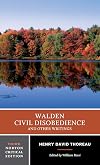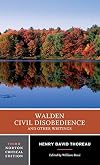
Walden, Civil Disobedience, and Other Writings (Norton Critical Editions)
by Henry David Thoreau
On This Page
Description
In addition to the texts of 'Walden' and 'Civil Disobedience', this revised and expanded 'Norton Critical Edition' reprints the increasingly important works 'Slavery in Massachusetts', 'Walking' and 'Wild Apples'. All texts are accompanied by annotations.Tags
Recommendations










































Member Reviews
Walden review
This is not the book that I expected. It isn't exactly life affirming, or even about tranquility as I expected it to be. It is, however, a book about startling us out of our complacency and focus on trivial matters. It is about ceasing to be so attentive to the external and begin cultivating out interior. Walden is more important now than ever before. We live in an age where the external aspects of living are very well done and held in high esteem, but interior aspect of life are not. We love iPods, but not wisdom.
The first two chapters and the conclusion are passionate and full of ideas, but what happens in the middle is too often overlooked. It is slow yet beautiful description seemingly without much significance, but to show more skip this part would be to miss the point. By channeling or focus on slowing down and noticing the everyday, Thoreau takes us to Walden with him to contemplate life. One does not need to live in a cabin in the woods to experience what Thoreau went through, one only needs to read his book.
I’ve heard from great admirers of the book that it is difficult and at times boring, but that shouldn’t cause anyone to skip those parts, as they are part if the journey. I honestly didn’t find a single aspect of it boring, but I can see why one might – even lovers of it. My professor confessed that he found some parts almost unbearable, but necessary.
This is a book of wisdom. It is philosophy more than anything else. Not so much a “how-to” guide for living, but a finger pointing to the direction of wisdom. We must not focus our lives so much on making money and being comfortable, but we must explore our lives and selves more. We have become very good at the externals of life, but do we know why we live? This book is a finger in the right direction. show less
This is not the book that I expected. It isn't exactly life affirming, or even about tranquility as I expected it to be. It is, however, a book about startling us out of our complacency and focus on trivial matters. It is about ceasing to be so attentive to the external and begin cultivating out interior. Walden is more important now than ever before. We live in an age where the external aspects of living are very well done and held in high esteem, but interior aspect of life are not. We love iPods, but not wisdom.
The first two chapters and the conclusion are passionate and full of ideas, but what happens in the middle is too often overlooked. It is slow yet beautiful description seemingly without much significance, but to show more skip this part would be to miss the point. By channeling or focus on slowing down and noticing the everyday, Thoreau takes us to Walden with him to contemplate life. One does not need to live in a cabin in the woods to experience what Thoreau went through, one only needs to read his book.
I’ve heard from great admirers of the book that it is difficult and at times boring, but that shouldn’t cause anyone to skip those parts, as they are part if the journey. I honestly didn’t find a single aspect of it boring, but I can see why one might – even lovers of it. My professor confessed that he found some parts almost unbearable, but necessary.
This is a book of wisdom. It is philosophy more than anything else. Not so much a “how-to” guide for living, but a finger pointing to the direction of wisdom. We must not focus our lives so much on making money and being comfortable, but we must explore our lives and selves more. We have become very good at the externals of life, but do we know why we live? This book is a finger in the right direction. show less
The works of the transcendentalists bring up good points, but their journals and parts of their writings bring up other facts: that they were just as insecure about their ideas as the average man-- interspersed with spurts of egocentrism.
May I never go to that egocentric place in my life. Ever.
May I never go to that egocentric place in my life. Ever.
well written, insightful, but about as exciting as watching ice melt.
Clearly this is a classic, so many people find value in it. I was supposed to read 'Walden' for my course, but ended up skimming it. It seems to me to be self-indulgent condescending nonsense. One extra star for the phrase '[t]he mass of men lead lives of quiet desperation'.
Ratings
Members
- Recently Added By
Author Information

619+ Works 49,437 Members
In September 1842, Nathaniel Hawthorne noted this social encounter in his journal: "Mr. Thorow dined with us yesterday. He is a singular character---a young man with much of wild original nature still remaining in him; and so far as he is sophisticated, it is in a way and method of his own. He is as ugly as sin, long-nosed, queer-mouthed, and with show more uncouth and somewhat rustic, although courteous manners, corresponding very well with such an exterior. But his ugliness is of an honest and agreeable fashion, and becomes him much better than beauty. On the whole, I find him a healthy and wholesome man to know." Most responses to Thoreau are as ambiguously respectful as was Hawthorne's. Thoreau was neither an easy person to like nor an easy writer to read. Thoreau described himself as a mystic, a Transcendentalist, and a natural philosopher. He is a writer of essays about nature---not of facts about it but of his ideals and emotions in its presence. His wish to understand nature led him to Walden Pond, where he lived from 1845 to 1847 in a cabin that he built. Though he was an educated man with a Harvard degree, fluent in ancient and modern German, he preferred to study nature by living "a life of simplicity, independence, magnanimity, and trust." Knowing this, we should beware of misreading the book that best reflected this great experience in Thoreau's life: Walden; or, Life in the Woods (1854). It is not a handbook of the simple life. Though there are elements in the book of a "whole-earth catalogue" mentality, to focus on the radical "economic" aspects of Thoreau's work is to miss much in the book. Nor is it an autobiography. The right way to read Walden is as a "transcendental" narrative prose poem, whose hero is a man named Henry, a modern Odysseus in search of a "true America." Thoreau left Walden Pond on September 6, 1846, exactly two years, two months, and two days after he had settled there. As he explained in the pages of Walden: "I left the woods for as good a reason as I went to live there. Perhaps it seemed to me that I had several more lives to live, and could not spare any more time for that one." Growth, change, and development were essential to his character. One should not overlook the significance of his selecting July 4 as the day for taking possession of his residence at Walden Pond, a day that celebrates the establishment of a new government whose highest ideal is individual freedom. In terms of Thoreau's redefinition of the nation-idea, "the only true America" is that place where one may grow wild according to one's nature, where one may "enjoy the land, but own it not." Thoreau believed that each person should live according to individual conscience, willing to oppose the majority if necessary. An early proponent of nonviolent resistance, he was jailed briefly for refusing to pay his poll tax to support the Mexican War and the slave system that had promoted that war. His essay "On Civil Disobedience" (1849), which came from this period of passive resistance, was acknowledged by Mahatma Gandhi (who read it in a South African jail) as the basis for his campaign to free India. Martin Luther King, Jr. later attributed to Thoreau and Gandhi the inspiration for his leadership in the civil rights movement in the United States. Thoreau contracted tuberculosis in 1835 and suffered from it sporadically afterwards. His health declined over three years with brief periods of remission, until he eventually became bedridden. Recognizing the terminal nature of his disease, Thoreau spent his last years revising and editing his unpublished works, particularly The Maine Woods and Excursions, and petitioning publishers to print revised editions of A Week and Walden. He died on May 6, 1862 at age 44. (Bowker Author Biography) show less
Some Editions
Classifications
- Genres
- Fiction and Literature, Literature Studies and Criticism
- DDC/MDS
- 818.303 — Literature & rhetoric American literature in English American miscellaneous writings in English Middle 19th Century 1830-61
- LCC
- PS3048 .A1 — Language and Literature American literature American literature Individual authors 19th century
- BISAC
Statistics
- Members
- 252
- Popularity
- 129,076
- Reviews
- 4
- Rating
- (4.17)
- Languages
- English
- Media
- Paper
- ISBNs
- 3
- ASINs
- 2