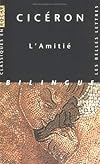
On Friendship [in translation]
by Marcus Tullius Cicero
On This Page
Description
In this treatise, Cicero writes about his own experience with friendship. Cicero ponders the meaning of this friendship by using the relationship between Scipio Aemilianus and Laelius to expound his views. Laelius' speech comprises the most part and is instigated by the death of his best friend Scipio and he expresses how he could bear the loss, and explicates his grounds for bereavement. He enumerates what qualities make for good friends, explains what characteristics expose a bad friend, show more and provides examples from his personal life. Throughout the book, Cicero emphasizes the importance of virtue in friendship and how true friendship cannot exist without it.The work is written as a dialogue between prominent figures of the Middle Roman republic and is set after the death of the younger Scipio Africanus (otherwise known as Scipio Aemilianus, Scipio Africanus Minor, or Scipio the Younger) in 129 BC. The interlocutors of the dialogue chosen by Cicero are Gaius Laelius a close friend of the late statesman, and Laelius's two sons-in-law, Gaius Fannius, and Quintus Mucius Scaevola. Interestingly, Scaevola himself was mentor and teacher to Cicero, who probably heard his teacher's reminiscences about these conversations first-hand. show lessTags
Recommendations

























Member Recommendations

by anonymous user
Member Reviews
Tenía yo curiosidad por esta obra desde hace tiempo, desde que ví en casa de mis padres su versión en latín, preparada para su traducción escolar. Hombre, lo cierto es que no es para dar saltos de alegría, y así lo advierte sensatamente el editor. Cicerón lo escribió al final de su vida, un poco de pasada, y lo dejó sin corregir. Y Cicerón no es Platón, obviamente. Se presenta en forma de diálogo, al estilo platónico, pero los interlocutores de Lelio, el protagonista, son meras comparsas, y acaba siendo una conferencia. Falta estructuración, aunque los capítulos, muy breves, tienen sentido en sí mismos. Proclama que la amistad debe separarse del interés, pero, de hecho, acaba afirmando la necesidad de tener amigos que show more a uno le convengan. Un concepto romano, aristocrático, político y, en el fondo, utilitario, de la amistad. Nada de sentimientos, nada de afectividad, nada de pasarlo bien. Hoy estamos muy lejos de estas ideas, pero no deja de resultar interesante conocerlas: otra amistad es posible, aunque quizá no deseable.
La edición es bastante buena, aunque abusa de las notas biográficas que estorban al lector no latinista o historiador. Por cierto que esta abundancia de referencias a la historia de la República Romana se aprecia también en el propio texto, y no deja de resultar a veces confusa, a pesar de los esfuerzos del editor en las notas por aclararnos quién es quién. Eso sí, los clasicistas imagino que disfrutarán. show less
La edición es bastante buena, aunque abusa de las notas biográficas que estorban al lector no latinista o historiador. Por cierto que esta abundancia de referencias a la historia de la República Romana se aprecia también en el propio texto, y no deja de resultar a veces confusa, a pesar de los esfuerzos del editor en las notas por aclararnos quién es quién. Eso sí, los clasicistas imagino que disfrutarán. show less
Mar 5, 2011 (Edited)Spanish
Boekje geschreven in 44 v.Chr., op het einde van zijn leven. Tractaat in dialoogvorm. Nogal grillige structuur.
Inhoudelijk een mooie oefening in het aftasten van een onderwerp gaande van bepaalde theorieën die al of niet worden weerlegd tot concrete modellen die kunnen worden opgevuld.
Vriendschap: staat op zichzelf en voor zich zelf, niet gericht op genot of gewin, en daarom eigenlijk alleen mogelijk tussen wijze, nobele mensen van gelijke rang en gezindheid. Een echt aristocratische visie op vriendschap dus, die wel mooie affiniteiten vertoond met de christelijke vriend¬schap (in zijn ethische omschrijving), maar toch te selectief gedefinieerd lijkt. De grens met liefde bijvoorbeeld wordt nergens aangegeven. Overigens gaat het show more alleen maar om de vriendschap tussen mannen. show less
Inhoudelijk een mooie oefening in het aftasten van een onderwerp gaande van bepaalde theorieën die al of niet worden weerlegd tot concrete modellen die kunnen worden opgevuld.
Vriendschap: staat op zichzelf en voor zich zelf, niet gericht op genot of gewin, en daarom eigenlijk alleen mogelijk tussen wijze, nobele mensen van gelijke rang en gezindheid. Een echt aristocratische visie op vriendschap dus, die wel mooie affiniteiten vertoond met de christelijke vriend¬schap (in zijn ethische omschrijving), maar toch te selectief gedefinieerd lijkt. De grens met liefde bijvoorbeeld wordt nergens aangegeven. Overigens gaat het show more alleen maar om de vriendschap tussen mannen. show less
Aug 17, 2010Dutch
SB-5
Jul 16, 2021Catalan
Ratings
Members
- Recently Added By
Lists

How to Read a Book's Recommended Reading List
309 works; 10 members

Books Referenced by Izetbegovic's Islam Between East and West
233 works; 2 members
Author Information

2,140+ Works 26,587 Members
Born in Arpinum on January 3, 106 B.C., Marcus Tullius Cicero was a Roman orator, writer, and politician. In Rome, Cicero studied law, oratory, philosophy, and literature, before embarking on a political career. Banished from Rome in 59 B.C. for the execution of some members of the Catiline group, Cicero devoted himself to literature. Cicero was show more pardoned by Julius Caesar in 47 B.C., and returned to Rome to deliver his famous speeches, known as the "Philippics," urging the senate to declare war on Marc Antony. Cicero's chief works, written between 46 and 44 B.C., can be classified in the categories of philosophical works, letters, and speeches. The letters, edited by his secretary Tiro, showcase a unique writing style and charm. The most popular work of the period was De Officiis, a manual of ethics, in which Cicero espoused fundamental Christian values half a century before Christ. Cicero was murdered in Formiae, Italy, on December 4, 43 B.C., by Antony's soldiers after the triumvirate of Antony, Lepidus, and Octavius was formed. (Bowker Author Biography) show less
Some Editions
Series
Belongs to Publisher Series
Work Relationships
Is contained in
Is an adaptation of
Has as a student's study guide
Common Knowledge
- Canonical title
- On Friendship [in translation]
- Original title
- Laelius De Amicitia
- Alternate titles*
- De Amicitia; Über die Freundschaft
- Original publication date
- c. 106 BC - 43 BC
- People/Characters*
- Caius Laelius; Quintus Mucius Scaevola
- First words*
- Quintus Mucius der Augur hatte die Gewohnheit, von seinem Schwiegervater Caius Laelius vieles aus dem Gedächtnis und in ergötzlicher Weise zu erzählen und ihn dabei unbedenklich in jedem Gespräch den "Weisen" zu nennen ; ... (show all)ich aber war von meinem Vater, als ich die Männertoga angelegt hatte, mit dem Ziel dem Scaevola zur Ausbildung zugeführt worden, daß ich niemals - soweit ich könnte und dürfte - von des Greises Seite wiche.
- Disambiguation notice
- This entry is for editions of Laelius de amicitia translated into a modern language. Please do not combine with editions in the original Latin or with editions containing other works.
*Some information comes from Common Knowledge in other languages. Click "Edit" for more information.
Classifications
Statistics
- Members
- 425
- Popularity
- 72,316
- Reviews
- 3
- Rating
- (3.45)
- Languages
- 11 — Catalan, Dutch, English, Finnish, French, German, Icelandic, Italian, Latin, Spanish, Swedish
- Media
- Paper, Audiobook, Ebook
- ISBNs
- 56
- ASINs
- 13