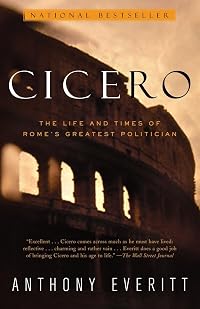
Cicero: The Life and Times of Rome's Greatest Politician
by Anthony Everitt
On This Page
Description
In this biography Anthony Everitt brings to life the world of ancient Rome in its glorious heyday. Cicero squared off against Caesar and was friends with young Brutus. He advised Pompey on his botched transition from military hero to politician. He lambasted Mark Antony and was the master of the smear campaign, as feared for his wit as he was for exposing his opponents' sexual peccadilloes. Brilliant, voluble, cranky, a terrible gossip, and a genius of political manipulation, Cicero was show more Rome's most revered politician, one of the greatest statesmen of all time. Accessible to us through unguarded letters written to his best friend, Atticus, Cicero emerges as a witty and resourceful political manipulator, the most eloquent witness to the last days of Republican Rome. show lessTags
Recommendations







Member Reviews
This is a very well written biography of the great Roman orator, lawyer and statesman. I read this straight after finishing the final volume of Robert Harris's excellent trilogy of novels about his life. Cicero was at the centre of the great events of the middle part of the 1st century BC, the critical two decades which saw the demise of the Roman Republic whose values of (by the standards of the time, and sometimes more theoretical than practical) democracy, checks and balances and the rule of law he held so dear. As a principled pragmatist, he stood in mostly consistent opposition to the growing tendency towards one man rule in the times of Caesar, Pompey, Mark Antony and finally Octavian. His writings betray a humanism which is rare show more by the standards of his contemporaries. Many of his speeches, hundreds of his letters and a number of philosophical and political works survive and provide a rich trove of classical thought to which we should be indebted two millennia after their author lived and died. His final demise, hunted down and killed on the run by soldiers hired by Octavian, is ignominious, but his name rightly lived on and still does as one of the greatest and best figures of his time. show less
Anthony Everitt's finely written biography of Cicero captures the struggles of a wiley politician turned statesman in tumultuous times. His detailed discussions of Rome's social history and Cicero's political and philosophical writing add to the biography's depth.
I just finished listening to Robert Harris's fictional trilogy about Cicero's life. I enjoy examining the same material from different vantage points and was surprised at how close the fictional account was to the biography. However, Everitt's biography is also a political history, and he examines factional politics in much greater detail, especially Cicero's ideological battles with Julius Caesar and Mark Anthony.
Overall, Cicero is an accessible, well-written biography. I show more recommend it highly to anyone interested in the Republic's demise. show less
I just finished listening to Robert Harris's fictional trilogy about Cicero's life. I enjoy examining the same material from different vantage points and was surprised at how close the fictional account was to the biography. However, Everitt's biography is also a political history, and he examines factional politics in much greater detail, especially Cicero's ideological battles with Julius Caesar and Mark Anthony.
Overall, Cicero is an accessible, well-written biography. I show more recommend it highly to anyone interested in the Republic's demise. show less
An outstanding biography. The author's work is comprehensive yet readable. Many biographers are partisan towards their subject, however the author is refreshingly objective- discussing Cicero's many strengths (as an orator, writer and devoted republican) and flaws (vanity, insecurity, lack of personal courage).
Cicero obviously lived in a fascinating period involving some of the most important people and events in history. Beyond that, I was pleasantly surprised to read the many different insights the author had- not only regarding Cicero, but as to the motivations of Cataline, Pompey, Caesar, Antony, Augustus, etc.
Highly recommend.
Cicero obviously lived in a fascinating period involving some of the most important people and events in history. Beyond that, I was pleasantly surprised to read the many different insights the author had- not only regarding Cicero, but as to the motivations of Cataline, Pompey, Caesar, Antony, Augustus, etc.
Highly recommend.
Well-crafted, highly readable biography of Marcus Tullius Cicereo (106-43 B.C.): lawyer, orator, prolific and popular writer, and statesman of Ancient Rome. Everitt takes his information from some 900 letters Cicero wrote (most of which were to his friend Atticus); many of his speeches (revised and edited by Cicero himself); and Cicero's books on philosophy and oratory. He wrote about the political events of his day: the rise of Julius Caesar, his assassination, and subsequent maneuvering to power of Mark Anthony and Octavian (later known as Augustus). He also set out to cover "the whole field in detail" of every philosophical system. Cicero had a son, Marcus, and a much-beloved daughter Tullia (who died while giving birth). He divorced show more his wife Terentia after some 30 years, although it is not clear why to historians. His second marriage lasted only a few months.
Cicero was a life-long devotee to Republican government (and thus an opponent of Caesar, who nevertheless lived to tell his tale for several reasons: Caesar was renown for his leniency, Caesar enjoyed Cicero's wit, and Cicero himself was a successful manipulator of people in general and alliances in particular). Cicero longed for power, but always played a secondary role in Roman politics. As Everitt observed, "Julius Caesar, with the pitiless insight of genius, understood that the constitution with its endless checks and balanaces prevented effective government... [but] for Cicero [the solution to Rome's crisis of inaction and inefficacy] lay in finding better men to run the government and better laws to keep them in order." How well Eliot's Prufrock unintentionally captures Cicero!
"No! I am not Prince Hamlet, nor was meant to be;
Am an attendant lord, one that will do
To swell a progress, start a scene or two,
Advise the prince; no doubt, an easy tool,
Deferential, glad to be of use,
Politic, cautious, and meticulous;
Full of high sentence, but a bit obtuse;
At times, indeed, almost ridiculous—
Almost, at times, the Fool."
Cicero never understood that he was wrong, nor passed by an opportunity to tout his own insight, influence, and value. Eventually Cicero was put to death after Octavian put Cicero's name on a proscription (a posting of people wanted dead by the leadership. All property was then confiscated and turned over to the state after the killer was rewarded.) Everitt brings Ancient Rome to life as if we were contemporaries of the protagonists. Excellent book that only makes the reader want to know more.
(JAF) show less
Cicero was a life-long devotee to Republican government (and thus an opponent of Caesar, who nevertheless lived to tell his tale for several reasons: Caesar was renown for his leniency, Caesar enjoyed Cicero's wit, and Cicero himself was a successful manipulator of people in general and alliances in particular). Cicero longed for power, but always played a secondary role in Roman politics. As Everitt observed, "Julius Caesar, with the pitiless insight of genius, understood that the constitution with its endless checks and balanaces prevented effective government... [but] for Cicero [the solution to Rome's crisis of inaction and inefficacy] lay in finding better men to run the government and better laws to keep them in order." How well Eliot's Prufrock unintentionally captures Cicero!
"No! I am not Prince Hamlet, nor was meant to be;
Am an attendant lord, one that will do
To swell a progress, start a scene or two,
Advise the prince; no doubt, an easy tool,
Deferential, glad to be of use,
Politic, cautious, and meticulous;
Full of high sentence, but a bit obtuse;
At times, indeed, almost ridiculous—
Almost, at times, the Fool."
Cicero never understood that he was wrong, nor passed by an opportunity to tout his own insight, influence, and value. Eventually Cicero was put to death after Octavian put Cicero's name on a proscription (a posting of people wanted dead by the leadership. All property was then confiscated and turned over to the state after the killer was rewarded.) Everitt brings Ancient Rome to life as if we were contemporaries of the protagonists. Excellent book that only makes the reader want to know more.
(JAF) show less
I am not sure it was a good idea to read Cicero’s biography, by a historian, right after reading a fictionalized account by a reporter and novelist (especially if the fictionalized account is not yet complete –only two volumes of the trilogy have been published – [a:Robert Harris|575|Robert Harris|http://d.gr-assets.com/authors/1242903284p2/575.jpg]). A great deal of the curiosity awakened in my ignorance has been damped. But it has also been gratifying to compare views and strengthen notions.
Although an academic, Anthony Everitt knows how to represent drama. The opening of the book is certainly brilliant. He starts with an engrossing account of Julius Caesar assassination in which the attending Cicero is the only one who is show more innocent of the bloody plot and yet for whom, and for what he represented, is the deed done. This is the sort of opening to which one goes back to reread after finishing the book.
In this account, Everitt does a good job in showing Cicero’s complex nature. He was someone who had to juggle between his ideas and his political role. And it was precisely this wavering which put his life at risk several times. It was not always clear to his friends and foes, whether it was the theoretical expositions or the Realpolitik practice, which were enlightening or dangerous.
Cicero was essentially a conservative who firmly believed that by persuasion and negotiation the former and idyllic Republic could come back to Rome and a healthy democratic society could be reinstated. And yet, in his politics he more than once supported and sided with the autocrats whose aim was precisely to do away with the Republic and the traditional political structures.
Following his life has provided me with a useful framework in which to place his writings, and indeed the chapters in which Everitt discusses these were for me more interesting than following the political intrigue. From the earlier transcriptions of the political speeches that Cicero composed as a youngish and aspiring politician, he moved at a somewhat later stage to more meditative musings on a balanced life, duty, and friendship, bequeathing to posterity his accumulated wisdom. And in his more advanced age, when his personal interests and emotional ties had loosened, he summoned the courage to produce the final acerbic, consistent and continuous attack on the Republic’s latest enemy. The fourteen Philippicae chant the swan song of a disappearing epoch in the history of Rome and of Cicero’s own life.
It seems Everitt’s main aim in writing this was to recover the central place that Cicero has had until relatively recently in the education of the layman. I wonder whether he will succeed in this ambitious aim, but he certainly has awakened my interest in this author. Through his pen Cicero emerges as a likeable and closer figure from whom we have a great deal to learn today, and who should stay out of the Olympus of Forgotten Figures and of the Myth of the Boring Classics.
“Caesar remarked that Cicero had won greater laurels than those worn by a general in his Triumph, for it meant more to have extended the frontiers of Roman genius than of its empire” show less
It's not a bad biography, but at least a quarter of the content is just rehashing the Caesar situation. Perhaps unavoidable given the popsci format - not being able to assume the reader knows anything at all about history, but at the same time for someone to pick up a biography on Cicero as their first read on this era seems ridiculous. Having the subject of your biography become a background character during large parts of the book didn't work for me.
A different approach to a classical figure. Reads like a conventional biography, which is really impressive for a classical figure.
Early in the book, I wasn't too much of a fan since it focused less on Cicero than his time, which tends to get really repetitive if you read other popular books about the late republican era. I understood later though that Cicero's youth is somewhat poorly documented and not everyone comes to the book with the background knowledge I happened to have. Cicero's such an interesting character, powerful and flawed and probably personally the most sympathetic character of this age.
I learned from Everitt the high personal nature of politics at the time (most leading men were related by either marriage or distant show more relatives), and Everitt's attention to detail really enlivens Cicero. Everitt depicts well the ever shifting nature of politics, instead of assigning individuals into permanent factions, individuals are unsure, convinced into factions, and sometimes abandon their faction for another one. It's a huge testament to Everitt, that he can document this without becoming too rote or vague. A good pleasure read, if hard to keep track of all the details, recommended for anyone with a slight interest in the classics. show less
Early in the book, I wasn't too much of a fan since it focused less on Cicero than his time, which tends to get really repetitive if you read other popular books about the late republican era. I understood later though that Cicero's youth is somewhat poorly documented and not everyone comes to the book with the background knowledge I happened to have. Cicero's such an interesting character, powerful and flawed and probably personally the most sympathetic character of this age.
I learned from Everitt the high personal nature of politics at the time (most leading men were related by either marriage or distant show more relatives), and Everitt's attention to detail really enlivens Cicero. Everitt depicts well the ever shifting nature of politics, instead of assigning individuals into permanent factions, individuals are unsure, convinced into factions, and sometimes abandon their faction for another one. It's a huge testament to Everitt, that he can document this without becoming too rote or vague. A good pleasure read, if hard to keep track of all the details, recommended for anyone with a slight interest in the classics. show less
Members
- Recently Added By
Published Reviews
ThingScore 25
Despite some nasty howlers in the Latin (why bother to use Latin words if you, or your editors, can’t get them right?), it turns into a businesslike tale, told with a sometimes engaging enthusiasm for its subject and a good eye for the spicier detail of late Republican life. At the same time, like most modern biographies of Cicero, it is also consistently disappointing. Everitt’s show more conventional ‘back-to-the-ancient-sources’ approach leaves him repeatedly at the mercy of the biographical and cultural assumptions of the one surviving ancient biography. show less
added by jburlinson
Lists

Best Roman Empire Books
49 works; 18 members

r/History Recommended Reading List
603 works; 12 members

Antigua Roma
39 works; 2 members

Biografías eminentes
24 works; 1 member

Book wishlist
78 works; 1 member
Author Information

11+ Works 5,458 Members
Anthony Everitt was secretary-general of the Arts Council for Great Britain. He lives in London.
Some Editions
Awards and Honors
Distinctions
Work Relationships
Common Knowledge
- Original title
- Cicero: The Life and Times of Rome's Greatest Politician
- Original publication date
- 2001
- People/Characters
- Marcus Tullius Cicero; Julius Caesar
- Important places
- Rome, Italy
- Dedication
- For Dolores and Simone
- First words
- The spring weather was unsettled in Rome.
- Last words
- (Click to show. Warning: May contain spoilers.)He handed it back with the words: "An eloquent man, my child, an eloquent man, and a patriot."
Classifications
- Genres
- History, Biography & Memoir, Nonfiction, General Nonfiction
- DDC/MDS
- 937.05092 — History & geography History of ancient world (to ca. 499) Italian Peninsula to 476 and adjacent territories to 476 Period of civil strife, 146-31 B.C. Biography
- LCC
- DG260 .C5 .E94 — History of Europe, Asia, Africa and Oceania City History of Italy Ancient Italy. Rome to 476 History By period Kings and Republic, 753-27 B.C. Republic, 509-27 Fall of the Republic and establishment Period of Marius and Sulla (Pompey).
- BISAC
Statistics
- Members
- 2,159
- Popularity
- 9,432
- Reviews
- 38
- Rating
- (3.91)
- Languages
- 7 — Dutch, English, German, Italian, Portuguese, Spanish, Turkish
- Media
- Paper, Audiobook, Ebook
- ISBNs
- 19
- ASINs
- 8