
Caesar (1)
Author of Civil Wars [bilingual Latin English]
For other authors named Caesar, see the disambiguation page.
Caesar (1) has been aliased into Julius Caesar.
Works by Caesar
Works have been aliased into Julius Caesar.
Caesar: Alexandrian War. African War. Spanish War (Loeb Classical Library No. 402) (1955) 141 copies
Caesar Gallic War IV 6 copies
Commentariorum. Pars Posterior Qua Continentur. Libri III De Bello Civili Cum Libris Incertorum Auctorum De Bello Alexandrino Africo Hispaniensi (1966) 3 copies
Caesar's Gallic war. Books I-IV 2 copies
Gallic War, books I-IV 1 copy
Caesar's Seventh Campaign in Gaul. B.C. 52. de Bello Gallico Lib. VII. Edited, with Notes, Excursus, and Tables of Idioms (2015) 1 copy
Veldtocht in Galli©± 1 copy
Caesar Commentarii Liber II 1 copy
Caesar De Bello Civili III 1 copy
Caesar Gallic War Book II 1 copy
Caesar - De Bello Gallico I 1 copy
Caesars Commentary 1 copy
Commentariorum (OCT) 1 copy
Cesar: Guerre D'Afrique 1 copy
Tagged
Common Knowledge
- Date of death
- 0044-03-15 BCE
- Gender
- male
- Burial location
- Rome, ITA
- Associated Place (for map)
- ITA
Members
Reviews
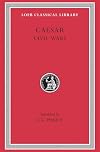
Julius Caesar's 3 books of commentaries on the Civil War between his forces and those of Gnaius Pompeius (Pompey) for control of Rome.
Caesar, of course, had no idea that he would have an audience 2000 years later who would be unfamiliar with the cast of characters. As a result, the opening pages of The Civil Wars are populated with names that, to those unfamiliar with the politicians and military personages of the day, will slow down reading. Nevertheless, the prose is clear, show more straightforward, and never boring.
There are quite a few complicated sentences with numerous dependent clauses; most are clear in their meaning. But at times it's difficult to determine the referent of a "he" or "him"; the sentence structure necessitates 2 or more close readings.
Other than that and the vast cast of characters, the prose is easy to follow and maintains a better pace and tension than most contemporary action-adventure books. Caesar faced enormous obstacles in bringing Pompey to bay, which he accomplished finally in the batttle of Pharsalus. As the reader, you never get a sense that he is bragging or exaggerating, although undoubtedly he played down some of his reverses. Yet it all appears remarkably even-handed.
One of the more fascinating sections describes the seige of Massilia (Marseilles). Caesar describes in detail the construction of a particular type of seige tower that allowed his soldiers, with no danger to themselves, to destroy a fortification of the city's walls, ensuring its capture. The story of the treachery of the leaders of Massilia is told without comment but is fascinating nonetheless for the clemency that he shows Massilia.
Caesar was famous for his clemency towards his enemies, and his campaigns show him to be that rarity in classical history, a commander who did his best to win vicotries and pacify conquered peoples with as little bloodshed as possible. None of his Roman enemies in the Civil Wars would have done the same had the roles been reversed; Caesar makes that clear by describing the cold-blooded execution of his soldiers captured after promises of safety were given to entice them to surrender. Time after time, however, Caesar pardons those of his opponents he captures. Some join him; others promptly return to fight him again.
Caesar's writing is concise. He covers long time periods, sieges, marches and battles with a minimum of words but sufficient detail to give a clear picture of the events. show less
Caesar, of course, had no idea that he would have an audience 2000 years later who would be unfamiliar with the cast of characters. As a result, the opening pages of The Civil Wars are populated with names that, to those unfamiliar with the politicians and military personages of the day, will slow down reading. Nevertheless, the prose is clear, show more straightforward, and never boring.
There are quite a few complicated sentences with numerous dependent clauses; most are clear in their meaning. But at times it's difficult to determine the referent of a "he" or "him"; the sentence structure necessitates 2 or more close readings.
Other than that and the vast cast of characters, the prose is easy to follow and maintains a better pace and tension than most contemporary action-adventure books. Caesar faced enormous obstacles in bringing Pompey to bay, which he accomplished finally in the batttle of Pharsalus. As the reader, you never get a sense that he is bragging or exaggerating, although undoubtedly he played down some of his reverses. Yet it all appears remarkably even-handed.
One of the more fascinating sections describes the seige of Massilia (Marseilles). Caesar describes in detail the construction of a particular type of seige tower that allowed his soldiers, with no danger to themselves, to destroy a fortification of the city's walls, ensuring its capture. The story of the treachery of the leaders of Massilia is told without comment but is fascinating nonetheless for the clemency that he shows Massilia.
Caesar was famous for his clemency towards his enemies, and his campaigns show him to be that rarity in classical history, a commander who did his best to win vicotries and pacify conquered peoples with as little bloodshed as possible. None of his Roman enemies in the Civil Wars would have done the same had the roles been reversed; Caesar makes that clear by describing the cold-blooded execution of his soldiers captured after promises of safety were given to entice them to surrender. Time after time, however, Caesar pardons those of his opponents he captures. Some join him; others promptly return to fight him again.
Caesar's writing is concise. He covers long time periods, sieges, marches and battles with a minimum of words but sufficient detail to give a clear picture of the events. show less

Edition: // Descr: xxxv, 460 p. : ill., maps 19.5 cm. // Series: Call No. { 878 C11 7 } Notes, Grammatical Appendix, and Prose Composition by Walter B. Gunnison and Walter S. Harley. // //
Edition: // Descr: 238 p. : ill., maps 19 cm. // Series: Call No. { 878 C11 6 } Edited with Notes, Summary of Forms and Syntax, Prose Composition, and Vocabulary by Ernest Riess and Arthur L. Janes Combined with Jane's Sight Reading. // //
You May Also Like
Associated Authors
Statistics
- Works
- 43
- Members
- 579
- Popularity
- #43,292
- Rating
- 4.1
- Reviews
- 3
- ISBNs
- 21
- Languages
- 3