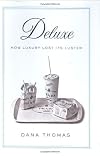
Deluxe: How Luxury Lost Its Luster
by Dana Thomas
On This Page
Description
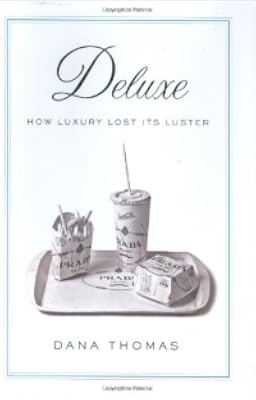
Once luxury was available only to the rarefied and aristocratic world of old money and royalty. It offered a history of tradition, superior quality, and a pampered buying experience. Today, however, luxury is simply a product packaged and sold by multibillion-dollar global corporations focused on growth, visibility, brand awareness, advertising, and, above all, profits. Award-winning journalist Dana Thomas digs deep into the dark side of the luxury industry to uncover all the secrets that show more Prada, Gucci, and Burberry don't want us to know. Deluxe is an uncompromising look behind the glossy facade that will enthrall anyone interested in fashion, finance, or culture. show lessTags
Recommendations














Member Reviews
Luxury products have democratized greatly, but only at great cost: lower quality, massive outsourcing (Thomas details that EU law governing source disclosure is much laxer than US law, so sellers can import goods from China, rip off the “Made in China” labels, and add “Made in Italy” with only small manipulations), and a pervasive materialism/consumerism that is connected to the massive overspending of the past few decades. Thomas is nostalgic for true luxury, available only to the wealthiest of the wealthy, not signalled by huge trademarks but by being “in the know.” It’s an interesting book, marred by Thomas’s uncritical acceptance of the industry’s idea that counterfeiting is a big source of terrorist income and show more sweatshop/slave labor, without ever comparing counterfeit goods to the equally cheap noncounterfeit goods made in the same factories and sold at Wal-Mart. I am much more persuaded that cheap is the problem. And the luxury brands, by buying into the corporate culture that demands 5% growth every quarter, helped spur the very consumerism/brand consciousness/bargain-hunting by both producers and consumers that drives counterfeiting. This is the world they made. Isn’t it wonderful? show less
i really, really enjoyed this book (the introductory chapters detailing the stages of licensing, vertical integration, and um conglomeration(?)) were so good.
the luxe aesthetic is not mine. luxury is interesting only in its old world-ishness and in the thrill of associations evoked by words like silk and crocodile skin and gold. fashion is *ideas*, and as such, designer clothes could cost even more than they do. think Duchamp or Damian Hurst (sp?). clothes should be durable, tailored nicely, etc, but how many times can any garment be worn before it decays naturally? how many times before it starts looking wrong (worn out physically or aesthetically)? i don't think the fabric quality or the stitching matter so much after a certain point show more (i mean, gareth bale is faster than cristiano ronaldo, but i'm not about to buy bale for juve), and to pay such prices for commodities and craftsmanship is to have waaaay more money than sense. one could, after all, visit the special ateliers Dior uses and order one's own clothese directly from the artisans. you could find someone who knows ciwgise and sewing and everything and get your own bag made; if the problem with that bag is it isnt recognizable as a Kelly or a Baguette, then im done with you. wanting to look rich is pretty much boring and unoriginal, but that desire keeps a lot of artists working...there would be no Marc Jacobs without LVMH, so grab yr logo bag and drink that moet or hennessey whatever, ya rich jerk. show less
the luxe aesthetic is not mine. luxury is interesting only in its old world-ishness and in the thrill of associations evoked by words like silk and crocodile skin and gold. fashion is *ideas*, and as such, designer clothes could cost even more than they do. think Duchamp or Damian Hurst (sp?). clothes should be durable, tailored nicely, etc, but how many times can any garment be worn before it decays naturally? how many times before it starts looking wrong (worn out physically or aesthetically)? i don't think the fabric quality or the stitching matter so much after a certain point show more (i mean, gareth bale is faster than cristiano ronaldo, but i'm not about to buy bale for juve), and to pay such prices for commodities and craftsmanship is to have waaaay more money than sense. one could, after all, visit the special ateliers Dior uses and order one's own clothese directly from the artisans. you could find someone who knows ciwgise and sewing and everything and get your own bag made; if the problem with that bag is it isnt recognizable as a Kelly or a Baguette, then im done with you. wanting to look rich is pretty much boring and unoriginal, but that desire keeps a lot of artists working...there would be no Marc Jacobs without LVMH, so grab yr logo bag and drink that moet or hennessey whatever, ya rich jerk. show less
Strong, well-argued social and business history. Makes you think and contains about 19 bits of little trivia you must share with friends. Luxury is both central and scarcely the point. Asks the larger question of "what happens when something admired by the few is suddenly within the reach of the many?"
A reasonably well-written book, though some chapters read more like a collection of vignettes and less like a cohesive, continuous narrative/exposition.
A very frustrating book for a number of reasons.
Firstly, the author clearly loves fashion and the history of fashion, and luxury (or at least the concept of luxury) and it's history; I, however, find much of this... tasteless. It is consumerism and gaudiness dressed up (pun intended, I suppose) in some form of respectability. But I recognize this is, at least in part, a purely personal view (though, I stress, only in part.)
Secondly, the author seems to find the "democratization" of luxury to be... problematic. I guess I was looking for more of a strong voice/opinion; much of what she show more describes is not new, but her description definitely leaves one feeling... repulsed, disgusted. And yet she never quite condemns it, which I found myself increasingly frustratedly waiting for.
Thirdly, she documents a bit of "true" luxury, discussed the rise on new luxury classes, again without ever really pointing out forcefully how the uber-rich in e.g. Russia or China are tied to endemic, state-tied corruption and brutal repression. It is mentioned more in passing... e.g., toward the very in end of the book, there is a quote from a Chanel representative (I believe it was Chanel) who interjects into her comment that these people's money isn't "dirty," betraying a self-awareness on the part of the representative that that kind of thing is in fact an issue.
The discussion on counterfeiting is also frustrating. The author's examples clearly illustrate the terrible consequences of piracy, that is it is emphatically not a victimless crime. I guess I couldn't help but feel I was left waiting for the other shoe to drop (pun... or not?) The insatiable hunger that drives people want "luxury" labels is on a straight line to this behavior, if at one more remove; where was the discussion of the elephant in the room?
I guess this last is what really bothered me, throughout the book. Everywhere the consumerism, greed, shallowness that the entire "luxury" industry -old and new forms- is built on, and yet it is left largely half said. Perhaps this on purpose. But it bothered me so much. show less
A very frustrating book for a number of reasons.
Firstly, the author clearly loves fashion and the history of fashion, and luxury (or at least the concept of luxury) and it's history; I, however, find much of this... tasteless. It is consumerism and gaudiness dressed up (pun intended, I suppose) in some form of respectability. But I recognize this is, at least in part, a purely personal view (though, I stress, only in part.)
Secondly, the author seems to find the "democratization" of luxury to be... problematic. I guess I was looking for more of a strong voice/opinion; much of what she show more describes is not new, but her description definitely leaves one feeling... repulsed, disgusted. And yet she never quite condemns it, which I found myself increasingly frustratedly waiting for.
Thirdly, she documents a bit of "true" luxury, discussed the rise on new luxury classes, again without ever really pointing out forcefully how the uber-rich in e.g. Russia or China are tied to endemic, state-tied corruption and brutal repression. It is mentioned more in passing... e.g., toward the very in end of the book, there is a quote from a Chanel representative (I believe it was Chanel) who interjects into her comment that these people's money isn't "dirty," betraying a self-awareness on the part of the representative that that kind of thing is in fact an issue.
The discussion on counterfeiting is also frustrating. The author's examples clearly illustrate the terrible consequences of piracy, that is it is emphatically not a victimless crime. I guess I couldn't help but feel I was left waiting for the other shoe to drop (pun... or not?) The insatiable hunger that drives people want "luxury" labels is on a straight line to this behavior, if at one more remove; where was the discussion of the elephant in the room?
I guess this last is what really bothered me, throughout the book. Everywhere the consumerism, greed, shallowness that the entire "luxury" industry -old and new forms- is built on, and yet it is left largely half said. Perhaps this on purpose. But it bothered me so much. show less
Maybe it was fate, I dunno; but I read this from a ship's library as I was on a cruise to Panama when the Haiti earthquake occurred. Those circumstances lent a certain ironic tang to my reading.
The book, which is a fairly seamless compilation of journal articles and notes, discusses the ways in which the old carriage trade companies have changed their approaches to marketing and to production as they attempt, mostly successfully, to increase profits. The author details what happens when small, exclusive, and proud companies are bought up by large conglomerates with eyes only for the bottom line.
In itself the book was interesting if a bit to journalistic in style to be more than a competent, if brief, study of the subject. Reading it show more under the circumstances above made me reflect very uncomfortably about what's important in life and why we have this endless urge to spend, possess, and spend some more. It made me depressed about the shallowness of large parts of my own life. show less
The book, which is a fairly seamless compilation of journal articles and notes, discusses the ways in which the old carriage trade companies have changed their approaches to marketing and to production as they attempt, mostly successfully, to increase profits. The author details what happens when small, exclusive, and proud companies are bought up by large conglomerates with eyes only for the bottom line.
In itself the book was interesting if a bit to journalistic in style to be more than a competent, if brief, study of the subject. Reading it show more under the circumstances above made me reflect very uncomfortably about what's important in life and why we have this endless urge to spend, possess, and spend some more. It made me depressed about the shallowness of large parts of my own life. show less
(Reprinted from the Chicago Center for Literature and Photography [cclapcenter.com]. I am the original author of this essay, as well as the owner of CCLaP; it is not being reprinted here illegally.)
I confess, I know barely anything about the world of high fashion, and so of course especially know nothing about the highest end of it all, the so-called "luxury" brands like Prada, Gucci and Hermés that charge just insane prices for the stupidest little stuff (a hundred dollars for a handkerchief, five hundred dollars for a t-shirt), sold specifically to members of the nouveau riche with self-esteem issues and platinum credit cards. Ah, but see, that right there is part of the big problem with the luxury industry these days, or so argues show more Dana Thomas in her brilliant but unfortunately long-winded new exposé Deluxe: How Luxury Lost Its Luster. You see, explains this veteran fashion journalist, back in the 1700s and early 1800s, the beginning of the Industrial Age when all these prestige brands were born, they became prestige brands precisely because it was...you know, prestigious stuff, objects that became known as "luxury items" precisely because they were truly luxurious; it's only in our modern (er, postmodern) times that the effort to even produce high-quality items has been dropped from these companies, when the "brand" part of "luxury brand" has suddenly become much more important than the "luxury" part.
For a whole variety of complicated reasons, Thomas successfully argues here, the entire luxury industry has recently become a dangerous shell game, something that now relies almost entirely on marketing and public opinion, on selling an idea rather than an actual product; sure, it made these companies just obscene amounts of money throughout the go-go '80s and '90s, but Thomas argues that it's a house of cards about to fall apart, that it was Americans' unending willingness to go into deep debt for no good reason in those years that essentially fueled that industry more than anything else. It's a highly intriguing theory to be sure, one that Thomas factually backs up over and over throughout the manuscript; it's just too bad that, you know, sometimes she takes forever to actually make her point.
Because that's the ironic thing, that my biggest criticism of Deluxe is actually Thomas' glowing credentials as a journalist; based in Paris for most of her adult life, she's been Newsweek's head fashion writer for a dozen years, the French correspondent for the Australian Harper's Bazaar, contributes regularly to such places as Vogue and The New Yorker, and was even a journalism professor for several years. This all comes shining through in the finished book, but that actually turns out to sometimes be a problem; this hard-news, magazine-based writer in fact sometimes has a difficult job figuring out how to trim her stories to make for a good full-sized book, with it sometimes coming off more as simply a collected series of magazine articles than as a cohesive 350-page manuscript. And in fact, part of this is the same problem I've noticed with a lot of fashion veterans who try writing something critical of the fashion industry, that they tend to simultaneously worship the very things they're being critical of, and in that annoying pink-hued "Sex in the City" way I find just so distressing and terrible. ("Oh, isn't it such a crime that the market's been so falsely manipulated, these companies can now charge $25,000 for a leather purse? And now, twelve pages on how those gorgeous little babies are made!")
Because make no mistake, Thomas has a devastatingly effective criticism to lay out here regarding the so-called luxury industry; that there is simply no luxury left in the industry, that a series of soulless marketing-oriented corporate executives have taken over and conglomerated all these companies over the last thirty years, turning the entire thing into an excuse to charge outrageous amounts of money for things that simply no longer cost very much to actually produce. And in fact this is the best thing about the book, is that Thomas' argument is just so unshakable and so backed up by numerous facts, laid out chronologically in a fascinating way that calls on history, economic theory, the emerging global marketplace and more. See, back in the early Industrial Age when all these companies started, it was impossible to mass-produce items of actual high quality; the only stuff that could be mass-produced in the 1700s and early 1800s was cheap crap, making the services of such artisan craftmasters as Mr. Gucci and Mr. Vuitton legitimately valuable, making their finely-crafted goods legitimately worthy of their reputation and price. That's how we come to have a luxury industry in the first place, after all; it was a legitimate need during a period of history when factories were able to churn out nothing else but cheap mass-produced crap.
And this worked fine for a long time; until the 1960s and '70s, in fact, when suddenly in our late Industrial Age you precisely did start seeing the mass output of items actually high in quality, coupled with an all-consuming countercultural revolution that suddenly made the entire concept of high fashion impossibly square and passé. It was this period that almost bankrupted many of these luxury companies, which is what allowed a series of European corporate conglomerates to swoop in and purchase them; and this just happened to occur a few years before Reagan and the sudden boom again in upper-middle-class Americans, a re-emergence of high fashion and an entire culture that almost religiously encouraged spending beyond one's means. These corporations realized that there was a ton of money at stake by selling these luxury goods to the teeming masses of middle-class Americans, all of them clutching Visa cards with insanely high credit ceilings; that's when you saw the rise of such "low-end" items as handbags and sunglasses, the proliferation of luxury goods in such previously unthinkable locations as malls and airports and Vegas casinos, the impeccable service and genteel elitism of the old big-city boutiques replaced by the gaudy blarings of tacky touristy "Total Consumer Environment" superstores.
This, Thomas argues, has then created a vicious cycle within that industry that these companies are finding harder and harder to break out of: that is, when you suddenly base your entire business plan on mere image, on mere public perception of your brand, on deliberately overcharging people for items not much higher in quality than at any other store, your entire strategy suddenly becomes one of high-volume sales, quick turnaround, flashier and flashier gimmicks in order to be the "hot item" among Hollywood celebrities for yet another six-week manufacturing cycle. And again, this worked fine for awhile, for the vast majority of the '90s when so-called "bling culture" first emerged (think Paris Hilton, think gangster rappers); but now you're starting to see a whole series of dents in that armor, things that chip away at this finely-designed haystack the industry had previously built. With the rise of luxury outlet malls, for example, suddenly the idea of instant hotness for a new item becomes even more important than ever; with so much of this stuff being manufactured now in China, suddenly the industry has a forgery crisis on its hands too. And not just forgeries, which is bad enough; these are the actual luxury goods that are being sold at the boutique superstores for tens of thousands of dollars, simply snuck out the back door of the factory instead of the front door and being sold off the back of a truck for a third of the price. That's the problem, Thomas so successfully argues, when you suddenly base your product line off of a logo alone, off of public perception alone, instead of the actual handmade exquisite craftmanship that built that public perception; now that these companies' actual products are just like anyone else's, they're subject to the same problems as everyone else's, even while being sold to the public in a dramatically different way.
If Deluxe had been 250 pages instead of 350, it would've blown my freakin' mind; as it is, I consider it still pretty good indeed, just with one too many tedious parts, parts that will appeal to existing fashionistas but almost no one else. And in fact, this is a general piece of advice I give to all magazine-journalist veterans, that a full-length book is simply a different creature, that there is a natural flow and rhythm needed in a large manuscript that can't be achieved simply by bunching together twelve magazine articles and calling it a day. That said, though, it gets a big recommendation from me today, an utterly fascinating look at how late capitalism combined with postmodernism has become the utter downfall of an entire industry we used to take for granted. This is exactly the kind of expansive, sweeping stuff I like to see journalists take on when tackling a full-length book; although flawed, I definitely suggest giving it a try anyway.
Out of 10: 9.0 show less
I confess, I know barely anything about the world of high fashion, and so of course especially know nothing about the highest end of it all, the so-called "luxury" brands like Prada, Gucci and Hermés that charge just insane prices for the stupidest little stuff (a hundred dollars for a handkerchief, five hundred dollars for a t-shirt), sold specifically to members of the nouveau riche with self-esteem issues and platinum credit cards. Ah, but see, that right there is part of the big problem with the luxury industry these days, or so argues show more Dana Thomas in her brilliant but unfortunately long-winded new exposé Deluxe: How Luxury Lost Its Luster. You see, explains this veteran fashion journalist, back in the 1700s and early 1800s, the beginning of the Industrial Age when all these prestige brands were born, they became prestige brands precisely because it was...you know, prestigious stuff, objects that became known as "luxury items" precisely because they were truly luxurious; it's only in our modern (er, postmodern) times that the effort to even produce high-quality items has been dropped from these companies, when the "brand" part of "luxury brand" has suddenly become much more important than the "luxury" part.
For a whole variety of complicated reasons, Thomas successfully argues here, the entire luxury industry has recently become a dangerous shell game, something that now relies almost entirely on marketing and public opinion, on selling an idea rather than an actual product; sure, it made these companies just obscene amounts of money throughout the go-go '80s and '90s, but Thomas argues that it's a house of cards about to fall apart, that it was Americans' unending willingness to go into deep debt for no good reason in those years that essentially fueled that industry more than anything else. It's a highly intriguing theory to be sure, one that Thomas factually backs up over and over throughout the manuscript; it's just too bad that, you know, sometimes she takes forever to actually make her point.
Because that's the ironic thing, that my biggest criticism of Deluxe is actually Thomas' glowing credentials as a journalist; based in Paris for most of her adult life, she's been Newsweek's head fashion writer for a dozen years, the French correspondent for the Australian Harper's Bazaar, contributes regularly to such places as Vogue and The New Yorker, and was even a journalism professor for several years. This all comes shining through in the finished book, but that actually turns out to sometimes be a problem; this hard-news, magazine-based writer in fact sometimes has a difficult job figuring out how to trim her stories to make for a good full-sized book, with it sometimes coming off more as simply a collected series of magazine articles than as a cohesive 350-page manuscript. And in fact, part of this is the same problem I've noticed with a lot of fashion veterans who try writing something critical of the fashion industry, that they tend to simultaneously worship the very things they're being critical of, and in that annoying pink-hued "Sex in the City" way I find just so distressing and terrible. ("Oh, isn't it such a crime that the market's been so falsely manipulated, these companies can now charge $25,000 for a leather purse? And now, twelve pages on how those gorgeous little babies are made!")
Because make no mistake, Thomas has a devastatingly effective criticism to lay out here regarding the so-called luxury industry; that there is simply no luxury left in the industry, that a series of soulless marketing-oriented corporate executives have taken over and conglomerated all these companies over the last thirty years, turning the entire thing into an excuse to charge outrageous amounts of money for things that simply no longer cost very much to actually produce. And in fact this is the best thing about the book, is that Thomas' argument is just so unshakable and so backed up by numerous facts, laid out chronologically in a fascinating way that calls on history, economic theory, the emerging global marketplace and more. See, back in the early Industrial Age when all these companies started, it was impossible to mass-produce items of actual high quality; the only stuff that could be mass-produced in the 1700s and early 1800s was cheap crap, making the services of such artisan craftmasters as Mr. Gucci and Mr. Vuitton legitimately valuable, making their finely-crafted goods legitimately worthy of their reputation and price. That's how we come to have a luxury industry in the first place, after all; it was a legitimate need during a period of history when factories were able to churn out nothing else but cheap mass-produced crap.
And this worked fine for a long time; until the 1960s and '70s, in fact, when suddenly in our late Industrial Age you precisely did start seeing the mass output of items actually high in quality, coupled with an all-consuming countercultural revolution that suddenly made the entire concept of high fashion impossibly square and passé. It was this period that almost bankrupted many of these luxury companies, which is what allowed a series of European corporate conglomerates to swoop in and purchase them; and this just happened to occur a few years before Reagan and the sudden boom again in upper-middle-class Americans, a re-emergence of high fashion and an entire culture that almost religiously encouraged spending beyond one's means. These corporations realized that there was a ton of money at stake by selling these luxury goods to the teeming masses of middle-class Americans, all of them clutching Visa cards with insanely high credit ceilings; that's when you saw the rise of such "low-end" items as handbags and sunglasses, the proliferation of luxury goods in such previously unthinkable locations as malls and airports and Vegas casinos, the impeccable service and genteel elitism of the old big-city boutiques replaced by the gaudy blarings of tacky touristy "Total Consumer Environment" superstores.
This, Thomas argues, has then created a vicious cycle within that industry that these companies are finding harder and harder to break out of: that is, when you suddenly base your entire business plan on mere image, on mere public perception of your brand, on deliberately overcharging people for items not much higher in quality than at any other store, your entire strategy suddenly becomes one of high-volume sales, quick turnaround, flashier and flashier gimmicks in order to be the "hot item" among Hollywood celebrities for yet another six-week manufacturing cycle. And again, this worked fine for awhile, for the vast majority of the '90s when so-called "bling culture" first emerged (think Paris Hilton, think gangster rappers); but now you're starting to see a whole series of dents in that armor, things that chip away at this finely-designed haystack the industry had previously built. With the rise of luxury outlet malls, for example, suddenly the idea of instant hotness for a new item becomes even more important than ever; with so much of this stuff being manufactured now in China, suddenly the industry has a forgery crisis on its hands too. And not just forgeries, which is bad enough; these are the actual luxury goods that are being sold at the boutique superstores for tens of thousands of dollars, simply snuck out the back door of the factory instead of the front door and being sold off the back of a truck for a third of the price. That's the problem, Thomas so successfully argues, when you suddenly base your product line off of a logo alone, off of public perception alone, instead of the actual handmade exquisite craftmanship that built that public perception; now that these companies' actual products are just like anyone else's, they're subject to the same problems as everyone else's, even while being sold to the public in a dramatically different way.
If Deluxe had been 250 pages instead of 350, it would've blown my freakin' mind; as it is, I consider it still pretty good indeed, just with one too many tedious parts, parts that will appeal to existing fashionistas but almost no one else. And in fact, this is a general piece of advice I give to all magazine-journalist veterans, that a full-length book is simply a different creature, that there is a natural flow and rhythm needed in a large manuscript that can't be achieved simply by bunching together twelve magazine articles and calling it a day. That said, though, it gets a big recommendation from me today, an utterly fascinating look at how late capitalism combined with postmodernism has become the utter downfall of an entire industry we used to take for granted. This is exactly the kind of expansive, sweeping stuff I like to see journalists take on when tackling a full-length book; although flawed, I definitely suggest giving it a try anyway.
Out of 10: 9.0 show less
Interesting business study of the premier luxury brands. This covers the history and financial challenges of the major couture and luxury brands. It goes into how the commitment to true luxury, quality and exclusivity have diminished due to mergers and acquisitions all in the name of corporate profit.
Members
- Recently Added By
Author Information

4 Works 906 Members
Dana Thomas has been the cultural and fashion writer for Newsweek in Paris for twelve years. She also taught journalism at The American University of Paris from 1996 to 1999.
Awards and Honors
Distinctions
Common Knowledge
- Original publication date
- 2007
- People/Characters
- Miuccia Prada; Pierre Cartier; Chloe Sevigny; Rachel Zoe
- Dedication
- For my grandparents,
O.R. and Anne Strackbein - First words
- Down the dusty roads of Xi'an the motor scooters zoom, weaving around potholes and rickety bicycles, bip-bip-bipping their horns as they circle the city's sixteenth-century bell tower.
- Last words
- (Click to show. Warning: May contain spoilers.)"Must get back to work," she said, and she clicked off in her stilettos.
- Blurbers
- Kakutani, Michiko; Zakaria, Fareed; Johnson, Richard; Isikoff, Michael; Achenbach, Joel; Apodaca, Rose (show all 7); Alexander, Jay
Classifications
- Genres
- Economics, Nonfiction, Business, General Nonfiction, Sociology, Art & Design, History
- DDC/MDS
- 338.47 — Society, government, & culture Economics Production Secondary industries and services Services and specific products
- LCC
- HD9999 .L852 .T46 — Social sciences Industries. Land use. Labor Industries. Land use. Labor Special industries and trades Miscellaneous industries and trades
- BISAC
Statistics
- Members
- 596
- Popularity
- 49,098
- Reviews
- 14
- Rating
- (3.78)
- Languages
- 7 — Dutch, English, French, Italian, Polish, Portuguese (Portugal), Spanish
- Media
- Paper, Audiobook, Ebook
- ISBNs
- 17
- ASINs
- 5