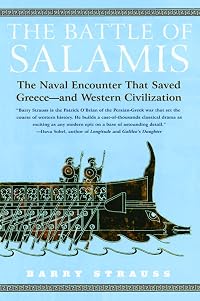
The Battle of Salamis: The Naval Encounter that Saved Greece -- and Western Civilization
by Barry S. Strauss 
On This Page
Description
An account of the 480 B.C. battle that rendered Athens the dominant power in Greece documents its importance as an event that made possible the foundation of western traditions, citing in particular the contributions of history's first woman commander. The battle of Salamis in 480 B.C. was the most important naval encounter of the ancient world. In the narrow strait between the island of Salamis and the Greek mainland, a heavily outnumbered Greek navy defeated the Persian armada in a show more brilliant victory that is still studied today. The Greek triumph at Salamis stopped the advancing Persians and saved the first democracy in history. It made Athens the dominant city in Greece, gave birth to the Athenian empire, and set the stage for the Age of Pericles. On the Persian side, the battle of Salamis also featured history's first female admiral and sailors from three continents. The Battle of Salamis features some of the most fascinating figures in the ancient world: Themistocles, the Athenian commander who masterminded the victory (and tricked his fellow Greeks into fighting); Xerxes, the Persian king who understood land but not naval warfare; Aeschylus, the Greek playwright who took part at Salamis and later immortalized it in drama; and Artemisia, the half-Greek queen who was one of Xerxes' trusted commanders and who turned defeat into personal victory. In his riveting story of this clash on the Greek seas, classicist and historian Barry Strauss offers a new in-depth account of the ancient battle. Drawing on recent work in archaeology, meteorology, and forensic science as well as on his own experience as a rower (both navies were oar powered), Strauss revises our understanding of one of history's pivotal wars and of Herodotus's classic if underrated account of it. But in addition to being exciting military history, The Battle of Salamis is also a vivid analysis of ancient culture. A scholar who has reexamined the original sources for this stirring narrative presents an exciting, perceptive work of military history and a shrewd analysis of the cultural differences between and within the contending Persian and Greek factions. show lessTags
Recommendations

















Member Recommendations

Member Reviews
Just before dawn on 25 September 480 BC, a Persian armada sailed out of the harbour at Phaleron, just along the coast from Athens. The ships took up position at the entrance to some narrow straits between the Greek mainland and an island called Salamis, where the Greeks had taken refuge. Their fragile alliance, so the Persians had been told, was on the brink of collapse. All they needed was to provoke panic: the Greeks would crumble. And… well, it didn’t quite happen as planned. What unfolded over the next twelve hours was one of the greatest sea-battles of antiquity, and Barry Strauss’s book brings it to pulsing, vivid life. This isn’t a story of nautical jargon and dry-as-dust tactics: it’s swashbuckling of the first order, show more set against a mighty clash of civilisations, and populated by a cast of characters so colourful that it’s easy to forget it all actually happened...
For the full review, please see my blog:
https://theidlewoman.net/2017/11/28/50704/ show less
For the full review, please see my blog:
https://theidlewoman.net/2017/11/28/50704/ show less
An epic tale of the great battle between the Greeks and Persians, fought entirely with large sausages.
Well, now that I’ve got that out of the way, I’m not sure quite how to take Salamis. The problem is that while the battle of Salamis is usually regarded as one of the most important in history – the seagoing equivalent of Thermopylae – there’s just not that much information available. What we’ve got is the play Persians, by Aeschylus, written 6 years after the battle (it’s possible that Aeschylus was there); The Histories of Herodotus, written about 38 years later (so it’s possible Herodotus may have interviewed some of the participants, on both sides); the History of Diodorus Siculus (perhaps 350 years later); show more Plutarch’s Life of Themistocles, written about 550 years later; and miscellaneous bits and pieces of other ancient authors.
Author Barry Strauss, a Cornell Classics professor, does the best he can with the skimpy source material. First, the book covers the entire naval campaign, not just the battle of Salamis; next, Strauss speculates a great deal on the motivation and characters of the participants – and makes his speculations interesting reading.
Unfortunately, although Strauss is very thoroughly grounded in Greek history, his interpretation of oared vessel naval tactics is often unsatisfying. For example, while Leonidas and his 300 were fighting a Thermopylae, the united Greek navy was guarding his flank at Artemisium (which is why the Persian just didn’t load troops on ships, land behind Thermopylae, and encircle Leonidas). The Persians had about 700 ships at Artemisium (although as Strauss points out, none of the ships were actually Persian; they belonged to client states like the Phoenicians, Egyptians, Ionian Greeks, and Cicilians); the Greeks had 271. So the Greeks attacked. According to Herodotus, the Persians completely surrounded the Greek ships, which formed a defensive circle. Then:
"…selected Greek triremes darted out of the circle, went through the loose enemy line, picked off vulnerable Persian triremes, and escaped. …The dispirited Persians headed back to their base at Aphetae."
Huh? Selected Greek triremes “escaped”? What were the other ones doing? What’s more, what was the Persian fleet doing, just watching? The quintessential trireme tactic is the diekplous. If two hostile triremes meet, they turn bow to bow, since the bows are strengthened to ram and withstand a ram. The ship doing the diekplous rows straight at the other in a game of nautical chicken, then at the last minute swerves to one side. Simultaneously the rowers on that side all pull in their oars. Ideally, the attacker cruises down the side of the other ship, shearing off oars (and probably killing or injuring rowers in the process). Then once passed, the attacking trireme puts out the oars again, backs oars on one side and pulls on the other, and essentially spins in place. Even if the other ship has managed to avoid the oar-shearing attack, if it isn’t also spinning, or isn’t spinning fast enough, it will present its stern or broadside to the attacker. Obviously, the diekplous required exquisite timing and a high degree of crew training. If you swerved too early, giving away your intentions, the other ship could turn slightly and ram you in the bow quarter, or even pull of its own diekplous on you. Similarly, it required fine coordination to have every rower rapidly yank a heavy oar into a crowded trireme hull, and then extend the oars again afterward. The defense against the diekplous was simply to have two staggered lines of ships. Despite what you see in Ben Hur about “ramming speed”, a trireme captain wanted to be going relatively slow when ramming; otherwise you ran the risk of having your ship stuck in the enemy or damaged your own oars. Thus if there’s a second line of ships waiting behind the first, it can engage while you’re trying the diekplous. So why didn’t this happen at Artemisium? The Persians clearly had enough superiority in ships to set up two or even three lines, making the Greek “escape” impossible. What happened? Strauss doesn’t speculate or even acknowledge the problem. My personal guess is either the ancient description of the battle is inaccurate, and the Greek ships weren’t really surrounded, or the Persian navy suffered serious command-and-control problems (there was a Persian admiral in command, one of Xerxes’ relatives; not only did he probably not know a thing about naval battles, he would have had to give orders in 30-odd different languages).
Once Thermopylae had fallen there was no point in the Greek navy remaining at Artemesium, so they sailed to Athens, evacuated the population to the island of Salamis, and waited for the Persians again. Here Strauss is a little more thorough in explaining what happened. The Persian navy made a “demonstration” by rowing up to the mouth of the channel and cruising around to see if the Greeks would come out and fight. They didn’t, so the Persians rowed back to their own anchorage at Phaleron. At this point Themistocles sent a secret message to Xerxes, saying he was turning traitor, that the Greek fleet was disunited and dispirited, and planned to sail away to the Peloponnesus. This was true; despite that fact that he was the one with all the ideas and the leader of the Athenian contingent, which made up more than half the fleet, Themistocles was not in command; the Greek admiral was Eurybiades the Spartan. The Spartans had insisted on command on both land and sea as a condition of their participation in the war. Eurybiades wanted to sail south, where the Spartans were busy building a defensive wall across the Isthmus of Corinth, and the fleet was to leave in the morning. Themistocles’ message to Xerxes convinced the Great King to go and attack the Greek fleet while it was pulling out; so the Persian ships put out to see again, this time actually entering the channel. The ancient historians say the Persians “surrounded” the Greeks, which modern histories have interpreted to mean that they sent a contingent to the other side of Salamis and entered the channel from both ends; Strauss disagrees, pointing out that the Persians would not have had time to do this. Instead he interprets “surrounded” as meaning the Persians took a semicircular position opposite the Greek anchorage. (Another mystery here: why didn’t the Persians attempt an attack on the Greeks at anchor? All the ancient historians agree that the Persian move was a surprise and the Greek sailors were all on shore when the Persian showed up. Instead the Persians waited until the Greeks boarded their triremes and came out.
So the rest is, as they say, history. The Greeks sang their paean, got on board (another thing that must have required particular training; there were 170 rowers stacked three deep in a 130-foot long ship. It must have required strict attention to seating assignments), and rowed out to smash the Persians. Again, a mystery; the ancient historians uniformly agree that the Greek triremes were heavier (and therefore slower, at least in acceleration) than their opponents. However, Strauss notes that the Persian triremes were wider (they carried 40 soldiers on deck, rather than the 10 of Greek ships) and taller (not just higher in the water; the Persian triremes had a bulwark along the deck to protect the fighters). So if they really weighed less than the Greek triremes, they must have been very lightly constructed. There is some evidence for this from the accounts of Salamis; the usual morning wind through the channel affected the Persian fleet much more than the Greeks. The real deciding factor may have been that the Persian rowers were exhausted; the Persian anchorage at Phaleron was about 5 miles from the Greek anchorage. The Persian rowers had pulled this distance for their “demonstration”, then pulled back to Phaleron, then rowed to Salamis again, then fought a day-long battle against Greeks who had spent the night on shore and who only had a short distance to go to engage.
Strauss starts each chapter with a character sketch of an individual – Herodotus, Themistocles, Artemisia of Hallicarnassus, and so on. These are written in a “you-are-there”, almost novelistic style, and are generally successful. Strauss pays a lot of attention to detail, with clothing, food, materials, and methods all described (there is an extensive bibliography, organized by chapter, but no footnotes). The book has excellent maps showing both the strategic and tactical situations, plus photographs of the area around Salamis to give some idea of how it would have looked from sea level. Although there is a photograph of the reconstructed trireme Olympias (a commissioned vessel in the Hellenic Navy) it would have been handy to have some detailed drawings, especially of the way the oarsmen were arranged.
I liked the book, even though I had a lot of questions about dubious points. It’s a good combination of scholarly research and popular history, and I think I’ll get some of Strauss’s other works. show less
Well, now that I’ve got that out of the way, I’m not sure quite how to take Salamis. The problem is that while the battle of Salamis is usually regarded as one of the most important in history – the seagoing equivalent of Thermopylae – there’s just not that much information available. What we’ve got is the play Persians, by Aeschylus, written 6 years after the battle (it’s possible that Aeschylus was there); The Histories of Herodotus, written about 38 years later (so it’s possible Herodotus may have interviewed some of the participants, on both sides); the History of Diodorus Siculus (perhaps 350 years later); show more Plutarch’s Life of Themistocles, written about 550 years later; and miscellaneous bits and pieces of other ancient authors.
Author Barry Strauss, a Cornell Classics professor, does the best he can with the skimpy source material. First, the book covers the entire naval campaign, not just the battle of Salamis; next, Strauss speculates a great deal on the motivation and characters of the participants – and makes his speculations interesting reading.
Unfortunately, although Strauss is very thoroughly grounded in Greek history, his interpretation of oared vessel naval tactics is often unsatisfying. For example, while Leonidas and his 300 were fighting a Thermopylae, the united Greek navy was guarding his flank at Artemisium (which is why the Persian just didn’t load troops on ships, land behind Thermopylae, and encircle Leonidas). The Persians had about 700 ships at Artemisium (although as Strauss points out, none of the ships were actually Persian; they belonged to client states like the Phoenicians, Egyptians, Ionian Greeks, and Cicilians); the Greeks had 271. So the Greeks attacked. According to Herodotus, the Persians completely surrounded the Greek ships, which formed a defensive circle. Then:
"…selected Greek triremes darted out of the circle, went through the loose enemy line, picked off vulnerable Persian triremes, and escaped. …The dispirited Persians headed back to their base at Aphetae."
Huh? Selected Greek triremes “escaped”? What were the other ones doing? What’s more, what was the Persian fleet doing, just watching? The quintessential trireme tactic is the diekplous. If two hostile triremes meet, they turn bow to bow, since the bows are strengthened to ram and withstand a ram. The ship doing the diekplous rows straight at the other in a game of nautical chicken, then at the last minute swerves to one side. Simultaneously the rowers on that side all pull in their oars. Ideally, the attacker cruises down the side of the other ship, shearing off oars (and probably killing or injuring rowers in the process). Then once passed, the attacking trireme puts out the oars again, backs oars on one side and pulls on the other, and essentially spins in place. Even if the other ship has managed to avoid the oar-shearing attack, if it isn’t also spinning, or isn’t spinning fast enough, it will present its stern or broadside to the attacker. Obviously, the diekplous required exquisite timing and a high degree of crew training. If you swerved too early, giving away your intentions, the other ship could turn slightly and ram you in the bow quarter, or even pull of its own diekplous on you. Similarly, it required fine coordination to have every rower rapidly yank a heavy oar into a crowded trireme hull, and then extend the oars again afterward. The defense against the diekplous was simply to have two staggered lines of ships. Despite what you see in Ben Hur about “ramming speed”, a trireme captain wanted to be going relatively slow when ramming; otherwise you ran the risk of having your ship stuck in the enemy or damaged your own oars. Thus if there’s a second line of ships waiting behind the first, it can engage while you’re trying the diekplous. So why didn’t this happen at Artemisium? The Persians clearly had enough superiority in ships to set up two or even three lines, making the Greek “escape” impossible. What happened? Strauss doesn’t speculate or even acknowledge the problem. My personal guess is either the ancient description of the battle is inaccurate, and the Greek ships weren’t really surrounded, or the Persian navy suffered serious command-and-control problems (there was a Persian admiral in command, one of Xerxes’ relatives; not only did he probably not know a thing about naval battles, he would have had to give orders in 30-odd different languages).
Once Thermopylae had fallen there was no point in the Greek navy remaining at Artemesium, so they sailed to Athens, evacuated the population to the island of Salamis, and waited for the Persians again. Here Strauss is a little more thorough in explaining what happened. The Persian navy made a “demonstration” by rowing up to the mouth of the channel and cruising around to see if the Greeks would come out and fight. They didn’t, so the Persians rowed back to their own anchorage at Phaleron. At this point Themistocles sent a secret message to Xerxes, saying he was turning traitor, that the Greek fleet was disunited and dispirited, and planned to sail away to the Peloponnesus. This was true; despite that fact that he was the one with all the ideas and the leader of the Athenian contingent, which made up more than half the fleet, Themistocles was not in command; the Greek admiral was Eurybiades the Spartan. The Spartans had insisted on command on both land and sea as a condition of their participation in the war. Eurybiades wanted to sail south, where the Spartans were busy building a defensive wall across the Isthmus of Corinth, and the fleet was to leave in the morning. Themistocles’ message to Xerxes convinced the Great King to go and attack the Greek fleet while it was pulling out; so the Persian ships put out to see again, this time actually entering the channel. The ancient historians say the Persians “surrounded” the Greeks, which modern histories have interpreted to mean that they sent a contingent to the other side of Salamis and entered the channel from both ends; Strauss disagrees, pointing out that the Persians would not have had time to do this. Instead he interprets “surrounded” as meaning the Persians took a semicircular position opposite the Greek anchorage. (Another mystery here: why didn’t the Persians attempt an attack on the Greeks at anchor? All the ancient historians agree that the Persian move was a surprise and the Greek sailors were all on shore when the Persian showed up. Instead the Persians waited until the Greeks boarded their triremes and came out.
So the rest is, as they say, history. The Greeks sang their paean, got on board (another thing that must have required particular training; there were 170 rowers stacked three deep in a 130-foot long ship. It must have required strict attention to seating assignments), and rowed out to smash the Persians. Again, a mystery; the ancient historians uniformly agree that the Greek triremes were heavier (and therefore slower, at least in acceleration) than their opponents. However, Strauss notes that the Persian triremes were wider (they carried 40 soldiers on deck, rather than the 10 of Greek ships) and taller (not just higher in the water; the Persian triremes had a bulwark along the deck to protect the fighters). So if they really weighed less than the Greek triremes, they must have been very lightly constructed. There is some evidence for this from the accounts of Salamis; the usual morning wind through the channel affected the Persian fleet much more than the Greeks. The real deciding factor may have been that the Persian rowers were exhausted; the Persian anchorage at Phaleron was about 5 miles from the Greek anchorage. The Persian rowers had pulled this distance for their “demonstration”, then pulled back to Phaleron, then rowed to Salamis again, then fought a day-long battle against Greeks who had spent the night on shore and who only had a short distance to go to engage.
Strauss starts each chapter with a character sketch of an individual – Herodotus, Themistocles, Artemisia of Hallicarnassus, and so on. These are written in a “you-are-there”, almost novelistic style, and are generally successful. Strauss pays a lot of attention to detail, with clothing, food, materials, and methods all described (there is an extensive bibliography, organized by chapter, but no footnotes). The book has excellent maps showing both the strategic and tactical situations, plus photographs of the area around Salamis to give some idea of how it would have looked from sea level. Although there is a photograph of the reconstructed trireme Olympias (a commissioned vessel in the Hellenic Navy) it would have been handy to have some detailed drawings, especially of the way the oarsmen were arranged.
I liked the book, even though I had a lot of questions about dubious points. It’s a good combination of scholarly research and popular history, and I think I’ll get some of Strauss’s other works. show less
Fascinating and well written summary of the Battle of Salamis, a crucial Greek naval win in the Greco-Persian War of the 400s B.C. The author has made this narrative interesting and not too scholarly for the general reader such as myself. We are informed as to the causes of the war, important battles up to that time {Artemesium--naval battle ending in a draw] and Thermopylae, the Spartans' "last stand" in spite of treachery and overwhelming odds. Then there are the factors leading up to the decision to face off against the Persians at sea from the Greek base on the island of Salamis. Eurybiades, the pragmatic Spartan, chief admiral of the Greek sea forces, defers to Themistocles in matters of strategy and planning. The author calls the show more Athenian "a latter-day Odysseus." By a ruse, the cunning Themistocles tricks the Persians into coming to Salamis to battle it out--just where Themistocles wants them to be. Themistocles knows the help he'll get from the geography and from the weather. Description of the one-day battle was fantastic; maps of each stage were invaluable. Then we follow the Great King's retreat. Salamis was not the last battle in the war, but a turning point; the author uses the analogy of a Gettysburg vs an Appomattox. I enjoyed reading about some of the unknown [to me] historical participants: Aeschylus the playwright as a participant and eyewitness; Artemesia, the wily woman admiral and queen of Halicarnassus; Aminias of Pallene, who may have started the battle, and others. I thought the last part of the subtitle a bit grandiose.
I thought easily the best parts were descriptions of a trireme and her crew with which Strauss opens the book and of ancient sea warfare both at Salamis and in general! I realize the author based his text heavily on primary sources: Herodotus, Aeschylus, Plutarch, and Timotheus, and on later writers' interpretations but I felt uneasy about so many "if"s, "maybe"s, "it could have happened this way" and other speculations including the [speculative] physical descriptions of the main players that opened nearly every chapter. Highly recommended. show less
I thought easily the best parts were descriptions of a trireme and her crew with which Strauss opens the book and of ancient sea warfare both at Salamis and in general! I realize the author based his text heavily on primary sources: Herodotus, Aeschylus, Plutarch, and Timotheus, and on later writers' interpretations but I felt uneasy about so many "if"s, "maybe"s, "it could have happened this way" and other speculations including the [speculative] physical descriptions of the main players that opened nearly every chapter. Highly recommended. show less
O livro tem uma descrição envolvente. Strauss investiga e pondera detalhes que fizeram de uma batalha naval praticamente perdida, uma vitória que rechaçou a tentativa de dominação Persa e livrou a maioria das cidades estado (que formavam a Liga de Delos) de serem subjulgadas pelo Rei Xerxes, o Rei dos Reis.
Dai dizer que essa batalha salvou o futuro da civilização ocidental?
Acho que é bem possível, já que a democracia ateniense esteve ameaçada (Atenas foi incendiada, embora a população tenha sido evacuada para a ilha de Salamina antes dos Persas chegarem) e após a vitória naval essa democracia ateniense só se mostrou mais forte e resoluta contra a dominação Persa. Também fiquei interessado em ler a peça de show more Ésquilo, que segundo consta, estava na batalha e já era um poeta consagrado.
Mas a guerra não parou por ali e mesmo a vitória grega em Platea ainda gerou desdobramentos interessantes registrados nesse livro.
A única decepção em saber detalhes da batalha histórica é que no final das contas '300: Rise of an Empire' por ser um filme é um relato BEM mais divertido. show less
Dai dizer que essa batalha salvou o futuro da civilização ocidental?
Acho que é bem possível, já que a democracia ateniense esteve ameaçada (Atenas foi incendiada, embora a população tenha sido evacuada para a ilha de Salamina antes dos Persas chegarem) e após a vitória naval essa democracia ateniense só se mostrou mais forte e resoluta contra a dominação Persa. Também fiquei interessado em ler a peça de show more Ésquilo, que segundo consta, estava na batalha e já era um poeta consagrado.
Mas a guerra não parou por ali e mesmo a vitória grega em Platea ainda gerou desdobramentos interessantes registrados nesse livro.
A única decepção em saber detalhes da batalha histórica é que no final das contas '300: Rise of an Empire' por ser um filme é um relato BEM mais divertido. show less
Barry Strauss does a very good job of telling one of the most interesting stories from history. The second war between the Persians and the Greeks was fought with the fate of Western civilization in the balance. After the Greek victory came the Golden Age of Greece who knows what would have followed a defeat.
The book is a military history of the war through the end of the Battle of Salamis. The emphasis is on the glory of war and the thrill of victory. The Greeks are fighting for freedom and their opponents are the slaves of Xerxes. In addition to the stories of the battles there were other interesting factors of the action discussed by the author.
All through the action the author lays out the geography of the different areas where the show more battles were fought. Greece is a small country with areas of mountains, islands and bays. Thermopylae was a battle created by the mountain geography along the Eastern coast of Greece. Extreme weather turned the Battle of Artesium into a Persian defeat as they lost 400 ships to the storm. The island of Salamis and the straits dictated the tactics of the battle.
The descriptions of Xerxes and Themistocles were the stories of two fascinating men. While Xerxes was the stern ruler of millions Themistocles had to make his arguments in the Assembly and always won with guile and bribery. In the end he becomes the servant of the Persians after being ostracised by his jealous countrymen.
I did not think the maps in the book were equal to the quality of the writing. Many were simple pen drawings that looked like stick figures. One other difficulty is that since there are very few sources for that time after you have read Herodotus you have read about eighty percent of what any author would have to say on this subject. Herodotus was a very good writer himself and is tough competition. This writer keeps a good pace to the story and the book is not overly long or dry at all. I would think that the reader that doesn't usually go for history might be surprised and really enjoy this book. I enjoyed the book very much. It is a book that makes me glad I like to read history. show less
The book is a military history of the war through the end of the Battle of Salamis. The emphasis is on the glory of war and the thrill of victory. The Greeks are fighting for freedom and their opponents are the slaves of Xerxes. In addition to the stories of the battles there were other interesting factors of the action discussed by the author.
All through the action the author lays out the geography of the different areas where the show more battles were fought. Greece is a small country with areas of mountains, islands and bays. Thermopylae was a battle created by the mountain geography along the Eastern coast of Greece. Extreme weather turned the Battle of Artesium into a Persian defeat as they lost 400 ships to the storm. The island of Salamis and the straits dictated the tactics of the battle.
The descriptions of Xerxes and Themistocles were the stories of two fascinating men. While Xerxes was the stern ruler of millions Themistocles had to make his arguments in the Assembly and always won with guile and bribery. In the end he becomes the servant of the Persians after being ostracised by his jealous countrymen.
I did not think the maps in the book were equal to the quality of the writing. Many were simple pen drawings that looked like stick figures. One other difficulty is that since there are very few sources for that time after you have read Herodotus you have read about eighty percent of what any author would have to say on this subject. Herodotus was a very good writer himself and is tough competition. This writer keeps a good pace to the story and the book is not overly long or dry at all. I would think that the reader that doesn't usually go for history might be surprised and really enjoy this book. I enjoyed the book very much. It is a book that makes me glad I like to read history. show less
I'm part-way through this, and expect to read it in pieces over the next few weeks. I'm interested in the topic, and certainly learning something, but the basic technique--a thrilling but mostly unsourced and often conjectural narrative--leaves me unsatisfied. Anyway, isn't that what Herodotus is?
This is a popularly written but well-researched account of the critical battle at Salamis which defeated Xerxes and the Persian Empire. Strauss writes well and descriptively outlines the battle before, during, and after the conflict. Along the way we are more generally introduced to sea warfare and ancient battles.
The book features a list of additional sources for Salamis. The best primary source is of course Herodotus. Second, Aeschylus' The Persians is the next best source, a sound translation is the one done by the University of Chicago. A third source is Plutarch's, The Rise and Fall of Athens (Penguin) which includes a biography of Themistocles. Thucydides', The Peloponnesian War is of course indispensable. The Robert Strassler, show more ed., Landmark Thucydides is a comprehensive guide in English. There are other important sources listed in the book as well.
A number of secondary sources should be noted. An interesting secondary source is Victor David Hanson's Carnage and Culture on Salamis (pp. 27-59). One of Hanson's main contentions is that Western warriors have a unique perspective on battle. Western warriors dissent, are adaptable, and are uniquely equipped due to democracy. Along the general lines of this interpretation is Josiah Ober, A Company of Citizens: Political Dissent in Democratic Athens: Intellectual Critics of Popular Rule. One of the most important works on seafaring is Lionel Casson, Ships and Seamanship in the Ancient World (Johns Hopkins University Press, 1995).
The work is along the same lines as Tom Holland's, Rubicon, or Paul Cartledge, Thermopylae, popular accounts which are well-written and scholarly credible. show less
The book features a list of additional sources for Salamis. The best primary source is of course Herodotus. Second, Aeschylus' The Persians is the next best source, a sound translation is the one done by the University of Chicago. A third source is Plutarch's, The Rise and Fall of Athens (Penguin) which includes a biography of Themistocles. Thucydides', The Peloponnesian War is of course indispensable. The Robert Strassler, show more ed., Landmark Thucydides is a comprehensive guide in English. There are other important sources listed in the book as well.
A number of secondary sources should be noted. An interesting secondary source is Victor David Hanson's Carnage and Culture on Salamis (pp. 27-59). One of Hanson's main contentions is that Western warriors have a unique perspective on battle. Western warriors dissent, are adaptable, and are uniquely equipped due to democracy. Along the general lines of this interpretation is Josiah Ober, A Company of Citizens: Political Dissent in Democratic Athens: Intellectual Critics of Popular Rule. One of the most important works on seafaring is Lionel Casson, Ships and Seamanship in the Ancient World (Johns Hopkins University Press, 1995).
The work is along the same lines as Tom Holland's, Rubicon, or Paul Cartledge, Thermopylae, popular accounts which are well-written and scholarly credible. show less
Members
- Recently Added By
Published Reviews
ThingScore 100
Wow, well, certainly a lot of localised myth and bullshit but the basic issues were correct.
The Persians were victim to local horseshit and the locals were privy to real-time data, as we were to term it today. Add that to arrogant Persian navy mistakes - as if their exhausted crew could outperform for thirty hours at a stretch flawlessly...ridiculous!
The Persians were fooled into diving into show more battle prematurely and when their rowers were exhausted beyond belief from two days of rowing in the open sea...they were easy prey to the waiting and disciplined Greeks.
Once again sad that so many lives were lost to futility of purpose, futlity of resolve, futility of understanding. show less
The Persians were victim to local horseshit and the locals were privy to real-time data, as we were to term it today. Add that to arrogant Persian navy mistakes - as if their exhausted crew could outperform for thirty hours at a stretch flawlessly...ridiculous!
The Persians were fooled into diving into show more battle prematurely and when their rowers were exhausted beyond belief from two days of rowing in the open sea...they were easy prey to the waiting and disciplined Greeks.
Once again sad that so many lives were lost to futility of purpose, futlity of resolve, futility of understanding. show less
added by TerryMcCarthy
Lists

THE WAR ROOM
813 works; 24 members

In Our Time books
4,934 works; 2 members
Author Information

27+ Works 3,458 Members
Barry Strauss is Professor of History and Classics, Bryce and Edith M. Bowmar Professor in Humanistic Studies at Cornell University. He is the author of seven books on ancient history, including The Death of Caesar, The Spartacus War, and The Trojan War: A New History. His books have been translated into eleven foreign languages.
Barry S. Strauss is a LibraryThing Author, an author who lists their personal library on LibraryThing.
Some Editions
Common Knowledge
- Original title
- The Battle of salamis
- Original publication date
- 2004
- People/Characters
- Aeschylus; Artemisia; Themistocles; Xerxes I
- Important places
- Greece
- Important events
- Greco-Persian Wars (499 BCE | 449 BCE); Second Persian Invasion of Greece (480 BCE | 479 BCE); Battle of Salamis (480 BCE-09)
Classifications
- Genres
- History, Nonfiction, General Nonfiction
- DDC/MDS
- 938.03 — History & geography History of ancient world (to ca. 499) Greece to 323 Greece to 323 Persian Wars; Union of Greece (500-479 BC)
- LCC
- DF225.6 .S76 — History of Europe, Asia, Africa and Oceania Greece History of Greece History By period Persian wars, 499-479 B.C.
- BISAC
Statistics
- Members
- 590
- Popularity
- 49,661
- Reviews
- 12
- Rating
- (3.79)
- Languages
- 7 — Chinese, English, Greek, Italian, Korean, Portuguese, Spanish
- Media
- Paper, Audiobook, Ebook
- ISBNs
- 15
- ASINs
- 4