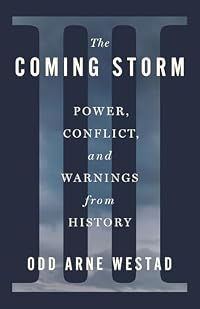
The Coming Storm: Power, Conflict, and Warnings from History
by Odd Arne Westad
On This Page
Description
"From a renowned Yale historian comes a chilling look at the looming threat of the next Great Power war and the urgent interventions necessary to avoid it in the twenty-first century.--Dust jacket flap. The vast majority of people alive today have come of age in a world of remarkable stability, presided over by either one or two Superpowers. This is not to say the world has been peaceful; but it has, to a great extent, been predictable. As an increasing number of Great Powers jostle for show more regional supremacy, as well as competitive advantage in nuclear technology, artificial intelligence, space exploration, and trade, our world has become more fragile, unpredictable--and combustible. The outbreak of global war among today's Great Powers seems increasingly likely. Such war, as Odd Arne Westad powerfully argues in this urgent book, would be of a magnitude and devastation never before seen. To understand the threats that face us in this complex new terrain, we must look to the lessons of the past, and especially the late nineteenth and early twentieth century--a time when Great Powers clashed and sought regional dominance, nationalism and populism were on the rise, and many felt that globalization had failed them; a time when tariffs increased, immigration and terrorism were among the biggest issues of the day, and a growing number of people blamed the citizens of other countries for their problems. A time, in other words, that carries eerie parallels with our own. show lessTags
Recommendations







Member Reviews
The Coming Storm by Odd Arne Westad is an excellent example of how history can be used to warn us about future events by showing how past similarities played out. This isn't predictive but a warning about potentialities.
This is, in many ways, a history book. But not a pure history book in that its purpose is not to simply expound on the past but to make explicit what we can learn from it that can help us with our current world. So there are no digressions from the history since the purpose of the book is what some may think are digressions. If you understand the aim of the book you won't make the same misjudgement or experience the same disappointment. In other words, read it for what it is, not what you might have wanted.
Active readers show more will not only have a lot to consider here but will also be thankful Westad assumed a certain level of intelligence in his readers and didn't feel the need to repeat the purpose of the book every time a point was made about similarities. Early in this volume he explains why he thinks we can look at the period before WWI and draw parallels with what is happening now. He explains how he will demonstrate that idea and also highlight some big picture ideas for how to steer everything away from another global conflict. As long as you're capable of keeping that in mind while reading, you will have no problem understanding how the similarities operate.
I wasn't sure at first just how much I was going to buy into his overall argument, but by the end I was convinced of the potential for events to follow a path not too different than before. Other multipolar periods of history that came before aren't appropriate for comparison for several reasons. The weapons available before 1800 weren't truly weapons of mass destruction, they weren't capable of killing people who were not in the vicinity of where the weapon was deployed. Additionally, the "world" prior to the "age of discovery" was smaller, in fact, there were several "worlds" on our planet, so while there were widespread destructive wars, they weren't global and weren't going to become global.
I think if you read this without trying to make it seem like Westad is saying that there are exact substitutions for the powers between eras and/or that he is claiming the same things will happen now that happened then, you will be able to engage with the big picture without getting lost and thinking there were no connections made. The point is that there are multiple players each with the ability to start a global conflict, even if they are viewing their actions as being more regional and specific. Between alliances and the interconnected nature of every aspect of live globally, regional power plays have the potential to be the beginning of a catastrophic global war.
Again, this is a warning based on historical facts and similarities. These aren't predictions. If we act with these possibilities in mind we can avoid an outcome similar to what came before. That is one of the main benefits of viewing history as something more than a collection of facts and narratives somehow isolated from our current world. This volume is an example of how to use history properly.
Recommended for history buffs and, more importantly, those in policy positions or studying to get into positions influencing policy.
Reviewed from a copy made available by the publisher via NetGalley. show less
This is, in many ways, a history book. But not a pure history book in that its purpose is not to simply expound on the past but to make explicit what we can learn from it that can help us with our current world. So there are no digressions from the history since the purpose of the book is what some may think are digressions. If you understand the aim of the book you won't make the same misjudgement or experience the same disappointment. In other words, read it for what it is, not what you might have wanted.
Active readers show more will not only have a lot to consider here but will also be thankful Westad assumed a certain level of intelligence in his readers and didn't feel the need to repeat the purpose of the book every time a point was made about similarities. Early in this volume he explains why he thinks we can look at the period before WWI and draw parallels with what is happening now. He explains how he will demonstrate that idea and also highlight some big picture ideas for how to steer everything away from another global conflict. As long as you're capable of keeping that in mind while reading, you will have no problem understanding how the similarities operate.
I wasn't sure at first just how much I was going to buy into his overall argument, but by the end I was convinced of the potential for events to follow a path not too different than before. Other multipolar periods of history that came before aren't appropriate for comparison for several reasons. The weapons available before 1800 weren't truly weapons of mass destruction, they weren't capable of killing people who were not in the vicinity of where the weapon was deployed. Additionally, the "world" prior to the "age of discovery" was smaller, in fact, there were several "worlds" on our planet, so while there were widespread destructive wars, they weren't global and weren't going to become global.
I think if you read this without trying to make it seem like Westad is saying that there are exact substitutions for the powers between eras and/or that he is claiming the same things will happen now that happened then, you will be able to engage with the big picture without getting lost and thinking there were no connections made. The point is that there are multiple players each with the ability to start a global conflict, even if they are viewing their actions as being more regional and specific. Between alliances and the interconnected nature of every aspect of live globally, regional power plays have the potential to be the beginning of a catastrophic global war.
Again, this is a warning based on historical facts and similarities. These aren't predictions. If we act with these possibilities in mind we can avoid an outcome similar to what came before. That is one of the main benefits of viewing history as something more than a collection of facts and narratives somehow isolated from our current world. This volume is an example of how to use history properly.
Recommended for history buffs and, more importantly, those in policy positions or studying to get into positions influencing policy.
Reviewed from a copy made available by the publisher via NetGalley. show less
Ratings
Members
- Recently Added By
Lists

The Economist Books of 2026 So Far (June 2026)
25 works; 1 member
Author Information

27+ Works 1,416 Members
Odd Arne Westad is the S. T. Lee Professor of US-Asia Relations at Harvard University and author or editor of eleven books. His The Global Cold War won the 2006 Bancroft Prize, the Harrington Award, and the Akira Iriye International History Award. Restless Empire: China and the World Since 1750 was awarded the 2013 Asia Society Book Award. He show more lives in Cambridge, Massachusetts. show less
Classifications
- Genres
- Politics and Government, History, Nonfiction, General Nonfiction
- DDC/MDS
- 909.83 — History & geography History World history 1800- 21st century, 2000-2099
- LCC
- HN49 .P6 .W47 — Social sciences Social history and conditions. Social problems. Social reform Social history and conditions. Social problems.
- BISAC
Statistics
- Members
- 48
- Popularity
- 622,043
- Reviews
- 1
- Rating
- (4.17)
- Languages
- English
- Media
- Paper, Ebook
- ISBNs
- 3
- ASINs
- 1