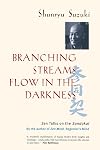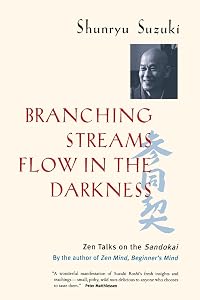
Branching Streams Flow in the Darkness: Zen Talks on the Sandokai
by Shunryu Suzuki
On This Page
Description
When Shunryu Suzuki Roshi's Zen Mind, Beginner's Mind was published in 1972, it was enthusiastically embraced by Westerners eager for spiritual insight and knowledge of Zen. The book became the most successful treatise on Buddhism in English, selling more than one million copies to date. Branching Streams Flow in the Darkness is the first follow-up volume to Suzuki Roshi's important work. Like Zen Mind, Beginner's Mind, it is a collection of lectures that reveal the insight, humor, and show more intimacy with Zen that made Suzuki Roshi so influential as a teacher. The Sandokai-a poem by the eighth-century Zen master Sekito Kisen (Ch. Shitou Xiqian)-is the subject of these lectures. Given in 1970 at Tassajara Zen Mountain Center, the lectures are an example of a Zen teacher in his prime elucidating a venerated, ancient, and difficult work to his Western students. The poem addresses the question of how the oneness of things and the multiplicity of things coexist (or, as Suzuki Roshi expresses it, "things-as-it-is"). Included with the lectures are his students' questions and his direct answers to them, along with a meditation instruction. Suzuki Roshi's teachings are valuable not only for those with a general interest in Buddhism but also for students of Zen practice wanting an example of how a modern master in the Japanese Soto Zen tradition understands this core text today. show lessTags
Recommendations










Member Reviews
This is a book to be read and re-read. But as author Suzuki points out, reading is only one half of our training--intellectual understanding. The other half is practice--zazen (meditation). The book is a redaction of a dozen or so lectures Suzuki gave in 1969 at the San Francisco Zen Center's mountain retreat, Tassajara. The lectures are an exegesis of an 8th century CE Japanese Zen poem by Sekitō Kisen, called Sandokai. In the first six lectures, the explication is highly paradoxical, or koan-like, and takes considerable patience on the part of the reader. The second half of the book, however, was more acessible. I think what helped me was that I began a program of meditation concurrent with the reading. The more I meditated the show more clearer the text became. This is an osmotic reading event. One must soak it up, slowly. show less
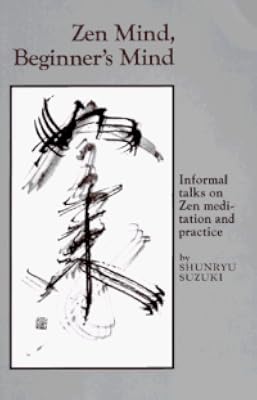
When Shunryu Suzuki Roshi's Zen Mind, Beginner's Mind was published in 1972, it was enthusiastically embraced by Westerners eager for spiritual insight and knowledge of Zen. The book became the most successful treatise on Buddhism in English, selling more than one million copies to date. Branching Streams Flow in the Darkness is the first follow-up volume to Suzuki Roshi's important work. Like Zen Mind, Beginner's Mind, it is a collection of lectures that reveal the insight, humor, and intimacy with Zen that made Suzuki Roshi so influential as a teacher.
The Sandokai—a poem by the eighth-century Zen master Sekito Kisen (Ch. Shitou Xiqian)—is the subject of these lectures. Given in 1970 at Tassajara Zen Mountain Center, the lectures show more are an example of a Zen teacher in his prime elucidating a venerated, ancient, and difficult work to his Western students. The poem addresses the question of how the oneness of things and the multiplicity of things coexist (or, as Suzuki Roshi expresses it, "things-as-it-is"). Included with the lectures are his students' questions and his direct answers to them, along with a meditation instruction. Suzuki Roshi's teachings are valuable not only for those with a general interest in Buddhism but also for students of Zen practice wanting an example of how a modern master in the Japanese Soto Zen tradition understands this core text today. show less
The Sandokai—a poem by the eighth-century Zen master Sekito Kisen (Ch. Shitou Xiqian)—is the subject of these lectures. Given in 1970 at Tassajara Zen Mountain Center, the lectures show more are an example of a Zen teacher in his prime elucidating a venerated, ancient, and difficult work to his Western students. The poem addresses the question of how the oneness of things and the multiplicity of things coexist (or, as Suzuki Roshi expresses it, "things-as-it-is"). Included with the lectures are his students' questions and his direct answers to them, along with a meditation instruction. Suzuki Roshi's teachings are valuable not only for those with a general interest in Buddhism but also for students of Zen practice wanting an example of how a modern master in the Japanese Soto Zen tradition understands this core text today. show less
Ratings
Members
- Recently Added By
Author Information

41+ Works 6,100 Members
Shunryu Suzuki (1904-1971) was one of the most influential spiritual teachers of the twentieth century and is truly a founding father of Zen in America. A Japanese priest of the Soto lineage, he taught in the United States from 1959 until his death. He was the founder of the San Francisco Zen Center and the Tassajara Zen Mountain Center.
Common Knowledge
- Publisher's editor
- Malcolm, Reed; Clark, Jim; Norton, Scott
- Blurbers
- Aitken, Robert; Gross, Rita M.; Kabat-Zinn, Jon
Classifications
Statistics
- Members
- 304
- Popularity
- 105,883
- Reviews
- 3
- Rating
- (4.15)
- Languages
- 5 — Dutch, English, German, Italian, Romanian
- Media
- Paper, Ebook
- ISBNs
- 10
- ASINs
- 4