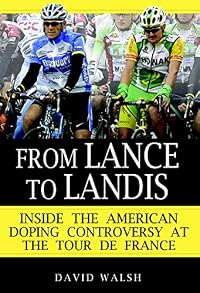
From Lance to Landis: Inside the American Doping Controversy at the Tour de France
by David Walsh
On This Page
Description
For eight years, the Tour de France, arguably the world’s most demanding athletic competition, was ruled by two men: Lance Armstrong and Floyd Landis. On the surface, they were feature players in one of the great sporting stories of the age–American riders overcoming tremendous odds to dominate a sport that held little previous interest for their countrymen. But is this a true story, or is there a darker version of the truth, one that sadly reflects the realities of sports in the show more twenty-first century? Landis’s title is now in jeopardy because drug tests revealing that his testosterone levels were eleven times those of a normal athlete strongly suggest that he used banned substances, and for years similar allegations have swirled around Armstrong. Now internationally acclaimed award-winning journalist David Walsh gives an explosive account of the shadow side of professional sports. In this electrifying, controversial, and scrupulously documented expos#65533;, Walsh explores the many facets of the cyclist doping scandals in the United States and abroad. He examines how performance-enhancing drugs can infiltrate a premier sports event–and why athletes succumb to the pressure to use them. In researching this book, Walsh conducted hundreds of hours of interviews with key figures in international cycling, doctors, and other insiders, including Emma O’Reilly, Armstrong’s longtime massage therapist; former U.S. Postal Service cycling team doctor Prentice Steffen; cycling legend Greg LeMond; and former teammates of both Landis and Armstrong. Central to the story is Lance Armstrong’s relentless, all-consuming drive to be the best. Also essential to this narrative is Floyd Landis, the unassuming, sympathetic hero who was the first winner of the Tour de France after Lance–and the first ever to face the threat of having his title revoked. More than anything else, this book will ignite anew the debate about whether there is room in the current sports culture for athletes who compete honestly, whether sports can be saved from a scandal as widespread as this, and what changes will have to be made. With a compelling narrative and revelations that will stun, enlighten, and haunt readers, David Walsh addresses numerous questions that arise in that crucial space where sports meet the larger American culture. show lessTags
Recommendations
















Member Reviews
Lance to Landis
Midway through the third stage of the 1924 Tour de France, Henri Pélissier (winner of the 1923 Tour) abandoned. Journalist Albert Londres found him drinking hot chocolate at a train station restaurant. The interview Pélissier gave is still important. After explaining what the suffering racers endured he showed Londres the various pills and potions he took to both improve his performance and mitigate his misery. “We run on dynamite,” he said.
Over the years the types of dynamite have changed. In the 1930s chemists synthesized amphetamines and racers soon learned how they could help and harm. Tom Simpson died in 1967 from the effects of dehydration, diarrhea and amphetamine overdose.
In the 1970s, the overuse of show more corticoids nearly killed 2-time Tour winner Bernard Thévenet. When he went public with his misdeeds, explaining that his use of steroids was the usual practice in the peloton, he received abuse from his sponsor, the public and his fellow riders.
In the 1990s EPO made doping necessary if a racer wanted to win. Riders like Marco Pantani and Bjarne Riis ran their hematocrits to a nearly lethal 60%. Any racer wishing to compete with these men and their like were forced to either stick the needle in their arms or retire. This is not just my guess. Many racers from that era (Andy Hampsten, for one) have gone public with how the sport was transformed by a drug that could dramatically improve a racer’s power output.
Today, with a reliable test for EPO available, racers have gone on to new strategies, including old-fashioned blood doping. The best racers can spend over $100,000 a year on both the drugs and the technical expertise to avoid detection. Since this technology is so expensive, it is generally only the lower-paid lesser riders who get caught by dope tests.
That brings us to Walsh’s book and the demand that he find a “smoking gun” before he levels any accusations. Smoking guns are almost impossible to find. In 1960, Tour de France doctor Pierre Dumas walked in on Gaston Nencini while he was calmly transfusing his own saved blood in his hotel room. That’s not going to happen today because what Nencini was doing to win the 1960 Tour was not illegal. Yet, Nencini was doing exactly what most doping experts think modern racers are doing, performing autologous (using their own saved blood for later injection) blood doping.
I urge any person concerned with the obvious problem of rampant doping in sports to read this book. Walsh isn’t a sensationalist. He is a man who hates cheaters. This book is the result of his belief that Lance Armstrong, like almost all of the rest of the professional peloton, used banned performance-enhancing modalities. By necessity, he must build a circumstantial case, but that should not be a justification to reject his conclusions out of hand. I finished the book feeling that Walsh had had indeed made his case.
An old, retired Italian pro with close connections to the racers of today once sat me down and explained much about doping. He concluded by saying, “Bill, they are all dirty.”
I would have liked Walsh to organize his information a little better. Still, that didn’t keep this book from curling the hair on the back of my neck. Even those who fervently believe in Armstrong’s innocence will learn much about modern professional cycling from this book. show less
Midway through the third stage of the 1924 Tour de France, Henri Pélissier (winner of the 1923 Tour) abandoned. Journalist Albert Londres found him drinking hot chocolate at a train station restaurant. The interview Pélissier gave is still important. After explaining what the suffering racers endured he showed Londres the various pills and potions he took to both improve his performance and mitigate his misery. “We run on dynamite,” he said.
Over the years the types of dynamite have changed. In the 1930s chemists synthesized amphetamines and racers soon learned how they could help and harm. Tom Simpson died in 1967 from the effects of dehydration, diarrhea and amphetamine overdose.
In the 1970s, the overuse of show more corticoids nearly killed 2-time Tour winner Bernard Thévenet. When he went public with his misdeeds, explaining that his use of steroids was the usual practice in the peloton, he received abuse from his sponsor, the public and his fellow riders.
In the 1990s EPO made doping necessary if a racer wanted to win. Riders like Marco Pantani and Bjarne Riis ran their hematocrits to a nearly lethal 60%. Any racer wishing to compete with these men and their like were forced to either stick the needle in their arms or retire. This is not just my guess. Many racers from that era (Andy Hampsten, for one) have gone public with how the sport was transformed by a drug that could dramatically improve a racer’s power output.
Today, with a reliable test for EPO available, racers have gone on to new strategies, including old-fashioned blood doping. The best racers can spend over $100,000 a year on both the drugs and the technical expertise to avoid detection. Since this technology is so expensive, it is generally only the lower-paid lesser riders who get caught by dope tests.
That brings us to Walsh’s book and the demand that he find a “smoking gun” before he levels any accusations. Smoking guns are almost impossible to find. In 1960, Tour de France doctor Pierre Dumas walked in on Gaston Nencini while he was calmly transfusing his own saved blood in his hotel room. That’s not going to happen today because what Nencini was doing to win the 1960 Tour was not illegal. Yet, Nencini was doing exactly what most doping experts think modern racers are doing, performing autologous (using their own saved blood for later injection) blood doping.
I urge any person concerned with the obvious problem of rampant doping in sports to read this book. Walsh isn’t a sensationalist. He is a man who hates cheaters. This book is the result of his belief that Lance Armstrong, like almost all of the rest of the professional peloton, used banned performance-enhancing modalities. By necessity, he must build a circumstantial case, but that should not be a justification to reject his conclusions out of hand. I finished the book feeling that Walsh had had indeed made his case.
An old, retired Italian pro with close connections to the racers of today once sat me down and explained much about doping. He concluded by saying, “Bill, they are all dirty.”
I would have liked Walsh to organize his information a little better. Still, that didn’t keep this book from curling the hair on the back of my neck. Even those who fervently believe in Armstrong’s innocence will learn much about modern professional cycling from this book. show less
Years before Lance Armstrong and Floyd Landis admitted to doping to win the Tour de France, David Walsh laid out the evidence for all to see.
Ratings
Members
- Recently Added By
Author Information

8 Works 317 Members
David Joseph Walsh was born on June 17, 1955. He is an Irish sports journalist, who is chief sports writer of the British newspaper The Sunday Times. He is a four-time Irish Sportswriter of the Year and a three-time U.K. Sportswriter of the Year. He has written books about American cyclist Lance Armstrong and helped expose doping within the show more cycling world. His books include From Lance to Landis: Inside the American Doping Controversy at the Tour de France and Seven Deadly Sins: My Pursuit of Lance Armstrong. (Bowker Author Biography) show less
Classifications
- Genres
- Sports and Leisure, Nonfiction, General Nonfiction, Science & Nature
- DDC/MDS
- 796.6 — Arts & recreation Recreation, sports, and performing arts Sports Cycling
- LCC
- GV1049.2 .T68 .W35 — Geography, Anthropology and Recreation Recreation. Leisure Recreation. Leisure Sports Cycling. Bicycling. Motorcycling
- BISAC
Statistics
- Members
- 61
- Popularity
- 505,403
- Reviews
- 2
- Rating
- (3.86)
- Languages
- English
- Media
- Paper, Ebook
- ISBNs
- 2
- ASINs
- 2