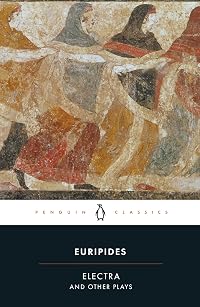
Electra and Other Plays
by Euripides
On This Page
Description
Written during the fierce struggle for supremacy between Sparta and Euripides' native Athens, these five plays are haunted by the shadow of war - and in particular its impact on women. In Electra, the children of Agamemnon take bloody revenge on their mother for murdering their father after his return from Troy, and Suppliant Womendepicts the grieving mothers of those killed in battle. The other plays deal with the aftermath of the Trojan War for the defeated survivors, as Andromacheshows show more Hector's widow as a trophy of war in the house of her Greek captor, and Hecabeportrays a defeated queen avenging the murder of her last-remaining son, while Trojan Womentells of the plight of the city's women in the hands of the victors. show lessTags
Recommendations











Member Reviews
Euripides seems to have had a thing for writing about strong, violent women. While it could not displace Medea for me, Electra also featured strong women characters that produced feelings of ambivalence in me. Electra, the title character, is the daughter of Clytemenestra and Agamemnon. The brutal history of her parents is told in other plays. While Electra is put in a bad situation by Clytemnestra's actions, I couldn't help but feel that she was pretty whiny about things- she seems to enjoy her misery in a weird way. In contrast, Clytemnestra was considerably more sympathetic than I was expecting her to be. She seemed grief stricken about what she had done but resolved to make the best of a bad situation. Which makes it rather jarring show more when Electra demands that her brother kill their mother even after he has second thoughts about matricide.
In addition to gripping female characters, Electra offers yet another meditation on the theme of appearance versus reality. The poor farmer who Electra has been forced to marry is probably the most honorable, good character in the drama and he disappears shortly into it. While he is of a low stature within society, he is about the only character who doesn't do anything morally questionable within the play. So don't judge a book by its cover, basically. Additionally, I was struck by how much the play seemed to question the judgment of the gods, specifically Apollo in this case. The only reason Orestes, the brother, goes through with killing his mother is because Apollo told him to (and Electra urged him to). And the play ends with a couple of the other minor gods telling Electra and Orestes that this was an error on the part of Apollo. What does it mean for humans when the gods make mistakes or don't agree? show less
In addition to gripping female characters, Electra offers yet another meditation on the theme of appearance versus reality. The poor farmer who Electra has been forced to marry is probably the most honorable, good character in the drama and he disappears shortly into it. While he is of a low stature within society, he is about the only character who doesn't do anything morally questionable within the play. So don't judge a book by its cover, basically. Additionally, I was struck by how much the play seemed to question the judgment of the gods, specifically Apollo in this case. The only reason Orestes, the brother, goes through with killing his mother is because Apollo told him to (and Electra urged him to). And the play ends with a couple of the other minor gods telling Electra and Orestes that this was an error on the part of Apollo. What does it mean for humans when the gods make mistakes or don't agree? show less
Ratings
Members
- Recently Added By
Lists

How to Read a Book's Recommended Reading List
309 works; 10 members
Author Information

1,345+ Works 34,170 Members
Euripides was born in Attica, Greece probably in 480 B.C. He was the youngest of the three principal fifth-century tragic poets. In his youth he cultivated gymnastic pursuits and studied philosophy and rhetoric. Soon after he received recognition for a play that he had written, Euripides left Athens for the court of Archelaus, king of Macedonia. show more Fragments of about fifty-five plays survive. Among his best-known plays are Alcestis, Medea and Philoctetes, Electra, Iphigenia in Tauris, The Trojan Women, and Iphigenia in Aulis Iphigenia. He died in Athens in 406 B.C. (Bowker Author Biography) show less
All Editions
Series
Belongs to Publisher Series
Common Knowledge
- Canonical title
- Electra and Other Plays
- Alternate titles
- 5 Plays: Andromache / Electra / Hecuba / Suppliant Women / Trojan Women
- Original publication date
- 1998
Classifications
- Genre
- Fiction and Literature
- DDC/MDS
- 882.01 — Literature & rhetoric Classical & modern Greek literatures Classical Greek dramatic poetry and drama standard subdivisions; collections; history, description, critical appraisal; Specific periods Ancient period to ca. 499
- LCC
- PA3975 .A2 — Language and Literature Greek language and literature. Latin language and literature Greek literature Individual authors Euripedes
- BISAC
Statistics
- Members
- 186
- Popularity
- 175,265
- Reviews
- 1
- Rating
- (3.88)
- Languages
- English
- Media
- Paper, Ebook
- ISBNs
- 2
- ASINs
- 1