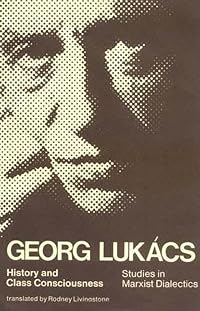
History and Class Consciousness: Studies in Marxist Dialectics
by Georg Lukács
On This Page
Description
Lukacs explores problems of consciousness and organization, drawing on Luxemburg and Lenin. When the proletariat proclaims the dissolution of the existing social order, Marx declares, it does no more than disclose the secret of its own existence, for it is the effective dissolution of that order. ..theory is essentially the intellectual expression of the revolutionary process itself. In it every stage of the process becomes fixed so that it may be generalised, communicated, utilised and show more developed. Because the theory does nothing but arrest and make conscious each necessary step, it becomes at the same time the necessary premise of the following one - show lessTags
Recommendations










Member Reviews
Remains today one of the definitive explications of Dialectical materialism - essential reading
CG-2
Oct 13, 2020Catalan
Members
- Recently Added By
Author Information

330+ Works 4,574 Members
George Steiner calls Lukacs "the one major critical talent to have emerged from the gray servitude of the Marxist world." This well-known writer on European literature combines a Marxist-Hegelian concern for the historical process with great artistic sensitivity. Lukacs joined the Hungarian Communist party in 1918, serving in its first government show more until the defeat of Bela Kun. He spent many years in exile, first in Berlin and then, from 1933 to 1945, in Moscow, writing and studying. He later became a professor of aesthetics in Budapest, but after the 1956 revolution he was stripped of influence because of his too-friendly attitude to non-Marxist literatures. Steiner has written: "A Communist by conviction, a dialectical materialist by virtue of his critical method, he has nevertheless kept his eyes resolutely on the past. Despite pressure from his Russian hosts, Lukacs gave only perfunctory notice to the much-heralded achievements of Soviet Realism. Instead, he dwelt on the great lineage of eighteenth and nineteenth century European poetry and fiction. The critical perspective is rigorously Marxist, but the choice of themes is central European and conservative." Lukacs has concentrated mainly on criticism of Russian, French, and German authors and often writes in German. Robert J. Clements has reported that Hungarian young people regard him as somewhat passe. (Bowker Author Biography) show less
Some Editions
Awards and Honors
Series
Belongs to Publisher Series
Work Relationships
Is contained in
Common Knowledge
- Canonical title*
- Geschichte und Klassenbewußtsein
- Original publication date
- 1923
*Some information comes from Common Knowledge in other languages. Click "Edit" for more information.
Classifications
- Genres
- Nonfiction, Philosophy, Literature Studies and Criticism, General Nonfiction, Politics and Government, History
- DDC/MDS
- 335.4108 — Society, government, & culture Economics Socialism and related systems Marxian systems Philosophic foundations, economic concepts, aims
- LCC
- HX260 .H8 .L783 — Social sciences Socialism. Communism. Anarchism Socialism. Communism. Anarchism
- BISAC
Statistics
- Members
- 1,110
- Popularity
- 22,832
- Reviews
- 2
- Rating
- (3.88)
- Languages
- 12 — English, French, German, Hungarian, Italian, Norwegian (Bokmål), Norwegian, Polish, Portuguese, Spanish, Swedish, Turkish
- Media
- Paper, Ebook
- ISBNs
- 35
- ASINs
- 22