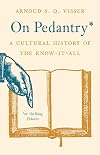
On Pedantry: A Cultural History of the Know-it-All
by Arnoud S. Q. Visser
On This Page
Description
Intellectuals have long provoked scorn and irritation, even downright aggression. Many learned individuals have cast such hostility as a badge of honour, a sign of envy, or a form of resistance to inconvenient truths. On Pedantry offers an altogether different perspective, revealing how the excessive use of learning has been a vice in Western culture since the days of Socrates. Taking readers from the academies of ancient Greece to today's culture wars, Arnoud Visser explains why pretentious show more and punctilious learning has always annoyed us, painting vibrant portraits of some of the most intensely irritating intellectuals ever known, from devious sophists and bossy savantes to hypercritical theologians, dry-as-dust antiquarians, and know-it-all professors. He shows how criticisms of pedantry have typically been more about conduct than ideas, and he demonstrates how pedantry served as a weapon in the perennial struggle over ideas, social status, political authority, and belief. Shifting attention away from the self-proclaimed virtues of the learned to their less-than-flattering vice, Visser makes a bold and provocative contribution to the history of Western thought. Drawing on a wealth of sources ranging from satire and comedy to essays, sermons, and film, On Pedantry sheds critical light on why anti-intellectual views have gained renewed prominence today and serves as essential reading in an age of rising populism across the globe. show lessTags
Recommendations




































Member Reviews
People have never liked lectures from know-it-alls. When the Roman authorities handed over the Christian grammarian Cassian of Imola to his pagan pupils for punishment, they stabbed him to death with the pens they had used in his classes. Arnoud Visser considers Cassian’s macabre end to be emblematic of the hostility intellectuals have attracted throughout the history of the West, especially when they have dared to correct mistakes or challenge received ideas. On Pedantry traces the development of a ‘cultural script’ that has variously represented intellectuals as subversive or futile, shabby or pretentious, effeminate or as exemplars of toxic masculinity. The charges are various and often contradictory, but the base note of show more annoyance is constant. That script now seems more powerful than ever. Michael Gove spoke for many tribunes of the populist right when he argued in the run up to Brexit that ‘the people of this country have had enough of experts’.
One immediate problem for a history of anti-intellectualism that begins with Socrates and ends with Eddie Murphy’s Nutty Professor is that the term intellectual is a ‘slippery thing’. Visser mainly takes it to mean scholars like Cassian: people whose job it has been to teach other people what to learn and how to learn. The book arises from the history of scholarship, a discipline that was once a worthy but nebbish auxiliary to intellectual history but now aspires to broader impact. Anthony Grafton, Dennis Duncan, and Dmitri Levitin have urged us that the development in early modern Europe of footnotes, indexes, chronologies, and other tools of the scholar’s trade is no merely antiquarian matter: who determines what is reliable information and how it should be transmitted has always been a debate fraught with political, religious, and moral consequences.
Read the rest of the review at https://www.historytoday.com/archive/review/pedantry-arnoud-sq-visser-review
Michael Ledger-Lomas is a historian of religion. show less
One immediate problem for a history of anti-intellectualism that begins with Socrates and ends with Eddie Murphy’s Nutty Professor is that the term intellectual is a ‘slippery thing’. Visser mainly takes it to mean scholars like Cassian: people whose job it has been to teach other people what to learn and how to learn. The book arises from the history of scholarship, a discipline that was once a worthy but nebbish auxiliary to intellectual history but now aspires to broader impact. Anthony Grafton, Dennis Duncan, and Dmitri Levitin have urged us that the development in early modern Europe of footnotes, indexes, chronologies, and other tools of the scholar’s trade is no merely antiquarian matter: who determines what is reliable information and how it should be transmitted has always been a debate fraught with political, religious, and moral consequences.
Read the rest of the review at https://www.historytoday.com/archive/review/pedantry-arnoud-sq-visser-review
Michael Ledger-Lomas is a historian of religion. show less
Members
- Recently Added By
Lists

LRB 48(12)
13 works; 1 member
Author Information
2 Works 42 Members
Classifications
- Genres
- Philosophy, History, Nonfiction
- DDC/MDS
- 305.552 — Society, government, & culture Social sciences, sociology & anthropology Social group - Age, Gender, Ethnicity People by social and economic levels Middle Class Intelligentsia, Intellectuals
- LCC
- AZ231 .V57 — General Works History of scholarship and learning. The humanities History of scholarship and learning. The humanities History
- BISAC
Statistics
- Members
- 24
- Popularity
- 1,112,514
- Reviews
- 1
- Languages
- English
- Media
- Paper, Ebook
- ISBNs
- 2