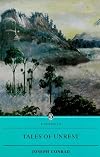
Tales of Unrest
by Joseph Conrad
On This Page
Description
Whether you're a longtime Conrad fan or a new reader who is interested in dipping into the work of one of the greatest fiction writers of the twentieth century, this comprehensive collection of rip-roaring action-adventure tales with remarkable psychological nuance will definitely fit the bill..
Tags
Recommendations

























Member Reviews
I had read these stories at least three times previously before coming to them again, today. And they were well worth rereading. These are among Conrad's earliest efforts. But all of them manage to create an atmosphere that foreshadows what will appear in later works. Only one, "The Return," falls short of expectations. Frankly, it's simply too wordy. The attempt at psychoanalyzing his two main characters doesn't quite succeed. Even so, it's an important piece within the context of Conrad's overall writing. And because I am currently reading and rereading through several Conrad stories and novels, I am able to see connection that weren't as obvious to me before.
One of these connections, coming out "The Return," will recur throughout show more Conrad's tales about men and women. It is the preoccupation with misdirected love. Of course, you could already see a bit of that in Almayer's Folly. And it's also, here, in the last story of this volume, "The Lagoon," which I understand from the author's note was written in the immediate aftermath of finish Almayer's Folly. Or at least hints of it are there. But the greater connection can be seen in later stories, "A Smile of Fortune," "Freya of the Seven Isles," "The Planter of Malata," and, especially, in "Because of the Dollars." In each instance, men are able to redeem themselves through walking away from a cold, loveless lair to seek further adventures or they have their lives ruined by undeserving women suspicious of all that is good and true in a person.
Another story, "The Idiots," traces the history of a mismatched marriage in the French countryside. The other two stories, "Karain: A Memory" and "An Outpost of Progress," are trader's tales. One is set in Southeast Asia and the other in Africa. Both allude to the other great "mismatch" in Conrad's work, the presence of colonial governments and their colonizer in parts of the world they fail to understand and always underestimate. show less
One of these connections, coming out "The Return," will recur throughout show more Conrad's tales about men and women. It is the preoccupation with misdirected love. Of course, you could already see a bit of that in Almayer's Folly. And it's also, here, in the last story of this volume, "The Lagoon," which I understand from the author's note was written in the immediate aftermath of finish Almayer's Folly. Or at least hints of it are there. But the greater connection can be seen in later stories, "A Smile of Fortune," "Freya of the Seven Isles," "The Planter of Malata," and, especially, in "Because of the Dollars." In each instance, men are able to redeem themselves through walking away from a cold, loveless lair to seek further adventures or they have their lives ruined by undeserving women suspicious of all that is good and true in a person.
Another story, "The Idiots," traces the history of a mismatched marriage in the French countryside. The other two stories, "Karain: A Memory" and "An Outpost of Progress," are trader's tales. One is set in Southeast Asia and the other in Africa. Both allude to the other great "mismatch" in Conrad's work, the presence of colonial governments and their colonizer in parts of the world they fail to understand and always underestimate. show less
St. Barth trip Book #3: A worthy read.....several tales of the South Seas, one of primitive Africa, and a unique victorian story of manners thrown in for good measure...all leading to the conclusion in different ways that if we devote too much of our human capital on 'thinking properly and intellectually,' we pay a dear price in our overall emotional well-being.....human-to-human genuine honest communication is a necessary part of our healthy existence.....over-thinking can be detrimental.
This is definitely not Conrad at his best.
Ratings
Members
- Recently Added By
Author Information

Joseph Conrad is recognized as one of the 20th century's greatest English language novelists. He was born Jozef Konrad Nalecz Korzeniowski on December 3, 1857, in the Polish Ukraine. His father, a writer and translator, was from Polish nobility, but political activity against Russian oppression led to his exile. Conrad was orphaned at a young age show more and subsequently raised by his uncle. At 17 he went to sea, an experience that shaped the bleak view of human nature which he expressed in his fiction. In such works as Lord Jim (1900), Youth (1902), and Nostromo (1904), Conrad depicts individuals thrust by circumstances beyond their control into moral and emotional dilemmas. His novel Heart of Darkness (1902), perhaps his best known and most influential work, narrates a literal journey to the center of the African jungle. This novel inspired the acclaimed motion picture Apocalypse Now. After the publication of his first novel, Almayer's Folly (1895), Conrad gave up the sea. He produced thirteen novels, two volumes of memoirs, and twenty-eight short stories. He died on August 3, 1924, in England. (Bowker Author Biography) show less
Some Editions
Series
Belongs to Publisher Series
Work Relationships
Is contained in
Common Knowledge
- Canonical title
- Tales of Unrest
- Original title
- Tales of Unrest
- Original publication date
- 1898
- Important places
- Africa; Malaya; England, UK
- Original language
- English
Classifications
Statistics
- Members
- 368
- Popularity
- 85,858
- Reviews
- 4
- Rating
- (3.75)
- Languages
- 11 — Catalan, Czech, Danish, Dutch, English, French, German, Italian, Portuguese, Spanish, Swedish
- Media
- Paper, Audiobook, Ebook
- ISBNs
- 86
- ASINs
- 22