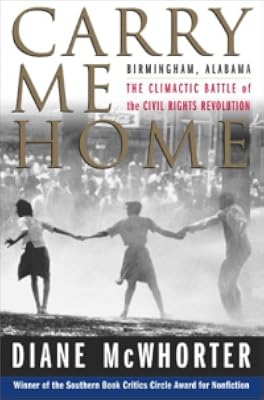
Carry Me Home: Birmingham, Alabama, the Climactic Battle of the Civil Rights Revolution
by Diane McWhorter
On This Page
Description
McWhorter's magisterial narrative tells the story of the civil rights movement in Birmingham, from the '50s through the '60s. In the tradition of such histories as Parting the Water and Walking in the Wind, Carry Me Home" documents the real story of integrating the South. It tells the story of the city called Bombingham, from the fifties through the sixties. It focuses on the black freedom fighters as well as those who resisted them--country-club elite, police, vigilantes. Meet the children show more who braved police dogs & fire department hoses, as well as the Ku Klux Klansmen who retaliated with dynamite. The book also breaks new ground with its startling revelations about the perpetrators of the Sunday-morning bombing of the Sixteenth Street Baptist Church, which killed four black girls & still generates headlines nearly four decades later. In the tradition of such histories as Parting the Water & Walking in the Wind, Carry Me Home documents the real story of integrating the South. It reveals the collusion between the city's establishment--the Big Mules-- & its designated subordinates: public officials (including the infamous Bull Connor) & the Klansmen who did the dirty work. It describes the competition for primacy within the movement's black leadership, especially between Birmingham's flamboyant preacher-activist, Fred Shuttlesworth, & an already world-famous King, against the backdrop of a hesitant Kennedy administration & the corrupt Hoover FBI. Carry Me Home is a magisterial narrative that brings to life one of the most significant periods in American history. This is an invaluable contribution to the history of modern America. A major work of history, investigative journalism that breaks new ground, and personal memoir, Carry Me Home is a dramatic account of the civil rights era's climactic battle in Birmingham, as the movement led by Martin Luther King, Jr., brought down the institutions of segregation. "The Year of Birmingham," 1963, was one of the most cataclysmic periods in America's long civil rights struggle. That spring, King's child demonstrators faced down Commissioner Bull Connor's police dogs and fire hoses in huge nonviolent marches for desegregation -- a spectacle that seemed to belong more in the Old Testament than in twentieth-century America. A few months later, Ku Klux Klansmen retaliated with dynamite, bombing the Sixteenth Street Baptist Church and killing four young black girls. Yet these shocking events also brought redemption: They transformed the halting civil rights movement into a national cause and inspired the Civil Rights Act of 1964, which abolished legal segregation once and for all. Diane McWhorter, the daughter of a prominent white Birmingham family, brilliantly captures the opposing sides in this struggle for racial justice. Tracing the roots of the civil rights movement to the Old Left and its efforts to organize labor in the 1930s, Carry Me Home shows that the movement was a waning force in desperate need of a victory by the time King arrived in Birmingham. McWhorter describes the competition for primacy among the movement's leaders, especially between Fred Shuttlesworth, Birmingham's flamboyant preacher-activist, and the already world-famous King, who was ambivalent about the direct-action tactics Shuttlesworth had been practicing for years. Carry Me Home is the first major movement history to uncover the segregationist resistance. McWhorter charts the careers of the bombers back to the New Deal, when Klansmen were agents of the local iron and coal industrialists fighting organized labor. She reveals the strained and veiled collusion between Birmingham's wealthy establishment and its designated subordinates -- politicians, the police, and the Klan. Carry Me Home is also the story of the author's family, which was on the wrong side of the civil rights revolution. McWhorter's quest to find out whether her eccentric father, the prodigal son of the white elite, was a member of the Klan mirrors the book's central revelation of collaboration between the city's Big Mules, who kept their hands clean, and the scruffy vigilantes who did the dirty work. Carry Me Home is the product of years of research in FBI and police files and archives, and of hundreds of interviews, including conversations with Klansmen who belonged to the most violent klavern in America. John and Robert Kennedy, J. Edgar Hoover, George Wallace, Connor, King, and Shuttlesworth appear against the backdrop of the unforgettable events of the civil rights era -- the brutal beating of the Freedom Riders as the police stood by; King's great testament, his "Letter from Birmingham Jail"; and Wallace's defiant "stand in the schoolhouse door." This book is a classic work about this transforming period in American history. show lessTags
Recommendations




Member Reviews
OK. Now that I have the anger out I can get to the real review of the book. What I have long thought is that the plight of blacks in this country happened because, as opposed to what we learn in school, the South won the Civil War, defeating the emancipation principle in civilian life. Certainly the North won the battles and the country did not split, but where was the freedom promised to blacks? 100 years later, in this book, here the blacks are seeking to have access to the rights GUARANTEED to them by the Consitution. Rights regularly denied them by the governments in the states comprising the old Confederacy.
McWhorter takes an unblinking look at her home town, a center of racial conflict that marked the effort to continue denial of show more those rights. And a process of denying that we are one country, white and black. She looks at the many skirmishes and battles along that pathway, pointing out that it was largely the violent efforts of those wanting to maintain segregation and the denial of rights that brought an end to what they wanted to keep. They were their own worst enemies.
Sadly, we are seeing a move again toward the denial of rights, but in more states than just the old Confederacy. Hidden under the cloak name "States Rights", it is a movement again seeking to deny to citizens of color access to the ballot box. And that voting rights also get denied to poor whites, well, that's just collateral damage. Their fault for being poor and no better than any N-word anyway. Make no mistake, "States Rights" is an effort to reconstitute, legally, white supremacy in the US -- an effort fully supported by the Republican Party leadership. Can you say "racist"? None are so blind as those who will not see, none so deaf as those who will not hear.
Are they going to make us go through all this s*** again? Seems so. All this little old white lady can say is "damnation". show less
McWhorter takes an unblinking look at her home town, a center of racial conflict that marked the effort to continue denial of show more those rights. And a process of denying that we are one country, white and black. She looks at the many skirmishes and battles along that pathway, pointing out that it was largely the violent efforts of those wanting to maintain segregation and the denial of rights that brought an end to what they wanted to keep. They were their own worst enemies.
Sadly, we are seeing a move again toward the denial of rights, but in more states than just the old Confederacy. Hidden under the cloak name "States Rights", it is a movement again seeking to deny to citizens of color access to the ballot box. And that voting rights also get denied to poor whites, well, that's just collateral damage. Their fault for being poor and no better than any N-word anyway. Make no mistake, "States Rights" is an effort to reconstitute, legally, white supremacy in the US -- an effort fully supported by the Republican Party leadership. Can you say "racist"? None are so blind as those who will not see, none so deaf as those who will not hear.
Are they going to make us go through all this s*** again? Seems so. All this little old white lady can say is "damnation". show less
There is no doubt Carry Me Home: Birmingham, Alabama: The Climactic Battle of the Civil Rights Revolution is testimony to McWhorter's nineteen year mission. Her conviction to expose the truth is on every page. What makes Carry Me Home so compelling in the unflinching examination of McWhorter's own family's beliefs and involvements in the tumultuous time of civil unrest. Interjecting personal biography give the book a unique drama. The detail with which McWhorter writes allows readers to not just walk in the footsteps of history but experience as if they are walking side by side in real time.
This book ticks off certain local folks (I live in Birmingham) but not for any good reason that I can see. McWhorter weaves the history of her family into that of the city, in order to give a glimpse of how white residents managed to shelter themselves for quite some time from the revolution taking place downtown. Fred Shuttlesworth, founder of the Alabama Christian Movement for Human Rights, emerges as the principal hero of the movement.
Detailed but dry events spanning twenty or so years of Birmingham history around the early Sixties leading up to the 16th Street Baptist Church bombing. McWhorter's father was apparently involved with Ku Klux Klan and perhaps with the bombing which she talks about. It's horrifying that the local and state police, courts and government collaborated with the Klan. It was disappointing in that it didn't explain why people were so invested in racism.
3650. Carry Me Home Birmingham, Alabama The Climactic Battle of the Civil Rights Revolution by Diane McWhorter (read 16 Nov 2002) I have wanted to read this since it came out, and when it won the Pulitzer Prize for Nonfiction this year I had another reason to read it. The author was born in 1952 and was a young girl while Birmingham was going thru the civil rights struggle, highlighted by the church bombing on Sept 15, 1963, which killed four young black girls. The book is quite "local" and no doubt people in Birmingham will be more caught up by the account than was I. I did not find it as good as David Garrow's Bearing the Cross (read 16 Jan 1989) nor as Taylor Branch's Parting the Waters (read 15 Dec 1994). But it is absorbing reading show more if a bit long and not overly well-written. It is well-documented and has a good bibliography. One has to be consistently appalled at the awfulness of the attitudes of so many whites in 1963 Birmingham, and relieved that now the murderers of the little black girls can be convicted whereas at the time they could not be. show less
Traces and maps my time in Ensley, Alabama, when cast out by my family of origin...
Ratings
Members
- Recently Added By
Lists

Pulitzer Prize for General Non-Fiction
16 works; 3 members

BLM
210 works; 1 member

TED 2013 Summer Reading List
190 works; 13 members
Author Information

3+ Works 897 Members
Diane McWhorter, a daughter of Birmingham's white elite, is a journalist & regular contributor to The New York Times & USA Today. She has also written about race & politics for The Washington Post, People, & other major publications. She lives in New York City. (Bowker Author Biography)
Awards and Honors
Awards
Notable Lists
Common Knowledge
- Canonical title
- Carry Me Home: Birmingham, Alabama, the Climactic Battle of the Civil Rights Revolution
- Original publication date
- 2001-03-15
- People/Characters
- Martin Luther King, Jr.
- Important places
- Birmingham, Alabama, USA; USA; Alabama, USA; Jefferson County, Alabama, USA
- Important events
- African-American Civil Rights Movement
- Disambiguation notice
- Full title (2001): Carry me home : Birmingham, Alabama, the climactic battle of the civil rights revolution / Diane McWhorter
Classifications
- Genres
- Politics and Government, History, Nonfiction, General Nonfiction, Biography & Memoir
- DDC/MDS
- 976.1 — History & geography History of North America South central United States Alabama
- LCC
- F334 .B69 .N449 — Local History of the United States, Canada and Latin America United States local history Alabama
- BISAC
Statistics
- Members
- 564
- Popularity
- 52,543
- Reviews
- 6
- Rating
- (4.13)
- Languages
- English
- Media
- Paper, Audiobook, Ebook
- ISBNs
- 7
- ASINs
- 6