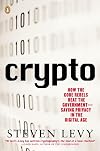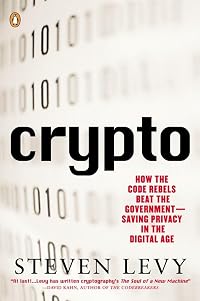
Crypto: How the Code Rebels Beat the Government Saving Privacy in the Digital Age
by Steven Levy
On This Page
Description
If you've ever made a secure purchase with your credit card over the Internet, then you have seen cryptography, or "crypto", in action. From Stephen Levy-the author who made "hackers" a household word-comes this account of a revolution that is already affecting every citizen in the twenty-first century. Crypto tells the inside story of how a group of "crypto rebels"-nerds and visionaries turned freedom fighters-teamed up with corporate interests to beat Big Brother and ensure our privacy on show more the Internet. Levy's history of one of the most controversial and important topics of the digital age sounds like the best futuristic fiction. show lessTags
Recommendations






Member Recommendations
Member Reviews
This book is about the battle for privacy: a battle that pitted nobodies against the world's most powerful people and governments. The nobodies won. Governments have always had a substantial stake in restricting access to information, often for very good reasons, but individuals need to protect their personal information also. The computer provided the means for incredibly powerful cryptographic tools, and those in power wanted to keep those tools to themselves. Whitfield Diffie was a contrarian. A genius, he didn't decide to learn to read until he was ten years old because he so enjoyed having his parents read to him. Once he decided to learn, he read everything, and he was particularly drawn to books about cryptography, the science of show more encoding information.
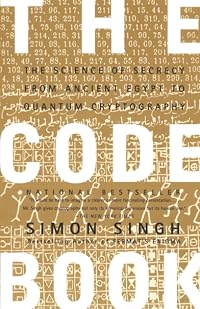
Interestingly, he was less interested in cryptanalysis and decoding. For a while he lost interest, thinking all the interesting work had already been done. After working at MIT, he moved on to indulge his passion for mathematics and computer programming and eventually [b:artificial intelligence|27543|Artificial Intelligence A Modern Approach (2nd Edition)|Stuart J. Russell|http://photo.goodreads.com/books/1167881696s/27543.jpg|1362]. While his hacker friends were indulging themselves breaking into other computers to see if it could be done, Diffie worked on software to prevent such intrusions. Then he read David Kahn's classic [b:The Codebreakers|17994|The Code Book The Science of Secrecy from Ancient Egypt to Quantum Cryptography|Simon Singh|http://photo.goodreads.com/books/1166855238s/17994.jpg|1031975] that revealed how much secret work was being done by the NSA (formerly known as No Such Agency). He realized an enormous amount of work was being done behind closed doors, and that offended his sense of propriety since privacy for individuals was important too. Encryption had become essential with the advent of the Internet.. Digital signatures, for example could be easily copied, as could digital documents, so how could they be made secure without slowing down transactions? In 1977, three MIT professors who had been intrigued by Diffie's work discovered the mechanism that would strike terror in the hearts of cryptanalysts (those who break codes). Using factoring of prime numbers as the focal point, they realized that a 129-digit product of two prime numbers would require millions of years to break by brute strength (computer analysis of all the possibilities), but that anyone who had a private key of one of the prime numbers could easily decode the message. Thus the key that performed the encryption could be made public -- indeed, the wider the dissemination the better. For a better explanation read the book. We’re pushing my envelope here.
The National Security Agency, better known as the NSA, an agency that in its early years did not even admit to its own existence, began a campaign to thwart the work of the mathematicians. Even after the Justice Department had ruled that the ITAR regulations (these prevented dissemination of even published papers) were unconstitutional, the agency was trying to use them to scare anyone working on novel forms of cryptography. In other words, in spite of their having sworn allegiance to the Constitution, the agency and its employees were operating in a manner that the legal arm of the government had said was clearly unconstitutional. Shades of Oliver North, who always thought he could be the sole interpreter of the Constitution.
The epitome of the governmental role in trying to thwart the proverbial horse from escaping the barn was the Clipper chip. This hardware device was designed to be placed in every device that might conceivably be used for communications, from computers to telephones. Initially proposed by the NSA with the concurrence of the FBI and National Institutes of Standards, the device would use an escrow key; that is, every time it was used a key would be sent to a government agency theoretically to be stored until such time as the government needed to get at the conversation. Unfortunately, the Clinton administration, techno-freaks though they professed to be, completely misread the mood of the country. After all, would you leave a key to your house at the police station so they could get in any time they wanted? The reaction from foreign countries was astonishment. They were supposed to give the U.S. government access to private business conversations, etc.? The hubris of it all.
The crowning blow, despite polls that showed 80% of the country being opposed to the Clipper chip, was when a consultant hired by the NSA to test the chip showed it could be broken. It took him 42 minutes after realizing that the checksum used to verify the key being sent to law enforcement was only sixteen bits and could be computationally broken by a home PC. That made it the subject of ridicule and it was doomed. Levy’s book is a real page-turner and a classic analysis of how of technology outpaces policy. show less
Interestingly, he was less interested in cryptanalysis and decoding. For a while he lost interest, thinking all the interesting work had already been done. After working at MIT, he moved on to indulge his passion for mathematics and computer programming and eventually [b:artificial intelligence|27543|Artificial Intelligence A Modern Approach (2nd Edition)|Stuart J. Russell|http://photo.goodreads.com/books/1167881696s/27543.jpg|1362]. While his hacker friends were indulging themselves breaking into other computers to see if it could be done, Diffie worked on software to prevent such intrusions. Then he read David Kahn's classic [b:The Codebreakers|17994|The Code Book The Science of Secrecy from Ancient Egypt to Quantum Cryptography|Simon Singh|http://photo.goodreads.com/books/1166855238s/17994.jpg|1031975] that revealed how much secret work was being done by the NSA (formerly known as No Such Agency). He realized an enormous amount of work was being done behind closed doors, and that offended his sense of propriety since privacy for individuals was important too. Encryption had become essential with the advent of the Internet.. Digital signatures, for example could be easily copied, as could digital documents, so how could they be made secure without slowing down transactions? In 1977, three MIT professors who had been intrigued by Diffie's work discovered the mechanism that would strike terror in the hearts of cryptanalysts (those who break codes). Using factoring of prime numbers as the focal point, they realized that a 129-digit product of two prime numbers would require millions of years to break by brute strength (computer analysis of all the possibilities), but that anyone who had a private key of one of the prime numbers could easily decode the message. Thus the key that performed the encryption could be made public -- indeed, the wider the dissemination the better. For a better explanation read the book. We’re pushing my envelope here.
The National Security Agency, better known as the NSA, an agency that in its early years did not even admit to its own existence, began a campaign to thwart the work of the mathematicians. Even after the Justice Department had ruled that the ITAR regulations (these prevented dissemination of even published papers) were unconstitutional, the agency was trying to use them to scare anyone working on novel forms of cryptography. In other words, in spite of their having sworn allegiance to the Constitution, the agency and its employees were operating in a manner that the legal arm of the government had said was clearly unconstitutional. Shades of Oliver North, who always thought he could be the sole interpreter of the Constitution.
The epitome of the governmental role in trying to thwart the proverbial horse from escaping the barn was the Clipper chip. This hardware device was designed to be placed in every device that might conceivably be used for communications, from computers to telephones. Initially proposed by the NSA with the concurrence of the FBI and National Institutes of Standards, the device would use an escrow key; that is, every time it was used a key would be sent to a government agency theoretically to be stored until such time as the government needed to get at the conversation. Unfortunately, the Clinton administration, techno-freaks though they professed to be, completely misread the mood of the country. After all, would you leave a key to your house at the police station so they could get in any time they wanted? The reaction from foreign countries was astonishment. They were supposed to give the U.S. government access to private business conversations, etc.? The hubris of it all.
The crowning blow, despite polls that showed 80% of the country being opposed to the Clipper chip, was when a consultant hired by the NSA to test the chip showed it could be broken. It took him 42 minutes after realizing that the checksum used to verify the key being sent to law enforcement was only sixteen bits and could be computationally broken by a home PC. That made it the subject of ridicule and it was doomed. Levy’s book is a real page-turner and a classic analysis of how of technology outpaces policy. show less
Levy is one of my favorite essayists. He finds a compelling story, researches it exhaustively, and then shares his excitement. The history of Internet cryptography is a perfect subject for Levy, who delights in recounting stories about technoradicals w
Excellent! This is a really interesting history of the development of public crypto and the interaction with NSA and FBI over it. This is a battle we were just fighting in the 90s and are already fighting again. You'll be surprised at how many parallels there are. The same players, the same arguments. This is a definite must-read if you want context for the current crypto debates going on, including #AppleVsFBI.
It just happens that soon after reading this book, I took a proper cryptology class as part of my computer science undergrad. This book was both: a) an awesome lesson in history, and b) an awesome 101-primer for anyone (let alone a student about to dive into the nittier/grittier details of math/etc.).
Absolutely loved this book.
Absolutely loved this book.
A an easy and illuminating read about the modern history of cryptography, or more specifically the tale of public key systems. The style is as one might expect of a journalist (highly readable but with a tendency to want to create drama where it isn't entirely necessary) but the material is well-referenced and there's a good index and bibliography. It was a revelation to me that Martin Gardner's SA column, which I vividly remember reading, played such a crucial role in the whole business, and came so early in the process.
I wish i'd read this book when i was in high school. Why? because it shows that math can be interesting, fun, and even revolutionary.
This book is a brilliant insight into the mathematics, personalities and politics in the debate over a citizen's right to privacy in the digital age.
This book is a brilliant insight into the mathematics, personalities and politics in the debate over a citizen's right to privacy in the digital age.
Not bad. It focuses mostly on the political and business aspects of the cryptography revolution of the last couple of decades. It also emphasizes the personalities of various key figures, which I found irrelevant. I know Levy was writing for a popular audience, but do we have to treat everything like a back-page gossip column? Also, I would have preferred more on the actual mathematics of it. I suppose this wouldn't be attractive for a popular audience, but it could have been put in an appendix. It's counterproductive to write a book about what crypto folks did without actually telling us what they did in any kind of detail!
Members
- Recently Added By
Lists

Cybersecurity Canon (award winners)
24 works; 2 members
Author Information

13 Works 5,480 Members
Steven Levy is a senior editor for "Newsweek." For ten years he wrote the "Iconoclast" column for "MacWorld" magazine. His previous books include "Hackers" & "Artificial Life." (Bowker Author Biography)
Some Editions
Series
Belongs to Publisher Series
Common Knowledge
- Original publication date
- 2001
- People/Characters
- Whitfield Diffie; Martin Hellman; Alan Turing
- Important places
- Bletchley Park, Bletchley, Buckinghamshire, England, UK; Buckinghamshire, England, UK
- Dedication
- To Teresa and Andrew
- First words
- Mary Fischer loathed Whitfield Diffie on sight.
- Last words
- (Click to show. Warning: May contain spoilers.)And thereafter kept his secret.
- Original language
- English
Classifications
- Genres
- Technology, Nonfiction, General Nonfiction, History, Science & Nature
- DDC/MDS
- 005.8 — Computer science, information & general works Computer science, knowledge & systems Artificial Intelligence/Virtual Reality Computer Security
- LCC
- QA76.9 .A25 .L49 — Science Mathematics Mathematics Instruments and machines Calculating machines Electronic computers. Computer science
- BISAC
Statistics
- Members
- 940
- Popularity
- 28,470
- Reviews
- 14
- Rating
- (3.95)
- Languages
- English, Italian, Korean, Spanish
- Media
- Paper, Audiobook, Ebook
- ISBNs
- 16
- ASINs
- 5