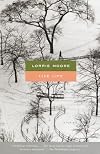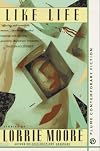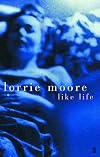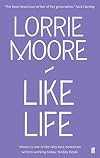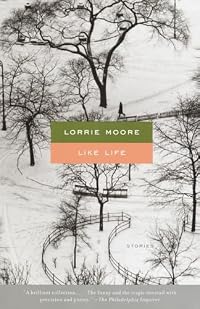
Like Life
by Lorrie Moore
On This Page
Description
Fiction. Literature. Short Stories. HTML:In Like Life’s eight exquisite stories, Lorrie Moore’s characters stumble through their daily existence. These men and women, unsettled and adrift and often frightened, can’t quite understand how they arrived at their present situations. Harry has been reworking a play for years in his apartment near Times Square in New York. Jane is biding her time at a cheese shop in a Midwest mall. Dennis, unhappily divorced, buries himself in self-help books show more about healthful food and healthy relationships. One prefers to speak on the phone rather than face his friends, another lets the answering machine do all the talking. But whether rejected, afraid to commit, bored, disillusioned or just misunderstood, even the most hard-bitten are not without some abiding trust in love. show lessTags
Recommendations








Member Recommendations
Member Reviews
Like Life by Lorrie Moore is a volume of short stories, each one about ordinary people living quiet lives of desperation. The characters are often trying to disguise their fears and weaknesses with plenty of sarcasm or poignancy. There are eight stories, all quite different, yet all paint pictures of the empty lives of unhappy, neurotic and at times quite bitter people.
I can’t say that I enjoyed reading these stories, yet I did find them all memorable which speaks to the quality of the writing. At times these bleak stories hit close to home with recognizable emotions and feelings as she details life’s trite experiences. Stories about trying to disguise an empty life, or attempting to stay true to one’s muse are delivered in a show more sharp, incisive and witty manner that emphasizes rather than disguises the characters’ disorganized lives.
Complicated, cruel and cynical, the stories in Like Life speak to all of our insecurities and make the reading of it a very personal experience. show less
I can’t say that I enjoyed reading these stories, yet I did find them all memorable which speaks to the quality of the writing. At times these bleak stories hit close to home with recognizable emotions and feelings as she details life’s trite experiences. Stories about trying to disguise an empty life, or attempting to stay true to one’s muse are delivered in a show more sharp, incisive and witty manner that emphasizes rather than disguises the characters’ disorganized lives.
Complicated, cruel and cynical, the stories in Like Life speak to all of our insecurities and make the reading of it a very personal experience. show less
I read one of Moore’s short stories in college, and it’s been in my mind ever since. I periodically reread it, perhaps twice a year, but until the past few days I haven’t read any of her other work. I checked this collection out from the library and nearly devoured it. The only story I truly dislike is the collection’s namesake story -“Like Life.” The others are wonderful. Some of the lines she writes are just so perfect. That sounds trite but I don’t know how else to describe them. “She felt like someone of whom she was fond, an old and future friend of herself, still unspent and up ahead somewhere, light like a light that moved.”
A wonderful collection of short stories. The author captures so much of the uncertainty and absurdity of existence. The first trip to the vet in 'Joy' had me laughing out loud. Almost immediately afterwards, Ms Moore introduces a plot thread that foreshadows grief and lost innocence. Like Kafka, like life, she mixes the small pleasures with the struggles to make sense of the shape of life. All wrapped up in the most exquisite prose; metaphors fresh, appropriate and beautiful in every one of the eight stories in this collection. The oddity of the title story caught me by surprise at first. By the end, I was once more in love with Ms Moore's all too human characters.
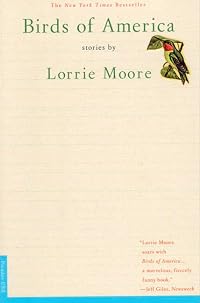
Lorrie Moore is a unique and wonderful writer. I was absolutely blown away by the first of her short stories that I read about 10 years ago, "How to Talk to Your Mother." It's so different from anything else written that I always include it in my Intro to Fiction courses. I also enjoyed her collection [Birds of America], so I was eager to read [Like Life]. It didn't disappoint.
The eight stories in the collection feature characters that are at the same time ordinary and distinctive. Many of them are lonely and/or somewhat desperate to find romance. One of Moore's finest techniques is the way she uses small details in the setting or secondary events to create a mood that suits her main character's emotional state. In "Two Boys," for show more example, Mary has moved to a new and very dull town following the breakup of a bad romance. We know by this description that that the move was probably not her best choice:
"She lived in a small room above a meat company--Alexander Hamilton Pork--and in front, daily, they wheeled in the pale, fatty carcasses, hooked and naked, uncut, unhooved. She tried not to let the refrigerated smell follow her in the door, up the stairs, the vague shame and hamburger death of it, though sometimes it did. Every day she tried not to step in the blood that ran off the sidewalk and collected in the gutter, dark and alive. At five-thirty she approached her own building in a halting tiptoe and held her breath. The trucks out front pulled away to go home, and the Hamilton Pork butchers, in their red-stained doctor's coats and badges printed from ten-dollar bills, hosed down the sidewalk, leaving the block glistening like a canal. The squeegee kid at the corner would smile at Mary and then, low on water, rush to dip into the puddles and smear their squeegees, watery pink, across the windshields of cars stopped for the light."
The little details say it all. Mary has been sending post cards to friends bragging that, for the first time in her life, she is dating two men at the same time--but neither one is the man of her dreams. The description above parallels the reader's perception that something isn't quite right in her life, no matter how hard she smiles, no matter how fast she tried to run upstairs, no matter how much water pours over the sidewalk. It's an image that recurs throughout the story.
Small but odd events take on significant meaning in the lives of Moore's characters. "Joy" revolves around a woman taking her cat to the vet for a flea bath; in "You're Ugly, Too," Zoe attends a Halloween party dressed as a bonehead and is set up with a man dressed as a naked woman. Mary ("Two Boys"), sitting in a park, is spat upon by a llittle girl dressed way beyond her years.
This may all sound rather depressing, but the amazing thing is that it isn't. Moore writes with humor and with affection for her characters, most of whom just pick up and keep on trying. They are people that I feel that I know well.
Moore's first novel, [A Gate to the Stairs], has gotten mixed reviews, but it was a finalist for the 2010 Orange Prize. It's sitting on my TBR shelf, and I look forward to reading it soon. She is an extraordinary short story writer; hopefully I will be able to say that she is an extraordinary novelist as well. show less
The eight stories in the collection feature characters that are at the same time ordinary and distinctive. Many of them are lonely and/or somewhat desperate to find romance. One of Moore's finest techniques is the way she uses small details in the setting or secondary events to create a mood that suits her main character's emotional state. In "Two Boys," for show more example, Mary has moved to a new and very dull town following the breakup of a bad romance. We know by this description that that the move was probably not her best choice:
"She lived in a small room above a meat company--Alexander Hamilton Pork--and in front, daily, they wheeled in the pale, fatty carcasses, hooked and naked, uncut, unhooved. She tried not to let the refrigerated smell follow her in the door, up the stairs, the vague shame and hamburger death of it, though sometimes it did. Every day she tried not to step in the blood that ran off the sidewalk and collected in the gutter, dark and alive. At five-thirty she approached her own building in a halting tiptoe and held her breath. The trucks out front pulled away to go home, and the Hamilton Pork butchers, in their red-stained doctor's coats and badges printed from ten-dollar bills, hosed down the sidewalk, leaving the block glistening like a canal. The squeegee kid at the corner would smile at Mary and then, low on water, rush to dip into the puddles and smear their squeegees, watery pink, across the windshields of cars stopped for the light."
The little details say it all. Mary has been sending post cards to friends bragging that, for the first time in her life, she is dating two men at the same time--but neither one is the man of her dreams. The description above parallels the reader's perception that something isn't quite right in her life, no matter how hard she smiles, no matter how fast she tried to run upstairs, no matter how much water pours over the sidewalk. It's an image that recurs throughout the story.
Small but odd events take on significant meaning in the lives of Moore's characters. "Joy" revolves around a woman taking her cat to the vet for a flea bath; in "You're Ugly, Too," Zoe attends a Halloween party dressed as a bonehead and is set up with a man dressed as a naked woman. Mary ("Two Boys"), sitting in a park, is spat upon by a llittle girl dressed way beyond her years.
This may all sound rather depressing, but the amazing thing is that it isn't. Moore writes with humor and with affection for her characters, most of whom just pick up and keep on trying. They are people that I feel that I know well.
Moore's first novel, [A Gate to the Stairs], has gotten mixed reviews, but it was a finalist for the 2010 Orange Prize. It's sitting on my TBR shelf, and I look forward to reading it soon. She is an extraordinary short story writer; hopefully I will be able to say that she is an extraordinary novelist as well. show less
Such a good mix of humour and pathos, the book is a good example of the author's compulsive penchant for wisecracks which fit awkwardly into the narrative, just like the absurd way her characters fit into their worlds.
Further reading: this Guardian review of Lorrie Moore's Collected Stories.
Further reading: this Guardian review of Lorrie Moore's Collected Stories.
This is a beautiful collection of short stories. Moore has a way of describing characters that can break my heart, and she captures the melancholy at the center of everyday lives. Many of her descriptions have the shock and immediacy, the rightness, of good poetry, only in prose form. My favorite stories are "Two Boys," "You're Ugly, Too," and "Like Life." Recommended.
As is often the case with a book of short stories, some of these stories I liked very much, and I found some to be rather less appealing. They were, however, all interesting reading. This was my first Moore book and I found her style to be always very entertaining, if not engaging at a deeper level all the time. Her characters are often quite wacky, especially the men. The last story was rather strange: a bizarre mix of almost-realism and futuristic fantasy. I've bought three second-hand Lorrie Moore books, and I'm working my way through them. The next one I read will be a novel, so it will be interesting to compare with these short stories to see if I find the longer form to be more deeply satisfying.
Members
- Recently Added By
Lists

1001 Books You Must Read Before You Die
1,448 works; 1,132 members

1,001 BYMRBYD Concensus
723 works; 27 members

Books recommended by Calgary Public Library staff
1,588 works; 4 members
Author Information

37+ Works 13,080 Members
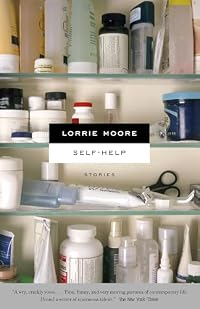
Lorrie Moore was born Marie Lorena Moore on January 13, 1957 in Glen Falls, New York. She was nicknamed Lorrie by her parents. She attended St. Lawrence University and won Seventeen magazine's fiction contest. After graduation, she moved to Manhattan and worked as a paralegal for two years. In 1980 she enrolled in Cornell University's M.F.A. show more program. After graduation from Cornell she was encouraged by a teacher to contact an agent who sold her collection, Self-Help, which was composed of stories from her master's thesis. Lorrie Moore writes about failing relationships and terminal illness. She is the Delmore Schwartz Professor in the Humanities at the University of Wisconsin-Madison where she teaches creative writing. She has also taught at Cornell University. She has written a children's book entitled The Forgotten Helper. She won the 1998 O. Henry Award for her short story People Like That They Are the Only People Here. In 1999 she was given the Irish Times International Fiction Prize for Birds of America. She was elected to the American Academy of Arts and Letters in 2006 and in 2010 her novel A Gate at the stairs was a finalist for the Pen/Faulkner Award for fiction. (Bowker Author Biography) show less
Some Editions
Awards and Honors
Series
Belongs to Publisher Series
Common Knowledge
- Canonical title*
- Net echt
- Original title
- Like life
- Original publication date
- 1990
- Epigraph
- "It seemed very sad to see you going off in your new shoes alone." - Zelda Fitzgerald, in a letter to her husband, February 1932
- Dedication
- For making the slow going less slow, the author wishes to thank the Corporation of Yaddo, the University of Wisconsin Graduate School, the Wisconsin Arts Board, the National Endowment for the Arts, and the Rockefeller Foundat... (show all)ion.
- First words
- For the first time in her life, Mary was seeing two boys at once. It involved extra laundry, an answering machine, and dark solo trips in taxicabs, which, in Cleveland, had to be summoned by phone, but she recommended it in ... (show all)postcards to friends.
- Last words
- (Click to show. Warning: May contain spoilers.)There was only this world, this looted, ventriloquized earth. If one were to look for a place to die, mightn't it be here?--like some old lesson of knowing your kind and returning. She was afraid, and the afraid, she realized, sought opportunities for bravery in love. She tucked the flower in her blouse. Life or death. Something or nothing. _You want something or nothing?_ She stepped toward him with a heart she'd someday tear the terror from. Here. But not now.
*Some information comes from Common Knowledge in other languages. Click "Edit" for more information.
Classifications
Statistics
- Members
- 991
- Popularity
- 26,262
- Reviews
- 18
- Rating
- (3.97)
- Languages
- 6 — Danish, Dutch, English, French, Portuguese, Spanish
- Media
- Paper, Audiobook, Ebook
- ISBNs
- 20
- ASINs
- 4