Children: the challenge
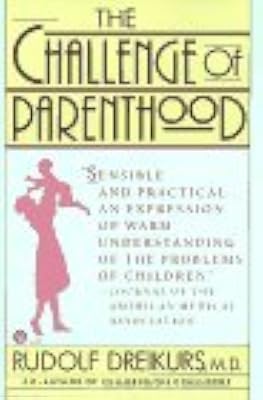
by Rudolf Dreikurs
On This Page
Description
Describes a step-by-step program designed to help parents deal with some of the common problems that occur throughout childhood, from toddler through preteen years.Tags
Recommendations














Member Reviews
The first half of this book made tons of sense. I really feel it has valuable things to say about how we should react impartially to a child's behavior, and try to understand why a child might react the way that he or she does, rather than getting involved in a power struggle. On the other hand, I felt that he was sometimes a little off-base in the end chapters. The book was written, if you are familiar with Meyers-Briggs typology at all, from a very 'thinking' rather than 'feeling' perspective. Perhaps I just don't understand my own unconscious well enough, but I feel that ignoring or grossly downplaying a child's hurt or fear, far from making him self-reliant, will only cause him to see YOU as uncaring. I know I would feel that show more someone was uncaring who allowed my sibling to give me a bloody nose, or my father to hit me, telling me that it was not their place to step in. Sure, you might become more 'self-reliant' in the face of that treatment, being left to fend for yourself, but at what emotional cost? Isn't there a middle road, showing concern for a child's well being while fostering independence? An interesting perspective, but I could never bring myself to follow the whole program, nor would I really want to. show less
I believe this books needs to be read with a good dose of time-capsule-awaredness. While there is certainly timeless knowledge within the book, there is also a sense of the good old days for what you can allow children to do safely.
Yes, you should learn to treat children as individuals, apart from siblings and any pre-conceived notions of age that you might have. But the world is a much scarier place than it was in 1964. The use of natural consequences when it comes to strangers is too great of a risk for me to allow with my children.
That said, I do believe that other natural consequences can do wonders for a child. Teaching a child that the world has order, and that learning the order can lead to happiness and that ignorance of the show more order can lead to dispair is something I think every person needs to learn. Unfortunately, I think that too many people today haven't yet learned this lesson, be their age 30 or 5. show less
Yes, you should learn to treat children as individuals, apart from siblings and any pre-conceived notions of age that you might have. But the world is a much scarier place than it was in 1964. The use of natural consequences when it comes to strangers is too great of a risk for me to allow with my children.
That said, I do believe that other natural consequences can do wonders for a child. Teaching a child that the world has order, and that learning the order can lead to happiness and that ignorance of the show more order can lead to dispair is something I think every person needs to learn. Unfortunately, I think that too many people today haven't yet learned this lesson, be their age 30 or 5. show less
Although this is an older parenting manual, the advice feels unique and fresh (though the language is somewhat dated in the 1964 edition I read. Lots of "Mothers" and "homemakers"). The crux of the book is understanding the evolving constellation of family relationships and encouraging each child with acknowledgment of their capabilities and unique qualities. Feels sound and sensible and should help parents avoid playing one child off the other or being played by the child. (AG, 12/23/09)
Many are the times I turned to this book while our children were young. It's been around for a while but still has value for those who want to raise children without shaming, blaming, etc. It fits the punishment to the crime, so to speak. It helped me put the various behaviors of our children in perspective so that the real problems being demonstrated could be addressed.
Children the Challenge offers excellent advice and proven strategies for parents who want to build love and trust in their families, helping them to raise happier, healthier, and better behaved children.
I read this book when I was 8 years old and my sister was born. I remember enjoying all the examples at the end. I haven't read it since then but I plan to read it again.
Children the Challenge offers excellent advice and proven strategies for parents who want to build love and trust in their families, helping them to raise happier, healthier, and better behaved children.
The warm and reassuring reference helps you to understand your children's actions better, giving you the guidance you need to discipline lovingly and effectively.
* Winning your children's cooperation and consideration
* Putting a step to senseless accidents and carelessness
* Dealing with jealousy and fighting
* "Downgrading" bad habits
* Overcoming your own fears
The warm and reassuring reference helps you to understand your children's actions better, giving you the guidance you need to discipline lovingly and effectively.
* Winning your children's cooperation and consideration
* Putting a step to senseless accidents and carelessness
* Dealing with jealousy and fighting
* "Downgrading" bad habits
* Overcoming your own fears
Members
- Recently Added By
Author Information

53 Works 905 Members
Common Knowledge
- Canonical title
- Children: the challenge
Classifications
- Genres
- Nonfiction, General Nonfiction
- DDC/MDS
- 649.1 — Applied science & technology Home economics & family management Child rearing; home care of people with illnesses and disabilities by family and friends Parenting
- LCC
- HQ769 .D653 — Social sciences The family. Marriage, Women and Sexuality The Family. Marriage. Women The family. Marriage. Home Children. Child development
- BISAC
Statistics
- Members
- 450
- Popularity
- 67,914
- Reviews
- 8
- Rating
- (4.37)
- Languages
- 6 — Dutch, English, French, German, Lithuanian, Russian
- Media
- Paper
- ISBNs
- 23
- ASINs
- 7