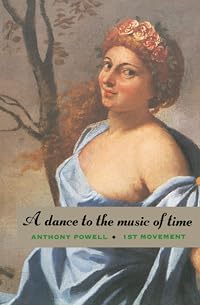
A Dance to the Music of Time: First Movement, Spring
by Anthony Powell
A Dance to the Music of Time (Collections and Selections — 01-03)
There is 1 current discussion about this work.
On This Page
Description
Movement 2. The rumble of distant events in Germany and Spain presages the storm of WWII. In England, even as the whirl of marriages and adulteries, fashions and frivolities, personal triumphs and failures gathers speed, men and women find themselves on the brink of fateful choices. Movement 3. Again we meet Widmerpool, doggedly rising in rank; Jenkins, shifted from one dismal army post to another; Stringham, heroically emerging from alcoholism; Templer, still on his eternal sexual quest. show more Meet Pamela Flitton, one of the most beautiful and dangerous women in modern fiction. Movement 4. England has won the war, but now the losses, physical and moral, must be counted. Pamela Widmerpool sets a snare for Trapnel, while her husband suffers private agony and public humiliation. It is a world of ambition, intrigue and dissolution set against a background of politics, business, high society and the counterculture in England and Europe. show lessTags
Recommendations































Member Recommendations

Invitation To the Dance: A Handbook to Anthony Powell's A Dance to the Music of Time by Hilary Spurling
davidcla Guide to characters, literary and place references, allusions to painting, chronology of narrated events. Entertaining to dip into at random, sometimes helpful when reading chronologically but one must keep an eye out for spoilers.

Member Reviews
A Dance to the Music of Time follows a group of British men as they move from school to university to adulthood. The story begins in the 1920s when the narrator, Nick Jenkins, is at boarding school with his friends Stringham and Templer. Their school days are coming to an end; will they go up to university or go directly to work? As they contemplate their next phase of life, they also spend countless hours mocking other students -- especially a boy named Widmerpool -- and playing pranks on their house master.
The "first movement" of A Dance to the Music of Time consists of three novellas spanning just over a decade: A Question of Upbringing, A Buyer's Market, and The Acceptance World. Jenkins and his friends come of age, finding their show more adult footing and struggling with love and loss. Several other characters move in and out of their lives, like partners in a dance. A woman appears initially as one man's girlfriend, later as the wife of a second man, and still later as a third man's lover. Other characters have recurring roles in the dance, taking the floor every so often and then fading into the background. As Jenkins muses in the second book:
I certainly did not expect that scattered elements of Mrs. Andriadis's party would recur so comparatively soon in my life ... their commitment was sufficient to draw attention once again to that extraordinary process that causes certain figures to appear and reappear in the performance of one or another sequence of what I have already compared with a ritual dance.
The dance metaphor works very well in this book. The sequence and pacing reminded me of a ballroom filled with people gracefully stepping through a minuet. And while it is obvious that time is passing, precise measures of time are rarely mentioned, giving the book a languid, leisurely feel. Yet every so often Powell sums things up with powerful prose, like this paragraph towards the end of A Question of Upbringing:
I knew now that this parting was one of those final things that happen, recurrently, as time passes: until at last they may be recognised fairly easily as the close of a period. This was the last I should see of Stringham for a long time. The path had suddenly forked. With regret, I accepted the inevitability of circumstance. Human relationships flourish and decay, quickly and silently, so that those concerned scarcely know how brittle, or how inflexible, the ties that bind them have become. ... A new epoch was opening: in a sense this night was the final remnant of life at school.
A Dance to the Music of Time is very British, and very evocative of the period between the wars. Every time I sat down to read, I was instantly transported into that world, while simultaneously reflecting on the "dance" representing my life. While this "first movement" was more than 700 pages long, I never tired of it and was sad to say good-bye to characters who have inhabited my imagination for over a week. I will most definitely be reading the rest of this series. show less
The "first movement" of A Dance to the Music of Time consists of three novellas spanning just over a decade: A Question of Upbringing, A Buyer's Market, and The Acceptance World. Jenkins and his friends come of age, finding their show more adult footing and struggling with love and loss. Several other characters move in and out of their lives, like partners in a dance. A woman appears initially as one man's girlfriend, later as the wife of a second man, and still later as a third man's lover. Other characters have recurring roles in the dance, taking the floor every so often and then fading into the background. As Jenkins muses in the second book:
I certainly did not expect that scattered elements of Mrs. Andriadis's party would recur so comparatively soon in my life ... their commitment was sufficient to draw attention once again to that extraordinary process that causes certain figures to appear and reappear in the performance of one or another sequence of what I have already compared with a ritual dance.
The dance metaphor works very well in this book. The sequence and pacing reminded me of a ballroom filled with people gracefully stepping through a minuet. And while it is obvious that time is passing, precise measures of time are rarely mentioned, giving the book a languid, leisurely feel. Yet every so often Powell sums things up with powerful prose, like this paragraph towards the end of A Question of Upbringing:
I knew now that this parting was one of those final things that happen, recurrently, as time passes: until at last they may be recognised fairly easily as the close of a period. This was the last I should see of Stringham for a long time. The path had suddenly forked. With regret, I accepted the inevitability of circumstance. Human relationships flourish and decay, quickly and silently, so that those concerned scarcely know how brittle, or how inflexible, the ties that bind them have become. ... A new epoch was opening: in a sense this night was the final remnant of life at school.
A Dance to the Music of Time is very British, and very evocative of the period between the wars. Every time I sat down to read, I was instantly transported into that world, while simultaneously reflecting on the "dance" representing my life. While this "first movement" was more than 700 pages long, I never tired of it and was sad to say good-bye to characters who have inhabited my imagination for over a week. I will most definitely be reading the rest of this series. show less
(7) I have been meaning to read this series for quite some time. The "first movement" as it were is a series of 3 short novels ( ~ 200 pages each.) A total of 4 movements of similar lengths exist - it appears the whole series is a musing on time as depicted in a 17th century painting of the same title introduced at the start of the book. This work has much in common with 'The Cazalets' which I just finished - a 4 or 5 book series about the time period spanning WW1 and WW2 in England as well, centered around one family. This seems to be centered around one narrator, Nick Jenkins, as he makes his way from school boy in the first novel, young adult in the second, to finally - in love as an adult, in the third. As opposed to the more show more feminine, social history, quotidian focus of the Cazalets, this series optics are a bit more high-faluting - this is an upper class man's world, focused on acquisition or reputation - how to think, and who to be, and be with in the world.
The writing is dense and although the reviews comment on how funny the novels are, I am not quite sure I agree. Certainly, there are some scenes that point out the humor in human foibles through situational irony but. . . funny is not the word I would use to describe the novels. I enjoyed them, but occasionally had to re-read passages again and again as Powell does a lot of analysis of his characters demeanors, actions, words. There is a lot of metaphor and definitely a lot of reference to literature, art, politics of the time that made things a wee bit tedious. There are also a great deal of outlandish coincidences throughout the novels - people from the past keep turning up in unlikely places with unsuspected connections between them. While this makes interesting reading, it strained credulity and made it hard to suspend disbelief in a book that seems to want us to take it seriously. I dunno, it seemed sometimes the tone of the novels was uneven.
Perhaps I am reading them wrong and I am to take things much more satirically which is why the humor escapes me? Anyway, I am sounding a bit too negative as overall, I am intrigued and have purchased the rest of the 'movements' so I will commit. I look forward to finding out what happens to Templar, Stringham, and certainly Widmerpool, though not without trepidation as each omnibus is quite the wrist-bender. Fans of Dickens, Eliot, The 'Forsyte saga,' and I think 'The Cazalet chronicles' will enjoy these novels. show less
The writing is dense and although the reviews comment on how funny the novels are, I am not quite sure I agree. Certainly, there are some scenes that point out the humor in human foibles through situational irony but. . . funny is not the word I would use to describe the novels. I enjoyed them, but occasionally had to re-read passages again and again as Powell does a lot of analysis of his characters demeanors, actions, words. There is a lot of metaphor and definitely a lot of reference to literature, art, politics of the time that made things a wee bit tedious. There are also a great deal of outlandish coincidences throughout the novels - people from the past keep turning up in unlikely places with unsuspected connections between them. While this makes interesting reading, it strained credulity and made it hard to suspend disbelief in a book that seems to want us to take it seriously. I dunno, it seemed sometimes the tone of the novels was uneven.
Perhaps I am reading them wrong and I am to take things much more satirically which is why the humor escapes me? Anyway, I am sounding a bit too negative as overall, I am intrigued and have purchased the rest of the 'movements' so I will commit. I look forward to finding out what happens to Templar, Stringham, and certainly Widmerpool, though not without trepidation as each omnibus is quite the wrist-bender. Fans of Dickens, Eliot, The 'Forsyte saga,' and I think 'The Cazalet chronicles' will enjoy these novels. show less
A Question of Upbringing 4 stars
Sillery showed interest in this remark, in spite of his evident dissatisfaction at the manner in which Miss Weedon treated him. He seemed unable to decide upon her precise status in the household: which was, indeed, one not easy to assess. It was equally hard to guess what she knew, or thought, of Sillery; whether she appreciated the extent of his experience in such situations as that which had arisen in regard to Stringham. Sitting opposite him, she seemed to have become firmer and more masculine; while Sillery himself, more than ever, took the shape of a wizard or shaman, equipped to resist either man or woman from a bisexual vantage.
I am starting a year-long re-read of A Dance to the Music of Time, show more having originally read them in the late 1990s, shortly after the BBC series aired. A Question of Upbringing is one of the books I remember best, as it covers the narrator's time at public school (unnamed, but obviously Eton) and University. Later in the series the books merged together in my memory, and I couldn't tell you which events happens in each book.
The first time I read this book, I don't think I noticed the resemblance to Brideshead Revisited, probably because events are spread out over more than one book. but Stringham's story is very similar to Sebastian Flyte's, and characters talk about his mother's estate much in the same ways as people talked about Brideshead. There is a similar car crash while the characters are at university, and although Jean is Templer's sister and not Stringham's, Nicholas's relationship with her over the years reminds me of Charles Ryder's with Julia Flyte.
It's a good start to the series, telling an interesting story while it introduces many of the characters who will drift in and out of the narrator's life over the years. I just wish Nicholas Jenkins wasn't such a colourless presence in the books. The way he tells us about the lives of his friends and acquaintances but leaves us guessing about important events in his own life becomes ever more irritating over the course of the series.
A Buyer's Market 4 stars
However, Gypsy Jones' comment, when thought of later, brought home the impossibility of explaining Widmerpool's personality at all briefly, even to an sympathetic audience. His case was not, of course, unique. He was merely one single instance, among many. of the fact that certain acquaintances remain firmly fixed within this or that person's particular orbit; a law which seems to lead inexorably to the conclusion that the often repeated saying that people can 'choose their friends' is true only in a most strictly limited degree.
This book is set around 1928, by which time Nicholas Jenkins is aged about 24 and has a job in publishing. It revolves around a series of social events, starting with the day he attends a dinner party at the Walpole-Wilsons, whose niece Barbara he has been in love with for the past year, and goes on to a ball. While walking homewards with Widmerpool, he meets an old friend of his parents, the artist Mr. Deacon and his young friend Gypsy Jones, they then come across Stringham, and all end up at a party held by Mrs Andriadis, the former mistress of a Balkan royal and current lover of Stringham.
During the course of the book, Nicholas keeps meeting the same people at house parties, birthday parties and funerals as the dance of life continues. I have never liked Nicholas, as he is too passive and for all his interest in the interactions of his circle of friends and acquaintances and what drives them, he is a bystander rather than a participant in their lives. I know he doesn't care for Widmerpool, but he has known him for a long time so it is really bad that he doesn't tell him that Gypsy was already 'in trouble' before Widmerpool met her, and just lets him go ahead with paying for her abortion.
The Acceptance World 4 stars
Umfraville returned to the room. He watched the completion of the game in silence. It was won by Barnby. Then he spoke. 'I have a proposition to make,' he said. 'I got on to Milly Andriadis just now on the telephone and told her we were all coming round to see her.'My first thought was that I must not make a habit of arriving with a gang of friends at Mrs. Andriadis's house as an uninvited guest; even at intervals of three or four years. A moment later I saw the absurdity of such diffidence, because, apart from any other consideration, she would not have the faintest remembrance of ever having met me before.
The story starts in 1931, so the depression has begun, but Nick isn't really affected, although there are casual mentions of people he knows having lost money due to 'the slump'. The dance metaphor is not only relevant to the way people come in and out of each other's life over the years, but also to the way the story flits from social event to social event, with hardly a mention of Nick's work or home life. The one time he does go to a business meeting (at the Ritz of all places) he ditches the meeting in favour of going to dinner with his old school friend Templer. Nothing ever seems to happen to Nick, and we usually find out about events in the other characters' lives at second hand, when Nick catches up with the gossip at yet another social gathering.
The way Nick portrays things, his circle flit about in their upper middle class world with hardly any interaction with the lower classes, so it comes as a surprise when Dick Umfraville chats to Mrs Andriadis's maid Ethel as if she is a real person. I have also noticed that Nick's descriptions of the people around him can be quite extreme and unrealistic, describing Mona as being 'like some savage creature, anxious to keep up appearances before members of a more highly civilised society' which doesn't really sync with anything she actually does, but provides a big contrast to Nick's own colourless personality. show less
Sillery showed interest in this remark, in spite of his evident dissatisfaction at the manner in which Miss Weedon treated him. He seemed unable to decide upon her precise status in the household: which was, indeed, one not easy to assess. It was equally hard to guess what she knew, or thought, of Sillery; whether she appreciated the extent of his experience in such situations as that which had arisen in regard to Stringham. Sitting opposite him, she seemed to have become firmer and more masculine; while Sillery himself, more than ever, took the shape of a wizard or shaman, equipped to resist either man or woman from a bisexual vantage.
I am starting a year-long re-read of A Dance to the Music of Time, show more having originally read them in the late 1990s, shortly after the BBC series aired. A Question of Upbringing is one of the books I remember best, as it covers the narrator's time at public school (unnamed, but obviously Eton) and University. Later in the series the books merged together in my memory, and I couldn't tell you which events happens in each book.
The first time I read this book, I don't think I noticed the resemblance to Brideshead Revisited, probably because events are spread out over more than one book. but Stringham's story is very similar to Sebastian Flyte's, and characters talk about his mother's estate much in the same ways as people talked about Brideshead. There is a similar car crash while the characters are at university, and although Jean is Templer's sister and not Stringham's, Nicholas's relationship with her over the years reminds me of Charles Ryder's with Julia Flyte.
It's a good start to the series, telling an interesting story while it introduces many of the characters who will drift in and out of the narrator's life over the years. I just wish Nicholas Jenkins wasn't such a colourless presence in the books. The way he tells us about the lives of his friends and acquaintances but leaves us guessing about important events in his own life becomes ever more irritating over the course of the series.
A Buyer's Market 4 stars
However, Gypsy Jones' comment, when thought of later, brought home the impossibility of explaining Widmerpool's personality at all briefly, even to an sympathetic audience. His case was not, of course, unique. He was merely one single instance, among many. of the fact that certain acquaintances remain firmly fixed within this or that person's particular orbit; a law which seems to lead inexorably to the conclusion that the often repeated saying that people can 'choose their friends' is true only in a most strictly limited degree.
This book is set around 1928, by which time Nicholas Jenkins is aged about 24 and has a job in publishing. It revolves around a series of social events, starting with the day he attends a dinner party at the Walpole-Wilsons, whose niece Barbara he has been in love with for the past year, and goes on to a ball. While walking homewards with Widmerpool, he meets an old friend of his parents, the artist Mr. Deacon and his young friend Gypsy Jones, they then come across Stringham, and all end up at a party held by Mrs Andriadis, the former mistress of a Balkan royal and current lover of Stringham.
During the course of the book, Nicholas keeps meeting the same people at house parties, birthday parties and funerals as the dance of life continues. I have never liked Nicholas, as he is too passive and for all his interest in the interactions of his circle of friends and acquaintances and what drives them, he is a bystander rather than a participant in their lives. I know he doesn't care for Widmerpool, but he has known him for a long time so it is really bad that he doesn't tell him that Gypsy was already 'in trouble' before Widmerpool met her, and just lets him go ahead with paying for her abortion.
The Acceptance World 4 stars
Umfraville returned to the room. He watched the completion of the game in silence. It was won by Barnby. Then he spoke. 'I have a proposition to make,' he said. 'I got on to Milly Andriadis just now on the telephone and told her we were all coming round to see her.'My first thought was that I must not make a habit of arriving with a gang of friends at Mrs. Andriadis's house as an uninvited guest; even at intervals of three or four years. A moment later I saw the absurdity of such diffidence, because, apart from any other consideration, she would not have the faintest remembrance of ever having met me before.
The story starts in 1931, so the depression has begun, but Nick isn't really affected, although there are casual mentions of people he knows having lost money due to 'the slump'. The dance metaphor is not only relevant to the way people come in and out of each other's life over the years, but also to the way the story flits from social event to social event, with hardly a mention of Nick's work or home life. The one time he does go to a business meeting (at the Ritz of all places) he ditches the meeting in favour of going to dinner with his old school friend Templer. Nothing ever seems to happen to Nick, and we usually find out about events in the other characters' lives at second hand, when Nick catches up with the gossip at yet another social gathering.
The way Nick portrays things, his circle flit about in their upper middle class world with hardly any interaction with the lower classes, so it comes as a surprise when Dick Umfraville chats to Mrs Andriadis's maid Ethel as if she is a real person. I have also noticed that Nick's descriptions of the people around him can be quite extreme and unrealistic, describing Mona as being 'like some savage creature, anxious to keep up appearances before members of a more highly civilised society' which doesn't really sync with anything she actually does, but provides a big contrast to Nick's own colourless personality. show less
The next book on my 1951 reading list was [A question of Upbringing]; this is the first part of Anthony Powell's 12 volume series A Dance to the Music of Time. It was much better value to buy the first three volumes in one book rather than just the first volume and as they were there in front of me I read all three volumes: I am just grateful that I did not buy all 12. Powells immense saga follows the lives of a number of individuals who meet as students at their Public School in the early 1920's. We follow the story in the first person through the eyes and many thoughts of Nick Jenkins, who like most of his school friends comes from a well-to-do family and these three books take us up to 1933. Anthony Powell was educated at Eton and show more Balliol college Oxford and his series of novels has the feel of an autobiography, certainly the milieu of Public school and debutante balls and then sliding into well paid positions of employment either in the city or through contacts made at University has a ring of authenticity. The social milieu could be described as upper middle class with plenty of Lords and Ladies hovering around the upper echelons.
Readers seem to have a love-hate relationship with this series of books and I can understand just why that is. Powell writes, as one might not be too surprised from his background, with a plum in his mouth and sometimes that plum becomes so large that the reader losses much of what is said. His long sentences with their many sub-clauses can become indistinct at best and completely obfuscate any meaning at worst. I lost count of the number of times I got to the end of one of these epics with only a vague impression of what I had just read. This style of writing is particularly evident in the second volume, and although it does occurs in volume three; The Acceptance World this book is a little more focused. One might give credit to Powell for imitating the confused thoughts of a 20 year old just making his way in the world, but I think this would be generous. Much Of volume 2 is focused on two events a debutants ball and a rather more bohemian party that some stragglers get to afterwards. Our protagonist Nick while spending much time describing the details of the guests dress and manners, their opulent surroundings and some of the events he witnesses, seems at a loss to understand their behaviour and even incidents in which he becomes involved remain a bit of a mystery.
Powell looks at everything through his protagonist Nick from an establishment point of view. This is a novel that reinforces the rigid class system that existed for wealthy people in the 1920's-30's and one could argue that Powell has his finger on the pulse of this era, however I sense an admiration of the social milieu in which he places his characters, it is though he is saying how wonderful it all was. One of the characters Widmerpool (we hardly ever learn their Christian names) who is less wealthy than most and realises he must work twice as hard as his contemporaries to get on says "brains and hard work are of very little avail unless you know the right people". This proves to be over optimistic because it is not the connections you might be able to forge, but the connections that your father or grandfather were able to make. It was all down to the position of your family in society. Widmerpool like other characters who were not from the right families are figures of fun in Powells hands, all the jokes are on them because they do not know how to behave correctly. It is all very well to have an accurate description of the young wealthy class in the period in which they lived, but not perhaps at the expense of all else. Reading the novels made me feel that they were outdated, but then thinking about the public school boys that currently run the British government in 2021; perhaps nothing much has changed.
Powells characterisations of his female characters are depressingly familiar; judged on their attractiveness to the male gaze and their propensity to conform to their partners wishes. Independently minded women are seen as either a threat or something to be managed and forever remain a mystery to their male counterparts. Nick himself who is very much a cypher in that he is a witness to events that happen around him, rather than instigating any of them, becomes in the third volume active in pursuing a love affair, but he is like a blind man stumbling towards an urge that needs satisfying.
There is much in these novels that were not to my taste, but they can have a dream like quality enhanced by Powells writing style. Characters did not elicit my care or sympathy for their predicaments, but I did enjoy the slow pace of the events and the insight of a world that I know existed and perhaps still exists. I will not be tempted to read any more of the books in this series; three were enough and I rate them as follows:
A Question of Upbringing - 3 stars
A Buyers Market - 2.5 stars
The Acceptance World - 4 stars. show less
Readers seem to have a love-hate relationship with this series of books and I can understand just why that is. Powell writes, as one might not be too surprised from his background, with a plum in his mouth and sometimes that plum becomes so large that the reader losses much of what is said. His long sentences with their many sub-clauses can become indistinct at best and completely obfuscate any meaning at worst. I lost count of the number of times I got to the end of one of these epics with only a vague impression of what I had just read. This style of writing is particularly evident in the second volume, and although it does occurs in volume three; The Acceptance World this book is a little more focused. One might give credit to Powell for imitating the confused thoughts of a 20 year old just making his way in the world, but I think this would be generous. Much Of volume 2 is focused on two events a debutants ball and a rather more bohemian party that some stragglers get to afterwards. Our protagonist Nick while spending much time describing the details of the guests dress and manners, their opulent surroundings and some of the events he witnesses, seems at a loss to understand their behaviour and even incidents in which he becomes involved remain a bit of a mystery.
Powell looks at everything through his protagonist Nick from an establishment point of view. This is a novel that reinforces the rigid class system that existed for wealthy people in the 1920's-30's and one could argue that Powell has his finger on the pulse of this era, however I sense an admiration of the social milieu in which he places his characters, it is though he is saying how wonderful it all was. One of the characters Widmerpool (we hardly ever learn their Christian names) who is less wealthy than most and realises he must work twice as hard as his contemporaries to get on says "brains and hard work are of very little avail unless you know the right people". This proves to be over optimistic because it is not the connections you might be able to forge, but the connections that your father or grandfather were able to make. It was all down to the position of your family in society. Widmerpool like other characters who were not from the right families are figures of fun in Powells hands, all the jokes are on them because they do not know how to behave correctly. It is all very well to have an accurate description of the young wealthy class in the period in which they lived, but not perhaps at the expense of all else. Reading the novels made me feel that they were outdated, but then thinking about the public school boys that currently run the British government in 2021; perhaps nothing much has changed.
Powells characterisations of his female characters are depressingly familiar; judged on their attractiveness to the male gaze and their propensity to conform to their partners wishes. Independently minded women are seen as either a threat or something to be managed and forever remain a mystery to their male counterparts. Nick himself who is very much a cypher in that he is a witness to events that happen around him, rather than instigating any of them, becomes in the third volume active in pursuing a love affair, but he is like a blind man stumbling towards an urge that needs satisfying.
There is much in these novels that were not to my taste, but they can have a dream like quality enhanced by Powells writing style. Characters did not elicit my care or sympathy for their predicaments, but I did enjoy the slow pace of the events and the insight of a world that I know existed and perhaps still exists. I will not be tempted to read any more of the books in this series; three were enough and I rate them as follows:
A Question of Upbringing - 3 stars
A Buyers Market - 2.5 stars
The Acceptance World - 4 stars. show less
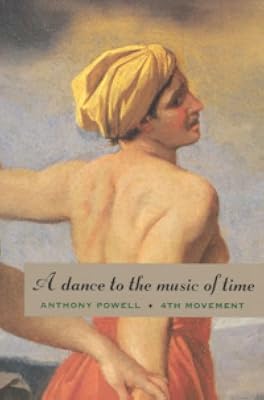
Anthony Powell published twelve volumes of a wonderful novel from 1951 to 1975. He divided this continuing series into four musical movements depicted in a Nicolas Poussin 1639-40 painting. The painting and the novel are entitled, A Dance to the Music of Time. The first movement includes three volumes: A Question of Upbringing, A Buyer's Market, and The Acceptance World. These volumes introduce and describe four male characters as they progress through British schools and university, enter the professional world of work, and accept a loss of illusions as they interact with others in the real world.
The first three parts of the story take place in the post World War I era of the 1920s and early 1930s. The characters are associated with show more British socioeconomic levels that include very wealthy (Templeton), wealthy (Stringham), upper middle class (Jenkins) and middle class (Widmerpool). After university, the characters go their separate ways determined by their economic classes but end up meeting in London while pursuing different individual goals.
Nicolas Jenkins, the narrator of the novel, gets a job at a firm that publishes "art books" and uses free time offered by his relatively unstructured job to write novels. Like Robert Musil's character in A Man Without Qualities, Nick is a keen observer who seems to be continually on the edge of the social dance, jumping in on occasion but content to ruminate about the motives and behaviors of others. As he focuses on his three school acquaintances, Nick's commentary becomes increasingly reliable as he compares current incidents to reinterpret collective experiences of the past. He learns to abandon simplistic rules for understanding of the choices of his friends and others. He also learns his station in life and the limits of his ability as observer to discover immutable standards of acceptable social actions. Life is just too complex and changeable to maintain superficial and immature interpretations of the dance of life.
Each volume of the first movement is self-contained as Powell gives readers descriptive reminders of characters and events that preceded the current action. The writing style is simple and direct and the pace is slow and deliberate. Powell presents many allusions to art, philosophy, and history like James Joyce in Ulysses with much less tangential writing. Using the Kindle dictionary and an iPhone, I enjoyed looking up each reference.
The tone of the first three works is humorous and satirical without being overly cynical (except for the spoof of John Galsworthy). Readers can visualize Poussin's painting and observe the dance of the four main characters. Economic, political and social parallels can be seen with our own turn of the century culture.
I highly recommend the first movement of Powell's omnibus work to readers who love to observe the dance of life. I have not encountered a contemporary writer who is such a good chronicler and analyst of the unfolding and interacting lives of realistic rather than stereotyped characters. I feel fortunate to have 9 more volumes in 3 more movements to read in the 4 paperback edition published by the University of Chicago press (1995). Though life is beautiful and upsetting, comical and tragic, expected and catastrophic, Powell shows readers the worst action they can take is to drop out of the dance. As in Proust's In Search of Lost Time, the social isolate is irrevocably self-centered forever missing the chances of a lifetime to listen to the music of time and in Powell's words move "hand in hand in intricate measure" with others. show less
The first three parts of the story take place in the post World War I era of the 1920s and early 1930s. The characters are associated with show more British socioeconomic levels that include very wealthy (Templeton), wealthy (Stringham), upper middle class (Jenkins) and middle class (Widmerpool). After university, the characters go their separate ways determined by their economic classes but end up meeting in London while pursuing different individual goals.
Nicolas Jenkins, the narrator of the novel, gets a job at a firm that publishes "art books" and uses free time offered by his relatively unstructured job to write novels. Like Robert Musil's character in A Man Without Qualities, Nick is a keen observer who seems to be continually on the edge of the social dance, jumping in on occasion but content to ruminate about the motives and behaviors of others. As he focuses on his three school acquaintances, Nick's commentary becomes increasingly reliable as he compares current incidents to reinterpret collective experiences of the past. He learns to abandon simplistic rules for understanding of the choices of his friends and others. He also learns his station in life and the limits of his ability as observer to discover immutable standards of acceptable social actions. Life is just too complex and changeable to maintain superficial and immature interpretations of the dance of life.
Each volume of the first movement is self-contained as Powell gives readers descriptive reminders of characters and events that preceded the current action. The writing style is simple and direct and the pace is slow and deliberate. Powell presents many allusions to art, philosophy, and history like James Joyce in Ulysses with much less tangential writing. Using the Kindle dictionary and an iPhone, I enjoyed looking up each reference.
The tone of the first three works is humorous and satirical without being overly cynical (except for the spoof of John Galsworthy). Readers can visualize Poussin's painting and observe the dance of the four main characters. Economic, political and social parallels can be seen with our own turn of the century culture.
I highly recommend the first movement of Powell's omnibus work to readers who love to observe the dance of life. I have not encountered a contemporary writer who is such a good chronicler and analyst of the unfolding and interacting lives of realistic rather than stereotyped characters. I feel fortunate to have 9 more volumes in 3 more movements to read in the 4 paperback edition published by the University of Chicago press (1995). Though life is beautiful and upsetting, comical and tragic, expected and catastrophic, Powell shows readers the worst action they can take is to drop out of the dance. As in Proust's In Search of Lost Time, the social isolate is irrevocably self-centered forever missing the chances of a lifetime to listen to the music of time and in Powell's words move "hand in hand in intricate measure" with others. show less
"This is perhaps an image of how we live."
The first three novels in this 12-volume series: A Question of Upbringing, A Buyer's Market and The Acceptance World, tracing the lives of the young male protagonists from their final year in school in the early 1920s to their years after university, discovering love, career, hope, loss, jealousy, society, and art.
Consistently enjoyable in its recreation of a world that for Powell was already his long-lost youth, and for my generation seems impossibly distant.
These first three volumes are the least exciting in the series, for my money, although the moments of high comedy often shine. But they gain much from the resonances they will leave for the remainder of the series. Perhaps now that I'm so show more abysmally old (gosh, nearing my mid-30s), I understand all the more how crucial, how seminal, how heartbreakingly eternal are the loves and joys of our youth. show less
The first three novels in this 12-volume series: A Question of Upbringing, A Buyer's Market and The Acceptance World, tracing the lives of the young male protagonists from their final year in school in the early 1920s to their years after university, discovering love, career, hope, loss, jealousy, society, and art.
Consistently enjoyable in its recreation of a world that for Powell was already his long-lost youth, and for my generation seems impossibly distant.
These first three volumes are the least exciting in the series, for my money, although the moments of high comedy often shine. But they gain much from the resonances they will leave for the remainder of the series. Perhaps now that I'm so show more abysmally old (gosh, nearing my mid-30s), I understand all the more how crucial, how seminal, how heartbreakingly eternal are the loves and joys of our youth. show less
Imagine if you will.......you.....settled into a cozy chair, inside the mind of the protagonist of a novel, with nothing better to do than be a silent observer of his every thought and feeling. Weird? Boring? Fascinating? All of these feelings were part of my experience reading this first volume of "A Dance To The Music of Time:First Movement". I am thoroughly impressed with Powell's ability to communicate the impressions, feelings and thoughts of a character to the degree he has done so in this novel. Set in the early 1900s in London, the story moves through the development of a prep school coy as he matures and moves out into London society, dipping his toes in several different social groups. As the volume ends, he may or may not show more have found love, and the reader is left heaving a sigh of relief at finishing this somewhat strenuous read, and also looking forward to the second volume. Reading this novel is not for the reader who requires action. It is more for the lover of the psychological. It would be a five star read if not for the occasional long tedious stretches. show less
Members
- Recently Added By
Published Reviews
ThingScore 50
I first began to read Dance when it was incomplete and there was something to look forward to. The pleasure then afforded was rather greater than that which is offered by a long look back.
added by Stevil2001
Lists

The Guardian's 1000 Novels Everyone Must Read
1,005 works; 550 members

1001 Books You Must Read Before You Die
1,448 works; 1,134 members

Recommend the 20 best books you've read in the last five years
2,168 works; 606 members

Folio Society
831 works; 53 members

posh people behave badly
23 works; 6 members

I Can't Finish This Book
189 works; 22 members

Books Read in 2021
5,361 works; 114 members
Canon de la narrativa universal del s. XX (cicutadry)
499 works; 3 members

.
396 works; 1 member
Talk Discussions
Current Discussions
Folio Archives 452: A Dance to the Music of Time : Spring by Anthony Powell 2006 in Folio Society Devotees (December 2025)
Author Information

61+ Works 13,440 Members
Anthony Powell was born on December 21, 1905 in Westminster, England and was educated at Eton College and Balliol College, Oxford. In 1926 he became an editor at Duckworth & Co. and later moved on to be a scriptwriter for Warner Brothers. By 1937 he was a regular contributor to The Spectator and the Daily Telegraph. From 1953-1959 Powell was the show more Literary Editor of Punch. His first book, The Barnard Letter, was published in 1928 and his first novel, Afternoon Men, was published in 1931. In 1951 Powell published A Question of Upbringing, which was the first of the 12-novel sequence A Dance to the Music of Time. In 1975 he published Hearing Secret Harmonies, which was the last novel of the sequence. Powell wrote Infants of the Spring, which is part of To Keep the Ball Rolling, his memoirs. He also published The Fisher King in 1986. Anthony Powell died peacefully at his home, The Chantry, aged 94 on March 28, 2000. (Bowker Author Biography) show less
Some Editions
Awards and Honors
Series

Work Relationships
Contains
Is abridged in
Has as a reference guide/companion
Common Knowledge
- Canonical title
- A Dance to the Music of Time: First Movement, Spring
- Original publication date
- 1962
- People/Characters
- Nicholas Jenkins; Charles Stringham; Peter Templer; Kenneth Widmerpool; Mrs. Andriadis; Uncle Giles Jenkins (show all 8); Lieutenant-Commander Buster Foxe; Miss Tuffy Weedon
- Important places
- England, UK
- Dedication
- For T.R.D.P.
- First words
- The men at work at the corner of the street had made a kind of a camp for themselves, where, marked out by tripods hung with red hurricane-lamps, an abyss in the road led down to a network of subterranean drainpipes.
- Last words
- (Click to show. Warning: May contain spoilers.)It was in their world that I now seemed to find myself.
- Original language
- English UK
- Disambiguation notice
- Omnibus volume of:
1 -- A Question of Upbringing;
2 -- A Buyer’s Market; and
3 -- The Acceptance World.
NOTE: The Simon Vance audiobook, combined here, is unabridged.
Classifications
Statistics
- Members
- 1,996
- Popularity
- 10,549
- Reviews
- 32
- Rating
- (3.96)
- Languages
- Catalan, English, Spanish
- Media
- Paper, Audiobook, Ebook
- ISBNs
- 13
- ASINs
- 22