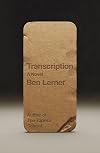
Transcription
by Ben Lerner
On This Page
Tags
Recommendations












































Member Reviews
A kafkaesque piece about the existential effects of screens and digital media on our lives. The unnamed narrator drops his phone in water on his way to interview his 90 year old mentor. Through this section there are constant reminders of how he has come to rely on his phone to locate himself in time and space and the disorientation he experiences without access to that.
Upon arrival at his mentor, Thomas', home there is more disorientation as the home appears as it did in the narrator's college days and yet is not quite the same. Thomas' memory seems to be fragmented, sprinkled with metaphors, and references to various art forms including Kafka's Hunger Artist. There is also conflation of memory between the narrator and Thomas' son, show more Max. The narrator has decided to work from memory in transcribing the interview though he leads Thomas to believe it is being recorded.
The second section deals with the unexpected reaction of the audience when he reveals during Thomas' eulogy that his last interview was not recorded but transcribed from the author's memory. Because of this he is accused of creating a fictional interview, as if the existence of a recording was needed to validate the interview as nonfiction. The memorial conference takes place in a hotel the straddles the border between Switzerland and France as a metaphor for the borders between fiction and reality. Switzerland is also referenced in all three sections of the book as it has become known as a suicide destination.
The final chapter is a dialogue between Max and the narrator. The content is primarily about Max's daughter who has an eating disorder (ARFID) and Max's last interactions with Thomas. The narrator also has a daughter with an anxiety disorder. The accelerated use of screens during the pandemic during enforced isolation plays a role here. And the use of ASMR videos seems to be the cure for Evie's eating disorder.
There's a lot to unpack in this narrative and the author draws no neat conclusions but instead leaves the reader to question the impact of digital devices on our memories, self awareness, memory, perception of reality, and our relationships with other humans. show less
Upon arrival at his mentor, Thomas', home there is more disorientation as the home appears as it did in the narrator's college days and yet is not quite the same. Thomas' memory seems to be fragmented, sprinkled with metaphors, and references to various art forms including Kafka's Hunger Artist. There is also conflation of memory between the narrator and Thomas' son, show more Max. The narrator has decided to work from memory in transcribing the interview though he leads Thomas to believe it is being recorded.
The second section deals with the unexpected reaction of the audience when he reveals during Thomas' eulogy that his last interview was not recorded but transcribed from the author's memory. Because of this he is accused of creating a fictional interview, as if the existence of a recording was needed to validate the interview as nonfiction. The memorial conference takes place in a hotel the straddles the border between Switzerland and France as a metaphor for the borders between fiction and reality. Switzerland is also referenced in all three sections of the book as it has become known as a suicide destination.
The final chapter is a dialogue between Max and the narrator. The content is primarily about Max's daughter who has an eating disorder (ARFID) and Max's last interactions with Thomas. The narrator also has a daughter with an anxiety disorder. The accelerated use of screens during the pandemic during enforced isolation plays a role here. And the use of ASMR videos seems to be the cure for Evie's eating disorder.
There's a lot to unpack in this narrative and the author draws no neat conclusions but instead leaves the reader to question the impact of digital devices on our memories, self awareness, memory, perception of reality, and our relationships with other humans. show less
Everything that happens, one might suppose, is recorded in that vast holding library called, “the past.” And yet the past seems remarkably indistinct at least from our standpoint in the present. It can unsettle one’s stomach, as sometimes happens when facing backward in a moving train. And even our strongest impressions of the past can, at times, be contradicted by others. Without direct access to the transcription, it is as though all we are and have been is fiction.
Ben Lerner’s short novel is divided into three segments. The first sees a writer visiting his aged mentor, Thomas, in order to interview him for a magazine. Unfortunately the phone with which he had intended to record their discussion is accidentally dropped in a show more sink full of water. In a pinch, the writer is forced to simply remember the evening and later, in part, fictionalize it. In the second segment we see the writer after having recounted the circumstances of what has become the last interview ever given by his mentor at a festschrift in his honour. The reaction of those learning that his published account was not so much a transcription as fiction startles him. In the final segment, Max, the son of the writer’s mentor, recounts some of his own interactions with his father as well as detailing the challenges of dealing with a daughter with an eating disorder. He is ostensibly speaking to the writer. But how much of his own account should be considered to be transcription or fiction?
This is an immensely subtle and thoughtful study of the nature of art, of the failure of communication, and the necessity for fiction in a universe which may or may not accommodate transcription. You can hardly imagine a writer better suited for this task than Ben Lerner. You will want to read this novel again almost immediately on finishing it. And you should.
Highly recommended. show less
Ben Lerner’s short novel is divided into three segments. The first sees a writer visiting his aged mentor, Thomas, in order to interview him for a magazine. Unfortunately the phone with which he had intended to record their discussion is accidentally dropped in a show more sink full of water. In a pinch, the writer is forced to simply remember the evening and later, in part, fictionalize it. In the second segment we see the writer after having recounted the circumstances of what has become the last interview ever given by his mentor at a festschrift in his honour. The reaction of those learning that his published account was not so much a transcription as fiction startles him. In the final segment, Max, the son of the writer’s mentor, recounts some of his own interactions with his father as well as detailing the challenges of dealing with a daughter with an eating disorder. He is ostensibly speaking to the writer. But how much of his own account should be considered to be transcription or fiction?
This is an immensely subtle and thoughtful study of the nature of art, of the failure of communication, and the necessity for fiction in a universe which may or may not accommodate transcription. You can hardly imagine a writer better suited for this task than Ben Lerner. You will want to read this novel again almost immediately on finishing it. And you should.
Highly recommended. show less
This is the kind of novella that derives much of its power from instability and incompletion. The reader is never entirely on firm ground. Conversations drift, memory falters, technology mediates nearly every human interaction, and even the book’s structure seems designed to resist easy interpretation. Yet the novella’s ambiguities don’t feel careless. Lerner has created a work less interested in resolving mysteries than in dramatizing how fragile perception, recollection, and communication have become in contemporary life.
The novella revolves around three principal figures: the unnamed narrator, his elderly mentor Thomas, and Thomas’s son Max. The tripartite structure mirrors these relationships, though the symmetry seems show more intentionally imperfect. The central section is brief and almost spectral, functioning less as a conventional narrative chapter than as an interruption or echo chamber between the larger movements of the book. This section, “[Hotel Villa Real],” is intentionally disorienting. My instinct is that the brackets signify some form of instability or altered status. It feels bracketed off from ordinary narrative reality—less a fully embodied scene than a suspended commentary on the first section. The title itself likely gestures toward “realness” or authenticity, which is fitting because this section revolves around the narrator’s confession that the famous final interview was never truly recorded. The participants’ discomfort and disgust about this ruse stem not simply from dishonesty but from the destruction of archival certainty. Thomas’s final words—supposedly preserved for posterity—were in fact reconstructed through memory and interpretation.
The opening section, “Hotel Providence,” is perhaps the novella’s most immediately accessible portion. Lerner’s rendering of Providence and the environs of Brown University is remarkably vivid. The physical details of campus life and the surrounding city possess an almost elegiac quality, perfectly suited to a narrative preoccupied with memory and intellectual inheritance. The setting itself becomes part of the book’s meditation on time: a university campus where past and present constantly overlap. For me, this setting worked well because it brought back vivid memories of my own undergraduate years at Brown.
The interview between the narrator and Thomas initially appears straightforward but gradually deteriorates into confusion and fragmentation. Uncertainty about Thomas’s mental state is central to the novella’s effect. Lerner deliberately leaves open whether Thomas is suffering from dementia, cognitive decline related to long covid, simple old age, or whether his apparently erratic thinking reflects the nonlinear habits of a brilliant but aging intellectual mind. Thomas’s inability to sustain a logical train of thought becomes unsettling precisely because he was once a celebrated scholar. The reader experiences the same discomfort as the narrator: the collapse of intellectual authority in real time.
The dead phone and fake recording device become crucial symbols. The narrator’s inability to record the interview forces him into unreliable transcription, memory, and improvisation. This directly connects to the novella’s title. “Transcription” refers not simply to the act of recording speech, but to the impossibility of ever perfectly capturing experience. Every act of remembering, writing, interviewing, or even listening becomes a distorted transcription rather than faithful preservation. Technology promises total documentation, yet the novel repeatedly demonstrates how fragile those systems actually are. The narrator pretends to possess technological mastery while secretly improvising around its failure.
The circumstances surrounding Thomas’s death remain unexplained because the novella is less concerned with biological causation than with the lingering aftereffects of presence. In many ways, Thomas is already disappearing during the first section through cognitive fragmentation. The memorial conference simply formalizes a vanishing process already well underway.
The final section, “Hotel Arbez,” contains the novella’s richest symbolic material. The real Hôtel Arbez Franco-Suisse famously straddles the border between France and Switzerland, with parts of the building literally existing in two nations simultaneously. This geographic instability mirrors the novella’s deeper concerns with thresholds and divided states: memory and forgetting, life and death, presence and absence, authenticity and fabrication. Thomas himself becomes a border figure after surviving covid. His near-death experience leaves him suspended between intellectual vitality and decline. Similarly, the narrator exists between truth and invention because of the fabricated recording. The hotel’s staircase crossing national borders suggests how impossible it may be to maintain clean separations between categories we once considered stable.
The novella resists simplistic condemnations of technology. Phones, recordings, and digital media certainly alienate people from one another, yet they also create strange new forms of consolation and survival. Max’s daughter’s eating disorder further extends the novel’s examination of mediation and embodiment. Her recovery through YouTube ASMR videos initially seems absurd or even comic, but Lerner treats it seriously as evidence that digital technologies are reshaping intimacy, comfort, and bodily regulation. The narrator’s separation from his own daughter because of his lost phone parallels Max’s daughter’s partial healing through online sensory experiences. Technology becomes both a problem and a provisional cure.
What makes the novella so compelling is precisely the unsettled feeling it leaves behind. Lerner refuses conventional narrative closure because the subjects he examines—memory, illness, mediation, inheritance—do not permit neat conclusions. Even the structure resembles a fractured transcript assembled from incomplete records and uncertain recollections.
For such a short work, “Transcription” engages an astonishing range of subjects: mentorship, intellectual legacy, the distortions of memory, the psychic aftereffects of the pandemic, family estrangement, and the increasingly unstable role technology plays in shaping consciousness itself. The novella’s obscurities are not failures of execution so much as expressions of its central insight: that modern experience increasingly feels partial, mediated, and difficult to fully comprehend even while we are living through it. The result is a work that rewards rereading. Its ambiguities linger because Lerner has constructed a novella less about delivering answers than about recreating the unsettling texture of contemporary thought and memory. show less
The novella revolves around three principal figures: the unnamed narrator, his elderly mentor Thomas, and Thomas’s son Max. The tripartite structure mirrors these relationships, though the symmetry seems show more intentionally imperfect. The central section is brief and almost spectral, functioning less as a conventional narrative chapter than as an interruption or echo chamber between the larger movements of the book. This section, “[Hotel Villa Real],” is intentionally disorienting. My instinct is that the brackets signify some form of instability or altered status. It feels bracketed off from ordinary narrative reality—less a fully embodied scene than a suspended commentary on the first section. The title itself likely gestures toward “realness” or authenticity, which is fitting because this section revolves around the narrator’s confession that the famous final interview was never truly recorded. The participants’ discomfort and disgust about this ruse stem not simply from dishonesty but from the destruction of archival certainty. Thomas’s final words—supposedly preserved for posterity—were in fact reconstructed through memory and interpretation.
The opening section, “Hotel Providence,” is perhaps the novella’s most immediately accessible portion. Lerner’s rendering of Providence and the environs of Brown University is remarkably vivid. The physical details of campus life and the surrounding city possess an almost elegiac quality, perfectly suited to a narrative preoccupied with memory and intellectual inheritance. The setting itself becomes part of the book’s meditation on time: a university campus where past and present constantly overlap. For me, this setting worked well because it brought back vivid memories of my own undergraduate years at Brown.
The interview between the narrator and Thomas initially appears straightforward but gradually deteriorates into confusion and fragmentation. Uncertainty about Thomas’s mental state is central to the novella’s effect. Lerner deliberately leaves open whether Thomas is suffering from dementia, cognitive decline related to long covid, simple old age, or whether his apparently erratic thinking reflects the nonlinear habits of a brilliant but aging intellectual mind. Thomas’s inability to sustain a logical train of thought becomes unsettling precisely because he was once a celebrated scholar. The reader experiences the same discomfort as the narrator: the collapse of intellectual authority in real time.
The dead phone and fake recording device become crucial symbols. The narrator’s inability to record the interview forces him into unreliable transcription, memory, and improvisation. This directly connects to the novella’s title. “Transcription” refers not simply to the act of recording speech, but to the impossibility of ever perfectly capturing experience. Every act of remembering, writing, interviewing, or even listening becomes a distorted transcription rather than faithful preservation. Technology promises total documentation, yet the novel repeatedly demonstrates how fragile those systems actually are. The narrator pretends to possess technological mastery while secretly improvising around its failure.
The circumstances surrounding Thomas’s death remain unexplained because the novella is less concerned with biological causation than with the lingering aftereffects of presence. In many ways, Thomas is already disappearing during the first section through cognitive fragmentation. The memorial conference simply formalizes a vanishing process already well underway.
The final section, “Hotel Arbez,” contains the novella’s richest symbolic material. The real Hôtel Arbez Franco-Suisse famously straddles the border between France and Switzerland, with parts of the building literally existing in two nations simultaneously. This geographic instability mirrors the novella’s deeper concerns with thresholds and divided states: memory and forgetting, life and death, presence and absence, authenticity and fabrication. Thomas himself becomes a border figure after surviving covid. His near-death experience leaves him suspended between intellectual vitality and decline. Similarly, the narrator exists between truth and invention because of the fabricated recording. The hotel’s staircase crossing national borders suggests how impossible it may be to maintain clean separations between categories we once considered stable.
The novella resists simplistic condemnations of technology. Phones, recordings, and digital media certainly alienate people from one another, yet they also create strange new forms of consolation and survival. Max’s daughter’s eating disorder further extends the novel’s examination of mediation and embodiment. Her recovery through YouTube ASMR videos initially seems absurd or even comic, but Lerner treats it seriously as evidence that digital technologies are reshaping intimacy, comfort, and bodily regulation. The narrator’s separation from his own daughter because of his lost phone parallels Max’s daughter’s partial healing through online sensory experiences. Technology becomes both a problem and a provisional cure.
What makes the novella so compelling is precisely the unsettled feeling it leaves behind. Lerner refuses conventional narrative closure because the subjects he examines—memory, illness, mediation, inheritance—do not permit neat conclusions. Even the structure resembles a fractured transcript assembled from incomplete records and uncertain recollections.
For such a short work, “Transcription” engages an astonishing range of subjects: mentorship, intellectual legacy, the distortions of memory, the psychic aftereffects of the pandemic, family estrangement, and the increasingly unstable role technology plays in shaping consciousness itself. The novella’s obscurities are not failures of execution so much as expressions of its central insight: that modern experience increasingly feels partial, mediated, and difficult to fully comprehend even while we are living through it. The result is a work that rewards rereading. Its ambiguities linger because Lerner has constructed a novella less about delivering answers than about recreating the unsettling texture of contemporary thought and memory. show less
This is a very interesting and maybe clever book released this past April. I say maybe because I'm not sure I got it and I'm not sure how important the unremarkable but distinct phrase "impossible staircase" really is.
Lerner is looking how our minds work, how we keep record, what association we make with the past and memory. He flags this early on as the narrator, unnamed but who seems a little like Lerner himself, goes to Providence, Rhode Island, his undergraduate college, to interview his mentor Thomas for his magazine. The past seeps in, it runs out the window. Our narrator disastrously drops his phone in the hotel sink, leaving him feeling unmoored, and, more importantly, without a recording device. Thomas is ninety years old, show more still an intellectual force and this interview is important to him. So our narrator lies and pretends to record the interview.
As the interview carries on, Thomas's mind sparks off in several directions, tying in various ways to history, time, and what we sense, recording itself. Born in Germany, he remembers Hitler on the radio, "In my memory his voice rises without end. It’s strange that our brains will allow this – to hear a scale as eternally ascending, an impossible staircase.” Later the interview starts to get weird. First Thomas claims a dream our narrator had was actually his own dream, and that the narrator dreamt it for him. And he starts to explain why. His deceased wife is there, in our narrator's dream, “Virginie on the impossible staircase, the mood ascending until there is no atmosphere to breath.” Then Thomas shifts again and speaks as if the narrator is his son. It's sad episode of dementia.
Or is it? That phrase "impossible staircase” will come up again and should unsettle everything the reader thought they were reading.
How much can we trust what we remember? Do we mix our associations? Did Thomas have dementia, or did our narrator convolute the story? And is everything we need to know in the text. In any case, I thoroughly enjoyed this short book, despite one dry spot, and I read it in a day and I'm giving it five stars. It is reminiscent of [Audition] by Katie Kitamura, a book I adored last year.
2026
https://www.librarything.com/topic/384249#9219706 show less
Lerner is looking how our minds work, how we keep record, what association we make with the past and memory. He flags this early on as the narrator, unnamed but who seems a little like Lerner himself, goes to Providence, Rhode Island, his undergraduate college, to interview his mentor Thomas for his magazine. The past seeps in, it runs out the window. Our narrator disastrously drops his phone in the hotel sink, leaving him feeling unmoored, and, more importantly, without a recording device. Thomas is ninety years old, show more still an intellectual force and this interview is important to him. So our narrator lies and pretends to record the interview.
As the interview carries on, Thomas's mind sparks off in several directions, tying in various ways to history, time, and what we sense, recording itself. Born in Germany, he remembers Hitler on the radio, "In my memory his voice rises without end. It’s strange that our brains will allow this – to hear a scale as eternally ascending, an impossible staircase.” Later the interview starts to get weird. First Thomas claims a dream our narrator had was actually his own dream, and that the narrator dreamt it for him. And he starts to explain why. His deceased wife is there, in our narrator's dream, “Virginie on the impossible staircase, the mood ascending until there is no atmosphere to breath.” Then Thomas shifts again and speaks as if the narrator is his son. It's sad episode of dementia.
Or is it? That phrase "impossible staircase” will come up again and should unsettle everything the reader thought they were reading.
How much can we trust what we remember? Do we mix our associations? Did Thomas have dementia, or did our narrator convolute the story? And is everything we need to know in the text. In any case, I thoroughly enjoyed this short book, despite one dry spot, and I read it in a day and I'm giving it five stars. It is reminiscent of [Audition] by Katie Kitamura, a book I adored last year.
2026
https://www.librarything.com/topic/384249#9219706 show less
This is another accomplished novel from Lerner. Even though this is a brief novel, there is a lot of skill in how the thoughts and themes weave in and around the actual story. He must live here because there are some passing Echo Park and Highland Park references. Having a nephew with ARFID and friends who have died from the Covid 19, the material here was easily "relatable". What actually happens is not so important as much as it provides an opportunity to talk about ideas, all kinds of ideas. A lot of these are about technology and how the iPhone and iPads has changed how we navigate our lives. It's also a book about aging and youth and being lost in the middle of it all. I think I would like to read this again at some point.
All my favorite things: an unreliable narrator, fallible memory, and competing versions of the story. Add some family drama, a lonely emotionally withdraw man, and a little meta textual commentary, and this might be my favorite book of the year. It reminds me of some of Philip Roth's best work.
This reads like the novelisation of a couple of so-so think pieces in The Atlantic about whatever the Nice White Person moral panic du jour is—there's nothing offensively bad here, but equally I'm not quite sure it needs to exist. What drove Ben Lerner to write this? Not sure. There's no impetus here. This is the kind of book where people in dialogue will make puns on "heirlooms" and "air looms", except there's no way to distinguish the pronunciation of those things in any standard English accent/dialect I'm aware of, so how does our POV character know that he's hearing that distinction? This is the kind of thing that reminds me forcefully that I'm reading a Character in a Piece of Literary Fiction who is being used to Convey Ideas, show more but see above re: how those ideas are Think-Piece-in-The Atlantic-level mid. show less
Members
- Recently Added By
Lists

What Twitter Talks About
14 works; 1 member

Books Read in 2026
1,951 works; 66 members

Read 2026 Ranked
17 works; 1 member

The Economist Books of 2026 So Far (June 2026)
25 works; 1 member

Economist book reviews (July 2026-)
13 works; 1 member
Author Information

14+ Works 4,585 Members
Awards and Honors
Awards
Distinctions
Notable Lists
Common Knowledge
- Canonical title
- Transcription
- Original publication date
- 2026-04-07
Classifications
Statistics
- Members
- 265
- Popularity
- 122,169
- Reviews
- 10
- Rating
- (3.92)
- Languages
- English, German
- Media
- Paper
- ISBNs
- 5