On This Page
Description
Human beings have always been mythmakers. Theologian Armstrong here investigates myth: what it is, how it has evolved, and why we still so desperately need it. She takes us from the Paleolithic period and the myths of the hunters, up to the Great Western Transformation of the last five hundred years and the discrediting of myth by science. The history of myth is the history of humanity, our stories and beliefs, our curiosity and attempts to understand the world, which link us to our show more ancestors and each other.--From publisher description. show lessTags
Recommendations








Member Reviews
In seven chapters and 159 pages, religious scholar Karen Armstrong attempts to give a brief outline of the history of mythology, producing an engaging, thoughtful book that, while perhaps not completely successful as history, is certainly a persuasive argument for the great meaning and significance of her subject matter.
In the first chapter, Armstrong examines the nature of myth - what it is and what it does - arguing that it is a particularly powerful type of storytelling that humans use to make sense of the world around them and their place in it. Its five characteristics are: 1) being rooted in death, and the fear of extinction, 2) being inseparable (usually) from ritual, 3) addressing the extreme and unknown experience, 4) show more demonstrating how one should behave, and 5) addressing parallel planes of existence, usually divine. The author argues that the truth of myth lies, not in its factuality, but in its effectiveness in providing insight into the meaning of life.
In the second chapter, the author examines the mythology of the Paleolithic Period (c. 20,000-8,000 BCE), or "the mythology of the hunters." This is the period in which human evolution was completed (for now, one assumes), and is characterized by myth which teaches humans to look beyond the tangible world. Many early mythologies had sky gods, perhaps indicating a human desire to "get above" the human condition, whether that means to transcend it, or simply to understand it more fully. It also addresses the growing human awareness of the ethical quandary of living in a world that requires killing other creatures in order to survive. As the author notes, "mythology often springs from profound anxiety about essentially practical problems, which cannot be assuaged by purely logical arguments."
In the third chapter, Armstrong looks at the mythology of the Neolithic Period (c. 8,000-4,000 BCE), or "the mythology of the farmers." During this time we see many creation myths, particularly in Europe and North America, that imagine people emerging from the earth, like plants, teaching them that they belong to the earth. The more agricultural Earth Mother is a transformation of the Great Mother of many hunting societies. The cyclical nature of agriculture gives rise to a new optimism about death in many myth traditions, with the possibility that it is not the end being considered.
In the fourth chapter, the author examines the mythology of the early civilizations stretching from c. 4,000 to 800 BCE. The first emergence of cities, in Mesopotamia, Egypt, China, India and Crete, lead to a new concern with order and chaos in mythology, perhaps pointing to the great fragility of these new human population centers. Urban life changes mythology, and the gods begin to seem more remote from the people.
In the fifth chapter, Armstrong discusses mythology in the Axial Age (c. 800-200 BCE), in which many of the religions and philosophies of the modern age had their birth. She focuses on Confucianism and Taoism in China, Buddhism and Hinduism in India, monotheism in the Middle East, and rationalism in Greece. Although sometimes very different, in their approach to how myth was used, each of these belief systems puts emphasis on a more interior, ethical interpretation of myth and ritual.
In the sixth chapter, the author looks at mythology in the Post-Axial Period (c. 200 BCE - c. 1500 CE), specifically examining myth in the West during this period. Because Western religion claims to be historical in origin, rather than mythical, its traditions have had a more problematic relationship with myth.
Finally, in the seventh and final chapter, Armstrong examines the "Great Western Transformation" (c. 1500-2000 CE), in which emphasis on logos leads to the death of myth. She examines the decline of myth, and the rise of existential despair in western societies, and how this has led to such horrors as the witchcraft craze of the 16th and 17th centuries, and the destructive and nihilistic ideologies of the 20th (fascism, communism).
Although long aware of Karen Armstrong's work, I had never picked up any of her books until A Short History of Myth was assigned as a class text in the course on the history of children's literature I took while getting my masters. On the whole, I found it an interesting book. I can see why some reviewers were unimpressed, feeling that too much had been left out, and that the book was too general, and not informative enough to be called a history. While I understand readers wanting more, I think that the qualities they critique are an inevitable result of the book's length and purpose. Perhaps if it had been called "A Short Introduction to Myth," it would not have aroused so much ire? I am not sure. In any case, I found the book engaging, even if it didn't cover much new ground, and I particularly enjoyed the final chapter, in which Armstrong argues for the importance of myth in human life, and posits authors and artists as the new keepers of that myth. This accords with my own analysis (and that of many other scholars) of fantasy fiction in particular - its relationship to folklore and myth, and the power it therefore has for contemporary readers. In point of fact, I taught a class on the connections between children's fantasy fiction and folklore while still an undergrad, something that remains a cherished experience.
Recommended particularly to readers interested in beginning to delve more deeply into folklore and mythological studies, but not sure where to start. show less
In the first chapter, Armstrong examines the nature of myth - what it is and what it does - arguing that it is a particularly powerful type of storytelling that humans use to make sense of the world around them and their place in it. Its five characteristics are: 1) being rooted in death, and the fear of extinction, 2) being inseparable (usually) from ritual, 3) addressing the extreme and unknown experience, 4) show more demonstrating how one should behave, and 5) addressing parallel planes of existence, usually divine. The author argues that the truth of myth lies, not in its factuality, but in its effectiveness in providing insight into the meaning of life.
In the second chapter, the author examines the mythology of the Paleolithic Period (c. 20,000-8,000 BCE), or "the mythology of the hunters." This is the period in which human evolution was completed (for now, one assumes), and is characterized by myth which teaches humans to look beyond the tangible world. Many early mythologies had sky gods, perhaps indicating a human desire to "get above" the human condition, whether that means to transcend it, or simply to understand it more fully. It also addresses the growing human awareness of the ethical quandary of living in a world that requires killing other creatures in order to survive. As the author notes, "mythology often springs from profound anxiety about essentially practical problems, which cannot be assuaged by purely logical arguments."
In the third chapter, Armstrong looks at the mythology of the Neolithic Period (c. 8,000-4,000 BCE), or "the mythology of the farmers." During this time we see many creation myths, particularly in Europe and North America, that imagine people emerging from the earth, like plants, teaching them that they belong to the earth. The more agricultural Earth Mother is a transformation of the Great Mother of many hunting societies. The cyclical nature of agriculture gives rise to a new optimism about death in many myth traditions, with the possibility that it is not the end being considered.
In the fourth chapter, the author examines the mythology of the early civilizations stretching from c. 4,000 to 800 BCE. The first emergence of cities, in Mesopotamia, Egypt, China, India and Crete, lead to a new concern with order and chaos in mythology, perhaps pointing to the great fragility of these new human population centers. Urban life changes mythology, and the gods begin to seem more remote from the people.
In the fifth chapter, Armstrong discusses mythology in the Axial Age (c. 800-200 BCE), in which many of the religions and philosophies of the modern age had their birth. She focuses on Confucianism and Taoism in China, Buddhism and Hinduism in India, monotheism in the Middle East, and rationalism in Greece. Although sometimes very different, in their approach to how myth was used, each of these belief systems puts emphasis on a more interior, ethical interpretation of myth and ritual.
In the sixth chapter, the author looks at mythology in the Post-Axial Period (c. 200 BCE - c. 1500 CE), specifically examining myth in the West during this period. Because Western religion claims to be historical in origin, rather than mythical, its traditions have had a more problematic relationship with myth.
Finally, in the seventh and final chapter, Armstrong examines the "Great Western Transformation" (c. 1500-2000 CE), in which emphasis on logos leads to the death of myth. She examines the decline of myth, and the rise of existential despair in western societies, and how this has led to such horrors as the witchcraft craze of the 16th and 17th centuries, and the destructive and nihilistic ideologies of the 20th (fascism, communism).
Although long aware of Karen Armstrong's work, I had never picked up any of her books until A Short History of Myth was assigned as a class text in the course on the history of children's literature I took while getting my masters. On the whole, I found it an interesting book. I can see why some reviewers were unimpressed, feeling that too much had been left out, and that the book was too general, and not informative enough to be called a history. While I understand readers wanting more, I think that the qualities they critique are an inevitable result of the book's length and purpose. Perhaps if it had been called "A Short Introduction to Myth," it would not have aroused so much ire? I am not sure. In any case, I found the book engaging, even if it didn't cover much new ground, and I particularly enjoyed the final chapter, in which Armstrong argues for the importance of myth in human life, and posits authors and artists as the new keepers of that myth. This accords with my own analysis (and that of many other scholars) of fantasy fiction in particular - its relationship to folklore and myth, and the power it therefore has for contemporary readers. In point of fact, I taught a class on the connections between children's fantasy fiction and folklore while still an undergrad, something that remains a cherished experience.
Recommended particularly to readers interested in beginning to delve more deeply into folklore and mythological studies, but not sure where to start. show less
Karen Armstrong was once a nun then an atheist so it's only reasonable that she became one of the world's greatest commentators on religion. In A Short History of Myth she says that "We need myths to help us to create a spiritual attitude, to see beyond our immediate requirements, and enable us to experience a transcendent value that challenges our solipsistic selfishness." She also says myth was the way humans came to reconcile with our mortality. She says that logos, or the way of looking at life realistically need not be at odds with mythos, rather they are companion views of life. However after the age of reason, religious people often thought they needed to explain their faith in realistic terms, they needed to avow a literal show more belief in religion, treating religious books not as tellings of necessary myth but as a factual account of reality; and that this negation of reality also lessons the ability of myth to sustain humans.
Lastly she claims that in the modern world based on logos literature has become our way of sustaining and expressing myth and accomplishes the same goals of reconciliation with mortality and the assistance in achieving transcendence. show less
Lastly she claims that in the modern world based on logos literature has become our way of sustaining and expressing myth and accomplishes the same goals of reconciliation with mortality and the assistance in achieving transcendence. show less
I've felt that some of Karen Armstrong's books -- most notably "A History of God" -- tried to do too much in too little space, but "A Short History of Myth" is a beautifully economical little text. I'm the most general of general readers on this subject, but in this one, the author lays out the broad changes that have occurred in human civilization over the last twenty thousand or so years and ably demonstrates how our myths have adapted to give our lives meaning and purpose. Armstrong is also very good at defining and reiterating what myths are and what they are for to her inevitably modern audience, sensing, correctly, I think that most citizens of the twenty-first century will find it difficult to conceive of a way of thinking that show more lies well outside the scientific, literal, and historically oriented thought patterns difficult that have been inculcated in us for generations now. In doing so, the author also shows a rare sensitivity to and understanding of a largely vanished way of thinking, stressing to her readers over and over again that myths' functions were unifying and therapeutic and that their "veracity" was never really a question that people in prehistoric times would have sought to address. Armstrong's writing also communicates how desperate many premodern peoples' struggles for survival really were, and which goes a long way toward explaining why so many of the early myths here can seem overwhelmingly intense, even to modern readers. For many of the people that Armstrong describes, life and death weren't at all abstract at any stage of their lives.
It's perhaps unsurprising, then, that the book falls apart a little in its last pages. Even though she posits earlier that people still seek transcendence through any number of activities, including art, drugs, sport, sex, and pop music, Armstrong believes that global modernity is essentially post-mythical, and that this lack has brought about severe psychic damage. It's not a terrible argument, when one considers the twentieth century's various fanaticisms, but the author's indication of art, specifically the art of the novel, as a possible solution seems far-fetched. The novel's essentially a product of modernity, after all, and while many people take solace in fiction, I can't see it serving as any society's foundational myth. It's also a bit strange -- though she's working in a very constrained space here -- that the author doesn't really touch on Freudian psychology as a modern analogue to myth-making.
Despite these qualms, as a person who's generally unacquainted with this subject, I thought that the author packed an enormous amount of big thoughts into a small space here. I can see why specialists would object to certain sections of it, but this one sparked my interest and made me aware of how much I don't know about this important subject. I will probably start looking around for next steps. Finally, although I don't usually mention this sort of thing, I have to say that the Cannongate edition of this one I found was just lovely: a handsome little paperback embossed with graphics reminiscent of cave paintings. Find that one if you can. show less
It's perhaps unsurprising, then, that the book falls apart a little in its last pages. Even though she posits earlier that people still seek transcendence through any number of activities, including art, drugs, sport, sex, and pop music, Armstrong believes that global modernity is essentially post-mythical, and that this lack has brought about severe psychic damage. It's not a terrible argument, when one considers the twentieth century's various fanaticisms, but the author's indication of art, specifically the art of the novel, as a possible solution seems far-fetched. The novel's essentially a product of modernity, after all, and while many people take solace in fiction, I can't see it serving as any society's foundational myth. It's also a bit strange -- though she's working in a very constrained space here -- that the author doesn't really touch on Freudian psychology as a modern analogue to myth-making.
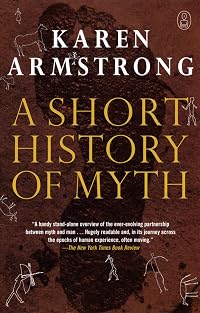
Despite these qualms, as a person who's generally unacquainted with this subject, I thought that the author packed an enormous amount of big thoughts into a small space here. I can see why specialists would object to certain sections of it, but this one sparked my interest and made me aware of how much I don't know about this important subject. I will probably start looking around for next steps. Finally, although I don't usually mention this sort of thing, I have to say that the Cannongate edition of this one I found was just lovely: a handsome little paperback embossed with graphics reminiscent of cave paintings. Find that one if you can. show less
If you've read any of Karen Armstrong's books on religion, you likely won't see much new material here. The 3 star rating largely reflects that lack of novelty. However, if you've ever wished that you didn't have to page trough a book with hundreds of pages to find that bit about the development of myth you remember from one of Armstrong's books, then you'll likely find this to be handy.
The most interesting foray into not-stock-Armstrong ground is the last chapter, which discusses myth in the modern west. If it's true that, as Armstrong says on pg 141 "in the pre-modern world, the divine was rarely regarded in the metaphysical terms imposed upon it by Western logos, but was usually used to help people understand their humanity" then the show more traditional religious mythos is fundamentally broken for many Westerners. Given that our greater understanding of science has made it hard to pull meaning from myths that relate to phenomena that we now understand from a naturalistic perspective, how can we salvage that understanding of our humanity that religious myth brought to us? What are our modern myths?
Armstrong finds the answer in art, especially literature. But not art casually consumed; such consumption will not cause us to delve deep into ourselves, coming out with a new understanding. Just as religious texts were most meaningful when experienced as part of ritual and liturgy, to take on the transformative role of myth, art must be consumed mindfully, as part of a process where you are open to transformation. This may sound like a tall order, but Armstrong points out that any art that immerses you has the potential to provide this transformative experience.
This is a perspective which I wish Armstrong had had a chance to develop more fully. I feel like compared to a religious based mythos, art has the strength that the broader variety means that most everyone will have something that speaks to them, if they can just find it. Art also evolves more gracefully over time and thus can more flexibly fit the different needs of different eras. But religion, when it is a successful mythos, can be more unifying. If we each have a personal mtyhos, we will likely end up more fragmented. It is also harder to dismiss the transformation a myth demands of you when you accept the metaphysical truth of that myth.
But those of us for whom the myths of religious paradigms are no longer functional still need our own form of myth, and cultivating the idea of art mindfully consumed as that myth can provide valuable guidance. show less
The most interesting foray into not-stock-Armstrong ground is the last chapter, which discusses myth in the modern west. If it's true that, as Armstrong says on pg 141 "in the pre-modern world, the divine was rarely regarded in the metaphysical terms imposed upon it by Western logos, but was usually used to help people understand their humanity" then the show more traditional religious mythos is fundamentally broken for many Westerners. Given that our greater understanding of science has made it hard to pull meaning from myths that relate to phenomena that we now understand from a naturalistic perspective, how can we salvage that understanding of our humanity that religious myth brought to us? What are our modern myths?
Armstrong finds the answer in art, especially literature. But not art casually consumed; such consumption will not cause us to delve deep into ourselves, coming out with a new understanding. Just as religious texts were most meaningful when experienced as part of ritual and liturgy, to take on the transformative role of myth, art must be consumed mindfully, as part of a process where you are open to transformation. This may sound like a tall order, but Armstrong points out that any art that immerses you has the potential to provide this transformative experience.
[T]he experience of reading a novel has certain qualities that remind us of the traditional apprehension of mythology. It can be seen as a form of meditation. Readers have to live with a novel for days or even weeks. It projects them into another world, parallel to but apart from their ordinary lives. They know perfectly well that this fictional realm is not 'real' and yet while they are reading it becomes compelling. A powerful novel becomes part of the backdrop of our lives, long after we have laid the book aside. It is an exercise of make-believe that, like yoga or a religious festival, breaks down barriers of space and time and extends our sympathies, so that we are able to empathise with other lives and sorrows. It teaches compassion, the ability to 'feel with' others. And, like mythology, an important novel is transformative. If we allow it to do so, it can change us forever. ... Any powerful work of art invades our being and changes it forever. -- page 147-8
This is a perspective which I wish Armstrong had had a chance to develop more fully. I feel like compared to a religious based mythos, art has the strength that the broader variety means that most everyone will have something that speaks to them, if they can just find it. Art also evolves more gracefully over time and thus can more flexibly fit the different needs of different eras. But religion, when it is a successful mythos, can be more unifying. If we each have a personal mtyhos, we will likely end up more fragmented. It is also harder to dismiss the transformation a myth demands of you when you accept the metaphysical truth of that myth.
But those of us for whom the myths of religious paradigms are no longer functional still need our own form of myth, and cultivating the idea of art mindfully consumed as that myth can provide valuable guidance. show less
my first karen armstrong. this is really a short history, so manages to stay pretty interesting the entire way through. there are parts, though, that really wanted more detail (and a few that wanted less) or explanation for the person (me!) that has no foundational knowledge of this stuff. i'm not really sure how much i actually know now, having read this, but it's likely that is more a reflection on my level of tiredness and focus than on the book itself.
she opens by saying that humans are the only creatures that think about death, which of course we can't know at all. she says, "Animals watch each other die but, as far as we know, they give the matter no further consideration." it really annoyed me that she started the book like this show more (this is the 4th sentence) because it may or may not be true but we have no idea, it is kind of irrelevant, and isn't provable at all (there is even anecdotal evidence that it might not be true, but obviously we can't know what an animal is thinking on this). if i hadn't known karen armstrong by reputation i would have grumbled about reading on after that statement. but read on, i did.
"Since the eighteenth century, we have developed a scientific view of history; we are concerned above all with what actually happened. But in the pre-modern world, when people wrote about the past they were more concerned with what an event had meant. A myth was an event which, in some sense, had happened once, but which also happened all the time." i found it really interesting to look at our religious texts in this light, as they were written during a time of completely different interpretation. so now we have evangelical christians saying that the bible means word for word what it says, when it was written at a time that no one took the words at face value like that. she later says, about western religions "...the three monotheistic faiths claim, at least in part, to be historically rather than mythically based." even though the texts were all written as mythology. so a major reinterpretation and re-explanation or repositioning of thought had to occur for people to continue to believe.
she cites confucius's golden rule, which i had never heard with a negative than a positive, and i like it much better: "Do not do unto others as you would not have done unto you."
a lot of interesting stuff here. makes me want to learn more. show less
she opens by saying that humans are the only creatures that think about death, which of course we can't know at all. she says, "Animals watch each other die but, as far as we know, they give the matter no further consideration." it really annoyed me that she started the book like this show more (this is the 4th sentence) because it may or may not be true but we have no idea, it is kind of irrelevant, and isn't provable at all (there is even anecdotal evidence that it might not be true, but obviously we can't know what an animal is thinking on this). if i hadn't known karen armstrong by reputation i would have grumbled about reading on after that statement. but read on, i did.
"Since the eighteenth century, we have developed a scientific view of history; we are concerned above all with what actually happened. But in the pre-modern world, when people wrote about the past they were more concerned with what an event had meant. A myth was an event which, in some sense, had happened once, but which also happened all the time." i found it really interesting to look at our religious texts in this light, as they were written during a time of completely different interpretation. so now we have evangelical christians saying that the bible means word for word what it says, when it was written at a time that no one took the words at face value like that. she later says, about western religions "...the three monotheistic faiths claim, at least in part, to be historically rather than mythically based." even though the texts were all written as mythology. so a major reinterpretation and re-explanation or repositioning of thought had to occur for people to continue to believe.
she cites confucius's golden rule, which i had never heard with a negative than a positive, and i like it much better: "Do not do unto others as you would not have done unto you."
a lot of interesting stuff here. makes me want to learn more. show less
A better name might have been "A Short Defense of Myth." I've always thought myths were attempts by primitive civilizations to explain the things that we've explained with science - creation myths because they didn't have instruments that supported the Big Bang theory; elemental gods to explain climatological and geological phenomena, etc. Armstrong offers a much smarter and more likely opinion: that myths reflect humankind's craving for transcendance, attempts to rectify the ambivance they feel about their own inevitable deaths and having to hunt their fellow creatures, for example.
My favote passage is her response to the disdain with which modern people look at myth; a product of the Enlightenment and Age of Reason that pushed show more anything not supported by direct evidence (myth, religion, etc.) into the fringes of public thought. It's a good reason why religious types are so radical today - they were shut out of the mainstream before Darwin's ink had dried.
"When we contemplate the dark epiphanies of the twentieth century, we see that modern anxiety is not simply the result of self-indulgent neurosis. We are facing something unprecedented. Other societies saw death as a transition to other modes of being. They did not nurture simplistic and vulgar ideas of an afterlife, but devised rites and myths that helped people to face the unspeakable. ...There is a moving and even heroic asceticism in the current rejection of myth. But purely linear, logical and historical modes of thought have debarred many of us from therapies and devices that have enabled men and women to draw on the full resources of their humanity in order to live with the unacceptable.
"We may be more spohisticated in material ways, but we have not advanced spiritually beyond the Axial Age: because of our supression of mythos we may even have regressed. We still long to 'get beyond' our immediate circumstances, and to enter a 'full time', a more intense, fulfilling existence. We try to enter this dimension by means of art, rock music, drugs or by entering the larger-than-life perspective of film. We still seek heroes. Elvis Presley and Princess Diana were both made into instant mythical beings, even objects of religious cult. But there is something unbalanced about this adulation. The myth of the hero was not intended to provide us with icons to admire, but was designed to tap into the vein of heroism within ourselves. Myth must lead to imitation or participation, not passive contemplation. We no longer know how to manage our mythical lives in a way that is spiritually challending and transformative.
"We must disabuse ourselves of the nineteenth-century fallacy that myth is false or that it represents an inferior mode of thought. ...We are myth-making creatures and, during the twentieth century, we saw some very destructive modern myths, which have ended in massacre and genocide. ...These distructive mythologies have been narrowly racial, ethnic, denominational and egotistic, an attempt to exalt the self by demonising the other. ...We cannot counter these bad myths with reason alone, because undiluted logos cannot deal with such deep-rooted, unexorcised fears, desires and neuroses. That is the role of an ethically and spritually informed mythology."
You would think someone would have thrown Canongate a parade to herald the creation of their Myths series, but no. This book is not the explosive, hold-on-to-your-hat intro this series deserves, but the passage above, more than the rest of the book, is what folks should keep in mind when they hold Atwood and Winterson's books in their hands. By reading the books that follow, you are becoming an accomplice to Armstrong's vision of creating Countermyths to our logical-yet-inhuman way of life today. show less
My favote passage is her response to the disdain with which modern people look at myth; a product of the Enlightenment and Age of Reason that pushed show more anything not supported by direct evidence (myth, religion, etc.) into the fringes of public thought. It's a good reason why religious types are so radical today - they were shut out of the mainstream before Darwin's ink had dried.
"When we contemplate the dark epiphanies of the twentieth century, we see that modern anxiety is not simply the result of self-indulgent neurosis. We are facing something unprecedented. Other societies saw death as a transition to other modes of being. They did not nurture simplistic and vulgar ideas of an afterlife, but devised rites and myths that helped people to face the unspeakable. ...There is a moving and even heroic asceticism in the current rejection of myth. But purely linear, logical and historical modes of thought have debarred many of us from therapies and devices that have enabled men and women to draw on the full resources of their humanity in order to live with the unacceptable.
"We may be more spohisticated in material ways, but we have not advanced spiritually beyond the Axial Age: because of our supression of mythos we may even have regressed. We still long to 'get beyond' our immediate circumstances, and to enter a 'full time', a more intense, fulfilling existence. We try to enter this dimension by means of art, rock music, drugs or by entering the larger-than-life perspective of film. We still seek heroes. Elvis Presley and Princess Diana were both made into instant mythical beings, even objects of religious cult. But there is something unbalanced about this adulation. The myth of the hero was not intended to provide us with icons to admire, but was designed to tap into the vein of heroism within ourselves. Myth must lead to imitation or participation, not passive contemplation. We no longer know how to manage our mythical lives in a way that is spiritually challending and transformative.
"We must disabuse ourselves of the nineteenth-century fallacy that myth is false or that it represents an inferior mode of thought. ...We are myth-making creatures and, during the twentieth century, we saw some very destructive modern myths, which have ended in massacre and genocide. ...These distructive mythologies have been narrowly racial, ethnic, denominational and egotistic, an attempt to exalt the self by demonising the other. ...We cannot counter these bad myths with reason alone, because undiluted logos cannot deal with such deep-rooted, unexorcised fears, desires and neuroses. That is the role of an ethically and spritually informed mythology."
You would think someone would have thrown Canongate a parade to herald the creation of their Myths series, but no. This book is not the explosive, hold-on-to-your-hat intro this series deserves, but the passage above, more than the rest of the book, is what folks should keep in mind when they hold Atwood and Winterson's books in their hands. By reading the books that follow, you are becoming an accomplice to Armstrong's vision of creating Countermyths to our logical-yet-inhuman way of life today. show less
From whence did myth come? What did they entail, explain, engender? When has a myth slipped into obscurity? Why are they so desperately needed? Will we be able to survive their loss?
Karen Armstrong engages these nigh unanswerable queries in her chronological overview of the mythos of humanity. While being a perhaps oversimplified progression of mythic time periods - progressing from the Palaeolithic stirrings of hunter-gatherers to the agrarian revolution of human understanding, stopping to investigate the budding civilization building and continuing to the Axial age of burgeoning human spirituality, dwelling upon the receding movement of the Post-Axial age, until arriving at what she refers to as the Great Western Transformation - show more Armstrong manages to ponder some ineffable matters within a short space. As an overview of periodic mythology, her short history is useful as a sort of guidepost, but it is the deeper questions she ponders that elevate the book beyond a typical mythologic atlas.
Of particular note are the open-ended musings she introduces that wonder whether the modern lack of a sustaining mythology can be partially or even fully abetted by the surge in art, and specifically the novel, as a form of mythic source. While she believes that for a myth to truly do its work it must be encountered within a sacred space, being rendered merely prosaic by profane settings, she also seems hopeful that art will 'step into this priestly role' and provide a way, as myth does and did, to enable us to see from a multitude of perspectives, to achieve a transcendent understanding beyond self-interest, to circumvent the ennui and lethargy that has enveloped the modern experience. Her short history was a stirring reminder to my personal mythos of how transportative myth has always been for me. show less
Karen Armstrong engages these nigh unanswerable queries in her chronological overview of the mythos of humanity. While being a perhaps oversimplified progression of mythic time periods - progressing from the Palaeolithic stirrings of hunter-gatherers to the agrarian revolution of human understanding, stopping to investigate the budding civilization building and continuing to the Axial age of burgeoning human spirituality, dwelling upon the receding movement of the Post-Axial age, until arriving at what she refers to as the Great Western Transformation - show more Armstrong manages to ponder some ineffable matters within a short space. As an overview of periodic mythology, her short history is useful as a sort of guidepost, but it is the deeper questions she ponders that elevate the book beyond a typical mythologic atlas.
Of particular note are the open-ended musings she introduces that wonder whether the modern lack of a sustaining mythology can be partially or even fully abetted by the surge in art, and specifically the novel, as a form of mythic source. While she believes that for a myth to truly do its work it must be encountered within a sacred space, being rendered merely prosaic by profane settings, she also seems hopeful that art will 'step into this priestly role' and provide a way, as myth does and did, to enable us to see from a multitude of perspectives, to achieve a transcendent understanding beyond self-interest, to circumvent the ennui and lethargy that has enveloped the modern experience. Her short history was a stirring reminder to my personal mythos of how transportative myth has always been for me. show less
Members
- Recently Added By
Lists

Books Read in 2014
2,344 works; 89 members

Books Read in 2018
4,360 works; 110 members
Author Information

57+ Works 36,352 Members
Karen Armstrong is one of the foremost commentators on religious affairs in both Britain and the United States. She spent seven years as a Roman Catholic nun and received a degree at Oxford University. (Publisher Provided)
Some Editions
Series

Belongs to Publisher Series
Work Relationships
Is contained in
Reference guide/companion to
Common Knowledge
- Canonical title
- A Short History of Myth
- Original title
- A Short History of Myth
- Original publication date
- 2004
- First words
- Human beings have always been mythmakers. Archaeologists have unearthed Neanderthal graves containing weapons, tools and the bones of a sacrificed animal, all of which suggest some kind of belief in a future world that was si... (show all)milar to their own. The Neanderthals may have told each other stories about the life that their dead companion now enjoyed. They were certainly reflecting about death in a way that their fellow-creatures did not. Animals watch each other die but, as far as we know, they give the matter no further consideration. But the Neanderthal graves show that when these early people became conscious of their mortality, they created some sort of counter-narrative that enabled them to come to terms with it. The Neanderthals who buried their companions with such care seem to have imagined that the visible, material world was not the only reality. From a very early date, therefore, it appears that human beings were distinguished by their ability to have ideas that went beyond their everyday experience. [from chapter i, "What Is a Myth?"]
- Last words
- (Click to show. Warning: May contain spoilers.)If it is written and read with serious attention, a novel, like a myth or any great work of art, can become an initiation that helps us to make a painful rite of passage from one phase of life, one state of mind, to another. A novel, like a myth, teaches us to see the world differently; it shows us how to look into our own hearts and to see our world from a perspective that goes beyond our own self-interest. If professional religious leaders cannot instruct us in mythical lore, our artists and creative writers can perhaps step into this priestly role and bring fresh insight to our lost and damaged world.
- Blurbers
- Mitchell, David; Flusfeder, David
- Original language
- English
- Canonical DDC/MDS
- 201.309; 398.209
- Canonical LCC
- BL312
Classifications
- Genres
- Religion & Spirituality, Nonfiction, General Nonfiction, History
- DDC/MDS
- 201.309 — Religion Religion Religious mythology, general classes of religion, interreligious relations and attitudes, social theology Mythology and mythological foundations Mythology and mythological foundations - standard subdivisions
- LCC
- BL312 — Philosophy, Psychology and Religion Religions. Mythology. Rationalism Religions. Mythology. Rationalism The myth. Comparative mythology
- BISAC
Statistics
- Members
- 2,226
- Popularity
- 9,117
- Reviews
- 53
- Rating
- (3.52)
- Languages
- 15 — Chinese, Danish, Dutch, English, Estonian, Finnish, French, German, Greek, Hungarian, Latvian, Lithuanian, Portuguese, Spanish, Swedish
- Media
- Paper, Audiobook, Ebook
- ISBNs
- 49
- ASINs
- 11