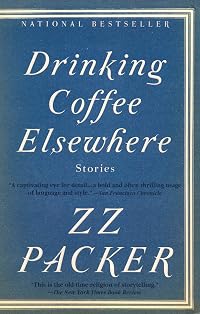
Drinking Coffee Elsewhere
by ZZ Packer
On This Page
Description
Discovered by The New Yorker, Packer "forms a constellation of young black experience"* whether she's writing from the perspective of a church-going black woman who has a crisis in faith, a young college student at Yale, or a young black man unwillingly accompanying his father to the Million Man March. This universally appealing collection of short fiction has already established ZZ Packer as "a writer to watch."Tags
Recommendations



































Member Recommendations

SqueakyChu short stories with interesting and varied black characters
Member Reviews
The eight stories in Drinking Coffee Elsewhere reveal an author finding her voice and, perhaps, revelling in its timbre. The best of these stories — I’m thinking of “Brownies,”, “Drinking Coffee Elsewhere,” and “Geese” — show remarkable poise, thoughtfulness, and trust; trust in her readers and in herself. None of the stories is especially innovative. Rather they show a young writer coming into her strength. Rightly lauded by a host of literary luminaries, she is a writer on the verge. What comes next will, I think, be truly exciting.
Packer takes on different narrative personae, but in many of her best stories in this collection the voice is of a highly intelligent black woman (whether very young or more mature) show more gingerly exploring the world around her, more or less successfully. Not always self-aware, the narrative voice is nonetheless urgent and beguiling. It is as though the future is just around the corner and our protagonist is determined to race forward to it rather than wait for its arrival. Inevitably this leads to situations that are unpredictable for the narrator, whether that confusion is due to the subtleties (or lack thereof) of racial demarcation, sexual orientation, or ethno-economic exoticism. When you stride out to meet the future, it often finds you unprepared and scrambling to regain your footing.
Gently recommended. And looking forward to whatever ZZ Packer decides to write next. show less
Packer takes on different narrative personae, but in many of her best stories in this collection the voice is of a highly intelligent black woman (whether very young or more mature) show more gingerly exploring the world around her, more or less successfully. Not always self-aware, the narrative voice is nonetheless urgent and beguiling. It is as though the future is just around the corner and our protagonist is determined to race forward to it rather than wait for its arrival. Inevitably this leads to situations that are unpredictable for the narrator, whether that confusion is due to the subtleties (or lack thereof) of racial demarcation, sexual orientation, or ethno-economic exoticism. When you stride out to meet the future, it often finds you unprepared and scrambling to regain your footing.
Gently recommended. And looking forward to whatever ZZ Packer decides to write next. show less
This is a splendid collection of African-American stories with a zing. They are biting, funny, and extremely well told.
In “Brownies”, a troop of Brownie scouts at camp decide to beat up the members of the all-white Brownie troop 909 by claiming they heard one of the troop members saying the word “nigger”. The meeting ground was the girls bathroom. The black Brownies’ encounter with Troop 909 was not at all like what they had imagined. This story is uproariously funny, but it has a sincere message.
In “Our Lady of Peace”, Lanea suffers through her first year of teaching at a Baltimore inner city school where she reveals mixed feelings to Sheba, a tough, tall unwed mother whose residence is in Our Lady of Peace.
“The Ant show more of the Self” follows Spurgeon who borrows his mom’s car to take his dad out of jail after posting bail. Little does Spurgeon know, at that time, that he and his dad would be headed to the Million Man March in Washington, DC, to engage in his dad’s entrepreneurial idea. show less
In “Brownies”, a troop of Brownie scouts at camp decide to beat up the members of the all-white Brownie troop 909 by claiming they heard one of the troop members saying the word “nigger”. The meeting ground was the girls bathroom. The black Brownies’ encounter with Troop 909 was not at all like what they had imagined. This story is uproariously funny, but it has a sincere message.
In “Our Lady of Peace”, Lanea suffers through her first year of teaching at a Baltimore inner city school where she reveals mixed feelings to Sheba, a tough, tall unwed mother whose residence is in Our Lady of Peace.
“The Ant show more of the Self” follows Spurgeon who borrows his mom’s car to take his dad out of jail after posting bail. Little does Spurgeon know, at that time, that he and his dad would be headed to the Million Man March in Washington, DC, to engage in his dad’s entrepreneurial idea. show less
This story collection really surprised me. "Before You Suffocate Your Own Fool Self," which I read recently, also featured talented young people of color trying to find their way in the world. What I found so interesting about "Drinking Coffee Elsewhere" was that the stories did not end triumphantly. They explore what happens when a person does not immediately transcend his or her difficult background. The title story in particular takes a hard look at the social isolation of arriving in a privileged world from such a low-income background. "Geese" took that idea to an even greater extreme, leaving its main character failing to fend for herself in distant Japan. The characters in these stories don't emerge with their spirits intact on show more the other side, and it's difficult to see a real way out for most of them. show less
This is an excellent collection of short stories by an author who was skilled at her craft. The characters are vividly drawn, yet the economy of words that is required in the short story genre is still maintained. The plots are engaging and I was never able to stop reading in the middle of a story and return to it later. They engaged me throughout.
The stories are about the experiences of being black in a culture dominated by whites. Because of this, this book is a valuable contribution to understanding the immense disservice racism does both the the perpertrators and to the victims.
This book tells stories which I will long remember and leaves me a little wiser and more empathetic about a situation that is a cancer in the American show more character and where the current political attituds are likely to make things even worse. show less
The stories are about the experiences of being black in a culture dominated by whites. Because of this, this book is a valuable contribution to understanding the immense disservice racism does both the the perpertrators and to the victims.
This book tells stories which I will long remember and leaves me a little wiser and more empathetic about a situation that is a cancer in the American show more character and where the current political attituds are likely to make things even worse. show less
I enjoy Packer's writing, especially the details of heat and scent that put me firmly in her world.
I loved the first story in the book, the one about the Brownie Girl Scout campout. It was refreshing to read a story with authentic details about Girl Scouting. For example, Tom Perrotta mentioned Girl Scouts briefly in The Leftovers, but they were doing fundraising for another organization, which Girl Scouts aren't allowed to do. Yes, yes, this is a horribly nitpicky detail to cite, but as a lifelong Girl Scout, I found Packer's details helped me form a connection with her and her characters. If the details hadn't been authentic, I wouldn't have felt like trusting her characters. As it was, I sang the "Brownie Smile Song" and "Make New show more Friends" along with her characters and that helped me to connect with them, which made the story all the more effective.
But oh, man, are her stories bleak.
Packer traps her characters. They're trapped by religion, by birth, by race. They're trapped by patterns of behavior and social structures designed to keep them safe and, when they attempt to break out of these structures whether to go to college or to Japan or to Baltimore, they inevitably find ruin and isolation. Of course, they were isolated before they attempted to break away, so her characters are largely damned if they do and damned if they don't.
In addition, there's a theme of parental abandonment, either by death or by prison or by addiction that lends a certain "original sin" aspect to the stories. Perhaps these characters are destined by their parents' situations to never be able to make a good go of it.
It's altogether too much like real life, which is kind of a downer.
I think it would have been less of a downer if this had been a novel rather than a series of short stories. If it were a novel, there would have been just one experience of desolation rather than one after another after another.
So, I'd like to read more ZZ Packer to see what else she does with her detailed writing style, just not until after I've read something lighter, like something with ponies and bunnies and pigs who herd sheep. show less
I loved the first story in the book, the one about the Brownie Girl Scout campout. It was refreshing to read a story with authentic details about Girl Scouting. For example, Tom Perrotta mentioned Girl Scouts briefly in The Leftovers, but they were doing fundraising for another organization, which Girl Scouts aren't allowed to do. Yes, yes, this is a horribly nitpicky detail to cite, but as a lifelong Girl Scout, I found Packer's details helped me form a connection with her and her characters. If the details hadn't been authentic, I wouldn't have felt like trusting her characters. As it was, I sang the "Brownie Smile Song" and "Make New show more Friends" along with her characters and that helped me to connect with them, which made the story all the more effective.
But oh, man, are her stories bleak.
Packer traps her characters. They're trapped by religion, by birth, by race. They're trapped by patterns of behavior and social structures designed to keep them safe and, when they attempt to break out of these structures whether to go to college or to Japan or to Baltimore, they inevitably find ruin and isolation. Of course, they were isolated before they attempted to break away, so her characters are largely damned if they do and damned if they don't.
In addition, there's a theme of parental abandonment, either by death or by prison or by addiction that lends a certain "original sin" aspect to the stories. Perhaps these characters are destined by their parents' situations to never be able to make a good go of it.
It's altogether too much like real life, which is kind of a downer.
I think it would have been less of a downer if this had been a novel rather than a series of short stories. If it were a novel, there would have been just one experience of desolation rather than one after another after another.
So, I'd like to read more ZZ Packer to see what else she does with her detailed writing style, just not until after I've read something lighter, like something with ponies and bunnies and pigs who herd sheep. show less
Long before you open Drinking Coffee Elsewhere, ZZ Packer's voice is a wave born in mid-ocean, gathering strength, obeying the moon's pull, churning toward land, so that when you finally do turn to the first page and read the first paragraph of the first story ("Brownies"), her strong, full, confident voice crashes over you:
By our second day at Camp Crescendo, the girls in my Brownie troop had decided to kick the asses of each and every girl in Brownie Troop 909. Troop 909 was doomed from the first day of camp; they were white girls, their complexions a blend of ice cream: strawberry, vanilla. They turtled out from their bus in pairs, their rolled-up sleeping bags chromatized with Disney characters: Sleeping Beauty, Snow White, Mickey show more Mouse; or the generic ones cheap parents bought: washed-out rainbows, unicorns, curly-eyelashed frogs. Some clutched Igloo coolers and still others held on to stuffed toys like pacifiers, looking all around them like tourists determined to be dazzled.
From that point forward, everything else is undertow.
Packer—whose much-lauded stories have appeared in The New Yorker, Harper's and the late great Story—arrives on the already-crowded short fiction market with all the fiery energy of Flannery O'Connor on a good day. The eight stories in Drinking Coffee Elsewhere are, as the photo on the dust jacket attests, messages in a bottle—or, more accurately, lightning in a bottle. Not only is the writing crisp and sharp, but Packer has a firm chokehold on each of her pitiable characters. She knows their hopes, their dreams, their resounding disappointments.
In "Every Tongue Shall Confess," Sister Clareese sings in the choir of the Greater Christ Emmanuel Pentecostal Church of the Fire Baptized and during the rest of the week at her nursing job, tries to convert an obstinate patient who mocks her at every turn. She straps on the Breastplate of Righteousness and marches forward, undaunted as Mrs. May on the horns of the bull in O'Connor's "Greenleaf."
In "The Ant of the Self," a champion high school debater picks his father up from jail and reluctantly drives him to the Million Man March in Washington, D.C. There, the ne'er-do-well father hopes to sell exotic birds to "the Afrocentric folks there." The chagrined son tells us, "He's so stupid, he's brilliant; so outside of the realm of any rationality that reason stammers and stutters when facing him." At the March, he hears a preacher exhort his listeners to cast off "the ant of the self—that small, blind, crumb-seeking part of ourselves." Getting rid of his good-for-nothing father isn't so easy, however.
"Geese" follows the downward spiral of a group of young people who can't find work in Tokyo and are slowly starving, at one point sharing one grapefruit and one banana between five people. The story relentlessly knocks them down from "the all-knowing arrogance of youth" to increasing desperation.
Other stories jolt us to the gritty terrain of drugs and prostitution in Atlanta, an unruly classroom in Baltimore, and a lunch counter in 1961 where a young girl—the only black student in her class—stages a mini sit-in protest. Packer never condescends to her characters, or the reader, as she tells the tales in voices that resonate with wit, anger and wisdom.
She has distilled her writing so that, in its 100-proof potency, it goes right to the back of the throat. Consider these two descriptions of characters from "Brownies":
Daphne hardly ever spoke, but when she did, her voice was petite and tinkly, the voice one might expect from a shiny new earring.
and
Usually people were quiet after Arnetta spoke. Her tone had an upholstered confidence that was somehow both regal and vulgar at once. It demanded a few moments of silence in its wake, like the ringing of a church bell or the playing of taps.
As William Strunk once advised would-be writers: "Omit needless words. Vigorous writing is concise. A sentence should contain no unnecessary words, a paragraph no unnecessary sentences, for the same reason that a drawing should have no unnecessary lines and a machine no unnecessary parts."
Nothing is wasted in a ZZ Packer story; every word relentlessly moves the reader forward to climaxes that sometimes leave us dangling in mid-air and sometimes bring us crashing down with, in the case of "Our Lady of Peace," three final, devastating words ("C'mon. Make me."). But on every page of Drinking Coffee Elsewhere, you feel the suck of the under-pulling water. Don't try to resist. Just let yourself drown in her words. show less
By our second day at Camp Crescendo, the girls in my Brownie troop had decided to kick the asses of each and every girl in Brownie Troop 909. Troop 909 was doomed from the first day of camp; they were white girls, their complexions a blend of ice cream: strawberry, vanilla. They turtled out from their bus in pairs, their rolled-up sleeping bags chromatized with Disney characters: Sleeping Beauty, Snow White, Mickey show more Mouse; or the generic ones cheap parents bought: washed-out rainbows, unicorns, curly-eyelashed frogs. Some clutched Igloo coolers and still others held on to stuffed toys like pacifiers, looking all around them like tourists determined to be dazzled.
From that point forward, everything else is undertow.
Packer—whose much-lauded stories have appeared in The New Yorker, Harper's and the late great Story—arrives on the already-crowded short fiction market with all the fiery energy of Flannery O'Connor on a good day. The eight stories in Drinking Coffee Elsewhere are, as the photo on the dust jacket attests, messages in a bottle—or, more accurately, lightning in a bottle. Not only is the writing crisp and sharp, but Packer has a firm chokehold on each of her pitiable characters. She knows their hopes, their dreams, their resounding disappointments.
In "Every Tongue Shall Confess," Sister Clareese sings in the choir of the Greater Christ Emmanuel Pentecostal Church of the Fire Baptized and during the rest of the week at her nursing job, tries to convert an obstinate patient who mocks her at every turn. She straps on the Breastplate of Righteousness and marches forward, undaunted as Mrs. May on the horns of the bull in O'Connor's "Greenleaf."
In "The Ant of the Self," a champion high school debater picks his father up from jail and reluctantly drives him to the Million Man March in Washington, D.C. There, the ne'er-do-well father hopes to sell exotic birds to "the Afrocentric folks there." The chagrined son tells us, "He's so stupid, he's brilliant; so outside of the realm of any rationality that reason stammers and stutters when facing him." At the March, he hears a preacher exhort his listeners to cast off "the ant of the self—that small, blind, crumb-seeking part of ourselves." Getting rid of his good-for-nothing father isn't so easy, however.
"Geese" follows the downward spiral of a group of young people who can't find work in Tokyo and are slowly starving, at one point sharing one grapefruit and one banana between five people. The story relentlessly knocks them down from "the all-knowing arrogance of youth" to increasing desperation.
Other stories jolt us to the gritty terrain of drugs and prostitution in Atlanta, an unruly classroom in Baltimore, and a lunch counter in 1961 where a young girl—the only black student in her class—stages a mini sit-in protest. Packer never condescends to her characters, or the reader, as she tells the tales in voices that resonate with wit, anger and wisdom.
She has distilled her writing so that, in its 100-proof potency, it goes right to the back of the throat. Consider these two descriptions of characters from "Brownies":
Daphne hardly ever spoke, but when she did, her voice was petite and tinkly, the voice one might expect from a shiny new earring.
and
Usually people were quiet after Arnetta spoke. Her tone had an upholstered confidence that was somehow both regal and vulgar at once. It demanded a few moments of silence in its wake, like the ringing of a church bell or the playing of taps.
As William Strunk once advised would-be writers: "Omit needless words. Vigorous writing is concise. A sentence should contain no unnecessary words, a paragraph no unnecessary sentences, for the same reason that a drawing should have no unnecessary lines and a machine no unnecessary parts."
Nothing is wasted in a ZZ Packer story; every word relentlessly moves the reader forward to climaxes that sometimes leave us dangling in mid-air and sometimes bring us crashing down with, in the case of "Our Lady of Peace," three final, devastating words ("C'mon. Make me."). But on every page of Drinking Coffee Elsewhere, you feel the suck of the under-pulling water. Don't try to resist. Just let yourself drown in her words. show less
This is an excellent collection of contemporary short fiction. Packer is great at quickly establishing characters, and while the stories tend to be more slice-of-life than a traditional beginning-middle-end format, they're all the better for capturing the nuance of character developments. Stories range from a conflict among troops of Brownies - one black, one white - to a teenage girl who runs away to Atlanta and is taken in by a pimp, to a boy forced by his father to try to sell birds at the Million Man March. All the stories are from an outsider's perspective and thus feel very relatable. I'll be looking out for future work from Z.Z. Packer.
Members
- Recently Added By
Lists

Recommend the 20 best books you've read in the last five years
2,168 works; 606 members

Backlisted
109 works; 9 members

Favorite Books by Mid-List Authors
25 works; 8 members

Pen/Faulkner Winners and Finalists
178 works; 9 members

Adult Books for YA Readers
194 works; 6 members

Recommendations
17 works; 1 member
Author Information

6+ Works 1,595 Members
ZZ Packer's stories have appeared in The New Yorker, Harper's, and Story. Packer is a recipient of a Whiting Writers' Award and a Rona Jaffe Foundation Writers' Award. A graduate of Yale, the Iowa Writers' Workshop, and the Writing Seminar at Johns Hopkins University, she has been a Wallace Stegner -- Truman Capote fellow at Stanford University, show more where she is currently a Jones lecturer. She lives in the San Francisco Bay area show less
Some Editions
Awards and Honors
Awards
Distinctions
Notable Lists
Work Relationships
Contains
Has as a student's study guide
Common Knowledge
- Canonical title
- Drinking Coffee Elsewhere
- Original title
- Drinking Coffee Elsewhere
- Original publication date
- 2003
- Important places*
- USA
- Epigraph*
- Teilen Sie meine Hoffnung, dass dieser Bericht über Menschen wie uns mithelfen mag, das Vermächtnis der Tatsache zu erleichtern, dass Geschichte sonst vorwiegend geschrieben wird von den Siegern.
Alex Haley, Wurzeln - Dedication
- Für meine Mutter, Rose Northington Packer, die "einen Weg aus der Ausweglosigkeit fand"
To my mother, Rose Northington Packer, who "made a way out of no way" - First words*
- Kaffee trinken anderswo: Die Orientierungsspiele begannen genau an dem Tag, an dem ich von Baltimore nach Yale kam.
Jede Zunge wird bekennen: Als Pastor Everett die Ankündigungen machte, die den Gottesdienst eröffneten, stand Clareese Mitchell mit den anderen Chormitgliedern da und wusste, dass sie wieder einmal ausharren, die starke Rü... (show all)stung Gottes, den Panzer der Gerechtigkeit anziehen musste, aber sie hatte ihr monatliches Unwohlsein und wollte eigentlich nur Eines: den Brüder-Kirchentag der Grossen Christus-Immanuel-Pfingstkirche der Feuergetauften verfluchen, der entschieden hatte, dass die Schwestern jeden Missionssonntag Weiss zu tragen hätten, ...
Unsere liebe Frau des Friedens: Der chromblitzende Verkaufsautomat im Busbahnhof Baltimore Travel Plaza blinkte: Chips! Chips! Chips!
Die Ameise des Ichs: "Aufstiegschancen", sagt mein Vater, nachdem ich ihn gegen Kaution aus dem Gefängnis geholt habe.
Brownies: Wir waren noch keine zwei Tage in Camp Crescendo, und die Mädchen meines Brownie-Trupps hatten schon beschlossen, dem gesamten Brownie-Trupp 909 die Ärsche zu polieren.
In Zungen reden: Nach der Sonntagsschule ging Tia gewöhnlich nach draussen, wo sie sich dann mit ihrer besten Freundin Marcelle unterhielt.
Gänse: Wenn die Leute daheim in Baltimore sie fragten, warum sie nach Tokio wollte, erzählte Dina ihnen, sie fahre nach Japan in der Hoffnung, einen Haufen Geld zu verdienen, es in einen Sparstrumpf zu stecken und dann ein ... (show all)Jahr an irgendeinem billigen tropischen Ort zu verbringen.
Doris kommt: Doris Yates stand im leeren Gotteshaus und fragte sich, ob die Welt wirklich in einigen wenigen Stunden enden würde. - Quotations
- He’s the only person I know who still calls cops “pigs”, a holdover from what he refers to as his Black Panther days, when “the brothers” raked their globes of hair with black-fisted Afro picks, then left them stuck... (show all) there like javelins.
- Last words*
- (Click to show. Warning: May contain spoilers.)Kaffee trinken anderswo: Sie klopft an die Tür und sagt: "Mach auf."
(Click to show. Warning: May contain spoilers.)Jede Zunge wird bekennen: Aber sie blieb noch ein paar Augenblicke lang stehen, auch als sich die übrigen Chorsängerinnen längst wieder gesetzt hatten und mit ihren Pappfächern wedelten, um ihre verschwitzten Gesichter zu kühlen.
(Click to show. Warning: May contain spoilers.)Unsere liebe Frau des Friedens: "Na los. Bring mich dazu."
(Click to show. Warning: May contain spoilers.)Die Ameise des Ichs: Und als mich der Drang zu weinen überkommt, warte ich - den Kopf in den Händen -, und er geht vorüber.
(Click to show. Warning: May contain spoilers.)Brownies: "Vielleicht ja. Einfach aus Freundlichkeit."
(Click to show. Warning: May contain spoilers.)In Zungen reden: Und sie lief los.
(Click to show. Warning: May contain spoilers.)Gänse: ...; erinnerte sich, wie sicher sie sich - in der allwissenden Arroganz der Jugend - gewesen war, dass sie unter denselben Umständen anders gehandelt hätte.
(Click to show. Warning: May contain spoilers.)Doris kommt: Der Himmel hatte gerade diesen Farbton erreicht, den sie besonders mochte, ein kaum noch leuchtendes Blau, dieses Blau, das ans Fenster kam, wenn man nicht wieder einschlafen konnte, es aber noch nicht schaffte, sich zum richtigen Wachsein aufzuraffen. - Blurbers
- Updike, John; Saunders, George; Smith, Zadie; Dybek, Stuart; Livesey, Margot; Dixon, Stephen
- Canonical DDC/MDS
- 813.6
- Canonical LCC
- PS3616.A335
*Some information comes from Common Knowledge in other languages. Click "Edit" for more information.
Classifications
Statistics
- Members
- 1,533
- Popularity
- 14,982
- Reviews
- 34
- Rating
- (3.84)
- Languages
- 8 — Dutch, English, French, German, Italian, Polish, Serbian, Spanish
- Media
- Paper, Audiobook, Ebook
- ISBNs
- 27
- UPCs
- 1
- ASINs
- 14