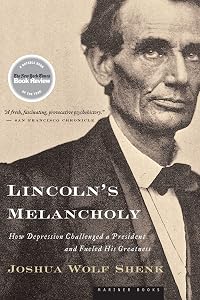
Lincoln's Melancholy: How Depression Challenged a President and Fueled His Greatness
by Joshua Wolf Shenk
On This Page
Description
Drawing on seven years of his own research and the work of other esteemed Lincoln scholars, Shenk reveals how the sixteenth president harnessed depression to fuel his astonishing success. Lincoln found the solace and tactics he needed to deal with the nation's worst crisis in the "coping strategies" he had developed over a lifetime of persevering through depressive episodes and personal tragedies. With empathy and authority gained from his own experience with depression, Shenk crafts a show more revelatory account of Lincoln and his legacy. Based on careful research, this book unveils a wholly new perspective on how our greatest president brought America through its greatest turmoil. By consciously shifting his goal away from personal contentment (which he realized he could not attain) and toward universal justice, Lincoln gained the strength and insight that he, and America, required to transcend profound darkness.--From publisher description. show lessTags
Recommendations










Member Reviews
Definitely one of my memorable books of the year but Lincoln’s Melancholy is not a traditional biography of Abraham Lincoln. Shenk’s premise is that Lincoln’s struggles with melancholy/depression ultimately helped him to guide America through the turmoils of the Civil War and, with reference to Lincoln’s writings and other contemporary documents, this is what Shenk sets out to prove with this book. Shenk tries to answer the questions of whether Lincoln’s melancholy was indeed what we would term clinical depression today, how Lincoln responded to his melancholy and how Lincoln’s experience of melancholy contributed to his work as a public figure.
If you’re looking for a straight biography of Lincoln and his presidency then show more this may not be the book to choose. Whilst Shenk does cover most of the major events of Lincoln’s life, his focus is more on discussing Lincoln’s thoughts and feelings around each event rather than giving the clearest picture of the progression of the events themselves. I didn’t come away from this book feeling like I understood how Abraham Lincoln became president or the whys and wherefores behind the American Civil War but I did come away feeling like I understood Lincoln’s personality and his melancholy.
Having experienced and struggled with depression/clinical depression/melancholy (whatever you want to call it) myself and knowing other people who have also struggled with it, I found this book quite an emotional read at times but also a very helpful book to read. The parts I found most interesting concerned the differences between our late 20th century/early 21st century views of mental illness and depression and the 19th century view of Lincoln’s time. Although the treatments for depression/melancholy in the 19th century often seemed quite barbaric to my eyes, this seemed to be balanced by a society that accepted personalities that were not always bright, bubbly and cheerful. Lincoln was well known when he was alive for having a sad and melancholy disposition as well as a great ability for telling jokes and laughing, and this sadness or melancholy seemed to be respected by his contemporaries as a normal aspect of people’s personalities; it was recognised that there may be a positive side to this as well as a negative.
‘The big difference is that today we often hear that the disease of depression is entirely distinct from the ordinary experience of being sad or in the dumps. But in the nineteenth-century conception of melancholy they were part of the same overall picture. A person with a melancholy temperament had been fated with both an awful burden and what Byron called ‘a fearful gift’. The burden was sadness and despair that could tip into a state of disease. But the gift was a capacity for depth, wisdom – even genius.’
I understood Shenk to be saying that Lincoln had both a melancholy disposition and that he experienced periods of what we term clinical depression. The phrase melancholy disposition doesn’t mean the sort of Eeyore-like negativity that I think in the 21st century we tend to associate with such a phrase, but includes a sense of graveness and sensitivity. Shenk, of course, is not advocating that we don’t treat clinical depression but that we recognise that the sort of temperaments that may be more susceptible to clinical depression and other mental illnesses have their good points and bad points in the same way as other temperaments do, and that, most importantly, it is OK to have a more melancholy temperament in the same way that it is OK to have a more bright and bubbly one.
In fact, interestingly, Shenk references certain studies which have shown that depressed people may be more in touch with reality than those we think of as optimists and he argues that it was this depressive realism that helped Lincoln govern America successfully during one of its toughest periods; he saw the approaching storm more quickly than his more optimistic opponents.
‘In Lincoln’s time people understood…. {that} every cognitive style has assets and defects, which change according to circumstances. This seems surprising today because, by some quirk of culture, some cognitive styles are held to be superior and others inferior; one emotion (joy) is “positive” and all others (sadness, fear, anger and shame) are “negative”. If we value accurate perception, however, we must qualify our worship of joy and happiness. People actively seek to filter out painful stimuli, and while this may help them limit distress, it can also sharply distort their actual environment. “If most of us remain ignorant of ourselves,” wrote Aldous Huxley, “it is because self-knowledge is painful and we prefer the pleasures of illusion.”’
One of the points that I found particularly encouraging was Shenk’s claim that although Lincoln’s suffering bore fruit during the American Civil War, he was never completely cured of his melancholy.
‘No point exists after which the melancholy dissolved – not January 1841, not during his “reign of reason” in middle age, and not at his political resurgence beginning in 1854. Some scholars aver that Lincoln’s melancholy abated in the war years, as he was too busy with his work to give space to his own gloom. We’ll see evidence to the contrary. Whatever greatness Lincoln achieved cannot be explained as a triumph over personal suffering. Rather, it must be accounted for as an outgrowth of the same system that produced the suffering. This is not a story of transformation but one of integration. Lincoln didn’t do great work because he solved the problem of his melancholy. The problem of his melancholy was all the more fuel for the fire of his great work.’
It probably sounds strange to say that’s encouraging, but as someone who has struggled with mental illness in one form or another for almost half my life, it’s more encouraging to read about someone who managed to live with something similar than to read the more common type of biography where the suffering is completely overcome, never again to reappear (crisis and recovery narratives as Shenk calls them).
So, in summary, if you want to understand how Lincoln became president and led America during the American Civil War then this is not the book for you. If you have any interest in mental illness or suffering then I think this would be both a helpful and interesting book to read. show less
If you’re looking for a straight biography of Lincoln and his presidency then show more this may not be the book to choose. Whilst Shenk does cover most of the major events of Lincoln’s life, his focus is more on discussing Lincoln’s thoughts and feelings around each event rather than giving the clearest picture of the progression of the events themselves. I didn’t come away from this book feeling like I understood how Abraham Lincoln became president or the whys and wherefores behind the American Civil War but I did come away feeling like I understood Lincoln’s personality and his melancholy.
Having experienced and struggled with depression/clinical depression/melancholy (whatever you want to call it) myself and knowing other people who have also struggled with it, I found this book quite an emotional read at times but also a very helpful book to read. The parts I found most interesting concerned the differences between our late 20th century/early 21st century views of mental illness and depression and the 19th century view of Lincoln’s time. Although the treatments for depression/melancholy in the 19th century often seemed quite barbaric to my eyes, this seemed to be balanced by a society that accepted personalities that were not always bright, bubbly and cheerful. Lincoln was well known when he was alive for having a sad and melancholy disposition as well as a great ability for telling jokes and laughing, and this sadness or melancholy seemed to be respected by his contemporaries as a normal aspect of people’s personalities; it was recognised that there may be a positive side to this as well as a negative.
‘The big difference is that today we often hear that the disease of depression is entirely distinct from the ordinary experience of being sad or in the dumps. But in the nineteenth-century conception of melancholy they were part of the same overall picture. A person with a melancholy temperament had been fated with both an awful burden and what Byron called ‘a fearful gift’. The burden was sadness and despair that could tip into a state of disease. But the gift was a capacity for depth, wisdom – even genius.’
I understood Shenk to be saying that Lincoln had both a melancholy disposition and that he experienced periods of what we term clinical depression. The phrase melancholy disposition doesn’t mean the sort of Eeyore-like negativity that I think in the 21st century we tend to associate with such a phrase, but includes a sense of graveness and sensitivity. Shenk, of course, is not advocating that we don’t treat clinical depression but that we recognise that the sort of temperaments that may be more susceptible to clinical depression and other mental illnesses have their good points and bad points in the same way as other temperaments do, and that, most importantly, it is OK to have a more melancholy temperament in the same way that it is OK to have a more bright and bubbly one.
In fact, interestingly, Shenk references certain studies which have shown that depressed people may be more in touch with reality than those we think of as optimists and he argues that it was this depressive realism that helped Lincoln govern America successfully during one of its toughest periods; he saw the approaching storm more quickly than his more optimistic opponents.
‘In Lincoln’s time people understood…. {that} every cognitive style has assets and defects, which change according to circumstances. This seems surprising today because, by some quirk of culture, some cognitive styles are held to be superior and others inferior; one emotion (joy) is “positive” and all others (sadness, fear, anger and shame) are “negative”. If we value accurate perception, however, we must qualify our worship of joy and happiness. People actively seek to filter out painful stimuli, and while this may help them limit distress, it can also sharply distort their actual environment. “If most of us remain ignorant of ourselves,” wrote Aldous Huxley, “it is because self-knowledge is painful and we prefer the pleasures of illusion.”’
One of the points that I found particularly encouraging was Shenk’s claim that although Lincoln’s suffering bore fruit during the American Civil War, he was never completely cured of his melancholy.
‘No point exists after which the melancholy dissolved – not January 1841, not during his “reign of reason” in middle age, and not at his political resurgence beginning in 1854. Some scholars aver that Lincoln’s melancholy abated in the war years, as he was too busy with his work to give space to his own gloom. We’ll see evidence to the contrary. Whatever greatness Lincoln achieved cannot be explained as a triumph over personal suffering. Rather, it must be accounted for as an outgrowth of the same system that produced the suffering. This is not a story of transformation but one of integration. Lincoln didn’t do great work because he solved the problem of his melancholy. The problem of his melancholy was all the more fuel for the fire of his great work.’
It probably sounds strange to say that’s encouraging, but as someone who has struggled with mental illness in one form or another for almost half my life, it’s more encouraging to read about someone who managed to live with something similar than to read the more common type of biography where the suffering is completely overcome, never again to reappear (crisis and recovery narratives as Shenk calls them).
So, in summary, if you want to understand how Lincoln became president and led America during the American Civil War then this is not the book for you. If you have any interest in mental illness or suffering then I think this would be both a helpful and interesting book to read. show less
This is an important book, really the first contribution to the much-needed heroes for depressives’ canon. Abraham Lincoln, consider by most to be the greatest American president, suffered to major depressive episodes as a young adult and chronic depression throughout his life. Shenk traces Lincoln’s mental history and defends his thesis that the challenges Lincoln faced from depression actually fueled his greatness. The author examines modern psychological understandings of depression as well as the view of melancholy from Lincoln’s time (generally more favorable than today). I can’t say enough about how great this book was for understanding Lincoln as well as my own struggles with depression.
The Perspectives of Psychiatry – show more Paul R. McHugh & Phillip R. Slavney
Born Losers: A History of Failure in America – Scott Sandage
“It is common sense that some situations call for pessimism, but as a culture Americans have strangely decided to endow optomism with unqualified favor. Politicians today compete to be the most optimistic, and accuse their opponent of pessimism, as if it were a defect. This trend is visible in psychology as well. Whereas ‘melancholy’ in Lincoln’s time was understood to be a multifaceted phenomenon that conferred potential advantages along with grave dangers, today we tend to discount its complexities. Psychiatrists see only a biological brain disease. Psychologists see only errors in thinking. That is, if you don’t like yourself, or you feel hopeless, or you see life as fundamentally dissatisfying, you’ve fallen victim to what researchers call ‘learned helplessness.’” – p. 134
“Whatever greatness Lincoln achieved cannot be explained as a triumph over personal suffering. Rather, it must be accounted for as an outgrowth of the same system that produced suffering. This is not a story of transformation but one of integration. Lincoln didn’t do great work because he solved the problem of his melancholy. The problem of his melancholy was all the more fuel for the fire of his great work.” – p. 156
“I am now the most miserable man living. If what I felt were distribute to the whole human family there would not be one happy face on the earth. I must die or be better it appears to me. I awfully forebode I shall not. The matter you speak of on my account you may attend to as you see fit, as I fear I shall be unable to attend to business. If I could be myself, I would rather stay here with Judge Logan. I can write no more.” – Letter from Abraham Lincoln, January 23, 1841, p. 212-13 show less
The Perspectives of Psychiatry – show more Paul R. McHugh & Phillip R. Slavney
Born Losers: A History of Failure in America – Scott Sandage
“It is common sense that some situations call for pessimism, but as a culture Americans have strangely decided to endow optomism with unqualified favor. Politicians today compete to be the most optimistic, and accuse their opponent of pessimism, as if it were a defect. This trend is visible in psychology as well. Whereas ‘melancholy’ in Lincoln’s time was understood to be a multifaceted phenomenon that conferred potential advantages along with grave dangers, today we tend to discount its complexities. Psychiatrists see only a biological brain disease. Psychologists see only errors in thinking. That is, if you don’t like yourself, or you feel hopeless, or you see life as fundamentally dissatisfying, you’ve fallen victim to what researchers call ‘learned helplessness.’” – p. 134
“Whatever greatness Lincoln achieved cannot be explained as a triumph over personal suffering. Rather, it must be accounted for as an outgrowth of the same system that produced suffering. This is not a story of transformation but one of integration. Lincoln didn’t do great work because he solved the problem of his melancholy. The problem of his melancholy was all the more fuel for the fire of his great work.” – p. 156
“I am now the most miserable man living. If what I felt were distribute to the whole human family there would not be one happy face on the earth. I must die or be better it appears to me. I awfully forebode I shall not. The matter you speak of on my account you may attend to as you see fit, as I fear I shall be unable to attend to business. If I could be myself, I would rather stay here with Judge Logan. I can write no more.” – Letter from Abraham Lincoln, January 23, 1841, p. 212-13 show less
A wonderful book but not a biography. A reader needs to already have some grounding in US history and the life of Abraham Lincoln as well as keep an open mind. Given the mountain of books written about Lincoln, this gem manages to unearth novel aspects about the man, his century and his country.
Shenk shows how Lincoln's struggle with depression made him a better man, how 19th century society was much more tolerant regarding depression - a marked contrast to today's fake smile and happiness society. Lincoln's sadness, a trait everybody noticed, would kill his political prospects today (with its paradox insistence on authenticity and positiveness). Lincoln, the personified American Dream, rising by his own hand from humble beginning to show more the command of the nation, would be very un-American, even European today - writing poetry, introverted, sad and quiet - only when cracking jokes would his spirits lift him, his face animate and a spark of joy transform his company. Given his awkward looks, he probably would be a comedy writer cheated by the corporations today.
Shenk's framing of Lincoln's life through his depressions as well as the numerous vignettes about Lincoln's life should enlighten and enchant most readers. I learned a lot about Lincoln and it changed the way I see him. Highly recommended. show less
Shenk shows how Lincoln's struggle with depression made him a better man, how 19th century society was much more tolerant regarding depression - a marked contrast to today's fake smile and happiness society. Lincoln's sadness, a trait everybody noticed, would kill his political prospects today (with its paradox insistence on authenticity and positiveness). Lincoln, the personified American Dream, rising by his own hand from humble beginning to show more the command of the nation, would be very un-American, even European today - writing poetry, introverted, sad and quiet - only when cracking jokes would his spirits lift him, his face animate and a spark of joy transform his company. Given his awkward looks, he probably would be a comedy writer cheated by the corporations today.
Shenk's framing of Lincoln's life through his depressions as well as the numerous vignettes about Lincoln's life should enlighten and enchant most readers. I learned a lot about Lincoln and it changed the way I see him. Highly recommended. show less
A great, scholarly work on Lincoln's inner life which was, apparently, very bleak. "I am now the most miserable man living", he said in his early thirties, and I admit, he might have been a contender. Comprised of oral reports, letters and references to other biographies and Lincoln's own writing, this work paints a picture all the way from Lincoln's early years to his assassination as president. Shenk critically assesses the available evidence, and, fortunately is honest when this evidence is not sufficient for bold and sweeping statements about Abe's life. Not only a biography but a study of mental health, this book is both historically important and valuable for those who are as melancholy as Lincoln, and yearn for a meaningful way show more to combat it, or atleast manage their way through bravely. show less
Book #81:
Title: [35468::Lincoln's Melancholy]
Author: Joshua Wolf Shenk
Dates: started 11-10-10; finished 11-28-10
Genre: non-fiction
Length: 243 pages (+ over 100 pages of notes, sources, & index)
Source: inter-library loan
Challenges: 1010 Challenge ("Blue vs. gray" category) & 75 Challenge
Most people with an interest in history have heard about Mary Todd Lincoln's mental problems, as documented in [3906445::The Madness of Mary Lincoln] which I read earlier this year. Lesser known are Honest Abe's psychological issues. Strong historical evidence exists which indicates that, prior to his presidency, Abraham Lincoln suffered several emotional breakdowns resulting from clinical depression, and that he suffered from "melancholy," or chronic show more depression, for most of his life.
Most enlightening is Shenk's contention that it was precisely Lincoln's tendency to depression which helped to fuel his greatness as President. Shenk argues that the wisdom and perspective Lincoln gained in his struggles with depression were vital to how he managed the challenges and tensions of the Executive Office during the Civil War. Indeed, the link between depression and creativity -- and Lincoln demonstrated genuine creativity in dealing with the challenges of an embattled nation -- has been documented by numerous studies. One aspect of Lincoln's personality which may have served our nation particularly well was his "depressive realism." At a time when many predicted that the War would be over in a few months, he knew better and was not disillusioned when the going was much tougher than was widely expected.
The book also looks at the differences between how depression, particularly in public figures, was viewed very differently in Lincoln's day than today. People accepted Lincoln's melancholy nature, and were even attracted by it; far different than today, where the mere hint of a history of mental health treatment can derail a potential candidate.
I found this book both interesting and inspiring. It was refreshing to see how Lincoln learned to cope with his dark moods and to channel his energies to constructive use.
The book ends with an epilogue which examines the history of Lincoln scholarship, and how this facet of his life and personality has been obscured in most histories of the man. show less
Title: [35468::Lincoln's Melancholy]
Author: Joshua Wolf Shenk
Dates: started 11-10-10; finished 11-28-10
Genre: non-fiction
Length: 243 pages (+ over 100 pages of notes, sources, & index)
Source: inter-library loan
Challenges: 1010 Challenge ("Blue vs. gray" category) & 75 Challenge
Most people with an interest in history have heard about Mary Todd Lincoln's mental problems, as documented in [3906445::The Madness of Mary Lincoln] which I read earlier this year. Lesser known are Honest Abe's psychological issues. Strong historical evidence exists which indicates that, prior to his presidency, Abraham Lincoln suffered several emotional breakdowns resulting from clinical depression, and that he suffered from "melancholy," or chronic show more depression, for most of his life.
Most enlightening is Shenk's contention that it was precisely Lincoln's tendency to depression which helped to fuel his greatness as President. Shenk argues that the wisdom and perspective Lincoln gained in his struggles with depression were vital to how he managed the challenges and tensions of the Executive Office during the Civil War. Indeed, the link between depression and creativity -- and Lincoln demonstrated genuine creativity in dealing with the challenges of an embattled nation -- has been documented by numerous studies. One aspect of Lincoln's personality which may have served our nation particularly well was his "depressive realism." At a time when many predicted that the War would be over in a few months, he knew better and was not disillusioned when the going was much tougher than was widely expected.
The book also looks at the differences between how depression, particularly in public figures, was viewed very differently in Lincoln's day than today. People accepted Lincoln's melancholy nature, and were even attracted by it; far different than today, where the mere hint of a history of mental health treatment can derail a potential candidate.
I found this book both interesting and inspiring. It was refreshing to see how Lincoln learned to cope with his dark moods and to channel his energies to constructive use.
The book ends with an epilogue which examines the history of Lincoln scholarship, and how this facet of his life and personality has been obscured in most histories of the man. show less
I just don't know what to make of this book. It's interesting and filled with all sorts of delectable detail, but as far as the major premise goes, I remain skeptical. The author's assumption is that because melancholy and depression change your focus on how you see the world and because Lincoln suffered from what seems to be perpetual gloom, that this enabled him to become the great man he became, moving through stages of fear and on to insight and creativity. Well, maybe.I have to admit that my crap detector went into overdrive on several occasions while reading this book.
Frankly, given the multiple tragedies in Lincoln's life he had every reason to be gloomy. Death was an ever present reality. (More on the barbaric medical practices show more of the time later.) Secondly, the 19th century seems to wallow in gloom. Just read some of Hawthorne, Poe, and others of the early 19th and you'll feel gloomy by osmosis.
Now for some of the really juicier and fun parts of this book. I laughed out loud at the passages on studies on depression and the realization that "happiness" is really a mental disorder: "Abramson and Alloy termed the benefit that depressed people showed in the experiment the "Depressive Realism" or the "Sadder but Wiser" effect. . . For example, one standard definition of mental health is the ability to maintain close and accurate contact with reality. . .But research shows that by this definition, happiness itself should be considered a mental disorder." (Priceless) "In fact,'much research suggests that when they are not depressed, people are highly vulnerable to illusions, including unrealistic optimism, overestimation of themselves, and an exaggerated sense of their capacity to control events." The lesson? Get Gloomy, folks. Happiness psychologist Richard Bentall suggested (only half-facetiously) should be classified as a psychiatric disorder: "major affective disorder (pleasant type.)"
Lincoln's "hypochondriasis" as it was known was treated in his day according to Dr. Benjamin Rush's Medical Inquiries and Observations upon the Diseases of the Mind, the stand text. This included "drastic interferences" with the body. Starting by bleeding (usually 12.5 pints in two months - we are really talking about a total flush here), then "blistering" by applying "small heated cups at the temples, behind the ears, and at the nape of the neck." Of course, leeches could also be used. Next, drugs were given to induce vomiting and diarrhea, all the while, requiring that the patients fast, Rush noting that elephant tamers make their charges more docile by starving them. Following this regimen was a diet of stimulants including quinine and black pepper in large doses. Mercury was used to purge the stomach (also arsenic and strychnine. Of course, mercury also causes depression, anxiety and irritability.) Green stools were a positive sign, indicating the "black bile" cause of the illness was leaving. Apparently the more the patient suffered the better as it was evidence the body was being cleaned out. Whether Lincoln underwent all of these treatments is unclear, although we know that Dr. Henry, his physician was an advocate of Rush's treatments.
Shenck appears to approve of Nietzsche's (and probably Frankel would approve, too) remark "That which does not kill me makes me stronger." Well, maybe.
Occasionally, I felt that the author might have done better to write a long journal article to make his point. Long digressions on the Missouri Compromise and other historical niceties while fascinating (and they were, I really enjoyed his lucid presentations of all sorts of historical facts) seemed unnecessary to his thesis. BUT, I really did enjoy the read and would recommend it. show less
Frankly, given the multiple tragedies in Lincoln's life he had every reason to be gloomy. Death was an ever present reality. (More on the barbaric medical practices show more of the time later.) Secondly, the 19th century seems to wallow in gloom. Just read some of Hawthorne, Poe, and others of the early 19th and you'll feel gloomy by osmosis.
Now for some of the really juicier and fun parts of this book. I laughed out loud at the passages on studies on depression and the realization that "happiness" is really a mental disorder: "Abramson and Alloy termed the benefit that depressed people showed in the experiment the "Depressive Realism" or the "Sadder but Wiser" effect. . . For example, one standard definition of mental health is the ability to maintain close and accurate contact with reality. . .But research shows that by this definition, happiness itself should be considered a mental disorder." (Priceless) "In fact,'much research suggests that when they are not depressed, people are highly vulnerable to illusions, including unrealistic optimism, overestimation of themselves, and an exaggerated sense of their capacity to control events." The lesson? Get Gloomy, folks. Happiness psychologist Richard Bentall suggested (only half-facetiously) should be classified as a psychiatric disorder: "major affective disorder (pleasant type.)"
Lincoln's "hypochondriasis" as it was known was treated in his day according to Dr. Benjamin Rush's Medical Inquiries and Observations upon the Diseases of the Mind, the stand text. This included "drastic interferences" with the body. Starting by bleeding (usually 12.5 pints in two months - we are really talking about a total flush here), then "blistering" by applying "small heated cups at the temples, behind the ears, and at the nape of the neck." Of course, leeches could also be used. Next, drugs were given to induce vomiting and diarrhea, all the while, requiring that the patients fast, Rush noting that elephant tamers make their charges more docile by starving them. Following this regimen was a diet of stimulants including quinine and black pepper in large doses. Mercury was used to purge the stomach (also arsenic and strychnine. Of course, mercury also causes depression, anxiety and irritability.) Green stools were a positive sign, indicating the "black bile" cause of the illness was leaving. Apparently the more the patient suffered the better as it was evidence the body was being cleaned out. Whether Lincoln underwent all of these treatments is unclear, although we know that Dr. Henry, his physician was an advocate of Rush's treatments.
Shenck appears to approve of Nietzsche's (and probably Frankel would approve, too) remark "That which does not kill me makes me stronger." Well, maybe.
Occasionally, I felt that the author might have done better to write a long journal article to make his point. Long digressions on the Missouri Compromise and other historical niceties while fascinating (and they were, I really enjoyed his lucid presentations of all sorts of historical facts) seemed unnecessary to his thesis. BUT, I really did enjoy the read and would recommend it. show less
This is a solid read. The book's premise is that Mr. Lincoln suffered from melancholy. Today, many would consider his suffering as clinical chronic depression. I think the book does speculate a lot, as it is impossible to really know how severe it was. However, based on writings of Lincoln himself and his contemporaries, it is highly likely he did suffer from depression at times. At one point early in his career, Lincoln does contemplate suicide, and he may have published a poem anonymously about suicide. Moreover, it's undeniable that Lincoln had a natural gloomy, contemplative countenance and aura about him. Evidence for that is all over the place from numerous published accounts of his peers to portraits of the man.
The author show more attempts to weave the analysis of Lincoln's mental health with his life story. He uses this linear progression of Mr. Lincoln's life to show how Lincoln learned how to adapt to his illness, and he shows the ways Lincoln used his suffering to see the world in a different way, and strategies he used to deal with depression, like humor. There is a lot to like about this book, and it contains many little stories about Lincoln that I haven't heard elsewhere.
So, I would recommend this one with the understanding that there is a bit of speculation here, and we may never know the whole picture of Lincoln's mental health. Perhaps, that is best. Lincoln is a mysterious man in many ways and I kind of like it that way. show less
The author show more attempts to weave the analysis of Lincoln's mental health with his life story. He uses this linear progression of Mr. Lincoln's life to show how Lincoln learned how to adapt to his illness, and he shows the ways Lincoln used his suffering to see the world in a different way, and strategies he used to deal with depression, like humor. There is a lot to like about this book, and it contains many little stories about Lincoln that I haven't heard elsewhere.
So, I would recommend this one with the understanding that there is a bit of speculation here, and we may never know the whole picture of Lincoln's mental health. Perhaps, that is best. Lincoln is a mysterious man in many ways and I kind of like it that way. show less
Members
- Recently Added By
Lists

Best Biographies
216 works; 24 members

Non-Fiction Worth Reading
1,025 works; 264 members

Books To Get From The Library
115 works; 5 members
Author Information

4+ Works 1,353 Members
Joshua Wolf Shenk is an essayist and independent scholar whose work has appeared in numerous magazines and in the national bestseller Unholy Ghost: Writers on Depression. He has written for The New Yorker, Harper's Magazine, The Atlantic Monthly, The New York Times, New Republic, the Economist, U.S. News and World Report, and other publications. show more His book, Lincoln's Melancholy: How Depression Challenged a President and Fueled His Greatness, has won awards from the Abraham Lincoln Institute, the National Alliance for the Mentally Ill, and the National Mental Health Association. (Bowker Author Biography) show less
Awards and Honors
Common Knowledge
- Original publication date
- 2005
- People/Characters
- Abraham Lincoln; Elizabeth Abell; Lyn Abramson; John Quincy Adams; Spiro T. Agnew (referenced as Spiro Agnew); Hagop S. Akiskal (show all 35); Lauren Alloy; Dwight Anderson; Sherwood Anderson; Nancy Andreasen; Paul Angle; Isaac N. Arnold (as Isaac Arnold); James Ashley; Edward Dickinson Baker (as Edward D. Baker); Jean Baker; William E. Barton; Edward Bates; Henry Ward Beecher; Jane Bell; John Bell; Richard Bentall; Albert J. Beveridge (as Albert Beveridge); James Harvey Bingham; Jonathan Birch; Chauncey Black; Albert Taylor Bledsoe; John Wilkes Booth; Henry C. Bowen; John Cabell Breckinridge (as John C. Breckinridge); Sidney Breese; John Bright; A. A. Brill; Noah Brooks; Preston Brooks; William J. Bross
- Important places
- USA
- Important events
- American Civil War (1861 | 1865)
- Epigraph
- The inclination to exchange thoughts with one another is probably an original impulse of our nature. If I be in pain I wish to let you know it, and to ask your sympathy and assistance; and my pleasurable emotions also, I wish... (show all) to communicate to, and share with you. -- Abraham Lincoln, February 11, 1859
- Dedication
- For Joanne Wolf Cohen and Richard L. Shenk
- First words
- A year before he died, Leo Tolstoy, told this story to a reporter for the New York World.
- Last words
- (Click to show. Warning: May contain spoilers.)Whenever possible, in the source notes that follow I have referred to the letters, interviews, and sketches that draw out the words of people who knew Lincoln, who felt his presence in a room, and who saw the flash of his blue-gray eyes.
- Blurbers
- Solomon, Andrew; Jamison, Kay Redfield; Holzer, Harold; Ghaemi, S. Nassir
Classifications
- Genres
- Nonfiction, General Nonfiction, History, Biography & Memoir
- DDC/MDS
- 973.7092 — History & geography History of North America United States Civil War Era (1857-1865) Civil War
- LCC
- E457.2 .S47 — History of the United States United States Civil War period, 1861-1865 Lincoln's administrations, 1861-April 15, 1865
- BISAC
Statistics
- Members
- 1,081
- Popularity
- 23,778
- Reviews
- 27
- Rating
- (4.10)
- Languages
- English
- Media
- Paper, Audiobook, Ebook
- ISBNs
- 8
- UPCs
- 3
- ASINs
- 8