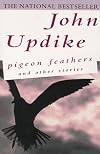
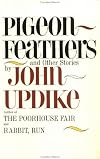
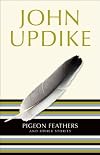
Pigeon Feathers and Other Stories
by John Updike
On This Page
Description
"Some of the most beautiful writing in contemporary American literature is between the covers of this book . . ." BOSTON HERALD The triumphant collection of short stories by America's most acclaimed novelist. "From the Paperback edition."Tags
Recommendations




















Member Reviews
This is the first complete collection I've read from Updike, though I've read his novels and a few of his stories in the past. "A & P"--one of the stories in this collection--was one of the first stories of his I encountered, and although I appreciated the language, it didn't particularly strike me as memorable or so powerful as his reputation would suggest. And, in general, that's where a lot of these stories land for me.
The mid-sized ones of around 10-15 pages are, for me, generally the most powerful and worthwhile ones here. Often centered around a character whose particular fatal flaw becomes clearer and clearer over the course of a story, and ultimately affects the ending of the story, these were the ones that carried me along with show more the most engagement. In the longest and shortest of the stories, Updike's language shone just as much as always, but I was reading to read. The last few stories in the book felt especially autobiographical and wandering, without the heft of many of the shorter stories.
I may very well read another of his collections and more of his novels, but it will be for language and his intricately built characters, fascinating as they are, as much as a want for story. show less
The mid-sized ones of around 10-15 pages are, for me, generally the most powerful and worthwhile ones here. Often centered around a character whose particular fatal flaw becomes clearer and clearer over the course of a story, and ultimately affects the ending of the story, these were the ones that carried me along with show more the most engagement. In the longest and shortest of the stories, Updike's language shone just as much as always, but I was reading to read. The last few stories in the book felt especially autobiographical and wandering, without the heft of many of the shorter stories.
I may very well read another of his collections and more of his novels, but it will be for language and his intricately built characters, fascinating as they are, as much as a want for story. show less
My headspace was a little off when I started this collection of short stories to begin with. I was excited to read them because I had finished a handful of other John Steinbeck novels over the past year — yes...John Steinbeck. I grabbed this off my shelf and apparently my brain only registered the "John" part and maybe "famous author" part for the last name. And even though the jacket is covered with rave reviews, Updike at least via this collection is far from a Steinbeck. In fact, he's far from recognizable as the Updike that the reviewers are lauding. Nothing happens in any of these stories. The writing is bland, the characters are bland. The human emotion and reaction....everything is so hollow.
I'll read Rabbit, Run at some point show more since that's one of his best-known books and I already own it, but I can't say I'm going to jump it to the head of the line anytime soon. This was the fourth work I've read by Updike and by far my least favorite (although none among the other three reached four stars).
Two stars. show less
I'll read Rabbit, Run at some point show more since that's one of his best-known books and I already own it, but I can't say I'm going to jump it to the head of the line anytime soon. This was the fourth work I've read by Updike and by far my least favorite (although none among the other three reached four stars).
Two stars. show less
Pigeon Feathers is a collection of short stories about Love’s shadow. By that I mean it is not about Love but about Love’s side effects. Lust, longing, loss. It’s a passionless book about passions.
I haven’t read anything else by John Updike and this doesn’t make me want to. He writes the way I’m afraid I will. Too many words, so carefully arranged to make an impact that you only notice the arrangement and never feel the impact. A gilded cardboard sledgehammer.
I have to admit I haven’t finished it. I won’t abandon it. I’ll put it somewhere I can pick it up when I have a spare minute or two (and we all know where that is) and I will plough through the last four stories. It’s not that it’s a bad book, just that it show more isn’t a good one. show less
I haven’t read anything else by John Updike and this doesn’t make me want to. He writes the way I’m afraid I will. Too many words, so carefully arranged to make an impact that you only notice the arrangement and never feel the impact. A gilded cardboard sledgehammer.
I have to admit I haven’t finished it. I won’t abandon it. I’ll put it somewhere I can pick it up when I have a spare minute or two (and we all know where that is) and I will plough through the last four stories. It’s not that it’s a bad book, just that it show more isn’t a good one. show less
This short collection of stories displays a realistic view of small town life that, presumably, Updike himself experienced. The title story, Pigeon Feathers, is especially moving in its portrayal of a young boy's crisis of faith. The experience of the reality of death has more import than the questions and answers obtained in the local sunday school.
Today We've read a story 'Should Wizard Hit Mommy?'. It was written by John Hoyer Updike the motive of this story was to highlight the difference in perspective of a child and the elder one. The main characters of the story are Jo, Jack, Roger Skunk, mother Skunk, owl, and wizard.
As per the story, Jo, the little girl was not happy with the end of the bedtime story told by her father. In that story, Roger Skunk removed the stink of his body with the help of the wizard but his mother forced the wizard to take back his magic from Roger skunk. Roger Skunk always desired to remove the stink of his body so that he could play with other animals. But later on, Roger understood that his stink was actually a book that helps him to get rid of his show more prey. That was the end of the story according to Jack. But his daughter Jo wanted the end to be like the wizard should hit Mommy.
In our opinion, the end of the story according to Jack, the father, was right as it is giving full justice to the situation in the story. Moreover, Jo is a kid and she is not experienced with the reality of the world. She lives in her fantasies and as a child, she has sympathy towards the little Rodger skunk. But she was unable to understand that the stink of Roger Skunk was the gift of nature for him.
The difference in the perspective of both father and daughter is the obvious result of generation gap which often happens in real life also. Generally, everyone faces this problem of a generation gap on a daily basis. We often neglect the advice of our elders without thinking about their care and perspective towards us.
We suggest everyone read this story and decide whose perspective is more appropriate this story is easily relatable to everyone.
Written by- Mahima Tiwari, M.P.
Jyoti Arora, Punjab. show less
As per the story, Jo, the little girl was not happy with the end of the bedtime story told by her father. In that story, Roger Skunk removed the stink of his body with the help of the wizard but his mother forced the wizard to take back his magic from Roger skunk. Roger Skunk always desired to remove the stink of his body so that he could play with other animals. But later on, Roger understood that his stink was actually a book that helps him to get rid of his show more prey. That was the end of the story according to Jack. But his daughter Jo wanted the end to be like the wizard should hit Mommy.
In our opinion, the end of the story according to Jack, the father, was right as it is giving full justice to the situation in the story. Moreover, Jo is a kid and she is not experienced with the reality of the world. She lives in her fantasies and as a child, she has sympathy towards the little Rodger skunk. But she was unable to understand that the stink of Roger Skunk was the gift of nature for him.
The difference in the perspective of both father and daughter is the obvious result of generation gap which often happens in real life also. Generally, everyone faces this problem of a generation gap on a daily basis. We often neglect the advice of our elders without thinking about their care and perspective towards us.
We suggest everyone read this story and decide whose perspective is more appropriate this story is easily relatable to everyone.
Written by- Mahima Tiwari, M.P.
Jyoti Arora, Punjab. show less
Not Updike's best collection but glad A&P was included, one of my favorites.
Diarrhea of the mouth. The ridiculously long paragraphs combined with the small print are a real hassle to read.
Members
- Recently Added By
Author Information

342+ Works 53,874 Members
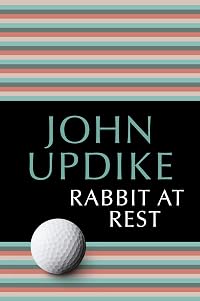
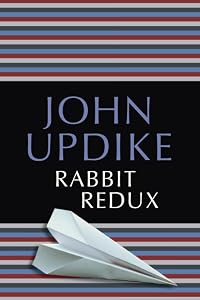
American novelist, poet, and critic John Updike was born in Reading, Pennsylvania on March 18, 1932. He received an A.B. degree from Harvard University, which he attended on a scholarship, in 1954. After graduation, he accepted a one-year fellowship to study painting at the Ruskin School of Drawing and Fine Art in Oxford, England. After returning show more from England in 1955, he worked for two years on the staff of The New Yorker. This marked the beginning of a long relationship with the magazine, during which he has contributed numerous short stories, poems, and book reviews. Although Updike's first published book was a collection of verse, The Carpentered Hen and Other Tame Creatures (1958), his renown as a writer is based on his fiction, beginning with The Poorhouse Fair (1959). During his lifetime, he wrote more than 50 books and primarily focused on middle-class America and their major concerns---marriage, divorce, religion, materialism, and sex. Among his best-known works are the Rabbit tetrology---Rabbit, Run (1960), Rabbit Redux (1971), Rabbit Is Rich (1981), and Rabbit at Rest (1988). Rabbit, Run introduces Harry "Rabbit" Angstrom as a 26-year-old salesman of dime-store gadgets trapped in an unhappy marriage in a dismal Pennsylvania town, looking back wistfully on his days as a high school basketball star. Rabbit Redux takes up the story 10 years later, and Rabbit's relationship with representative figures of the 1960s enables Updike to provide social commentary in a story marked by mellow wisdom and compassion in spite of some shocking jolts. In Rabbit Is Rich, Harry is comfortably middle-aged and complacent, and much of the book seems to satirize the country-club set and the swinging sexual/social life of Rabbit and his friends. Finally, in Rabbit at Rest, Harry arrives at the age where he must confront his mortality. Updike won the Pulitzer Prize for both Rabbit Is Rich and Rabbit at Rest. Updike's other novels range widely in subject and locale, from The Poorhouse Fair, about a home for the aged that seems to be a microcosm for society as a whole, through The Court (1978), about a revolution in Africa, to The Witches of Eastwick (1984), in which Updike tries to write from inside the sensibilities of three witches in contemporary New England. The Centaur (1963) is a subtle, complicated allegorical novel that won Updike the National Book Award in 1964. In addition to his novels, Updike also has written short stories, poems, critical essays, and reviews. Self-Consciousness (1989) is a memoir of his early life, his thoughts on issues such as the Vietnam War, and his attitude toward religion. He was elected to the American Academy of Arts and Letters in 1977. He died of lung cancer on January 27, 2009 at the age of 76. (Bowker Author Biography) John Updike was born in 1932, in Shillington, Pennsylvania. Since 1957 he has lived in Massachusetts. His novels have won the Pulitzer Prize, the National Book Award, the National Book Critics Circle Award, & the Howells Medal. (Publisher Provided) John Updike was born in 1932 and attended Harvard College and the Ruskin School of Drawing and Fine Art in Oxford, England. Form 1955 to 1957 he was a staff member of The New Yorker, which he contributed numerous writings. Updike's art criticism has appeared in publications including Arts and Antiques, The New Republic, The New York Times Book Review, and Realites, among many others. He is the author of such best-selling novels as Rabbit Run and Rabbit is Rich. His many works of fiction, poetry and criticism have been awarded the Pulitzer Prize, the National Book Award, the American Book Award, and the National Book Critics Circle Award. For the past 40 years he has lived in Massachusetts. (Publisher Provided) John Updike is the author of some 50 books, including collections of short stories, poems, & criticism. His novels have won the Pulitzer Prize, the National Book Award, the National Book Critics Circle Award, & the Howells Medal. Born in Shillington, Pennsylvania, in 1932, he has lived in Massachusetts since 1957. (Publisher Provided) show less
Awards and Honors
Awards
Distinctions
Work Relationships
Common Knowledge
- Canonical title
- Pigeon Feathers and Other Stories
- Original publication date
- 1962
- People/Characters
- Claire ("Walter Briggs"); Jack ("Walter Briggs"); Jo ("Walter Briggs"); Clyde Behn ("The Persistence of Desire"); Janet ("The Persistence of Desire"); Dr. Pennypacker ("The Persistence of Desire") (show all 65); Robin Cox ("Still Life"); Jack Fredericks ("Still Life"); Leonard Hartz ("Still Life"); Professor Seabright ("Still Life"); Mom Baer ("Flight"); Mr. Baer ("Flight"); Molly Bingaman ("Flight"); Mrs. Bingaman ("Flight"); Allen Dow ("Flight"); Lillian Baer Dow ("Flight"); Victor Dow ("Flight"); Catharine Miller ("Flight"); Judith Miller ("Flight"); Judith Potteiger ("Flight"); Jack ("Jo"); Joanne ("Jo"); Bobby ("Should Wizard Hit Mommy?"); Clare ("Should Wizard Hit Mommy?"); Lionel Griffin ("A Sense of Shelter"); Barry Kruppman ("A Sense of Shelter"); Mary Landis ("A Sense of Shelter"); Virginia ("A Sense of Shelter"); William Young ("A Sense of Shelter"); Kenneth Bentley ("Dear Alexandros"); Alexandros Koundouriotis ("Dear Alexandros"); Reverend Dobson ("Pigeon Feathers"); Anita Haier ("Pigeon Feathers"); David Kern ("Pigeon Feathers"); Elsie Kern ("Pigeon Feathers"); Elsie Kern's father ("Pigeon Feathers"); Elsie Kern's mother ("Pigeon Feathers"); George Kern ("Pigeon Feathers"); Robert ("Home"); Robert's father ("Home"); Robert's mother ("Home"); Corinne ("Home"); Joanne ("Home"); "the Dutchman" ("Home"); Ben ("You'll Never Know, Dear, How Much I Love You"); Bela ("The Astronomer"); Harriet ("The Astronomer"); Walter ("The Astronomer"); Lengel ("A & P"); Queenie ("A & P"); Sammy ("A & P"); Stokesie ("A & P"); Eve ("The Doctor's Wife"); Ralph ("The Doctor's Wife"); the doctor's wife ("The Doctor's Wife"); unnamed lifeguard ("Lifeguard"); Clare ("The Crow in the Woods"); Jack ("The Crow in the Woods"); the blessed man of Boston (an old Chinese man, in "The Blessed Man of Boston, My Grandmother's Thimble, and Fanning Island"); "our Lutheran minister" (in "The Blessed Man of Boston, My Grandmother's Thimble, and Fanning Island"); Marquesans on Fanning Island (in "The Blessed Man of Boston, My Grandmother's Thimble, and Fanning Island"); David Kern ("Packed Dirt, Churchgoing, A Dying Cat, A Traded Car"); David Kern's father ("Packed Dirt, Churchgoing, A Dying Cat, A Traded Car"); David Kern's mother ("Packed Dirt, Churchgoing, A Dying Cat, A Traded Car"); Elaine Kern (David Kern's wife, in "Packed Dirt, Churchgoing, A Dying Cat, A Traded Car")
- Epigraph
- In revenge, however, my memory of the past has closed the door against me more and more. I could have returned at first, had human beings allowed it, through an archway as wide as the span of heaven over the earth, but as I ... (show all)spurred myself on in my forced career, the opening narrowed and shrank behind me; I felt more comfortable in the world of men and fitted it better; the strong wind that blew after me out of my past began to slacken; today it is only a gentle puff of air that plays around my heels; and the opening in the distance, through which it comes and through which I once came myself, has grown so small that, even if my strength and my will power sufficed to get me back to it, I should have to scrape the very skin from my body to crawl through.
KAFKA, 'A Report to an Academy' - Dedication
- To William Maxwell
- First words
- Coming back from Boston, Jack drove, his baby son slept in a Carry-Cot on the front seat beside him, and in the back seat Clare sang to their girl, Jo, age two. ("Walter Briggs")
- Last words
- (Click to show. Warning: May contain spoilers.)We in America need ceremonies, is I suppose, sailor, the point of what I have written. ("Packed Dirt, Churchgoing, A Dying Cat, A Traded Car")
Classifications
Statistics
- Members
- 716
- Popularity
- 39,828
- Reviews
- 9
- Rating
- (3.61)
- Languages
- 5 — English, French, Hungarian, Serbian, Swedish
- Media
- Paper, Ebook
- ISBNs
- 15
- ASINs
- 25