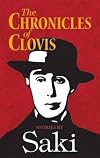
The Chronicles of Clovis
by Saki
On This Page
Description
Hector Hugh Munro was a prolific British writer who worked in a variety of literary genres. Under the pen name Saki, he produced a series of plays and tales, many of which center around a sophisticated bon vivant called Clovis who delights in skewering the pretensions of his elders with a rapier-like wit. The stories collected in The Chronicles of Clovis will delight fans of P.G. Wodehouse, Rudyard Kipling, and Oscar Wilde..
Tags
Recommendations





















Member Reviews
THE CHRONICLES OF CLOVIS is a collection of twenty-eight short stories. The longest tale stretches to a whopping ten pages, but most of them are more in the three- to five-page range. Clovis, an affluent young man with a troublemaker’s spirit, serves as a unifying force throughout the majority of the stories, whether he acts as instigator, storyteller, or avid listener.
I bought the book for two reasons. First, it contains “Sredni Vashtar,” one of my favourite short stories. Second, the mouldering old Penguin I snagged at the Children’s Hospital’s latest Book Market is absolutely gorgeous. It looks like it’s about to fall apart, but the binding is solid and the book feels wonderful in the hand. Reading it was always a show more sensual pleasure (in the literal sense), even if it sometimes left something to be desired on an intellectual level.
It’s not that THE CHRONICLES OF CLOVIS is poorly written or unworthy of deeper thought; it’s just that it’s so bloody hateful. Saki is a satirist who writes in the Wildean mode. He’s concerned with upper class characters who care little for anything but their own pleasure. They’re quite happy to run roughshod over everyone else, provided it adds a little fun to their day.
The result is a set of stories about a classist, self-centered, altogether unpleasant group of people whose behavior is coded as funny. As I read, I discovered that my already low tolerance for this kind of thing takes a nosedive when there’s a humorous bend to it. The stories I loved, like “Sredni Vashtar” and “The Hounds of Fate,” are dark and cruel without much in the way of an amusement factor. The ones I loathed, like the anti-Suffragist “Hermann the Irascible – A Story of the Great Weep,” are clearly meant to offer hilarious social commentary.
To be fair, it’s entirely possible to read these stories as a condemnation of this sort of behavior; a sort of, “damn, rich folks can be stupid about their privileges” type of deal. I think the inclusion of “Hermann” proves Saki held with at least some of the attitudes his characters espouse, though. In this story, King Hermann of England “helps” women see they’d rather not have the vote by making it mandatory that they vote in every single election for every single kind of public official. By the end, they’re clamouring for a return to the old ways.
OMFG, y’all. O. M. F. G.
And yet, I couldn’t dislike THE CHRONICLES OF CLOVIS. I hated so much about the things it chose to be, but Saki’s evocative prose and his careful (if morally frustrating) delineations of character were often enough to see me through. I didn’t always like the book, but I usually enjoyed it--perhaps because I had a wonderful time scowling at it.
It’s worth noting, too, that there are many women herein, and outside of “Hermann,” I don’t think Saki treats them as appreciably more repugnant or flawed than any of his male characters. Everyone, regardless of gender, possesses a great number of faults, many of which spring from their vast privilege. Some of this privilege is gendered, but I feel like most of it has to do with social standing. Many, though not all, negotiations take place between people of the same gender. Problems arise when the characters are unable to reconcile their own faults with everyone else’s.
Basically, THE CHRONICLES OF CLOVIS is worth reading for the prose and the satisfaction of growling profanities at the dodgier bits, but don’t expect something progressive from it. It’s a product of its time and is often disgusting by modern standards.
(This review originally appeared on my blog, Stella Matutina.) show less
I bought the book for two reasons. First, it contains “Sredni Vashtar,” one of my favourite short stories. Second, the mouldering old Penguin I snagged at the Children’s Hospital’s latest Book Market is absolutely gorgeous. It looks like it’s about to fall apart, but the binding is solid and the book feels wonderful in the hand. Reading it was always a show more sensual pleasure (in the literal sense), even if it sometimes left something to be desired on an intellectual level.
It’s not that THE CHRONICLES OF CLOVIS is poorly written or unworthy of deeper thought; it’s just that it’s so bloody hateful. Saki is a satirist who writes in the Wildean mode. He’s concerned with upper class characters who care little for anything but their own pleasure. They’re quite happy to run roughshod over everyone else, provided it adds a little fun to their day.
The result is a set of stories about a classist, self-centered, altogether unpleasant group of people whose behavior is coded as funny. As I read, I discovered that my already low tolerance for this kind of thing takes a nosedive when there’s a humorous bend to it. The stories I loved, like “Sredni Vashtar” and “The Hounds of Fate,” are dark and cruel without much in the way of an amusement factor. The ones I loathed, like the anti-Suffragist “Hermann the Irascible – A Story of the Great Weep,” are clearly meant to offer hilarious social commentary.
To be fair, it’s entirely possible to read these stories as a condemnation of this sort of behavior; a sort of, “damn, rich folks can be stupid about their privileges” type of deal. I think the inclusion of “Hermann” proves Saki held with at least some of the attitudes his characters espouse, though. In this story, King Hermann of England “helps” women see they’d rather not have the vote by making it mandatory that they vote in every single election for every single kind of public official. By the end, they’re clamouring for a return to the old ways.
OMFG, y’all. O. M. F. G.
And yet, I couldn’t dislike THE CHRONICLES OF CLOVIS. I hated so much about the things it chose to be, but Saki’s evocative prose and his careful (if morally frustrating) delineations of character were often enough to see me through. I didn’t always like the book, but I usually enjoyed it--perhaps because I had a wonderful time scowling at it.
It’s worth noting, too, that there are many women herein, and outside of “Hermann,” I don’t think Saki treats them as appreciably more repugnant or flawed than any of his male characters. Everyone, regardless of gender, possesses a great number of faults, many of which spring from their vast privilege. Some of this privilege is gendered, but I feel like most of it has to do with social standing. Many, though not all, negotiations take place between people of the same gender. Problems arise when the characters are unable to reconcile their own faults with everyone else’s.
Basically, THE CHRONICLES OF CLOVIS is worth reading for the prose and the satisfaction of growling profanities at the dodgier bits, but don’t expect something progressive from it. It’s a product of its time and is often disgusting by modern standards.
(This review originally appeared on my blog, Stella Matutina.) show less
Munro's mind runs on rest-cures and unrest-cures, but it's mostly the latter if Clovis Sangrail is around (or even if he's not: sometimes he is a mere listener or inactive participant, sometimes he makes one comment, and sometimes, as in “Hermann the Irascible,” “Sredni Vashtar,””The Chaplet,””Mowsle Barton,” and other stories, he's not there at all). Clovis's England is one where most of the inhabitants are the idle rich, where the god Pan holds sway in some rural quarters and witchcraft in others, where prominent men of politics and business can be suddenly replaced by angels, and where Clovis struggles, usually successfully, for control in townhouses and country houses with the Baronesses and Lady Bastables. For show more example, when the Baroness wants to jolly everyone up after a divisive local election, she lights on the idea of a play, and Clovis suggests Agamemnon with predictably disastrous results. Lady Bastable's fear of social upheaval enables Clovis to stampede her with a shout of “the jacquerie!” Here, as in some of the dialogue, we can hear traces of Wilde: “All decent people live beyond their incomes nowadays, and those who aren't respectable live beyond other people's. A few gifted individuals manage to do both.” Elsewhere in the same story (“The Match-maker”): “brevity is the soul of widowhood.” One of my favorite remarks is the Baroness's to Constance Broddle in Esme: “You're looking nicer than usual . . . but that's so easy for you.”
A strain of offhand cruelty runs through the stories. Although the wicked are punished in “Sredni Vashtar,” the gypsy child eaten by the hyena in “Esme” seems innocent enough, and there is no poetic justice in the suicide of the humorless Eleanor Stringham―though there might be in the murder of the orchestra leader b y the chef in “The Chaplet.” People come to sticky ends in “The Easter Egg” and “The Hounds of Fate.”
We are apt to forget, looking back at the stories, that Clovis is still in his teens at their beginning. But the themes of the stories are often those of adolescent fantasy and wish-fulfillment. My mother is about to leave me with Lady Bastable for a week, but what if I could prevent it? What if the pets around me could talk or assume enough fierceness to punish my aunt-tormentor? What if I could control the Baroness that everyone finds so formidable? What if all the venal politicians could be turned into animals and replaced by beings who intended nothing but good? Isn't there an odd resemblance between people and their pets? Suppose it extended to behavior? show less
A strain of offhand cruelty runs through the stories. Although the wicked are punished in “Sredni Vashtar,” the gypsy child eaten by the hyena in “Esme” seems innocent enough, and there is no poetic justice in the suicide of the humorless Eleanor Stringham―though there might be in the murder of the orchestra leader b y the chef in “The Chaplet.” People come to sticky ends in “The Easter Egg” and “The Hounds of Fate.”
We are apt to forget, looking back at the stories, that Clovis is still in his teens at their beginning. But the themes of the stories are often those of adolescent fantasy and wish-fulfillment. My mother is about to leave me with Lady Bastable for a week, but what if I could prevent it? What if the pets around me could talk or assume enough fierceness to punish my aunt-tormentor? What if I could control the Baroness that everyone finds so formidable? What if all the venal politicians could be turned into animals and replaced by beings who intended nothing but good? Isn't there an odd resemblance between people and their pets? Suppose it extended to behavior? show less
Deliciously bitter comic little stories of the upper class, five or ten pages long, icy, acidic, unsparing. Not a drop of kindness anywhere. Something like Maupassant triple-distilled. It only hurts when you laugh.
This is a wonderful genre to which Saki alone belongs.
This is a wonderful genre to which Saki alone belongs.
Solid collection of short stories from a master of the genre. Saki/Munro was able to put across his stories with a lot of punch, and with great brevity, in this case being the soul of wit. Many of the stories in this collection feature his running character Clovis Sangrail, and his reactions and/or interventions in various crises of upper-crust society. This collection has the famous "Filboid Studge," but it also has a wicked story, "Tobermory," about a cat that apparently learns to speak (and gossip); "The Hounds of Fate," in which a person who steps into the shoes of a mysterious man gets more than he bargained for; "Ministers of Grace," in which governmental figures (some of which are clearly recognizable) are changed into animals; show more and others. Well worth picking up. show less
Not going to lie - I have absolutely no memory of why I wanted to read this. It's not bad though! There are some genuinely darkly funny stories in here, although unfortunately I don't think all of them have aged that well (at least I had a hard time following some of them as someone who's not a student of the British upper class). Somewhere between a 3 and a 4, but I'll mark it 4.
Amusing short stories but not quite as good as Beasts and Superbeasts. Saki has a very British sense of humor -- if you don't like Wodehouse, Jerome or other authors of that ilk, you will probably not find these funny...
I don't know if it was the pompous lugubriousness of the narrator or that was the tone of the book anyway, but I mostly found the stories unbearable in their snobbishness, misanthropy and weak humour. Maybe they are just dated and such attitudes were not only acceptable but considered funny at the time.
There were 28 stories, three days listening, and some of them I had forgotten by the time I started the next one and had to replay them in order to be sure I'd 'read' them.
I was going to say that there were some high spots but that would be exaggerating - there were some stories that were quite funny is more accurate. The branding of a breakfast cereal in Filboid Studge, the Story of a Mouse that Helped was amusing. However, Herman the show more Irascible - A story of the Great Weep was about as misanthropic and anti-feminist as anything I have read anywhere. The Unrest-Cure and Stampeding of Lady Bastable were a waste of time, they weren't funny at all. I could see the Unrest-Cure being a Monty Pythonesque sketch involving Nazis, upper-class twits and the possibility of Jews, and working quite well, but as a story, no.
This review is quite long enough, it was bad enough deciding I would definitely finish the book, but now that's behind me, and so is this review. show less
There were 28 stories, three days listening, and some of them I had forgotten by the time I started the next one and had to replay them in order to be sure I'd 'read' them.
I was going to say that there were some high spots but that would be exaggerating - there were some stories that were quite funny is more accurate. The branding of a breakfast cereal in Filboid Studge, the Story of a Mouse that Helped was amusing. However, Herman the show more Irascible - A story of the Great Weep was about as misanthropic and anti-feminist as anything I have read anywhere. The Unrest-Cure and Stampeding of Lady Bastable were a waste of time, they weren't funny at all. I could see the Unrest-Cure being a Monty Pythonesque sketch involving Nazis, upper-class twits and the possibility of Jews, and working quite well, but as a story, no.
This review is quite long enough, it was bad enough deciding I would definitely finish the book, but now that's behind me, and so is this review. show less
Members
- Recently Added By
Lists

1910s
90 works; 16 members

Michael Dirda's 100 Best Comic Novels
100 works; 1 member
Author Information

318+ Works 6,373 Members
Some Editions
Series
Belongs to Publisher Series
Work Relationships
Is contained in
Contains
Common Knowledge
- People/Characters
- Clovis Sangrail
- Dedication
- TO THE LYNX KITTEN,
WITH HIS RELUCTANTLY GIVEN CONSENT,
THIS BOOK IS AFFECTIONATELY DEDICATED - First words
- "All hunting stories are the same," said Clovis; "just as all Turf stories are the same, and all-"
- Last words
- (Click to show. Warning: May contain spoilers.)In company with the tortoise, which Colonel John presented to him on his last visit, he potters about his lawn and kitchen garden, with none of his erstwhile sprightliness; and his nephews and nieces are fairly well justified in alluding to him as "Old Uncle Groby".
Classifications
Statistics
- Members
- 308
- Popularity
- 104,104
- Reviews
- 11
- Rating
- (4.11)
- Languages
- English, French, German, Spanish
- Media
- Paper, Audiobook, Ebook
- ISBNs
- 54
- UPCs
- 1
- ASINs
- 22