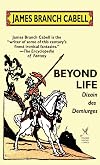
Beyond life : dizain des démiurges
by James Branch Cabell
The Biography of the Life of Manuel (volume 1), Cabell (Brewer Order) (Biography of the Life of Manuel (No. 1, v. 1)), The Biography of Manuel in order of publication (11)
On This Page
Description
This fantastic work of fiction is a conversation between an author named John Chateris, and a youthful editor. The two discuss books and editions, which are not yet written, in the setting of a library - a figurative story which comments on the publishing industry, done in a masterful way.Tags
Recommendations




Member Recommendations

Crypto-Willobie Similar kinda thang. A literary manifesto by an early 20c man-of-letters/fantasist, in the form of a discursive dialogue.
20

Member Reviews
Romance, the first and loveliest daughter of human vanity .... [152]
My purpose in picking up Beyond Life, and not another unread work from this favourite author, was to gain some clarity around the Cabellian concept of Romance, in particular the three modes he's elsewhere named Gallant, Chivalric, and Poetic. Cabell refers here explicitly to both gallantry and chivalry, but not to the poetic; and there is no clear demarcation between those two he mentions. I did not gain much clarity by way of distinction, but there is much offered by way of depth of description and myriad example.
Cabell employs here the same narrative voice used for his fiction --witty, convoluted, ironic-- to discuss literature and the aims of authors in creative show more fiction. The narrative frame he chooses is that of a defense of his aesthetic creed, cast in the form of a rebuttal to a critique which in fact was never written. And yet, once the rebuttal is complete, Cabell invites his imagined critic to supply the preface thereto, and the critic (Guy Holt) obliges. That essay is printed here as "Introduction". Already this premise provides a glimpse into what lies ahead, the nested structure of Cabell's argument and his slippery way of crafting it.
Cabell's (and Holt's?) resulting argument is eminently readable but is not reducible to a 3-sentence summary.
I observe instead that Cabell's subtitle supplies a clue. He postulates that Romanticism adopts the view that man's creativity mirrors the Deity's; we can make our life real by dreaming it. Realism in the sense of mirroring our actual circumstances is not creative. Put another way: Romance is driven by a demiurgic spirit [152-53], to falsely urge us to create and yet thereby lead us to truth in our creation. Romance treats of humans as they ought to be, and not chiefly as they are.
And to end, it is perhaps enough (for now) to observe Cabell takes Romance broadly and not only or even primarily as "that especial manifestation of Romance which is sold in book form" [16]. Rather, Cabell's Romance is an outlook on all human activity, on civilisation, the way we best engage the hostile world in which we find ourselves.
I ask of literature precisely those things which I feel the lack in my own life. [345] show less
My purpose in picking up Beyond Life, and not another unread work from this favourite author, was to gain some clarity around the Cabellian concept of Romance, in particular the three modes he's elsewhere named Gallant, Chivalric, and Poetic. Cabell refers here explicitly to both gallantry and chivalry, but not to the poetic; and there is no clear demarcation between those two he mentions. I did not gain much clarity by way of distinction, but there is much offered by way of depth of description and myriad example.
Cabell employs here the same narrative voice used for his fiction --witty, convoluted, ironic-- to discuss literature and the aims of authors in creative show more fiction. The narrative frame he chooses is that of a defense of his aesthetic creed, cast in the form of a rebuttal to a critique which in fact was never written. And yet, once the rebuttal is complete, Cabell invites his imagined critic to supply the preface thereto, and the critic (Guy Holt) obliges. That essay is printed here as "Introduction". Already this premise provides a glimpse into what lies ahead, the nested structure of Cabell's argument and his slippery way of crafting it.
Cabell's (and Holt's?) resulting argument is eminently readable but is not reducible to a 3-sentence summary.
I observe instead that Cabell's subtitle supplies a clue. He postulates that Romanticism adopts the view that man's creativity mirrors the Deity's; we can make our life real by dreaming it. Realism in the sense of mirroring our actual circumstances is not creative. Put another way: Romance is driven by a demiurgic spirit [152-53], to falsely urge us to create and yet thereby lead us to truth in our creation. Romance treats of humans as they ought to be, and not chiefly as they are.
And to end, it is perhaps enough (for now) to observe Cabell takes Romance broadly and not only or even primarily as "that especial manifestation of Romance which is sold in book form" [16]. Rather, Cabell's Romance is an outlook on all human activity, on civilisation, the way we best engage the hostile world in which we find ourselves.
I ask of literature precisely those things which I feel the lack in my own life. [345] show less
"What is man, that his welfare be considered?-an ape who chatters to himself of kinship with the archangels while filthily he digs for groundnuts..."
Wow... that was uplifting and depressing in equal measure. With a frame of fiction, the opinions expressed being attributed to John Charteris a recurring fictional author in various of Cabells works. But once inside the frame we have a non-fiction examination of realism vs romanticism which morphs and expands until all of human endeavour is weighted in the balance.
I'm not a fan of non-fiction much but as usual Cabells beautiful wordplay and esoteric knowledge, his sarcasm and intelligence, honesty and blatant lies all add to an essay which is eminently readable albeit very highbrow.
Aswell show more as occasionally confusing on a sentence basis due to Cabells erudition, it also gets pretty confused on an idea basis. I found it quite jumbled as to which side Cabell was promoting at various times but that wasn't entirely my fault. Ultimately the author doesn't have any more answers than the rest of us regarding the point of life or art but he does ask beautiful questions which is quite enough.
If you want to know if this book is for you just check out some of my updates, i really wanted to just quote every line.
"Yet more clearly do I perceive this same man is a maimed god... He is under penalty condemned to compute eternity with false weights and to estimate infinity with a yardstick; and he very often does it..." show less
Wow... that was uplifting and depressing in equal measure. With a frame of fiction, the opinions expressed being attributed to John Charteris a recurring fictional author in various of Cabells works. But once inside the frame we have a non-fiction examination of realism vs romanticism which morphs and expands until all of human endeavour is weighted in the balance.
I'm not a fan of non-fiction much but as usual Cabells beautiful wordplay and esoteric knowledge, his sarcasm and intelligence, honesty and blatant lies all add to an essay which is eminently readable albeit very highbrow.
Aswell show more as occasionally confusing on a sentence basis due to Cabells erudition, it also gets pretty confused on an idea basis. I found it quite jumbled as to which side Cabell was promoting at various times but that wasn't entirely my fault. Ultimately the author doesn't have any more answers than the rest of us regarding the point of life or art but he does ask beautiful questions which is quite enough.
If you want to know if this book is for you just check out some of my updates, i really wanted to just quote every line.
"Yet more clearly do I perceive this same man is a maimed god... He is under penalty condemned to compute eternity with false weights and to estimate infinity with a yardstick; and he very often does it..." show less
As much an admirer as I am of Cabell's writing, I'm not sure what to make of this book. Some consider it a manifesto of great genius. I might admit that, but I also find it hard to slog through. I don't believe I've ever read it through in one sitting, or set of sittings, but read it piece here and piece there.
Nevertheless, this is the primary source for Cabell's own reflections on literature. He retrod the same ground later, in more readable fashion (if you ask me) in a later volume of "The Biography of the Life of Manuel," but this is the first and most important, written, as it was, as a function of his arguing with Guy Holt, the genius at the publisher's desk at Robert McBride and Company.
It's in this book, after all, that Cabell show more trots out that strangest doctrine of literature, that of the Economic School:
"[P]eople think of Marlowe simply as a poet, whereas his real daring, like that of all the elect among creative writers, was displayed as an economist."
What does he mean by that? Read the book to find out. show less
Nevertheless, this is the primary source for Cabell's own reflections on literature. He retrod the same ground later, in more readable fashion (if you ask me) in a later volume of "The Biography of the Life of Manuel," but this is the first and most important, written, as it was, as a function of his arguing with Guy Holt, the genius at the publisher's desk at Robert McBride and Company.
It's in this book, after all, that Cabell show more trots out that strangest doctrine of literature, that of the Economic School:
"[P]eople think of Marlowe simply as a poet, whereas his real daring, like that of all the elect among creative writers, was displayed as an economist."
What does he mean by that? Read the book to find out. show less
This is a set of essays that Mr. Cabell places in the mouth of an avatar, John Charteris. They are more than a little pretentious, but Mr. Cabell had no great need to publish for money, and indulges himself. I find them amusing.
Here are three hundred fifty-eight pages wherein Cabell demonstrates over and over how fiction prefigures history. Done in a most interesting and entertaining style and seen by some as extremely subversive. I give it:
Ratings
Members
- Recently Added By
Lists

Best Essay Collections
61 works; 24 members
Talk Discussions
Past Discussions
Beyond Life in The Rabble Discuss Cabell: James Branch Cabell &c (January 2019)
Author Information

244+ Works 5,517 Members
James Branch Cabell (1879-1956) is best known for his tales of the imaginary land of Poictesme, where chivalry and galantry live on
Some Editions
Series

The Biography of the Life of Manuel
20 works (volume 1)

Cabell (Brewer Order)
53 works (Biography of the Life of Manuel (No. 1, v. 1))

The Biography of Manuel in order of publication
25 works (11)
Belongs to Publisher Series
Modern Library (25.2)
Work Relationships
Common Knowledge
- Canonical title
- Beyond life : dizain des démiurges
- Original publication date
- 1919-01
- People/Characters
- James Branch Cabell; John Charteris
- Dedication
- To Guy Holt
- First words
- Whenever I am in Fairhaven, if but in thought, I desire the company of John Charteris.
- Quotations
- To spin romances is, indeed, man's proper and peculiar function in a world wherein he only of created beings can make no profitable use of the truth about himself. [Section 9 of Chapter II, "Which Deals With The Demiurge"]
- Last words
- (Click to show. Warning: May contain spoilers.)But when we note how visibly it sways all life we perceive that we are talking about God.
Classifications
Statistics
- Members
- 134
- Popularity
- 242,050
- Reviews
- 6
- Rating
- (3.68)
- Languages
- English
- Media
- Paper, Ebook
- ISBNs
- 8
- ASINs
- 11