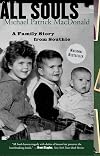
All Souls: A Family Story from Southie
by Michael Patrick MacDonald
On This Page
Description
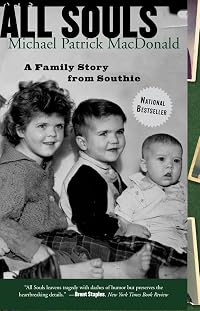
A breakaway bestseller since its first printing,? All Souls ? takes us deep into Michael Patrick MacDonald's Southie, the proudly insular neighborhood with the highest concentration of white poverty in America. Rocked by Whitey Bulger's crime schemes and busing riots, MacDonald's Southie is populated by sharply hewn characters like his Ma, a miniskirted, accordion-playing single mother who endures the deaths of four of her eleven children. Nearly suffocated by his grief and his community's show more code of silence, MacDonald tells his family story here with gritty but moving honesty. show lessTags
Recommendations


















Member Recommendations
Member Reviews
Moving, depressing, but with the tiniest glimmer of hope, this book isn’t for the faint of heart. Macdonald describes the dark underside, the fear, and the degrading poverty of growing up in one of the worst housing projects in South Boston.
The book is somewhat disjointed and the individual stories are often fragmented. But the throughline of abuse by officials, by criminals, and often by each other, carries the book forward. This reader was torn between sorrow and fury at the system that seemed designed for produce failing families and crumbling neighborhoods.
Near the end the author describes a good-sized group of kids, armed with sticks and rocks and bats, chasing a hapless raccoon who had mistakenly wandered into Old Colony. show more MacDonald muses about how great it is to see “the kids having a grand time.”
No. No it’s not. It’s just another case of mindless group violence aimed at some hapless, powerless creature. The raccoon escapes, but that doesn’t erase the extremely unpleasant picture of the truth of Lyndon Johnson’s old idea about giving people something to look down on so they’ll feel better about themselves.
A sad and ultimately depressing book—but good grief, what the people suffered, and why, is just unconscionable. show less
The book is somewhat disjointed and the individual stories are often fragmented. But the throughline of abuse by officials, by criminals, and often by each other, carries the book forward. This reader was torn between sorrow and fury at the system that seemed designed for produce failing families and crumbling neighborhoods.
Near the end the author describes a good-sized group of kids, armed with sticks and rocks and bats, chasing a hapless raccoon who had mistakenly wandered into Old Colony. show more MacDonald muses about how great it is to see “the kids having a grand time.”
No. No it’s not. It’s just another case of mindless group violence aimed at some hapless, powerless creature. The raccoon escapes, but that doesn’t erase the extremely unpleasant picture of the truth of Lyndon Johnson’s old idea about giving people something to look down on so they’ll feel better about themselves.
A sad and ultimately depressing book—but good grief, what the people suffered, and why, is just unconscionable. show less
Macdonald lived as one of nine children born in poverty stricken South Boston (aka "Southie") one of those places, like my home province of NS - that for no good reason people tend to be proud to be from (Hey - you know those bus riots - that was us!!! Whiltey Bulger - one of us!!!) Macdonald does a very good job of dispelling the romance of Southie. His family is devastated by drugs and violence and little is done by his neighbours to either stop the trend or help the family. Tragic personal history, tragic cultural history. Worth reading, especially for anyone in the greater Boston area.
For all the time following the career of Whitey Bulger and re-watching The Town I was interested in an insider's memoir account of growing up in the Southie Irish-American neighborhood. The main arc is insular, ethnic pride and community eroded year by year by guns and drugs. Multiple tragedies to the author's own family result in nudging him to an activist role and and key role in a successful gun buyback program. I thought it was particularly interesting to read of the reaction in his community to the forced school integration of the 70s and the BHA under the tenure of Boston Mayor John F. Collins (1960–1968) segregating the public housing developments in the city, moving black families into the development at Columbia Point while show more reserving developments in South Boston for white families who started refusing assignment to the Columbia Point project by the early 1960s. This seems to only strengthen short-sighted racism (maybe giving strength to criminals like Bulger) and then the disruption and seething discontent of trying to reverse this through policy. show less
Books about white urban poverty are underrepresented in the literature, so All Souls: Family Story from Southie helps fill an important niche. Well-written, personal, and compelling, MacDonald does an excellent job of bringing his family and their close-knit neighborhood to life. His "view from the inside" of Southie provides an excellent counterbalance to the media characterizations of the neighborhood: Southie was not working class: it was poor. It was not drug-free: it was a swamp of addicts and dealers. "Getting Out" was necessary to make it, yet if one left one was no longer an insider.
What makes this book a 3-star volume is its lack of contextualization and its hands-off approach to the exercise of agency. It seems almost as show more though the author is concerned that his words will be taken less seriously if he makes it sound as though things are, or have the capacity to be, better. show less
What makes this book a 3-star volume is its lack of contextualization and its hands-off approach to the exercise of agency. It seems almost as show more though the author is concerned that his words will be taken less seriously if he makes it sound as though things are, or have the capacity to be, better. show less
All Souls is exhausting and draining and I would recommend it to anyone. MacDonald's writing is hardly poetic, which only adds to the weight of the book's realism. It reads like a brutal and bloody call for social justice in one of the most honest and least political voices imaginable. I feel like this book will haunt me for a while.
I love narrative non-fiction more than any other genre. By far, this is one of my favorite, most memorable books. One thing I always remember from the author as he recounts his poor childhood in South Boston was how much the neighborhood kids used to love getting firefighters to come out to their block. The reason they were so fascinated? "They were the only men we knew who had jobs." MacDonald's traumatic account of his upbringing is soul-stirring and enlightening.
Ok, I admit it. When I saw the title I thought it was about a family from the South. As in across the Mason-Dixon Line. Of course, as soon as I began to read the book, I realized my lucky mistake. The author writes about life in Southie, a poor district of Boston. But don't let the residents hear you call their neighborhood poor. Those are fighting words for the Southie the author grew up in. This is a very moving book that takes the reader into the hidden Southie. We follow the author and his large family (and friends) as they struggle to survive each day. Too often, the young don't survive. They lose their lives to murder, suicide, and drugs.
Members
- Recently Added By
Lists

A Boston Reading List
120 works; 10 members
Author Information

2+ Works 1,113 Members
Michael Patrick MacDonald helped launch Boston's successful gun-buyback program and is founder of the South Boston Vigil Group. He lives in South Boston, Massachusetts.
Awards and Honors
Awards
Distinctions
Common Knowledge
- Original publication date
- 1999
- People/Characters
- Michael Patrick MacDonald; James "Whitey" Bulger
- Important places
- Boston, Massachusetts, USA
Classifications
- Genres
- Biography & Memoir, Nonfiction, General Nonfiction, History
- DDC/MDS
- 974.46104092 — History & geography History of North America Northeastern United States (New England and Middle Atlantic states) Massachusetts Suffolk County Boston
- LCC
- F73.68 .S7 .M33 — Local History of the United States, Canada and Latin America United States local history Massachusetts
- BISAC
Statistics
- Members
- 957
- Popularity
- 27,818
- Reviews
- 23
- Rating
- (3.98)
- Languages
- English
- Media
- Paper, Audiobook, Ebook
- ISBNs
- 13
- UPCs
- 2
- ASINs
- 7