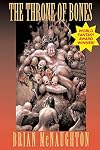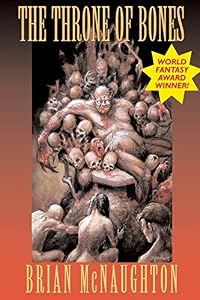
The Throne of Bones
by Brian McNaughton
On This Page
Description
This book won a World Fantasy Award. It's remarkable: the stories are rich, fascinating stuff - creepy and unsettling and phantasmic. Imagine what Tolkien's Lord of the Rings would have been like if Tolkien had tried to tell that story sympathetically from the point of view of the human denizens of Mordor and you'll have the slightest sense of what you're about to wade into ... but only just a sense. These stories will make the same demands on you that they made on Brian: they will command show more and compel you, and fill you full of terrible wonder. And when you've finished them, you'll find yourself wanting more. show lessTags
Recommendations














Member Recommendations
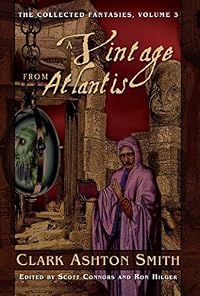
JeffreySinclair Throne of Bones was certainly inspired by the fantastic works of Clark Ashton Smith.
30
JeffreySinclair Throne of Bones was certainly inspired by the fantastic works of Clark Ashton Smith.
30

Member Reviews
Throne of Bones could be considered McNaughton's opus. The collection first put out by Terminal Frights (now defunct), with tantalizing hints that there is significantly more material set in this world, collects McNaughton's work centered around ghouls of the vaguely Lovecraftian sort. I say vaguely because, if you're familiar with that style of ghoul its a good starting point, but this expands greatly on the lore of ghouls, taking it in some interesting and unforeseen directions. Hence it being generally regarded as the 'Dracula' or 'Frankenstein' of ghoul stories. Its also McNaughton's foray in to serious worldbuilding, as these interconnected stories span multiple clearly well developed and thought through cultures and across time in show more a world that, while horrific in its own right, shows clear influences of early 20th century/late 19th century fantasy and sword & sorcery authors.
I was prepared for the explicity ghoul-porn (though there was far less of that than I was led to believe), I was prepared for the sometimes cumbersone/tiresome older/weirder fantasy world-building naming schemes, I was prepared for the weird/lovecraftian elements. What I was not prepared for was the humor. Because there's been some intense worldbuilding going on, the interconnected nature of the story telling gave McNaughton the chance to do more character development in these short works than we would normally expected from short fiction. Getting to know and understand the internal lives of necromancers, scholars, the bumbling nobles, and the ghouls themselves set up a great deal of dramatic irony for the reader to laugh at. And while much of the action sequences are well written in the sword and sorcery style, even there we get to see and frequently find humor in the exploits of one of our more reluctant protagonists.
Honestly, I think is really where McNaughton's work shines in this collection, though I'm likely to be in the minority. Not the world building, not the horror, not the exceptionally well polished and carefully crafted writing. But in showing us characters and events in the midst of a world every bit as horrific and grey as the skin of his ghouls that can make also make us laugh, and in a few cases, evoke sadness and pity.
Is it my favorite work of weird fiction? No. Is it even the best of the novel length collections Terminal Fright put out in its heyday? Not in my opinion. And I would say lovers of Robert E. Howard sword and sorcery are likely to find more to enjoy here than the lovers of Lovecraftian weird fiction I think its normally directed at. But there are definitely some things to enjoy here. If nothing else, I think the humor alone makes it worth a read. And even the old Terminal Fright hardbacks are out there on secondary markets for relatively low prices, let alone the newer editions. show less
I was prepared for the explicity ghoul-porn (though there was far less of that than I was led to believe), I was prepared for the sometimes cumbersone/tiresome older/weirder fantasy world-building naming schemes, I was prepared for the weird/lovecraftian elements. What I was not prepared for was the humor. Because there's been some intense worldbuilding going on, the interconnected nature of the story telling gave McNaughton the chance to do more character development in these short works than we would normally expected from short fiction. Getting to know and understand the internal lives of necromancers, scholars, the bumbling nobles, and the ghouls themselves set up a great deal of dramatic irony for the reader to laugh at. And while much of the action sequences are well written in the sword and sorcery style, even there we get to see and frequently find humor in the exploits of one of our more reluctant protagonists.
Honestly, I think is really where McNaughton's work shines in this collection, though I'm likely to be in the minority. Not the world building, not the horror, not the exceptionally well polished and carefully crafted writing. But in showing us characters and events in the midst of a world every bit as horrific and grey as the skin of his ghouls that can make also make us laugh, and in a few cases, evoke sadness and pity.
Is it my favorite work of weird fiction? No. Is it even the best of the novel length collections Terminal Fright put out in its heyday? Not in my opinion. And I would say lovers of Robert E. Howard sword and sorcery are likely to find more to enjoy here than the lovers of Lovecraftian weird fiction I think its normally directed at. But there are definitely some things to enjoy here. If nothing else, I think the humor alone makes it worth a read. And even the old Terminal Fright hardbacks are out there on secondary markets for relatively low prices, let alone the newer editions. show less
Fresh, Disturbing Escapism
I am biased toward enjoying provocative fantasy/horror, and Throne of Bones delivers a pleasantly disturbing escape that is too shocking for young adults. The first tale, Ringard and Dendra, admittedly should prove digestible to many. Less so are the next six stories, which are a connected set (the titular Throne of Bones sequence) and should prove weird and jarring even to mature dark fantasy readers (can you say "ghoul erotica"?). Here, the timid and disoriented may want to leave the book unfinished. But hang in there. With each successive story, the connection between characters clarifies as does the "rules" of being a ghoul. All is consistent. And Bizzare. Excellent. The book won a 1997 World Fantasy Award show more and remains fresh and daring, even now (2012).
Oddly-placed, but well-done, is a stylistic humor reminiscent of that presented in Cohen Brothers movies (Fargo 1996, Burn After Reading 2008); the situations are so dire and characters so pathetic, that you cannot help but laugh at their choices and predicaments.
I was originally hooked by Alan Rogers introductory comments:
“You hold in your hands a book of stories that forced Brian McNaughton to write. Make no mistake: I don’t exaggerate. There’s a reason this book won the World Fantasy Award. The stories inside it are rich, fascinating stuff—creepy and unsettling and phantasmic. Imagine what Tolkien’s Lord of the Rings would have been like if Tolkien had tried to tell that story sympathetically from the point of view of the human denizens of Mordor and you’ll have the slightest sense of what you’re about to wade into—but only just a sense. These stories will make the same demands on you that they made on Brian: they will command and compel you, and fill you full of terrible wonder. And when you’ve finished them you’ll find yourself wanting more.” —Alan Rodgers
I disagree with the Tolkien call-out since it raises the expectation that the book would resemble Sword & Sorcery or Epic Fantasy (this book fits neither sub-genre). The world is medieval, but there is little military or melee action (however, it is decidedly "dark fantasy"). Otherwise, Rodgers' note is accurate.
Abject People/Artists: Many paint the entire book as being "about ghouls." True the Throne of Bones sequence is ghoul focused, but that comprises only 6 of the 15 tales. More generally, themes explore being an abject person, often with regard to being a misunderstood artist. Many characters are artists and it seems very possible that Brian McNaughton was conveying his own ability to create and enjoy dark art (while not being appreciated by others). Examples:
In the first tale, Ringard, a sculptor, and his painter wife Dendra, struggle to live in a world that shuns their union. The snipet below captures the protagonists ability to see hidden subjects and the ability of his father to not appreciate that skill: "In every stick I [Ringard] saw hidden shapes, and I became obsessed with revealing them. My father fretted that I meant to ruin him by turning his valuable firewood into whimsies. I perversely maintained that my carvings had more worth than kindling, that they even justified the sacrifice of living trees. Those captive owls and trout were really there. Why would the gods let me see them, if not to set me the challenge of liberating them?" Ringard and Dendra
Then there was Asterial Vendren, a misunderstood writer of horror fiction: "I [Asteriel Vendren, writer] seldom give readings anymore. I am sick of women who scream or faint, men who grumble, "Barbarous!" or "Obscene!", sick of the self-righteous show they make of stamping out before I finish. And half of those who remain, of ocurse, will approach me to ask if I really skinned my mistress to preserve her exquisite tattoos, and might they not call on me to examine the artwork?" The Vendren Worm
And ... the body painter Tiphytsorn Glocque (who continually strives to find unique, brilliant ways to decorate skin) laments as he is arrested and brought before a magistrate for being a lunatic:
"How could anyone understand his Art when they couldn't even see it? " The Art of Tiphystorn Glocque
Many more examples pervade the book. Amplifying the artistic themes are a dozen grotesque, full-page paintings from the cover artist, Jamie Oberschlake. Incidentally, he continues to produce disturbing paintings.
No maps or index? I was taken by the promise on the Dust Jacket by publisher Ken Abner (Terminal Fright) that promised that he had a genuine map and promised to published it with additional material at a later date. Sadly, that was claimed in 1997, I cannot find any related sequels for sale, and Brian has passed away in 2004.
Jeff Van Dermeer Interview did interview the author in 1999 (available online) and revealed that Brian was not keen on sharing his map:
JVD: "The dust jacket for the book includes an appreciation by the publisher, Ken Abner. He mentions you have a whole chronology and set of maps for Seelura. You didn't want these published with the collection. Abner mentions those items as "crutches." Could you elaborate on why you didn't want the chronology and maps published?"
Brian McNaughton: "None of that stuff is really finished -- and if it were, I would feel less inclined to write fiction about my imaginary world. A certain sense of discovery is necessary for me. Besides, I feel strongly that the stories should stand on their own. I have to know as much about the world as possible in order to convince the readers that I know what I'm writing about, and that my characters weren't found yesterday under a cabbage leaf. The late Lin Carter deserves our admiration and gratitude for all he did to bring dark fantasy to the attention of the public, but he's the last sort of person I would want messing around with my creations. Maps and chronologies only encourage such people."
Ultimately, a map was not critical to enjoy the book. However, an index would have been much appreciated as the names of people and places proved disorienting. When ghouls begin taking the pace of other people, an index would have helped keep me grounded. Brian McNaughton was a great artist. Read this when you feel like everything in your book queue is derivative, shallow fluff. show less
I am biased toward enjoying provocative fantasy/horror, and Throne of Bones delivers a pleasantly disturbing escape that is too shocking for young adults. The first tale, Ringard and Dendra, admittedly should prove digestible to many. Less so are the next six stories, which are a connected set (the titular Throne of Bones sequence) and should prove weird and jarring even to mature dark fantasy readers (can you say "ghoul erotica"?). Here, the timid and disoriented may want to leave the book unfinished. But hang in there. With each successive story, the connection between characters clarifies as does the "rules" of being a ghoul. All is consistent. And Bizzare. Excellent. The book won a 1997 World Fantasy Award show more and remains fresh and daring, even now (2012).
Oddly-placed, but well-done, is a stylistic humor reminiscent of that presented in Cohen Brothers movies (Fargo 1996, Burn After Reading 2008); the situations are so dire and characters so pathetic, that you cannot help but laugh at their choices and predicaments.
I was originally hooked by Alan Rogers introductory comments:
“You hold in your hands a book of stories that forced Brian McNaughton to write. Make no mistake: I don’t exaggerate. There’s a reason this book won the World Fantasy Award. The stories inside it are rich, fascinating stuff—creepy and unsettling and phantasmic. Imagine what Tolkien’s Lord of the Rings would have been like if Tolkien had tried to tell that story sympathetically from the point of view of the human denizens of Mordor and you’ll have the slightest sense of what you’re about to wade into—but only just a sense. These stories will make the same demands on you that they made on Brian: they will command and compel you, and fill you full of terrible wonder. And when you’ve finished them you’ll find yourself wanting more.” —Alan Rodgers
I disagree with the Tolkien call-out since it raises the expectation that the book would resemble Sword & Sorcery or Epic Fantasy (this book fits neither sub-genre). The world is medieval, but there is little military or melee action (however, it is decidedly "dark fantasy"). Otherwise, Rodgers' note is accurate.
Abject People/Artists: Many paint the entire book as being "about ghouls." True the Throne of Bones sequence is ghoul focused, but that comprises only 6 of the 15 tales. More generally, themes explore being an abject person, often with regard to being a misunderstood artist. Many characters are artists and it seems very possible that Brian McNaughton was conveying his own ability to create and enjoy dark art (while not being appreciated by others). Examples:
In the first tale, Ringard, a sculptor, and his painter wife Dendra, struggle to live in a world that shuns their union. The snipet below captures the protagonists ability to see hidden subjects and the ability of his father to not appreciate that skill: "In every stick I [Ringard] saw hidden shapes, and I became obsessed with revealing them. My father fretted that I meant to ruin him by turning his valuable firewood into whimsies. I perversely maintained that my carvings had more worth than kindling, that they even justified the sacrifice of living trees. Those captive owls and trout were really there. Why would the gods let me see them, if not to set me the challenge of liberating them?" Ringard and Dendra
Then there was Asterial Vendren, a misunderstood writer of horror fiction: "I [Asteriel Vendren, writer] seldom give readings anymore. I am sick of women who scream or faint, men who grumble, "Barbarous!" or "Obscene!", sick of the self-righteous show they make of stamping out before I finish. And half of those who remain, of ocurse, will approach me to ask if I really skinned my mistress to preserve her exquisite tattoos, and might they not call on me to examine the artwork?" The Vendren Worm
And ... the body painter Tiphytsorn Glocque (who continually strives to find unique, brilliant ways to decorate skin) laments as he is arrested and brought before a magistrate for being a lunatic:
"How could anyone understand his Art when they couldn't even see it? " The Art of Tiphystorn Glocque
Many more examples pervade the book. Amplifying the artistic themes are a dozen grotesque, full-page paintings from the cover artist, Jamie Oberschlake. Incidentally, he continues to produce disturbing paintings.
No maps or index? I was taken by the promise on the Dust Jacket by publisher Ken Abner (Terminal Fright) that promised that he had a genuine map and promised to published it with additional material at a later date. Sadly, that was claimed in 1997, I cannot find any related sequels for sale, and Brian has passed away in 2004.
Jeff Van Dermeer Interview did interview the author in 1999 (available online) and revealed that Brian was not keen on sharing his map:
JVD: "The dust jacket for the book includes an appreciation by the publisher, Ken Abner. He mentions you have a whole chronology and set of maps for Seelura. You didn't want these published with the collection. Abner mentions those items as "crutches." Could you elaborate on why you didn't want the chronology and maps published?"
Brian McNaughton: "None of that stuff is really finished -- and if it were, I would feel less inclined to write fiction about my imaginary world. A certain sense of discovery is necessary for me. Besides, I feel strongly that the stories should stand on their own. I have to know as much about the world as possible in order to convince the readers that I know what I'm writing about, and that my characters weren't found yesterday under a cabbage leaf. The late Lin Carter deserves our admiration and gratitude for all he did to bring dark fantasy to the attention of the public, but he's the last sort of person I would want messing around with my creations. Maps and chronologies only encourage such people."
Ultimately, a map was not critical to enjoy the book. However, an index would have been much appreciated as the names of people and places proved disorienting. When ghouls begin taking the pace of other people, an index would have helped keep me grounded. Brian McNaughton was a great artist. Read this when you feel like everything in your book queue is derivative, shallow fluff. show less
A fantastic series of stories in the Weird Tales tradition that are unabashedly delicious, dark and deranged. A must read for everyone who has the ability to fall in love with dangerous places and enjoy being aroused at taboo and atrocity.
The Throne of Bones is a collection of short stories by Brian McNaughton in a generally horror genre. As Alan Rodgers says in the Introduction, it is more of a Fantasy Horror in the vein of J.R.R. Tolkien. All of the stories take place in the same general geographical location, which works well to tie all of the stories together. However, each story takes place at a different place in time. They are more or less in chronological order to avoid confusion. Most of the stories are centered on ghouls and, essentially, zombies. There is a great deal, more than I care for in fact, of sex, in particular necrophilia, though it isn't written in a crude romance novel sort of way. Thus, it isn't a terrible burden, but I did get a little queasy show more when one character was complaining of holding the butt of his mate in the muck of a rotting corpse's coffin. Besides that, the stories are pretty well written and engaging. Interesting and certainly original. My particular favorite story in this compilation is the final story entitled, Liron Wolfbaiter. It reminds me a lot of Fear and Loathing in Las Vegas, in that everything can be questioned, because you don't know whether it is due to a dream or is actually in reality. Overall, a good book, though not excellent. show less
The best fantasy book about necrophilia ever written, among other things.
Ratings
Members
- Recently Added By
Lists

Works Cited in Kevin Wetmore's Eaters of the Dead
61 works; 1 member
Author Information

17+ Works 364 Members
Awards and Honors
Awards
Notable Lists
Common Knowledge
- Canonical title
- The Throne of Bones
- Original publication date
- 1997
Classifications
Statistics
- Members
- 207
- Popularity
- 157,340
- Reviews
- 5
- Rating
- (4.06)
- Languages
- English
- Media
- Paper, Audiobook, Ebook
- ISBNs
- 5
- ASINs
- 3