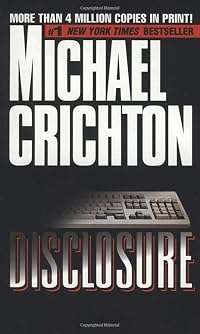
Disclosure
by Michael Crichton
On This Page
Description
From the author of Jurassic Park, Timeline, and Sphere comes an electrifying thriller in which a shocking accusation of sexual harassment triggers a gripping psychological game of cat and mouse and threatens to derail a brilliant career.#1 NEW YORK TIMES BESTSELLER
“A fresh and provocative story.”—People
An up-and-coming executive at the computer firm DigiCom, Tom Sanders is a man whose corporate future is certain. But after a closed-door meeting with his new boss—a woman show more who is his former lover and has been promoted to the position he expected to have—Sanders finds himself caught in a nightmarish web of deceit in which he is branded the villain.
As Sanders scrambles to defend himself, he uncovers an electronic trail into the company’s secrets—and begins to grasp that a cynical and manipulative scheme has been devised to bring him down.
“Crichton writes superbly. . . . The excitement rises with each page.”—Chicago Tribune
“A heart-stop story running on several tracks at once. Disclosure is up to [Crichton’s] usual locomotive speed.”—The Boston Globe
“Expertly crafted, ingenious and absorbing.”—The Philadelphia Inquirer. show less
Tags
Recommendations





Member Reviews
A quite excellent thriller from Michael Crichton. Like most, I first came to Crichton's writing through Jurassic Park, that exquisite, engrossing and impossible-to-dislike concept. But what I have found even more remarkable since is that despite this major conventional (dinosaur) footprint on popular culture, Crichton also did a good line in principled, sometimes contrarian takes on contentious social and political subjects.
Whether or not you agree with his perspectives on climate change scepticism (State of Fear), foreign corporate influence (Rising Sun) or, in the case of the present novel Disclosure, sexual harassment, you can't help but admire how Crichton would stand there and spit in the eye of political correctness and peer show more pressure – and what's more, he did so after the success of Jurassic Park, when a higher public profile meant a higher risk for speaking so out of turn about these issues. In these books, he would highlight the flaws in the accepted arguments and, through his characters and the plot, play out many of the risks of what would happen if the orthodoxy were accepted uncritically. As much as you can admire Crichton for delivering us the beloved Jurassic Park and other page-turning thrillers, you can also admire him for these three titles mentioned above. They show that not only was he a writer of skill but a writer of courage.
Disclosure is the exemplar of this nexus between the skill and courage of Crichton's writing. State of Fear was good and Rising Sun even better, both as polemics and as engrossing, moreish thrillers, but their soapboxing of the issues was more overt. It was palatable, given the books' readability, but quite pronounced. Disclosure, in contrast, is far more balanced. There is less of the soapbox (though it is, indeed, quite a lovely soapbox Crichton had). The issues of sexual harassment in the workplace and the more radical, unreflective aspects of the then-emergent doctrine of feminism are not only more nuanced, but woven expertly into the characters and the plot. You really can't see the seams, and Crichton's message is all the better for it.
Without naming some very prominent names, most thriller writers quixotically seek literary immortality by sales figures and by volume of titles, and the more desperate do so by churning out according to an increasingly exhausted formula. In contrast, Michael Crichton's credibility and reputation is secure not only by Jurassic Park but by daring to be original, to swim against the current, to comment on issues that mattered to him – while all the time providing cracking thrillers that still attained those same high sales figures. It means that novels like Disclosure – unjustly diminished among Crichton's work – remain astonishingly timely, the book tackling with forthrightness and independent thought issues of sex and gender and power that our culture still equivocates and hides from more than 30 years after its release. Writers wouldn't dare nowadays. I've never been shy of admitting that I personally prefer more cultured literary titles over often-throwaway thrillers, but Michael Crichton the thriller-writer is one I would quite happily admit to my own pantheon of remarkable writers. show less
Whether or not you agree with his perspectives on climate change scepticism (State of Fear), foreign corporate influence (Rising Sun) or, in the case of the present novel Disclosure, sexual harassment, you can't help but admire how Crichton would stand there and spit in the eye of political correctness and peer show more pressure – and what's more, he did so after the success of Jurassic Park, when a higher public profile meant a higher risk for speaking so out of turn about these issues. In these books, he would highlight the flaws in the accepted arguments and, through his characters and the plot, play out many of the risks of what would happen if the orthodoxy were accepted uncritically. As much as you can admire Crichton for delivering us the beloved Jurassic Park and other page-turning thrillers, you can also admire him for these three titles mentioned above. They show that not only was he a writer of skill but a writer of courage.
Disclosure is the exemplar of this nexus between the skill and courage of Crichton's writing. State of Fear was good and Rising Sun even better, both as polemics and as engrossing, moreish thrillers, but their soapboxing of the issues was more overt. It was palatable, given the books' readability, but quite pronounced. Disclosure, in contrast, is far more balanced. There is less of the soapbox (though it is, indeed, quite a lovely soapbox Crichton had). The issues of sexual harassment in the workplace and the more radical, unreflective aspects of the then-emergent doctrine of feminism are not only more nuanced, but woven expertly into the characters and the plot. You really can't see the seams, and Crichton's message is all the better for it.
Without naming some very prominent names, most thriller writers quixotically seek literary immortality by sales figures and by volume of titles, and the more desperate do so by churning out according to an increasingly exhausted formula. In contrast, Michael Crichton's credibility and reputation is secure not only by Jurassic Park but by daring to be original, to swim against the current, to comment on issues that mattered to him – while all the time providing cracking thrillers that still attained those same high sales figures. It means that novels like Disclosure – unjustly diminished among Crichton's work – remain astonishingly timely, the book tackling with forthrightness and independent thought issues of sex and gender and power that our culture still equivocates and hides from more than 30 years after its release. Writers wouldn't dare nowadays. I've never been shy of admitting that I personally prefer more cultured literary titles over often-throwaway thrillers, but Michael Crichton the thriller-writer is one I would quite happily admit to my own pantheon of remarkable writers. show less
“Harassment is about power---the undue exercise of power by a superior over a subordinate.”
― Michael Crichton, Disclosure
I would love to see, how this book would be received were it released today. As it was, it did cause a stir way back when it was first released. I thought it was a great book and the movie, while not AS good was pretty awesome as well.
I happen to know that this sort of thing happens..harrassers can be either female or male. It is all about control and really does not have anything to do with sex although some people, even as far as we have come, cannot seem to come to grips with that fact.
I believe this book was in fact, based on a true story and names and situations were in fact changed.
It is a strong and show more powerful read and anyone who has missed this one really should read it. It remains one of my all time favorites. show less
― Michael Crichton, Disclosure
I would love to see, how this book would be received were it released today. As it was, it did cause a stir way back when it was first released. I thought it was a great book and the movie, while not AS good was pretty awesome as well.
I happen to know that this sort of thing happens..harrassers can be either female or male. It is all about control and really does not have anything to do with sex although some people, even as far as we have come, cannot seem to come to grips with that fact.
I believe this book was in fact, based on a true story and names and situations were in fact changed.
It is a strong and show more powerful read and anyone who has missed this one really should read it. It remains one of my all time favorites. show less
Confession: I do not read many "airport thrillers" because the usual plot twists are almost always two-dimensional and anti-climactic, according to my tastes. So, my 2 star rating is purely personal. It was ok, okay? Crichton's prose is silky smooth and the pages just fly by almost as fast as the scenes from a movie I haven't seen. This was a bargain-bin find...$2 for a first edition non-remainder HB with flawless cover jacket.
The story, set in the early 1990s, revolves around an explosive situation due to alleged sexual harassment in the workplace. As most are probably aware of, a blockbuster movie was made from it. To Crichton's credit, he attempts at the end to disparage the kind of categorical thinking which, even today, passes as show more wisdom among our cultural icons.
I'm going to cheat and point any reader that has read this far to goodreads reviewer "Michael" 's review posted on Nov 27, 2010 that begins this way:
"CD-ROMs! Small (aka, hilariously clunky) cell phones! Modems! Virtual reality! Sexual harassment lawsuits! And hey, what's this Internet thing?...." (Careful! There are spoilers.)
I couldn't have said it any better. show less
The story, set in the early 1990s, revolves around an explosive situation due to alleged sexual harassment in the workplace. As most are probably aware of, a blockbuster movie was made from it. To Crichton's credit, he attempts at the end to disparage the kind of categorical thinking which, even today, passes as show more wisdom among our cultural icons.
I'm going to cheat and point any reader that has read this far to goodreads reviewer "Michael" 's review posted on Nov 27, 2010 that begins this way:
"CD-ROMs! Small (aka, hilariously clunky) cell phones! Modems! Virtual reality! Sexual harassment lawsuits! And hey, what's this Internet thing?...." (Careful! There are spoilers.)
I couldn't have said it any better. show less
"Power is neither male nor female."
Ultimately I'm giving this one a three star rating for various reasons, but it was engrossing and harder to put down than most 3 star books.
Crichton touches on the very real but often neglected and non-discussed issue of using sexual harassment as a weapon and political maneuver. Usually this subject is brought up because of the power being leaked out of the other end of the spectrum, producing victims, yet here he shows that certainly isn't always the case, even if it's not politically correct to point that out. The issue of diversity and women's rights come up often, but rather than making it sound like sexism digs, he's showing the black and white angles that aren't influenced by only emotive show more responses.
Despite having Meredith Johnson be a manipulative shrew who used sex as a weapon, and his wife Susan sadly seeing herself as a victim while not able to hold it together well, Crichton did deliver the excellent female character Fernandez as the attorney, and the intelligent and well-appreciated Stephanie Kaplan. Tom himself as a lead was relatively mediocre and not fully convincing by himself, but still the story was a hard to put down soap opera.
Technology in it is severely dated – oooh! Shiny cd drives alert! --- but I read it for the story and not the dinosaur advancements.
Sometimes first names are overused in dialogue, and sometimes characters are slightly one-dimensional, but it was an enjoyable corporate soap opera with a satisfying take-off turn in the end. I still have a lot of Michael Crichton left to read, which excites me since I’ve enjoyed most of the books by him I’ve tried so far. show less
Ultimately I'm giving this one a three star rating for various reasons, but it was engrossing and harder to put down than most 3 star books.
Crichton touches on the very real but often neglected and non-discussed issue of using sexual harassment as a weapon and political maneuver. Usually this subject is brought up because of the power being leaked out of the other end of the spectrum, producing victims, yet here he shows that certainly isn't always the case, even if it's not politically correct to point that out. The issue of diversity and women's rights come up often, but rather than making it sound like sexism digs, he's showing the black and white angles that aren't influenced by only emotive show more responses.
Despite having Meredith Johnson be a manipulative shrew who used sex as a weapon, and his wife Susan sadly seeing herself as a victim while not able to hold it together well, Crichton did deliver the excellent female character Fernandez as the attorney, and the intelligent and well-appreciated Stephanie Kaplan. Tom himself as a lead was relatively mediocre and not fully convincing by himself, but still the story was a hard to put down soap opera.
Technology in it is severely dated – oooh! Shiny cd drives alert! --- but I read it for the story and not the dinosaur advancements.
Sometimes first names are overused in dialogue, and sometimes characters are slightly one-dimensional, but it was an enjoyable corporate soap opera with a satisfying take-off turn in the end. I still have a lot of Michael Crichton left to read, which excites me since I’ve enjoyed most of the books by him I’ve tried so far. show less
Part of the reason it took me so long to read this book is because ... I had no real care to finish it, if I'm to be honest. Many, many, many times I said, "Do I really care? I could just not read it at all and go on to something else..." But, apparently, I really did care! I kept reading it when I wanted to. I would read, like, 3 paragraphs or a chapter ... never a whole lot. To some degree the suspense killed me. I just could not believe how *stupid* (arrogant?) Sanders was! I wanted to see just how bad it got. Then, in the middle of "Wednesday," I could not put the book down!
It got *so* freakin' good! I was carrying the book around with me whenever I had to do something -- laundry is done? I'm reading the book as I'm walking show more downstairs. Coffee's done? I'm reading while sipping my coffee. It was so good!! But ... how good was it really? It took me forever to read!
But it was really good, it was. The sexual harassment and the 1 paragraph that describes how just the accusation of being sexually abused or harassed can ruin someone's life, and how men have had to become so cautious, even with their own kids ... *That* alone is reason to read this book!! It is so freakin' true!!
Adrianne show less
It got *so* freakin' good! I was carrying the book around with me whenever I had to do something -- laundry is done? I'm reading the book as I'm walking show more downstairs. Coffee's done? I'm reading while sipping my coffee. It was so good!! But ... how good was it really? It took me forever to read!
But it was really good, it was. The sexual harassment and the 1 paragraph that describes how just the accusation of being sexually abused or harassed can ruin someone's life, and how men have had to become so cautious, even with their own kids ... *That* alone is reason to read this book!! It is so freakin' true!!
Adrianne show less
Suspenseful, engrossing, and agonizing to see a manipulator in action, using assumptions and company policy to destroy her boss. Brilliantly written. This would generate discussion at a book club.
Disclosure is a tricky book. Early on, I almost put it down because I was truly afraid it was about to be a train wreck. Historically, I like Michael Crichton. Or, at least, I enjoy his Jules Verne-esque ability to zero into science aspects of science fiction and create an intriguing, unique thriller.
I own a bunch of Michael Crichton books, largely because there was a library book sale and they were all there and I plucked them up without abandon. Disclosure ended up being one that I would not have read if it was not there for a dollar and I recognized the author. The book was so far out of my wheelhouse – there’s corporate manipulation and sexual harassment and just… it’s messy. It’s messy.
At the beginning, I was worried it show more was going to turn into one of those pompous dialogues about how women are entrapping men with sexual harassment claims and how it’s a biological “fact” that men and women are wired differently and blah blah blah. You know the talk. I put down the book at one point and googled “Michael Crichton sexist” because honestly? I didn’t want to read a book where the story was a thin veil for a lecture about how men are the real victims here.
Ultimately, I stuck with it. Google reassured me, and I took a leap and decided to trust it. I’m going to take a biota an unpopular opinion here… the book was not misogynistic bullshit. It was a gender swapped situation with good arguments realistic obstacles. It wasn’t perfect, and could benefit from some education, but it wasn’t the worst. And, since it was written back in 1994, this was before the #MeToo movement. That also gave me pause… but it was handled okay. Not perfect. But okay. It was over the top in many ways, but it does show a side of the story seen less frequently, from a victim far less often believed. As far as the issues contained here, both sides have something to say about Disclosure. Some readers will feel it’s anti-feminist. BookRiot actually talked about this last year, so it’s worth checking out their article. I agree with a lot of their points and I think this could have been an effective narrative, but it certainly comes off as defensive.
Let’s move past the sexual harassments themes and talk technical stuff.
All that said, I felt like Disclosure was rushed. Crichton claims in the afterword that the novel was based on a real court case, but I’m not sure which one. The beginning of the book positively dragged, with over a hundred pages of set up for a tech company and a whole lot of drivel about CD-ROM drives. While CDs were progressive in 1994, they are quaint artifacts these days. The book relies so heavily on this up and coming technology that it dates itself horribly. Even the “advanced” tech of the VR world – which we are still growing and developing in 2020 – has flaws.
So much of the story is told in dialogue that it’s difficult to relate to the characters. I’m not totally convinced that Tom is a good guy although Crichton goes above and beyond and way out of his way to make sure the reader identifies Meredith as a villain. Her actions are so over-the-top that it’s almost cartoonish. The aspects that make this a thriller came off as convenient to me and I was not impressed with the “twist”.
Generally, while I will still recommend many of Crichton’s books, this one really feels like a soapbox money-grab to me. It’s not enough for me to boycott him (Jurassic Park, c’mon) but it’s also just… not… good. show less
I own a bunch of Michael Crichton books, largely because there was a library book sale and they were all there and I plucked them up without abandon. Disclosure ended up being one that I would not have read if it was not there for a dollar and I recognized the author. The book was so far out of my wheelhouse – there’s corporate manipulation and sexual harassment and just… it’s messy. It’s messy.
At the beginning, I was worried it show more was going to turn into one of those pompous dialogues about how women are entrapping men with sexual harassment claims and how it’s a biological “fact” that men and women are wired differently and blah blah blah. You know the talk. I put down the book at one point and googled “Michael Crichton sexist” because honestly? I didn’t want to read a book where the story was a thin veil for a lecture about how men are the real victims here.
Ultimately, I stuck with it. Google reassured me, and I took a leap and decided to trust it. I’m going to take a biota an unpopular opinion here… the book was not misogynistic bullshit. It was a gender swapped situation with good arguments realistic obstacles. It wasn’t perfect, and could benefit from some education, but it wasn’t the worst. And, since it was written back in 1994, this was before the #MeToo movement. That also gave me pause… but it was handled okay. Not perfect. But okay. It was over the top in many ways, but it does show a side of the story seen less frequently, from a victim far less often believed. As far as the issues contained here, both sides have something to say about Disclosure. Some readers will feel it’s anti-feminist. BookRiot actually talked about this last year, so it’s worth checking out their article. I agree with a lot of their points and I think this could have been an effective narrative, but it certainly comes off as defensive.
Let’s move past the sexual harassments themes and talk technical stuff.
All that said, I felt like Disclosure was rushed. Crichton claims in the afterword that the novel was based on a real court case, but I’m not sure which one. The beginning of the book positively dragged, with over a hundred pages of set up for a tech company and a whole lot of drivel about CD-ROM drives. While CDs were progressive in 1994, they are quaint artifacts these days. The book relies so heavily on this up and coming technology that it dates itself horribly. Even the “advanced” tech of the VR world – which we are still growing and developing in 2020 – has flaws.
So much of the story is told in dialogue that it’s difficult to relate to the characters. I’m not totally convinced that Tom is a good guy although Crichton goes above and beyond and way out of his way to make sure the reader identifies Meredith as a villain. Her actions are so over-the-top that it’s almost cartoonish. The aspects that make this a thriller came off as convenient to me and I was not impressed with the “twist”.
Generally, while I will still recommend many of Crichton’s books, this one really feels like a soapbox money-grab to me. It’s not enough for me to boycott him (Jurassic Park, c’mon) but it’s also just… not… good. show less
Members
- Recently Added By
Lists

The Worst Bestsellers Podcast
295 works; 5 members

Simulated Reality in Fiction
124 works; 7 members

Books Read in 2022
5,166 works; 112 members
Author Information

142+ Works 172,071 Members
John Michael Crichton, known as Michael Crichton, was born on October 28, 1942 in Chicago, Illinois. He wrote novels while attending Harvard University and Harvard Medical School to help pay the tuition. One of these, The Andromeda Strain, which was published in 1969, became a bestseller. After graduating summa cum laude, he was a postdoctoral show more fellow at the Salk Institute in California before becoming a full-time writer and film director. His carefully researched novels included Eaters of the Dead, The Terminal Man, The Great Train Robbery, Congo, Sphere, Jurassic Park, Rising Sun, Disclosure, The Lost World, Airframe, and Micro. He also wrote non-fiction works including Five Patients: The Hospital Explained, Jasper Johns, and Travels. In the late 1960s, he also wrote under the pen names Jeffrey Hudson and John Lange. He has received several awards including Writer of the Year in 1970 from the Association of American Medical Writers and two Edgar Awards in 1968 and in 1979. Many of his novels have been made into highly successful films, six of which he directed. He was also the creator and executive producer of the Emmy Award-winning television series ER. In addition to his writing and directorial success, his expertise in information science enabled him to run a software company and develop a computer game. He died of cancer on November 4, 2008 at the age of 66. (Bowker Author Biography) show less
Awards and Honors
Distinctions
Series
Belongs to Publisher Series
Work Relationships
Is contained in
Is abridged in
Kirjavaliot - Verkossa (Disclosure) / Ihmeiden aika (St. Agnes' stand) / Tuhon siemenet (Growth) / Piinaava pelko (Death penalties) by Valitut Palat
Reader's Digest Condensed Books 1994 v05: Daybreak / Disclosure / St. Agnes Stand / The Fist of God by Reader's Digest
Common Knowledge
- Canonical title*
- Disclosure
- Original title
- Disclosure
- Original publication date
- 1993
- People/Characters
- Tom Sanders; Meredith Johnson; Don Cherry
- Important places
- Seattle, Washington, USA; Cupertino, California, USA; Malaysia
- Related movies
- Disclosure (1994 | IMDb); Aitraaz (2004 | IMDb)
- Dedication
- For Douglas Crichton
- First words
- Tom Sanders never intended to be late for work on Monday, June 15.
- Quotations*
- Het is een werkgever niet toegestaan: (I) enige persoon werkgelegenheid te onthouden dan wel te ontslaan of anderszins enige persoon te discrimineren voor zover het zijn vergoeding, arbeidstijden, arbeidsvoorwaarden of uit de... (show all)ze arbeid voortvloeiende voordelen betreft, op grond van ras, huidkleur, godsdienst, geslacht of nationale herkomst van die persoon of (2) zijn werknemers of sollicitanten naar werk op enigerlei wijze te beperken, te scheiden of in te delen in categorieën op wat voor wijze dan ook, zodanig dat enig persoon werkgelegenheid wordt onthouden of dreigt te worden onthouden of anderszins zijn staat van werknemer schade wordt toegebracht op grond van ras, huidkleur, godsdienst, geslacht of nationale herkomst van die persoon (Titel VII, Wet op de burgerrechten van 1964) Macht is niet mannelijk en niet vrouwelijk (Katharine Graham)
- Last words
- (Click to show. Warning: May contain spoilers.)"No," he said. "It's nobody."
- Original language*
- Englisch
*Some information comes from Common Knowledge in other languages. Click "Edit" for more information.
Classifications
Statistics
- Members
- 6,053
- Popularity
- 2,097
- Reviews
- 62
- Rating
- (3.44)
- Languages
- 20 — Chinese, Czech, Danish, Dutch, English, Finnish, French, German, Hungarian, Icelandic, Italian, Japanese, Lithuanian, Marathi, Norwegian (Bokmål), Polish, Russian, Spanish, Swedish, Portuguese (Portugal)
- Media
- Paper, Audiobook, Ebook
- ISBNs
- 83
- UPCs
- 3
- ASINs
- 39