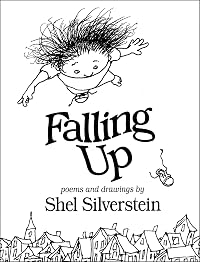
Falling Up: Poems and Drawings
by Shel Silverstein
On This Page
Description
A collection of humorous poems and drawings.Tags
Recommendations




Member Reviews
Re-read for Solomon's bedtime story.
Many many moons ago, when I spent the summer as a Girl Scout camp counselor in Alaska, Sarat sends this to me as a part of a care package and it remains one of my favorite books that I've ever received as a gift. I probably would have though of myself as "too old" to have bought this for myself at the time, but I loved it then, and I love getting to share it with my kids now. Fun to read, fun to read aloud, and fun to gawk at all the illustrations together -- it's a fantastic family read-aloud.
It makes me want to invest in more children's poetry, while at the same time I wonder what else could possibly hold up to Silverstein's goofy wordplay and imaginative irreverence?
Many many moons ago, when I spent the summer as a Girl Scout camp counselor in Alaska, Sarat sends this to me as a part of a care package and it remains one of my favorite books that I've ever received as a gift. I probably would have though of myself as "too old" to have bought this for myself at the time, but I loved it then, and I love getting to share it with my kids now. Fun to read, fun to read aloud, and fun to gawk at all the illustrations together -- it's a fantastic family read-aloud.
It makes me want to invest in more children's poetry, while at the same time I wonder what else could possibly hold up to Silverstein's goofy wordplay and imaginative irreverence?
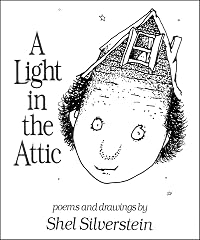
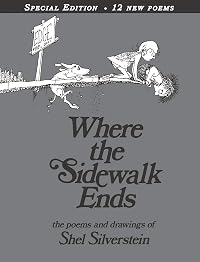
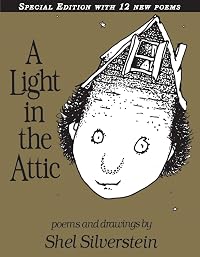
This volume contains a number of absurdist poems by Shel Silverstein that run the gamut from grooming a porcupine to a child dreaming of teaching his teachers. As a kid, I loved this title and Silverstein's other popular poetry books, A Light in the Attic and Where the Sidewalk Ends. They are still silly and fun, although as an adult I noticed more of the disturbing bits here and there (e.g., an illustration of a child with an arrow through his forehead, a father putting golf balls off of his son's nose, etc. etc.). As long as a child isn't easily made uncomfortable by things like that, this book is still fitting for its audience, even if there's one or two dated references (VCR player anyone?). The illustrations blend perfectly with show more the text and/or serve to further illuminate it, often putting the finishing touch on a joke. Some of the wordplay might actually be over some kids' heads, but there's plenty here for them to enjoy. show less
It feels a little shameful to give something by Shel Silverstein an "average" rating, since his books are decidedly not average books. However this book didn't rise up for me - it is a rather large collection of Silverstein's zany poems and drawings. There are some very good poems in here, but unfortunately I thought quite a few were not so great - they tried too hard perhaps. At their best the crazy drawings are an integral part of the poetry - word play that one might not even really understand until you look at the drawing and then go "A-ha!"
Silverstein’s Falling Up is a poetry book full of whimsical, absurd, and beautiful poetry. This was one of the first poetry books I read and enjoyed growing up! Silverstein explores children’s dreams, hopes, fears, and apprehensions through delightful metaphor, and without a drop of condescension (which children absolutely detest, and can usually smell from a mile away).
Who doesn't love Shel Silverstein? Seriously. He makes poetry fun. He's gross, hilarious, and he includes ridiculous pictures. I still love his first two poetry collections more than Falling Up, but that's likely because I read and fell in love with those two books in elementary school. This is just another great volume of poetry and would be a happy addition to the first two in any classroom. I love that his poems vary in length, so that if you assign students to memorize a poem they have a lot of variety to choose from. He also puts a lot of thought into word choice, so that his poems flow easily and are smooth reading.
I personally fell in love with Falling Up. Its a collection of poems that are geared towards kids since they depict scenarios relatable to children. The Falling Up poem itself is about tripping on your untied shoe lace, flipping backwards and describing everything thats going past your eyes. That's so silly and beautiful at the same time! There is also more serious ones that express messages of kindness and doing good through the poem Sharing. There are so many different topics from the anxieties of the diving board (which I can personally relate to) to being worried and asking for help. I'd recommend this to any read of all ages (including adults), its heart warming and can teach the reader a lot about empathy. It's perfect.
I fell in love with falling up back in grade school. This book is full of wonderful poems, ryhmes, limericks, and silly stories aabout everything to absolutely nothing. This book is great for young kids to build their imagination while reading these stories. This book is full of hilarious tales that are both traditional and modern.
Members
- Recently Added By
Published Reviews
ThingScore 100
Shel Silverstein is that rare adult who can still think like a child. He has continued to polish his own brand of humorous verse -- whimsical, inventive, with catchy rhythms and, as X. J. Kennedy says, "a streak of the wierd." It's a distinctive kind of verse that appeals to most ages, and he illustrates it with bold and equally distinctive line drawings.
added by Shortride
Lists

Brilliant poetry collections for kids
51 works; 18 members

Honey For a Child's Heart
1,152 works; 25 members

Geek Dad Read to Your Kids List
79 works; 4 members

Children's Poetry
10 works; 1 member

Children's Humor
51 works; 6 members

Favorite Recent Poetry: 1980-2022
178 works; 70 members

Written and Illustrated By
805 works; 1 member

Poetry volumes by single author
122 works; 8 members
Author Information

101+ Works 86,218 Members
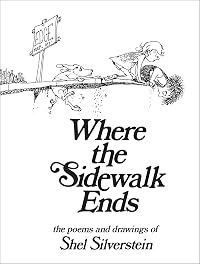
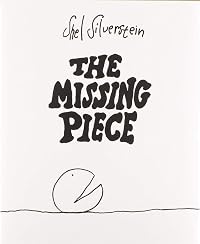
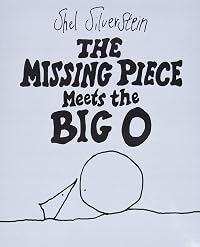
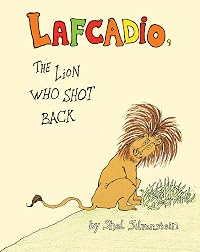
The most popular current writer of humorous verse for children, Shel Silverstein was born in Chicago, Illinois, has been married and divorced, has one daughter, and currently lives in Brooklyn, New York. His career includes composing popular songs, drawing cartoons, writing many adult articles (several for Playboy), and acting. However, he is best show more known for his self-illustrated children's poetry. His first such book was Uncle Shelby's Story of Lafcadio, the Lion Who Shot Back (1963), the humorous tale of a lion who turns the tables on hunters. It was followed by The Giving Tree (1964), a story of a parentlike tree that gives endlessly and is endlessly used by its son. Several other such picture books followed, including The Missing Piece (1976), about a circle that goes in search of a missing piece, and its sequel, The Missing Piece Meets the Big O (1981). However, two collections of poetry are probably his best-loved work: Where the Sidewalk Ends: The Poems and Drawings of Shel Silverstein (1974), and A Light in the Attic (1981). All of Silverstein's poetry for children employs the language play common to Lewis Carroll and Edward Lear. Silverstein is probably the best of the contemporary nonsense poets for children. (Bowker Author Biography) show less
Awards and Honors
Awards
Distinctions
Work Relationships
Is contained in
Is expanded in
Common Knowledge
- Canonical title
- Falling Up: Poems and Drawings
- Original publication date
- 1996-09
- People/Characters
- Headphone Harold; Clean Gene; Allison Beals
- Dedication
- To Matt
- First words
- I tripped on my shoelace
And I fell up— - Quotations
- Gardener
We gave you a chance
To water the plants
We didn't mean that way—
Now zip up your pants. - Last words
- (Click to show. Warning: May contain spoilers.)Once you are, then you've been—
As soon as you're in, you're out.
Classifications
Statistics
- Members
- 9,230
- Popularity
- 1,161
- Reviews
- 205
- Rating
- (4.25)
- Languages
- 5 — Chinese, English, German, Hebrew, Spanish
- Media
- Paper, Ebook
- ISBNs
- 22
- UPCs
- 2
- ASINs
- 15