
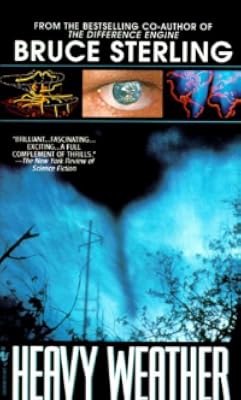
Heavy Weather
by Bruce Sterling
On This Page
Description
A novel of the 21st century. It's 2031, and the atmosphere's wrecked. The Storm Troopers - scientists, techno-freaks - get their kicks from weather. Hooked up to drones through virtual-reality rigs, they plunge into the eye of a storm. Their Holy Grail is a tornado, the F6.Tags
Recommendations












Member Reviews
Heavy Weather looks like an adaptation of the movie Twister on the surface: giant tornadoes, obsessed scientists, even that one scene with the flying cow, but it's actually a smart dark mirror that seriously asks and answers the question "What would it be like to live through the worst of anthropocentric climate change?"
In the year 2031, Alex Unger is dying in a private Mexican hospital when his sister Janey breaks him out and takes him for one last fling chasing tornadoes in blasted West Texas, where civilization simply dried up and blew away in a megadrought. It's bad everywhere: governments have collapsed into emergency management posses; pandemics strike with regularity; and the best that people can do is scrape out a shallow grave show more of a life before something kills them. The goal for the characters is the F-6 Super-Tornado, a storm a whole order of magnitude bigger than anything on this Earth. There's some amazing lyrical descriptions of storms across the Texas wastes, and the thrill of chasing tornadoes.
But where this book shines is its nihilistic shadow government. The Very Serious People who have decided that for civilization to survive, the population must fall. Nothing so crass as a Holocaust, just little tweaks here and there to ensure the birth rate falls and the death rate rises. All the chaos and suffering is careful planned by a distributed cadre of secret survivalists... Life boat cannibals who are willing to do anything to see that some of us get through, rather than none.
Heavy Weather is supremely creepy, and has only become more so in the past twenty years. Sure, an honest reviewer would note that some of the dialog is clunky, and that Janey might not be the best character, but it's got a solid dozen or so moments that make my hair stand on end, even after years of rereading.
I'll ask you, like Sterling asks in one of my favorite scenes in all of literature, "When did mankind lose control of its destiny?" show less
In the year 2031, Alex Unger is dying in a private Mexican hospital when his sister Janey breaks him out and takes him for one last fling chasing tornadoes in blasted West Texas, where civilization simply dried up and blew away in a megadrought. It's bad everywhere: governments have collapsed into emergency management posses; pandemics strike with regularity; and the best that people can do is scrape out a shallow grave show more of a life before something kills them. The goal for the characters is the F-6 Super-Tornado, a storm a whole order of magnitude bigger than anything on this Earth. There's some amazing lyrical descriptions of storms across the Texas wastes, and the thrill of chasing tornadoes.
But where this book shines is its nihilistic shadow government. The Very Serious People who have decided that for civilization to survive, the population must fall. Nothing so crass as a Holocaust, just little tweaks here and there to ensure the birth rate falls and the death rate rises. All the chaos and suffering is careful planned by a distributed cadre of secret survivalists... Life boat cannibals who are willing to do anything to see that some of us get through, rather than none.
Heavy Weather is supremely creepy, and has only become more so in the past twenty years. Sure, an honest reviewer would note that some of the dialog is clunky, and that Janey might not be the best character, but it's got a solid dozen or so moments that make my hair stand on end, even after years of rereading.
I'll ask you, like Sterling asks in one of my favorite scenes in all of literature, "When did mankind lose control of its destiny?" show less
Bruce Sterling seems to be a victim of his reputation. Reviewers of Heavy Weather, his 1994 novel about near-future storm chasers using VR and other neat tech to pursue super tornadoes across a depopulated Great Plains, often ask, where’s the cyberpunk you gave us in the eighties. Yet the novel's world is carefully constructed. Sterling offers some intriguing speculations about the behavior of tornadoes and the future of money. There is also plenty of tech, but it is subordinate to the character-driven story he wants to tell.
Sterling doesn’t get enough credit for his nuanced characters. Alex, the asthmatic weakling who overcompensates by doubling down on any dare, reminds me of Lois Bujold’s Miles Vorkosigan. His sister Janey show more matures in stages throughout the story, as does her obsessed scientist lover. Other members of the Troupe of storm chasers are also given compelling backstories.
The novel may have been the inspiration for Twister, Michael Crichton’s 1996 film on a similar subject. The film is standard action-disaster fare, but it lacks the zip of Sterling's world-building and character development. show less
Sterling doesn’t get enough credit for his nuanced characters. Alex, the asthmatic weakling who overcompensates by doubling down on any dare, reminds me of Lois Bujold’s Miles Vorkosigan. His sister Janey show more matures in stages throughout the story, as does her obsessed scientist lover. Other members of the Troupe of storm chasers are also given compelling backstories.
The novel may have been the inspiration for Twister, Michael Crichton’s 1996 film on a similar subject. The film is standard action-disaster fare, but it lacks the zip of Sterling's world-building and character development. show less
This may be a product of my expectations, but I liked how this novel was similar and distinctly different from a lot of science fiction. The orientation and world view is “futurist,” in that it is a thought experiment that projects how a very real event (e.g., climate change) and realistic technological change (e.g., virtual reality, autonomous vehicles) fuse with politics, economics, professions, and social life generally. It envisions a world that arises out of the one we are familiar with. In this case, instead of predicting trends to form the basis of a strategic business model, Sterling is raising issues worth thinking about and acting upon now.
As far as that futurism goes, this novel offers a compellingly “possible” world show more with some useful concepts and frames of thinking that could conceivably arise. Also, there are some eerie, accidental connections to our modern age with the vague references to “impeachments” and the “State of Emergency” that were situated around 2019 in the story timeline. The “State of Emergency” was likely some kind of climate disaster, but connections like this are fun. show less
As far as that futurism goes, this novel offers a compellingly “possible” world show more with some useful concepts and frames of thinking that could conceivably arise. Also, there are some eerie, accidental connections to our modern age with the vague references to “impeachments” and the “State of Emergency” that were situated around 2019 in the story timeline. The “State of Emergency” was likely some kind of climate disaster, but connections like this are fun. show less
A brother and sister are part of a storm-chasing group the rowms the ecologically devastated southern US, planning for the coming of the near-mythical F6-strength tornado. A hallmark climate-change novel. The eerie, ghastly climactic scene in the shadow of the F6 hits pretty hard in the context of current conspiracy theories swirling around covid.
My reactions to reading this novel in 1994. Spoilers follow.
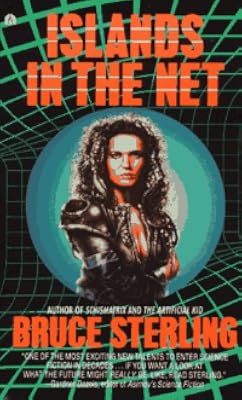
The contrasts and similarities between this and Sterling’s 1988 novel Islands in the Net are interesting.
The earlier novel was set in 2022. This novel is set nine years later in 2031.
Both novels feature a contemporary social concern hovering over their worlds. In Islands in the Net, it was the “Abolition” of nuclear weapons as befitting a novel of the nuclear-obsessed Eighties. In Heavy Weather, the effects of the much touted Greenhouse Effect loom over the novel’s milieu. (The title refers to not only the disturbed, violent weather of the Greenhouse world but also its political/social turmoil.)
Both novels heavily feature the economic effects of the information age. show more Data pirates featured heavily in Islands in the Net. Here, Sterling postulates other adverse effects of the information age. The U.S. “State of Emergency” in 2015 nationalized all data, and software in general has little value since it can be copied so easily. (Sterling also postulates that software and computer circuits so complicated that computers design them and no human really understands them.). “Unbreakable encryption, digital authentication, anonymous remailing, and network untraceability” have destroyed any governmental – indeed any human – control over the economy with “all workable standards of wealth … vaporized, digitized, and vanished”. Taxation becomes impossible. (I would dearly like to know what research sources Sterling used in forming this vision and how they think governments will be unable to tax wealth. The cybersphere, after all, is not the whole world, just a virtual depiction of it. Wealth also exists in physical objects which a government can take as taxes. For that matter, I’d like to know Sterling’s politics. He has taken enough swipes at Reagan and Republicans so it’s clear he’s not a conservative. Yet, he also takes a lot of swipes at Marxism’s failure. I suspect, especially given what little I’ve read of his non-fiction about computer crime, that he’s something of an anarchist with muddled ideas of economics.). Vast amounts of black-market money (from untaxed work and crime) comes to the surface, and market forces set up private currencies (of course, historically they have existed).
Islands in the Net has a much more hopeful air about it. Essentially, it’s a tale of taming the wilder uses of tech. This novel posits a much darker, more anarchic world. Essentially this is a novel of people finding purpose and surviving in a bleak, devastated world where sexual intimacy is deadly. Several new strains of diseases are sexually transmitted or spread through casual contact, severe storms frequently devastate the Midwest, the economy of America and the world is in ruin, disease and famine and environmental ruin stalk the planet. It’s no mistake that the two protagonists of this novel – Jane and Alex Unger – are essentially fearless individuals because they have little to live for. This is particularly true of sickly Alex who doesn’t expect to live to see his 22nd birthday. (We first meet him in a quack black market Mexican clinic getting a “lung enema”.) He just wants a more meaningful death (like by gunshot or plane accident) than illness. His sister – Jane Unger is fearless in her quest, shared by her fellow Storm Troupers, for the apocalyptic F-6 storm (a storm so severe it is only theoretical – at one point it is theorized it will be a massive permanent storm like Jupiter’s Great Red Spot). The passionate love of her life, Troupe leader and charismatic Jerry Mulcahey is willing to risk death to give witness to the F-6’s destruction. Other members of the group find purpose in being crypto-Luddite terrorists.
In a bleak aside to the more optimistic, computer heavy Sterling novels of Schismatrix and Islands in the Net, computer technology here offers little in the way of salvation and much in the way of social dislocation. Not only has the cybersphere brought economic chaos, but Alex Unger satirically notes that bums with cheap laptop computers full of the Library of Congress spend their time coming up with “pathetic, shattered, crank, paranoid” theories for their personal failures. He quips that it “almost beat drugs for turning smart people into human wreckage.” The situation is nicely summed up with the Troup possessing a supercomputer with more power than all the planet’s computers in the 1990’s. It’s a loan but no one wants it back. It seems that not only is not much help in modeling the chaos of an F-6 but also not much good solving the world’s problems.
Leo Mulcahey, Jerry’s brother, finds purpose as part of a shadow cabal existing in – but not of – the government. In a nice bit showing how a small, powerful conspiracy could be organized piecemeal in the Information Age, Sterling gives us a cabal of semi-Luddites dedicated to doing what no one else is willing to do – solve the world’s social and environmental problems by any means necessary. (This cabal is an interesting contrast to the formal, strictly multi-national, high level group in George Turner’s recent The Destiny Makers. They meet to secretly plan a population cull.) They accomplish this by fostering plagues, covert sterilization programs, increasing death tolls by delaying aid and/or diverting public attention. (This sudden plot twist is only in the last quarter of the novel.) This purpose exacts such a toll on the soul though that several conspirators, including Leo, plan to use the communication black out caused by the F-6 to escape their governmental masters. Ultimately – in a plot development that will no doubt please Orson Scott Card and Nancy Kress who have criticized sf for ignoring family and children in future stories – the Ungers find value and purpose in life in the oldest place of all – the family. They genuinely acknowledge and become aware of their love for each other. For Jane’s part, fear enters her life with her and Jerry’s child – a “hostage to fortune”. Alex becomes reconciled with his father, is cured, and begins on planning what to do with his life, and he falls in love. (Leo’s story is less happy. Alex kills him.)
The story ends on no happy note – just that the Ungers will survive the future, plan for it, and get by through their love for each other. As always, this novel exhibits Sterling’s impressively plausible blend of future tech, politics, and economics, but it’s the best novel of his I’ve read because it’s very funny in parts. Here Sterling exhibits in his fiction the wit I’ve seen in his reviews and articles. I particularly liked the character of Alex – a bright young man who longs for a good death, refuses to feel guilty about the pain of others, and who has a young man’s passion for things like rare paper comic books. show less
The contrasts and similarities between this and Sterling’s 1988 novel Islands in the Net are interesting.
The earlier novel was set in 2022. This novel is set nine years later in 2031.
Both novels feature a contemporary social concern hovering over their worlds. In Islands in the Net, it was the “Abolition” of nuclear weapons as befitting a novel of the nuclear-obsessed Eighties. In Heavy Weather, the effects of the much touted Greenhouse Effect loom over the novel’s milieu. (The title refers to not only the disturbed, violent weather of the Greenhouse world but also its political/social turmoil.)
Both novels heavily feature the economic effects of the information age. show more Data pirates featured heavily in Islands in the Net. Here, Sterling postulates other adverse effects of the information age. The U.S. “State of Emergency” in 2015 nationalized all data, and software in general has little value since it can be copied so easily. (Sterling also postulates that software and computer circuits so complicated that computers design them and no human really understands them.). “Unbreakable encryption, digital authentication, anonymous remailing, and network untraceability” have destroyed any governmental – indeed any human – control over the economy with “all workable standards of wealth … vaporized, digitized, and vanished”. Taxation becomes impossible. (I would dearly like to know what research sources Sterling used in forming this vision and how they think governments will be unable to tax wealth. The cybersphere, after all, is not the whole world, just a virtual depiction of it. Wealth also exists in physical objects which a government can take as taxes. For that matter, I’d like to know Sterling’s politics. He has taken enough swipes at Reagan and Republicans so it’s clear he’s not a conservative. Yet, he also takes a lot of swipes at Marxism’s failure. I suspect, especially given what little I’ve read of his non-fiction about computer crime, that he’s something of an anarchist with muddled ideas of economics.). Vast amounts of black-market money (from untaxed work and crime) comes to the surface, and market forces set up private currencies (of course, historically they have existed).
Islands in the Net has a much more hopeful air about it. Essentially, it’s a tale of taming the wilder uses of tech. This novel posits a much darker, more anarchic world. Essentially this is a novel of people finding purpose and surviving in a bleak, devastated world where sexual intimacy is deadly. Several new strains of diseases are sexually transmitted or spread through casual contact, severe storms frequently devastate the Midwest, the economy of America and the world is in ruin, disease and famine and environmental ruin stalk the planet. It’s no mistake that the two protagonists of this novel – Jane and Alex Unger – are essentially fearless individuals because they have little to live for. This is particularly true of sickly Alex who doesn’t expect to live to see his 22nd birthday. (We first meet him in a quack black market Mexican clinic getting a “lung enema”.) He just wants a more meaningful death (like by gunshot or plane accident) than illness. His sister – Jane Unger is fearless in her quest, shared by her fellow Storm Troupers, for the apocalyptic F-6 storm (a storm so severe it is only theoretical – at one point it is theorized it will be a massive permanent storm like Jupiter’s Great Red Spot). The passionate love of her life, Troupe leader and charismatic Jerry Mulcahey is willing to risk death to give witness to the F-6’s destruction. Other members of the group find purpose in being crypto-Luddite terrorists.
In a bleak aside to the more optimistic, computer heavy Sterling novels of Schismatrix and Islands in the Net, computer technology here offers little in the way of salvation and much in the way of social dislocation. Not only has the cybersphere brought economic chaos, but Alex Unger satirically notes that bums with cheap laptop computers full of the Library of Congress spend their time coming up with “pathetic, shattered, crank, paranoid” theories for their personal failures. He quips that it “almost beat drugs for turning smart people into human wreckage.” The situation is nicely summed up with the Troup possessing a supercomputer with more power than all the planet’s computers in the 1990’s. It’s a loan but no one wants it back. It seems that not only is not much help in modeling the chaos of an F-6 but also not much good solving the world’s problems.
Leo Mulcahey, Jerry’s brother, finds purpose as part of a shadow cabal existing in – but not of – the government. In a nice bit showing how a small, powerful conspiracy could be organized piecemeal in the Information Age, Sterling gives us a cabal of semi-Luddites dedicated to doing what no one else is willing to do – solve the world’s social and environmental problems by any means necessary. (This cabal is an interesting contrast to the formal, strictly multi-national, high level group in George Turner’s recent The Destiny Makers. They meet to secretly plan a population cull.) They accomplish this by fostering plagues, covert sterilization programs, increasing death tolls by delaying aid and/or diverting public attention. (This sudden plot twist is only in the last quarter of the novel.) This purpose exacts such a toll on the soul though that several conspirators, including Leo, plan to use the communication black out caused by the F-6 to escape their governmental masters. Ultimately – in a plot development that will no doubt please Orson Scott Card and Nancy Kress who have criticized sf for ignoring family and children in future stories – the Ungers find value and purpose in life in the oldest place of all – the family. They genuinely acknowledge and become aware of their love for each other. For Jane’s part, fear enters her life with her and Jerry’s child – a “hostage to fortune”. Alex becomes reconciled with his father, is cured, and begins on planning what to do with his life, and he falls in love. (Leo’s story is less happy. Alex kills him.)
The story ends on no happy note – just that the Ungers will survive the future, plan for it, and get by through their love for each other. As always, this novel exhibits Sterling’s impressively plausible blend of future tech, politics, and economics, but it’s the best novel of his I’ve read because it’s very funny in parts. Here Sterling exhibits in his fiction the wit I’ve seen in his reviews and articles. I particularly liked the character of Alex – a bright young man who longs for a good death, refuses to feel guilty about the pain of others, and who has a young man’s passion for things like rare paper comic books. show less
Liked it very much. There is a definite shared world of ideas between Sterling, Gibson and Stephenson, etc. The down and out warrior-genius; the bad-ass girl; the ex-Special Forces wackos; the apocalyptic possibilities, etc. It's like the hand-shake of shared symbology. But, this is not a complaint. I love it.
Okay, it's like this: Anarchic, punkish weather researchers/tornado chasers contend with cops, government agents, rival weather researchers, bandit gangs, and really, really bad weather in a globally-warmed, anarchic, punkish, dystopian future. Occasionally interesting passages strung together with a thin, silly plot. Not Sterling's best.
Members
- Recently Added By
Lists

Character-driven SF
59 works; 1 member
Author Information

131+ Works 20,963 Members
Bruce Sterling is a recent winner of the Nebula Award and the author of the nonfiction book "The Hacker Crackdown" as well as novels and short story collections. He co-authored, with William Gibson, the critically acclaimed novel "The Difference Engine." He lives in Austin, Texas, with his wife and daughter. (Publisher Provided)
Series
Belongs to Publisher Series
Work Relationships
Is contained in
Common Knowledge
- Original publication date
- 1994-10
Classifications
Statistics
- Members
- 1,262
- Popularity
- 19,371
- Reviews
- 16
- Rating
- (3.37)
- Languages
- 6 — Czech, English, French, German, Italian, Portuguese
- Media
- Paper, Audiobook, Ebook
- ISBNs
- 15
- ASINs
- 9