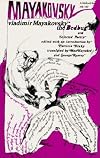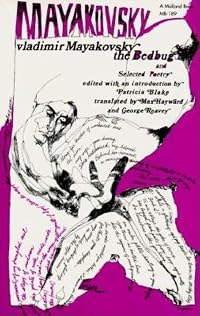
The Bedbug and Selected Poetry
by Vladimir Majakovskij
On This Page
Description
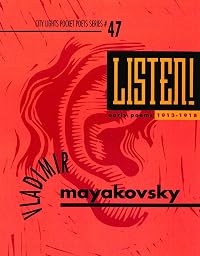
This selection of Mayakovsky's work covers his entire career--from the earliest pre-revolutionary lyrics to a poem found in a notebook after his suicide. Splendid translations of the poems, with the Russian on a facing page, and a fresh, colloquial version of Mayakovsky's dramatic masterpiece, The Bedbug.Tags
Recommendations









Member Reviews
Have you seen
a dog lick the hand that thrashed it?!
The five stars are for the poetry. the play is a satire which endures because of its all too human kernel. The verse is loud, a clamoring. Metallic. I appreciate a verb like shock in this instance. Current is also a valuable word when considering these riveting lines of Mayakovsky. Seeking council the other day I went to my Director--who sighed from over steaming bowl of noodles and said, No wisdom. She could use some Mayakovsky about now. My crazy sister noted the other night on social media that Hollywood should leave politics alone. These poems couldn't help her.
a dog lick the hand that thrashed it?!
The five stars are for the poetry. the play is a satire which endures because of its all too human kernel. The verse is loud, a clamoring. Metallic. I appreciate a verb like shock in this instance. Current is also a valuable word when considering these riveting lines of Mayakovsky. Seeking council the other day I went to my Director--who sighed from over steaming bowl of noodles and said, No wisdom. She could use some Mayakovsky about now. My crazy sister noted the other night on social media that Hollywood should leave politics alone. These poems couldn't help her.
Mayakovsy's poems are filled with depressing lines, like, "I love to see children die..." When I first read this line in Russian, I thought I had the second verb wrong. Nope. I sure hope I'm missing his irony, but I'm happy to miss it. His verse is self-absorbed, depressing and narrow: so he'd make a great American poet, the male equivalent of Sylvia Plath, except he didn't try to kill his kids. But the poem I cite suggests he would have, had he the chance.
He was a satirist of society, so elevated by Stalin to litarary sainthood. His play Bedbug, here, has quite a bit of slapstick--about marriage between a heiress and a working stiff, then futuristic robots. The one passage I enjoyed was M's use of committee-meeting language at the show more nuptials: "This marriage is now convened."
Occasionally there are revealing period-reflections, for instance, communist newspapers from all over the globe--Chicago, Indonesia--report the nuptials.
But the Bedbug ages pretty well, esp in the Max Hayward trans. After all, it's from 1930, but seems more like the fifties. Wonderful final scenes of proletarian man on exhibit in a zoo, with a bedbug--both exotica in the future. show less
He was a satirist of society, so elevated by Stalin to litarary sainthood. His play Bedbug, here, has quite a bit of slapstick--about marriage between a heiress and a working stiff, then futuristic robots. The one passage I enjoyed was M's use of committee-meeting language at the show more nuptials: "This marriage is now convened."
Occasionally there are revealing period-reflections, for instance, communist newspapers from all over the globe--Chicago, Indonesia--report the nuptials.
But the Bedbug ages pretty well, esp in the Max Hayward trans. After all, it's from 1930, but seems more like the fifties. Wonderful final scenes of proletarian man on exhibit in a zoo, with a bedbug--both exotica in the future. show less
A classic of early-Soviet literature. "The Bedbug" is a terrific story and offers great insight into the politicized literature of the era.
This is a fantastic collection of the range and skill of Mayakovsky's writings.
Ratings
Members
- Recently Added By
Lists

Harold Bloom - The Western Canon: D. The Chaotic Age
833 works; 24 members

Personal 2026 reads
31 works; 1 member
Author Information

401+ Works 2,455 Members
Mayakovsky was one of Russia's most important avant-garde poets. A member of the Futurist group of painters and poets in the century's second decade, he became noted for his flamboyant public appearances, aesthetic iconoclasm, and very real verbal brilliance. Early involvement with the Bolsheviks in 1908 was followed years later by endorsement of show more the new Soviet government. Mayakovsky placed his talents at the service of the Soviet state, although his dreams for radical cultural changes were rebuffed by the new rulers, most of whom had relatively conservative tastes in literature. During the civil war and the 1920's, Mayakovsky wrote a great deal of agitational verse of varying quality; he also wrote film scenarios and two plays. A notable figure in the Soviet Union, with a considerable international reputation, he was allowed to travel abroad. However, he also drew harsh criticism for his deviation from the increasingly rigid cultural norms. This, combined with problems in his personal life, ultimately led to his suicide at age 36---an event that resounded greatly in Soviet culture. Mayakovsky was a great innovator in versification, striking in his use of extravagant metaphor and hyperbole. His experiments with rhythm, rhyme, and language affected many poets, and this originality went hand in hand with great lyric talent, often refracted through comic and tragic personas. Among his most important achievements are his long narrative poems, such as "A Cloud in Trousers" (1915), "War and the World" (1916), and "About That" (1923). Also excellent are his plays, "The Bedbug" (1928) and "The Bathhouse" (1929)---brilliant satires of Soviet philistinism and bureaucracy. (Bowker Author Biography) show less
Some Editions
Awards and Honors
Work Relationships
Contains
Common Knowledge
- Canonical title
- The Bedbug and Selected Poetry
Classifications
- Genres
- Poetry, Fiction and Literature
- DDC/MDS
- 891.7142 — Literature & rhetoric Literatures of other languages East Indo-European and Celtic literatures Russian and East Slavic languages Russian poetry USSR 1917–1991 Early 20th century 1917–1945
- LCC
- PG3476 .M3 .A24 — Language and Literature Slavic languages and literatures. Baltic languages. Albanian language Slavic. Baltic. Albanian Russian literature Individual authors and works 1917-1960
- BISAC
Statistics
- Members
- 415
- Popularity
- 74,942
- Reviews
- 4
- Rating
- (3.92)
- Languages
- English, Russian
- Media
- Paper
- ISBNs
- 2
- ASINs
- 6