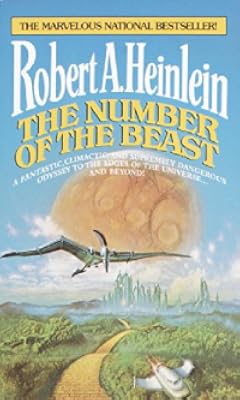
The Number of the Beast
by Robert A. Heinlein
Number Of The Beast (1), World As Myth (2), Lazarus Long (3)
On This Page
Description
The wickedest, most wonderful science fiction story ever created in our—or any—timeAnything can begin at a party in California—and everything does in this bold masterwork by a grand master of science fiction.
When four supremely sensual and unspeakably cerebral humans—two male, two female—find themselves under attack from aliens who want their awesome quantum breakthrough, they take to the skies—and zoom into the cosmos on a rocket roller-coaster ride of adventure, danger, show more ecstasy, and peril.
. show less
Tags
Recommendations




















Member Recommendations
Member Reviews
Originally posted at Fantasy Literature.
When I was a kid I loved some of Robert A. Heinleinƒ??s Â??JuvenilesÂ? Â?? science fiction stories for children and teens. Red Planet was one of my favorites and I must have read it at least five times. These novels are part of the reason I kept reading science fiction Â?? they left such an impression on my young mind.
Despite this nostalgia, I havenÂ??t read Heinlein in years. When Blackstone Audio recently started releasing some of his later novels on audio, I thought it was time to check out some IÂ??d never read. The first one I tried was The Number of the Beast, written in 1980 after a seven-year hiatus brought on by ill health when Heinlein was in his seventies.
This show more story starts when professor Zebadiah John Carter meets Deety (short for Dejah Thoris) Burroughs and her father, mathematician Jacob Burroughs, at a party hosted by a socialite named Hilda Corners. Within minutes, Zebadiah and Deety are engaged and JacobÂ??s car is bombed by unknown attackers. Zebadiah, Deety, Jacob, and Hilda flee in ZebÂ??s flying car, Jacob and Hilda decide to get married, and they all hide out in a cabin where Jacob has been working on a device that can access parallel universes. Soon the couples are visiting places such as Oz, Lilliput, and Barsoom (fans of Edgar Rice Burroughs will already have noticed that Zeb and DeetyÂ??s names come from the BARSOOM novels). There are lots of SFF in-jokes and Heinlein self-referentially brings in some of his characters from his previous books (heÂ??s assuming youÂ??ve read them) and even he and his wife are mentioned.
The audio production of The Number of the Beast was excellent. It was read by a cast of top-tier narrators: Bernadette Dunne, Emily Durante, Malcom Hillgartner, Sean Runnette, Paul Michael Garcia, and Tom Weiner. They were exceptional. Unfortunately, the story was wretchedly awful and I was not able to finish it. It started off bad from the very first scene and persevered in its badness until I started skimming and finally gave up. (Â??LifeÂ??s too short.Â?Â)
Most of the problem was the characters and their non-stop obnoxious dialogue and interactions. We hear from all four points of view and every one of them is odious. The first one we hear from is Zebadiah as he�?s dancing with Deety who he�?s just met at Hilda�?s party. He�?s looking down her dress and wishing she�?d shut up. Then he asks her about her cleavage: �?Is that cantilevering natural, or is there an invisible bra, you being in fact the sole support of two dependents?� Fortunately for Zeb, Deety is just as infatuated with her �?teats� as he is and is happy to discuss all of their perfections (often), and all of her other perfections (often), with us every time it�?s her turn to talk. To be fair, I must admit that she�?s quick to alert us of her imperfections in great detail, too, such as the body odor which requires her to soak in a hot soapy tub twice daily. (Thank you, Deety.)
Despite his annoyance with DeetyÂ??s chatter, once they are much better acquainted (i.e., three minutes later), the two are engaged and off they go to get married, with Jacob and Hilda in tow. When they arrive at the cabin, after JacobÂ??s car is bombed, things get even worse. Now Jacob and Hilda are hitched, too, and the four of them are running around scantily clad. Each in turn regales us with his or her sleazy interior monologues (DeetyÂ??s teats are frequently the subject) and the four of them together engage in constant banter thatÂ??s supposed to be clever, witty, and provocative but is usually just vulgar, sexist, and boring. When Deety takes off her bikini top in front of her father, and then says that she wouldnÂ??t have refused him if heÂ??d made advances toward her when she was younger, I knew IÂ??d suffered long enough. I stuck it out a bit longer just because I was in the car and had nothing else to listen to and I hoped The Number of the Beast might redeem itself but, looking back, I would have profited more from listening to my squeaky fanbelt.
How sad it is to hate a novel written by an author you loved in your youth. I used to think of Robert A. Heinlein as one of my heroes, but now I find out he was a self-indulgent perverted narcissist with a breast fetish and an obsession with incest. To protect my memories, and to give Heinlein the benefit of the doubt, IÂ??d like to assume that the dismal quality of Number of the Beast was caused by HeinleinÂ??s poor health. I donÂ??t know. I just feel really disappointed. show less
When I was a kid I loved some of Robert A. Heinleinƒ??s Â??JuvenilesÂ? Â?? science fiction stories for children and teens. Red Planet was one of my favorites and I must have read it at least five times. These novels are part of the reason I kept reading science fiction Â?? they left such an impression on my young mind.
Despite this nostalgia, I havenÂ??t read Heinlein in years. When Blackstone Audio recently started releasing some of his later novels on audio, I thought it was time to check out some IÂ??d never read. The first one I tried was The Number of the Beast, written in 1980 after a seven-year hiatus brought on by ill health when Heinlein was in his seventies.
This show more story starts when professor Zebadiah John Carter meets Deety (short for Dejah Thoris) Burroughs and her father, mathematician Jacob Burroughs, at a party hosted by a socialite named Hilda Corners. Within minutes, Zebadiah and Deety are engaged and JacobÂ??s car is bombed by unknown attackers. Zebadiah, Deety, Jacob, and Hilda flee in ZebÂ??s flying car, Jacob and Hilda decide to get married, and they all hide out in a cabin where Jacob has been working on a device that can access parallel universes. Soon the couples are visiting places such as Oz, Lilliput, and Barsoom (fans of Edgar Rice Burroughs will already have noticed that Zeb and DeetyÂ??s names come from the BARSOOM novels). There are lots of SFF in-jokes and Heinlein self-referentially brings in some of his characters from his previous books (heÂ??s assuming youÂ??ve read them) and even he and his wife are mentioned.
The audio production of The Number of the Beast was excellent. It was read by a cast of top-tier narrators: Bernadette Dunne, Emily Durante, Malcom Hillgartner, Sean Runnette, Paul Michael Garcia, and Tom Weiner. They were exceptional. Unfortunately, the story was wretchedly awful and I was not able to finish it. It started off bad from the very first scene and persevered in its badness until I started skimming and finally gave up. (Â??LifeÂ??s too short.Â?Â)
Most of the problem was the characters and their non-stop obnoxious dialogue and interactions. We hear from all four points of view and every one of them is odious. The first one we hear from is Zebadiah as he�?s dancing with Deety who he�?s just met at Hilda�?s party. He�?s looking down her dress and wishing she�?d shut up. Then he asks her about her cleavage: �?Is that cantilevering natural, or is there an invisible bra, you being in fact the sole support of two dependents?� Fortunately for Zeb, Deety is just as infatuated with her �?teats� as he is and is happy to discuss all of their perfections (often), and all of her other perfections (often), with us every time it�?s her turn to talk. To be fair, I must admit that she�?s quick to alert us of her imperfections in great detail, too, such as the body odor which requires her to soak in a hot soapy tub twice daily. (Thank you, Deety.)
Despite his annoyance with DeetyÂ??s chatter, once they are much better acquainted (i.e., three minutes later), the two are engaged and off they go to get married, with Jacob and Hilda in tow. When they arrive at the cabin, after JacobÂ??s car is bombed, things get even worse. Now Jacob and Hilda are hitched, too, and the four of them are running around scantily clad. Each in turn regales us with his or her sleazy interior monologues (DeetyÂ??s teats are frequently the subject) and the four of them together engage in constant banter thatÂ??s supposed to be clever, witty, and provocative but is usually just vulgar, sexist, and boring. When Deety takes off her bikini top in front of her father, and then says that she wouldnÂ??t have refused him if heÂ??d made advances toward her when she was younger, I knew IÂ??d suffered long enough. I stuck it out a bit longer just because I was in the car and had nothing else to listen to and I hoped The Number of the Beast might redeem itself but, looking back, I would have profited more from listening to my squeaky fanbelt.
How sad it is to hate a novel written by an author you loved in your youth. I used to think of Robert A. Heinlein as one of my heroes, but now I find out he was a self-indulgent perverted narcissist with a breast fetish and an obsession with incest. To protect my memories, and to give Heinlein the benefit of the doubt, IÂ??d like to assume that the dismal quality of Number of the Beast was caused by HeinleinÂ??s poor health. I donÂ??t know. I just feel really disappointed. show less
There are few things more distressing – from a bibliophile point of view, anyway – than a favoured author who fails.
Certainly, the literary world is rife with examples of acclaimed authors who fail, at various times in their lives, to meet expectations. Is there any Ernest Hemingway novel more disappointing than ISLANDS IN THE STREAM? Should Joseph Heller really have written CLOSING TIME? Has Nicholson Baker destroyed his career with CHECKPOINT?
Add to the list of the ignoble this entry: Robert A. Heinlein should never, NEVER have written THE NUMBER OF THE BEAST. It should have remained locked away in a file drawer somewhere, gathering dust, and consigned to eventual destruction in an unfortunate house fire.
Heinlein is a grand show more master in science fiction, and indeed in literature. His best works such as STRANGER IN A STRANGE LAND and THE MOON IS A HARSH MISTRESS hold up not only as classic sci-fi, but classics in literature. Even his lesser efforts have been nothing if not fun; THE PUPPET MASTERS is an oft-imitated piece of paranoia, STARSHIP TROOPERS is a great, goofy, right-wing, ridiculous wartime auctioneer, and THE DOOR INTO SUMMER is a marvelous little time-travel love story.
There is consensus, however, that his later works lack the bite and sparkle of his early successes. Yet even in the autumn of his career, after suffering a stroke, he still managed to write clever fictions: FRIDAY is a non-stop auctioneer that harkens back to his earlier pop fictions, and JOB: A COMEDY OF JUSTICE, if overlong and prone to bouts of speechifying, is an intellectual workout.
But NUMBER OF THE BEAST is abominable, a failure at every level. Generally considered with good cause to be his worst novel, it is an indulgent, gangly, and hopeless mess, an amalgam of every one of Heinlein’s worst tendencies.
The plot involves four hyper-intelligent and deeply over-sexed geniuses who, on the run from some undefined alien entity, jump from time to time and universe to universe in a souped-up wondercar named Gay Deceiver. Along the way, they break through several imaginary barriers, spending time with Glinda the Good Witch in Oz, as well as other fantastic landscapes better left in the books they came from. And at all times, the four engage in bizarre and amateurish dialogue that reads as the ramblings of Dan Brown on his worst day. And that’s saying something. The Hardy Boys would have quit their detective duties and gone into exile if they were forced to recite dialogue this inane.
Here’s a typical example (and remember, such dialogue goes on for pages):
Our men came back looking cheerful, with Zebbie carrying Jacob’s rifle and wearing Jacob’s pistol. Zebbie gave me a big grin. “Cap’n, there wasn’t a durn thing wrong with me that Carter’s Little Liver Pills couldn’t have fixed. Now I’m right.”
“Good.”
“But just barely,” agreed my husband. “Hilda – Captain Hilda my beloved – your complex schedule almost caused me to have a childish accident.”
“I think that unnecessary discussion wasted more time than did my schedule. As may be, Jacob, I would rather have to clean up a ‘childish accident’ than have to bury you.”
“But-”
“Drop the matter!”
“Pop, you had better believe it!” sang out Deety.
Jacob looked startled (and hurt, and I felt the hurt). Zebbie looked sharply at me, no longer grinning. He said nothing, went to Deety, reached for his rifle. “I’ll take that, hon.”
Deety held it away from him. “The Captain has not relieved me.”
“Oh. Okay, we’ll do it by the book.” Zebbie looked at me. “Captain, I thoroughly approve of your doctrine of continuous guard; I was too slack.”
And on, and on, and on, and on, until the reader is screaming at all four of them to shut up! As the annoying quartet continue to quarrel amongst themselves as to the correct mode of discipline, all the while throwing around asides and quips that would make Henry Youngman ashamed along with technobabble that reads like a quantum mechanic instruction manual, it is all one can do to focus on the page rather than do something more constructive, such as start a bonfire with the pages so as to have the book fulfill some useful purpose.
Some have said that such writing on Heinlein’s part was intentional; that the novel is not in itself badly written, but that it is in fact a parody of bad writing. THE NUMBER OF THE BEAST, then, is a massive in-joke on Heinlein’s part, a text on how NOT to write a novel.
Fair enough, but such a theory reeks of desperation. Some people cannot fathom that a writer may simply release a bad novel, and will do anything to justify its existence rather than admit that Heinlein failed spectacularly.
But if the reverse is true, and Heinlein meant all the poor dialogue and whisper-thin characterization as a joke, let me be the first to advocate that a joke only goes so far, and that 500+ pages of bad writing, however intentioned, is a chore to read. THE NUMBER OF THE BEAST is poor, poor, poor. It sullies Heinlein’s reputation, even as he sullies himself with self- indulgent references to his own better works. He even puts down STRANGER, the one novel that will outlive them all, and deservedly so. Heinlein, whatever his intentions, wrote a horrible, horrible novel. No editor in the world could have fixed this. show less
Certainly, the literary world is rife with examples of acclaimed authors who fail, at various times in their lives, to meet expectations. Is there any Ernest Hemingway novel more disappointing than ISLANDS IN THE STREAM? Should Joseph Heller really have written CLOSING TIME? Has Nicholson Baker destroyed his career with CHECKPOINT?
Add to the list of the ignoble this entry: Robert A. Heinlein should never, NEVER have written THE NUMBER OF THE BEAST. It should have remained locked away in a file drawer somewhere, gathering dust, and consigned to eventual destruction in an unfortunate house fire.
Heinlein is a grand show more master in science fiction, and indeed in literature. His best works such as STRANGER IN A STRANGE LAND and THE MOON IS A HARSH MISTRESS hold up not only as classic sci-fi, but classics in literature. Even his lesser efforts have been nothing if not fun; THE PUPPET MASTERS is an oft-imitated piece of paranoia, STARSHIP TROOPERS is a great, goofy, right-wing, ridiculous wartime auctioneer, and THE DOOR INTO SUMMER is a marvelous little time-travel love story.
There is consensus, however, that his later works lack the bite and sparkle of his early successes. Yet even in the autumn of his career, after suffering a stroke, he still managed to write clever fictions: FRIDAY is a non-stop auctioneer that harkens back to his earlier pop fictions, and JOB: A COMEDY OF JUSTICE, if overlong and prone to bouts of speechifying, is an intellectual workout.
But NUMBER OF THE BEAST is abominable, a failure at every level. Generally considered with good cause to be his worst novel, it is an indulgent, gangly, and hopeless mess, an amalgam of every one of Heinlein’s worst tendencies.
The plot involves four hyper-intelligent and deeply over-sexed geniuses who, on the run from some undefined alien entity, jump from time to time and universe to universe in a souped-up wondercar named Gay Deceiver. Along the way, they break through several imaginary barriers, spending time with Glinda the Good Witch in Oz, as well as other fantastic landscapes better left in the books they came from. And at all times, the four engage in bizarre and amateurish dialogue that reads as the ramblings of Dan Brown on his worst day. And that’s saying something. The Hardy Boys would have quit their detective duties and gone into exile if they were forced to recite dialogue this inane.
Here’s a typical example (and remember, such dialogue goes on for pages):
Our men came back looking cheerful, with Zebbie carrying Jacob’s rifle and wearing Jacob’s pistol. Zebbie gave me a big grin. “Cap’n, there wasn’t a durn thing wrong with me that Carter’s Little Liver Pills couldn’t have fixed. Now I’m right.”
“Good.”
“But just barely,” agreed my husband. “Hilda – Captain Hilda my beloved – your complex schedule almost caused me to have a childish accident.”
“I think that unnecessary discussion wasted more time than did my schedule. As may be, Jacob, I would rather have to clean up a ‘childish accident’ than have to bury you.”
“But-”
“Drop the matter!”
“Pop, you had better believe it!” sang out Deety.
Jacob looked startled (and hurt, and I felt the hurt). Zebbie looked sharply at me, no longer grinning. He said nothing, went to Deety, reached for his rifle. “I’ll take that, hon.”
Deety held it away from him. “The Captain has not relieved me.”
“Oh. Okay, we’ll do it by the book.” Zebbie looked at me. “Captain, I thoroughly approve of your doctrine of continuous guard; I was too slack.”
And on, and on, and on, and on, until the reader is screaming at all four of them to shut up! As the annoying quartet continue to quarrel amongst themselves as to the correct mode of discipline, all the while throwing around asides and quips that would make Henry Youngman ashamed along with technobabble that reads like a quantum mechanic instruction manual, it is all one can do to focus on the page rather than do something more constructive, such as start a bonfire with the pages so as to have the book fulfill some useful purpose.
Some have said that such writing on Heinlein’s part was intentional; that the novel is not in itself badly written, but that it is in fact a parody of bad writing. THE NUMBER OF THE BEAST, then, is a massive in-joke on Heinlein’s part, a text on how NOT to write a novel.
Fair enough, but such a theory reeks of desperation. Some people cannot fathom that a writer may simply release a bad novel, and will do anything to justify its existence rather than admit that Heinlein failed spectacularly.
But if the reverse is true, and Heinlein meant all the poor dialogue and whisper-thin characterization as a joke, let me be the first to advocate that a joke only goes so far, and that 500+ pages of bad writing, however intentioned, is a chore to read. THE NUMBER OF THE BEAST is poor, poor, poor. It sullies Heinlein’s reputation, even as he sullies himself with self- indulgent references to his own better works. He even puts down STRANGER, the one novel that will outlive them all, and deservedly so. Heinlein, whatever his intentions, wrote a horrible, horrible novel. No editor in the world could have fixed this. show less
I feel very conflicted about this book. It's one of the ones that I've re-read every year or two; it's large, and once you start it it's very hard to put down. Heinlein, whatever his faults, was a storyteller - and a gripping one.
But his faults are largely on display in this book.
When I was a young teen, my brother and I used to torture each other by reading particularly ripe and painful passages out loud to each other. This book, and the "Notebooks of Lazarus Long" excerpts from Time Enough For Love, comprised our list of pain. They were truly retch-inducing.
But that damned Heinlein really WAS talented. Witness the fact that I've read the book more than ten times in the past couple of decades.
The flaws are many? He gets really creepy show more on the sex. The "old man Heinlein" voice is particularly noticable - it's a bit jarring and weird for everyone to banter and quip like someone from Kansas City in the 1930s. The incest angle gets really sickening, to be honest - why does he glory in it in so many books? I have to wonder.
And towards the end the whole thing basically falls apart. I'll avoid spoiling it, but basically reality sort of falls apart and things just get weird. There are lots and lots (and lots and lots) of obvious in-jokes, some of which I get, and some of which I don't. That gets old and tired after a while. I'll also say that there's something of a loss in the book; it starts out first-person in the voice of one protagonist, but then starts rotating between viewpoints in each chapter. Towards the end, when the original lead is "speaking", it feels as if he's somehow lost. They're all just merging into a single Heinleinian superman/woman.
Which reminds me of a parody of Heinlein that my teen-aged self wanted to write, come to think of it. His later characters are all sex maniacs, and all act, think, and talk the same - like an idealized Heinlein, I presume. If he hadn't had a gift for storytelling on a par with that of Rudyard Kipling, he would never have gotten away with it.
I've gone back and forth on this book. I hated it the first time I read it (shortly after it was first published), warmed up to it again...and now, decades later, I find myself more repulsed by the sex and incest angles than I used to be. Maybe I'm just getting old. Nonetheless, I'll likely end up reading the book again in another year or three. show less
But his faults are largely on display in this book.
When I was a young teen, my brother and I used to torture each other by reading particularly ripe and painful passages out loud to each other. This book, and the "Notebooks of Lazarus Long" excerpts from Time Enough For Love, comprised our list of pain. They were truly retch-inducing.
But that damned Heinlein really WAS talented. Witness the fact that I've read the book more than ten times in the past couple of decades.
The flaws are many? He gets really creepy show more on the sex. The "old man Heinlein" voice is particularly noticable - it's a bit jarring and weird for everyone to banter and quip like someone from Kansas City in the 1930s. The incest angle gets really sickening, to be honest - why does he glory in it in so many books? I have to wonder.
And towards the end the whole thing basically falls apart. I'll avoid spoiling it, but basically reality sort of falls apart and things just get weird. There are lots and lots (and lots and lots) of obvious in-jokes, some of which I get, and some of which I don't. That gets old and tired after a while. I'll also say that there's something of a loss in the book; it starts out first-person in the voice of one protagonist, but then starts rotating between viewpoints in each chapter. Towards the end, when the original lead is "speaking", it feels as if he's somehow lost. They're all just merging into a single Heinleinian superman/woman.
Which reminds me of a parody of Heinlein that my teen-aged self wanted to write, come to think of it. His later characters are all sex maniacs, and all act, think, and talk the same - like an idealized Heinlein, I presume. If he hadn't had a gift for storytelling on a par with that of Rudyard Kipling, he would never have gotten away with it.
I've gone back and forth on this book. I hated it the first time I read it (shortly after it was first published), warmed up to it again...and now, decades later, I find myself more repulsed by the sex and incest angles than I used to be. Maybe I'm just getting old. Nonetheless, I'll likely end up reading the book again in another year or three. show less
Before I started writing a review of this book, because I felt so strongly about it, I first read enough prior reviews that I realized there’s no need for me to add anything: it’s already been said. The dialog is sophomoric and tedious—it took all my efforts (and remembrances of Heinlein’s greatness) to finish the story. My first impression is that my teenage self might have enjoyed the story and dialog…but my elder self finds it all rather silly and immature. And finally, in the last chapter, I realized that Heinlein was "literarily" masturbating. He was having fun partying with his friends and didn’t need—or cared?—to please anyone but himself.
Okay, ignoring the puerility of the story, I would definitely like to show more comment about the premise that “whatever we can imagine, can exist, somewhere”. I don’t believe it. And I wouldn’t be surprised if John Scalzi wrote his “Red Shirts” story after having read this book.
The universe is a super-set (THE super-set!); our imaginations form a microscopically small sub-set of “reality”. The fact that God (or the “Absolute”) has created us out of His/Her/Its imagination doesn’t make our imaginary worlds any realer. Or even conceivable. My understanding of religion is that God wants us to grow out of our belief that anything less than “God” is meaningful or relevant. Playing with the idea that anything we imagine can be real distracts us from the “truth” that we, ourselves, are: not merely figments of God’s imagination…but split-off aspects of God that, theoretically, are able to merge back with God—much as a drop of water can merge with the ocean. show less
Okay, ignoring the puerility of the story, I would definitely like to show more comment about the premise that “whatever we can imagine, can exist, somewhere”. I don’t believe it. And I wouldn’t be surprised if John Scalzi wrote his “Red Shirts” story after having read this book.
The universe is a super-set (THE super-set!); our imaginations form a microscopically small sub-set of “reality”. The fact that God (or the “Absolute”) has created us out of His/Her/Its imagination doesn’t make our imaginary worlds any realer. Or even conceivable. My understanding of religion is that God wants us to grow out of our belief that anything less than “God” is meaningful or relevant. Playing with the idea that anything we imagine can be real distracts us from the “truth” that we, ourselves, are: not merely figments of God’s imagination…but split-off aspects of God that, theoretically, are able to merge back with God—much as a drop of water can merge with the ocean. show less
(Original Review, 1980-08-31)
Robert Heinlein's agent had hoped to get $1 million for his latest novel, "The Number of the Beast." What he had to settle for was half that, and not from his accustomed publisher nor from any of the houses with heavy SF publishing programs. The U.S. book rights went to Fawcett Columbine, and the resulting trade paperback is $6.95 per copy. Is it worth it? Very likely not. It's full of science fiction community in-jokes. Its payoff depends heavily on your being able to recognize not only the bylines, but also the principal characters and personalities of a fair number of other science fiction writers. No casual reader or newcomer to SF can possibly hope to understand what's going on; taken simply as a show more narrative reading experience, it's at best inconclusive and frustrating. It begins in Heinlein's classic action mode of the 1940s and early '50s. It has the expectable utterly competent hero in deadly peril as the result of an attack on the world's entire social system. The explicit promise to the reader is that the hero will, as he always has, solve his personal problem by saving the world. But the hero has access to a machine that lets him shift out of this reality into any other reality-including fictional realities. So he slips into the Land of Oz, into E. E. Smith's classic "Galactic Patrol" sci-fi series, and then into Heinlein's own "Lazarus Long" series. The deadly peril is swiftly forgotten. A major purpose of this shifting seems to be to allow everyone to make love to everyone else…sometimes expanding these possibilities by having the characters undergo sex changes. This latter feature is very much in keeping with the "new" Heinlein who appeared in the late 1950s, when the back half of "Stranger in a Strange Land" suddenly became like nothing so much as a talky Jack Woodford novel. This new Heinlein is sometimes on, sometimes off, setting up extended socio-philosophical dialogues against rudimentary action backgrounds. Never has he been as excessively verbal as he is in Number, or as prone to killing a point after it's been made. Finally, Heinlein simply throws a party; a vast, rip-roaring fantasy assemblage to which he "invites" those writers for whom he has developed a personal affinity as a member of the West Coast science fiction community. At that party, we are told incidentally that the hero and the world were never in any sort of peril at all.
It was all a joke on the reader. Well, you “pays” your money and you “gets” your laughs, all the way from the bank.
Forget about the fleeting references to other works (like references to "Dune" in Varley's 'Titan') -- this book not only manages to make references to Star Trek, the Lensman series, Alice in Wonderland, the Land of Oz, Stranger in a Strange Land [and Heinlein trashes himself here by saying, "'My God, the things some writers will do for money!'"], Known Space, the Foundation Series, Poul Anderson, SF critics. I think this wins the prize. Since the book is about 90% conversation, it is probably only for die-hard Heinlein fans like myself....And there are some weird/ illustrations in the trade-paperback...
NUMBER OF THE BEAST (NOTB) is poor writing for all the reasons given in this network before, but it is not sexist and I can prove it. The second theme of NOTB is not "the problems of command", but the inability of some men (otherwise able) to accept that a women can be the best in what they have been brought up to believe is "man's" work. It is this theme that is unresolved (Jake thinks he's in line, but he still has and is a problem). Lazarus and Zeb have adapted: one by resolving to avoid Sharpie except where the situation is limited by acquaintance to acquaintance protocol, and the other by accepting her leadership. Jake hasn't done either. The men also get their ears pinned back over who's going to do what once the children are born - they're not going to get to leave the women and children home. Heinlein can't resolve these problems short of making them all Howards and Howards have all the time they need for all the activities they want (i.e., time enough for screwing around and time enough for love). It's because he isn't a sexist (*) that:
1) He raises these ideas;
2) Can’t resolve them.
Enough of flaming (really), but does anyone know what "floccinaucinihilipilificatrix" [2018 EDIT: I still don't know what it means...] is supposed to mean (NOTB p. 134).
I have read the British version which came out in hardback a month or two ago. I have seen plenty of copies of the American trade paperback version at the (non) local bookstore so I guess it is out for real now. The American version was apparently edited down by on the order of 100 pages. This is widely considered not to be much of a loss.
The book, in a word, is "uncontrolled". Basically Heinlein didn't exercise much control at all about what he wrote. There is a story-line. There is characterization. There is adventure. But there are also long diatribes about such varied topics as: women’s rights, wifely duties, husbandly duties, responsibilities of a military commander and the like. The same themes and points of view as come out in most of his books particularly "Time Enough for Love".
As for you fans of books that reference other books this one has it in spades. It is partly contrived like as though he heard this discussion on this BBS and decided to write a book that would reference lots of other SF books. On the whole I enjoyed it but several friends of mine did not finish it, perhaps I'm incurable but there are presumably quite a few incurable Heinlein fans out there so I'm not alone.
Note (*). The author of Podkayne, and Glory Road? Is anybody going to claim that Star isn't the BOSS in Road? Isn't Heinlein the one who put adventure in adventuress? So I sprang the question to a female friend of mine over lunch at the school cafeteria. Mark me down for an MCP if you want (and I didn't think I had it in me).
Me: Heinlein; sexist??!
Her: She says "Chomp, chomp, Yes, I think so."
Me: "But, but, but, why?", sez I.
Her: "All his women get pregnant first thing in his recent books"
Me: Silence.
And this from a future female mathematician who wanted to become eagerly pregnant, with my very reluctant cooperation, after finishing high-school and university..
So I accept the gauntlet. RAH's recent women get pregnant quickly because he's trying to get it into some thick skulls out there that a society or family that doesn't think that an 8 month pregnant women is the most beautiful sight around (so to speak), has just about joined the dinosaurs. Of course if women find it too much of an inconvenience to bear children (I personally think it’s an inconvenience to even help raise them; 2018 EDIT: little did I know I would raise three children in the long future!) and if our society makes it clear (and it most certainly does) that having children is a crushing burden to our instant gratification, consumer and "me" oriented ethic, then our ethics are counter-survival.
[2018 EDIT: As Schlafly would say if she were a man, "I have my now wife's permission to write this".]
[2018 EDIT: This review was written at the time as I was running my own personal BBS server. Much of the language of this and other reviews written in 1980 reflect a very particular kind of language: what I call now in retrospect a “BBS language”.] show less
Robert Heinlein's agent had hoped to get $1 million for his latest novel, "The Number of the Beast." What he had to settle for was half that, and not from his accustomed publisher nor from any of the houses with heavy SF publishing programs. The U.S. book rights went to Fawcett Columbine, and the resulting trade paperback is $6.95 per copy. Is it worth it? Very likely not. It's full of science fiction community in-jokes. Its payoff depends heavily on your being able to recognize not only the bylines, but also the principal characters and personalities of a fair number of other science fiction writers. No casual reader or newcomer to SF can possibly hope to understand what's going on; taken simply as a show more narrative reading experience, it's at best inconclusive and frustrating. It begins in Heinlein's classic action mode of the 1940s and early '50s. It has the expectable utterly competent hero in deadly peril as the result of an attack on the world's entire social system. The explicit promise to the reader is that the hero will, as he always has, solve his personal problem by saving the world. But the hero has access to a machine that lets him shift out of this reality into any other reality-including fictional realities. So he slips into the Land of Oz, into E. E. Smith's classic "Galactic Patrol" sci-fi series, and then into Heinlein's own "Lazarus Long" series. The deadly peril is swiftly forgotten. A major purpose of this shifting seems to be to allow everyone to make love to everyone else…sometimes expanding these possibilities by having the characters undergo sex changes. This latter feature is very much in keeping with the "new" Heinlein who appeared in the late 1950s, when the back half of "Stranger in a Strange Land" suddenly became like nothing so much as a talky Jack Woodford novel. This new Heinlein is sometimes on, sometimes off, setting up extended socio-philosophical dialogues against rudimentary action backgrounds. Never has he been as excessively verbal as he is in Number, or as prone to killing a point after it's been made. Finally, Heinlein simply throws a party; a vast, rip-roaring fantasy assemblage to which he "invites" those writers for whom he has developed a personal affinity as a member of the West Coast science fiction community. At that party, we are told incidentally that the hero and the world were never in any sort of peril at all.
It was all a joke on the reader. Well, you “pays” your money and you “gets” your laughs, all the way from the bank.
Forget about the fleeting references to other works (like references to "Dune" in Varley's 'Titan') -- this book not only manages to make references to Star Trek, the Lensman series, Alice in Wonderland, the Land of Oz, Stranger in a Strange Land [and Heinlein trashes himself here by saying, "'My God, the things some writers will do for money!'"], Known Space, the Foundation Series, Poul Anderson, SF critics. I think this wins the prize. Since the book is about 90% conversation, it is probably only for die-hard Heinlein fans like myself....And there are some weird/ illustrations in the trade-paperback...
NUMBER OF THE BEAST (NOTB) is poor writing for all the reasons given in this network before, but it is not sexist and I can prove it. The second theme of NOTB is not "the problems of command", but the inability of some men (otherwise able) to accept that a women can be the best in what they have been brought up to believe is "man's" work. It is this theme that is unresolved (Jake thinks he's in line, but he still has and is a problem). Lazarus and Zeb have adapted: one by resolving to avoid Sharpie except where the situation is limited by acquaintance to acquaintance protocol, and the other by accepting her leadership. Jake hasn't done either. The men also get their ears pinned back over who's going to do what once the children are born - they're not going to get to leave the women and children home. Heinlein can't resolve these problems short of making them all Howards and Howards have all the time they need for all the activities they want (i.e., time enough for screwing around and time enough for love). It's because he isn't a sexist (*) that:
1) He raises these ideas;
2) Can’t resolve them.
Enough of flaming (really), but does anyone know what "floccinaucinihilipilificatrix" [2018 EDIT: I still don't know what it means...] is supposed to mean (NOTB p. 134).
I have read the British version which came out in hardback a month or two ago. I have seen plenty of copies of the American trade paperback version at the (non) local bookstore so I guess it is out for real now. The American version was apparently edited down by on the order of 100 pages. This is widely considered not to be much of a loss.
The book, in a word, is "uncontrolled". Basically Heinlein didn't exercise much control at all about what he wrote. There is a story-line. There is characterization. There is adventure. But there are also long diatribes about such varied topics as: women’s rights, wifely duties, husbandly duties, responsibilities of a military commander and the like. The same themes and points of view as come out in most of his books particularly "Time Enough for Love".
As for you fans of books that reference other books this one has it in spades. It is partly contrived like as though he heard this discussion on this BBS and decided to write a book that would reference lots of other SF books. On the whole I enjoyed it but several friends of mine did not finish it, perhaps I'm incurable but there are presumably quite a few incurable Heinlein fans out there so I'm not alone.
Note (*). The author of Podkayne, and Glory Road? Is anybody going to claim that Star isn't the BOSS in Road? Isn't Heinlein the one who put adventure in adventuress? So I sprang the question to a female friend of mine over lunch at the school cafeteria. Mark me down for an MCP if you want (and I didn't think I had it in me).
Me: Heinlein; sexist??!
Her: She says "Chomp, chomp, Yes, I think so."
Me: "But, but, but, why?", sez I.
Her: "All his women get pregnant first thing in his recent books"
Me: Silence.
And this from a future female mathematician who wanted to become eagerly pregnant, with my very reluctant cooperation, after finishing high-school and university..
So I accept the gauntlet. RAH's recent women get pregnant quickly because he's trying to get it into some thick skulls out there that a society or family that doesn't think that an 8 month pregnant women is the most beautiful sight around (so to speak), has just about joined the dinosaurs. Of course if women find it too much of an inconvenience to bear children (I personally think it’s an inconvenience to even help raise them; 2018 EDIT: little did I know I would raise three children in the long future!) and if our society makes it clear (and it most certainly does) that having children is a crushing burden to our instant gratification, consumer and "me" oriented ethic, then our ethics are counter-survival.
[2018 EDIT: As Schlafly would say if she were a man, "I have my now wife's permission to write this".]
[2018 EDIT: This review was written at the time as I was running my own personal BBS server. Much of the language of this and other reviews written in 1980 reflect a very particular kind of language: what I call now in retrospect a “BBS language”.] show less
I like Robert A Heinlein. This book is clever in many asepcts - the Continua Device, the exploration of other worlds and the possibility that worlds we see as fiction (like the Land of Oz) actually exist in other universes, and Heinlein is brilliant when it comes to science, there is some 'hard science' in here. I enjoyed the intellectual parts.
However, the 'free love' and walking around naked gets really old. His later works had a lot of this in it, and to be honest, it got old fast after the first book I read that had this in it. I'm not a fundamentalist Christian or a prude, but I found the descriptions of nakedness and free love to be rather tiring, especially since this is like, the fifth book which had this in it. This is the last show more World as Myth book I read, as I have already read all the others (including the sequel 'To Sail Beyond the Sunset') so Robert A Heinlein did a good job in making the World as Myth universe, it just could have done less with polyamory and nudity. show less
However, the 'free love' and walking around naked gets really old. His later works had a lot of this in it, and to be honest, it got old fast after the first book I read that had this in it. I'm not a fundamentalist Christian or a prude, but I found the descriptions of nakedness and free love to be rather tiring, especially since this is like, the fifth book which had this in it. This is the last show more World as Myth book I read, as I have already read all the others (including the sequel 'To Sail Beyond the Sunset') so Robert A Heinlein did a good job in making the World as Myth universe, it just could have done less with polyamory and nudity. show less
The Gay Deceiver is hands down the coolest ship ever constructed. As the genesis of Heinlein's concept of pantheistic solipsism, this book isn't too shabby either. While the "journey to new universe, explore, get into trouble, escape--wash-rinse-repeat" cycle gets a little tedious in a few spots, Heinlein's imagination and ability to keep you engaged is definitely worth the read.
Members
- Recently Added By
Published Reviews
Recensie(s)
Een koppige geleerde, zijn mooie dochter, een fantastische piloot en een 1.50 m. grote feministe belanden met een ruimte/tijdmachine in alternatieve universa waar ze de meest ongelooflijke avonturen beleven, op jacht naar het Beest der Openbaringen. Heinlein is altijd een vrij controversieel SF-schrijver geweest, en dit is erg duidelijk geworden met dit boek. Het is inderdaad een show more zeer opmerkelijk werk met een bijzonder rijk scala van onderwerpen in die typische, onnavolgbare Heinlein-stijl. Het boek heeft wekenlang nr. 1 gestaan op de Amerikaanse bestsellerslijsten, wat bewijst dat SF op dit niveau een zeer groot publiek kan aanspreken. De kontroversiele inhoud van dit boek bewijst dat Heinlein een encyclopedische kennis bezit en dat hij die treffend, spannend en toch intellektueel verantwoord kan verwoorden. Duidelijk is dat bijna geen SF-schrijver de beperkingen van het genre zo drastisch heeft doorbroken als Heinlein in dit boek.
(NBD|Biblion recensie, B. van Laerhoven.) show less
Een koppige geleerde, zijn mooie dochter, een fantastische piloot en een 1.50 m. grote feministe belanden met een ruimte/tijdmachine in alternatieve universa waar ze de meest ongelooflijke avonturen beleven, op jacht naar het Beest der Openbaringen. Heinlein is altijd een vrij controversieel SF-schrijver geweest, en dit is erg duidelijk geworden met dit boek. Het is inderdaad een show more zeer opmerkelijk werk met een bijzonder rijk scala van onderwerpen in die typische, onnavolgbare Heinlein-stijl. Het boek heeft wekenlang nr. 1 gestaan op de Amerikaanse bestsellerslijsten, wat bewijst dat SF op dit niveau een zeer groot publiek kan aanspreken. De kontroversiele inhoud van dit boek bewijst dat Heinlein een encyclopedische kennis bezit en dat hij die treffend, spannend en toch intellektueel verantwoord kan verwoorden. Duidelijk is dat bijna geen SF-schrijver de beperkingen van het genre zo drastisch heeft doorbroken als Heinlein in dit boek.
(NBD|Biblion recensie, B. van Laerhoven.) show less
added by karnoefel
Lists

Best Time Travel Novels
165 works; 125 members

Bibliography for Among Others
159 works; 15 members

Speculative Fiction to Read
706 works; 32 members

Books Read in 2017
4,249 works; 129 members

Books Read in 2006
421 works; 8 members
Book Worlds We'd Like To Visit
322 works; 158 members

Books Read in 2025
4,091 works; 97 members

1980 great books
63 works; 1 member
Author Information

456+ Works 174,195 Members
Robert Anson Heinlein was born on July 7, 1907 in Butler, Mo. The son of Rex Ivar and Bam Lyle Heinlein, Robert Heinlein had two older brothers, one younger brother, and three younger sisters. Moving to Kansas City, Mo., at a young age, Heinlein graduated from Central High School in 1924 and attended one year of college at Kansas City Community show more College. Following in his older brother's footsteps, Heinlein entered the Navel Academy in 1925. After contracting pulmonary tuberculosis, of which he was later cured, Heinlein retired from the Navy and married Leslyn MacDonald. Heinlein was said to have held jobs in real estate and photography, before he began working as a staff writer for Upton Sinclair's EPIC News in 1938. Still needing money desperately, Heinlein entered a writing contest sponsored by the science fiction magazine Thrilling Wonder Stories. Heinlein wrote and submitted the story "Life-Line," which went on to win the contest. This guaranteed Heinlein a future in writing. Using his real name and the pen names Caleb Saunders, Anson MacDonald, Lyle Monroe, John Riverside, and Simon York, Heinlein wrote numerous novels including For Us the Living, Methuselah's Children, and Starship Troopers, which was adapted into a big-budget film for Tri-Star Pictures in 1997. The Science Fiction Writers of America named Heinlein its first Grand Master in 1974, presented 1975. Officers and past presidents of the Association select a living writer for lifetime achievement. Also, the Science Fiction and Fantasy Hall of Fame inducted Heinlein in 1998. Heinlein died in 1988 from emphysema and other related health problems. Heinlein's remains were scattered from the stern of a Navy warship off the coast of California. (Bowker Author Biography) show less
Some Editions
Awards and Honors
Awards
Series


Belongs to Publisher Series
Work Relationships
Was inspired by
Common Knowledge
- Canonical title*
- El Número de la Bestia
- Original title
- The Number of the Beast
- Original publication date
- 1980
- People/Characters
- Hilda Corners; Jacob Burroughs; Deety Carter (Dejah Thoris Burroughs Carter); Zebadiah Carter (Zebediah John Carter); Gay Deceiver; Lazarus Long (show all 35); Glinda; Rinkitink; Tik-Tok; Charles Dodgson / Lewis Carroll (referenced); Edward E. Smith; Andrew Jackson "Slipstick" Libby (Elizabeth Andrew Jackson Libby Long); Lapis Lazuli Long; Lorelei Lee Long; Dora; Hazel Stone; Anne (Fair Witness); John Carter (mentioned); Dejah Thoris (mentioned); Edgar Rice Burroughs (mentioned); Archimedes of Syracuse (mentioned); Leonardo da Vinci (mentioned); Paul Dirac (mentioned); Thomas Jefferson (mentioned); Alfred Habdank Skarbek Korzybski (mentioned); H. P. Lovecraft (mentioned); Professor James Moriarty (mentioned); Great-Aunt Nettie (mentioned); George Pal (mentioned); Mrs. Giles Smythe-Belisha; H. G. Wells (mentioned); Benjamin Lee Whorf (mentioned); Cecil Yang; Uncle Zamir; Jubal Harshaw
- Important places
- Mars; Barsoom; Camelot; Oz; Wonderland; Tertius (show all 25); Beulahland (planet); Earth; Gay Deceiver; Arizona Strip, Arizona, USA; Elko, Nevada, USA; Grand Canyon, Arizona, USA; Helium, Barsoom; Hill Air Force Range, Ogden, Utah, USA; New Raffles; Paducah, Kentucky, USA; Palembang, South Sumatra, Indonesia; San Andreas Fault; Singapore; Snug Harbor; Sumatra, Indonesia; Utah State University, Logan, Utah, USA; Winnemucca, Nevada, USA; Valhalla; United Kingdom
- Important events
- Assassination of John F. Kennedy
- Dedication
- To Marion and Walter Minton
- First words
- 'He's a Mad Scientist and I'm his Beautiful Daughter.'
- Last words
- (Click to show. Warning: May contain spoilers.)The voder answered. 'Friend Zebadiah — are you sure?'
- Original language
- English
- Canonical DDC/MDS
- 813.08762
*Some information comes from Common Knowledge in other languages. Click "Edit" for more information.
Classifications
- Genres
- Science Fiction, Fiction and Literature
- DDC/MDS
- 813.08762 — Literature & rhetoric American literature in English American fiction in English By type Genre fiction Adventure fiction Speculative fiction Science fiction
- LCC
- PS3515 .E288 .N8 — Language and Literature American literature American literature Individual authors 1900-1960
- BISAC
Statistics
- Members
- 4,192
- Popularity
- 3,646
- Reviews
- 48
- Rating
- (3.43)
- Languages
- 10 — Czech, Dutch, English, German, Hebrew, Hungarian, Italian, Portuguese, Russian, Spanish
- Media
- Paper, Audiobook, Ebook
- ISBNs
- 28
- ASINs
- 21