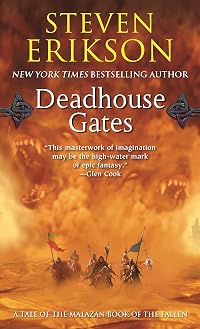
Deadhouse Gates
by Steven Erikson
World of Malazan (Book of the Fallen 2), Malazan Chronology (8), Malazan Book of the Fallen (2)
On This Page
Description
The second novel in the awe-inspiring Malazan Book of the Fallen series. "Gripping, fast-moving, delightfully dark, with a masterful and unapologetic brutality reminiscent of George R. R. Martin." — Elizabeth HaydonIn the vast dominion of Seven Cities, in the Holy Desert Raraku, the seer Sha'ik and her followers prepare for the long-prophesied uprising known as the Whirlwind. Unprecedented in size and savagery, this maelstrom of fanaticism and bloodlust will embroil the Malazan Empire in show more one of the bloodiest conflicts it has ever known, shaping destinies and giving birth to legends . . .
Set in a brilliantly realized world ravaged by dark, uncontrollable magic, Deadhouse Gates is a novel of war, intrigue and betrayal confirms Steven Eirkson as a storyteller of breathtaking skill, imagination and originality—a new master of epic fantasy.
At the Publisher's request, this title is being sold without Digital Rights Management Software (DRM) applied.
. Fantasy. Fiction. show less
Tags
Recommendations



Member Recommendations
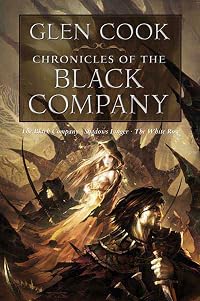
Lucky-Loki The notion of an army's own historian being the main viewpoint of a campaign is a very striking one, and while only one of the plotlines in "Deadhouse Gates" (albeit perhaps the most memorable one), this is the case for nearly all the volumes of "Black Company", which also shares a lot in the tone and feel of the respective universes, populated with grim albeit resiliant characters and gallow's humour.
Member Reviews
I picked up this book after reading a friend's gift to me, the first book in this series, last year, and I liked it well enough. It had enough going for it that I tracked down the second one, too. Now that, that was a good idea.
Deadhouse Gates is a sequel closer to the Diana Wynne Jones style sequel than the George R. R. Martin style one, since you probably can get away with not reading the previous book in the series and still get most of the quality. You'd miss some character points and a couple of connections, but not that much, all around. It's set on a different continent from the previous book, with a largely different set of characters, and a largely unrelated plot setup.
The setup is basically the same, though: multi-POV, most of show more them low-ranking players, and it takes you through the course of a military campaign: one army taking a huge train of refugees through a large amount of hostile territory to try to deliver them to the one remaining safe haven. There are also other plot lines, dealing with journeys of redemption, assassination and discovery.
There's a lot to keep track of, but it's not confusing. The descriptions are lucid, if horrifying sometimes, the characters fleshed-out and lively, the scale sweeping and epic, and the plotting very well done, although it's a bit of a slog as everything gets set up; with all the POVs and plotlines, getting all the pieces on the board takes a while, and it's not great until they're all out there. The battles and tactics are well-handled and not monotonous: it's not the same thing twice, and it's all fairly realistic (allowing for the magic of the world, but it's well delineated how that works).
The first one felt like he was reaching at points, and that there was a bit of Dragon Ball Z syndrome (he's INCREDIBLY POWERFUL... but not as powerful as... THIS GUY HERE!). The latter is around only once or twice here, but the first is gone completely. Erikson feels in control of his prose and plotting, and the result is a brilliant epic story. I was going to ding it for what feels like workmanlike prose in places, but then towards the end, Erikson really brings something out emotionally; it made me cry, it was so good. I think much of it, because it's supposed to be a history, can come off a bit dry, but it's still the good kind of history.
All told: very well done, indeed. If only all the books I read this year are this good, I'll be a very happy man. show less
Deadhouse Gates is a sequel closer to the Diana Wynne Jones style sequel than the George R. R. Martin style one, since you probably can get away with not reading the previous book in the series and still get most of the quality. You'd miss some character points and a couple of connections, but not that much, all around. It's set on a different continent from the previous book, with a largely different set of characters, and a largely unrelated plot setup.
The setup is basically the same, though: multi-POV, most of show more them low-ranking players, and it takes you through the course of a military campaign: one army taking a huge train of refugees through a large amount of hostile territory to try to deliver them to the one remaining safe haven. There are also other plot lines, dealing with journeys of redemption, assassination and discovery.
There's a lot to keep track of, but it's not confusing. The descriptions are lucid, if horrifying sometimes, the characters fleshed-out and lively, the scale sweeping and epic, and the plotting very well done, although it's a bit of a slog as everything gets set up; with all the POVs and plotlines, getting all the pieces on the board takes a while, and it's not great until they're all out there. The battles and tactics are well-handled and not monotonous: it's not the same thing twice, and it's all fairly realistic (allowing for the magic of the world, but it's well delineated how that works).
The first one felt like he was reaching at points, and that there was a bit of Dragon Ball Z syndrome (he's INCREDIBLY POWERFUL... but not as powerful as... THIS GUY HERE!). The latter is around only once or twice here, but the first is gone completely. Erikson feels in control of his prose and plotting, and the result is a brilliant epic story. I was going to ding it for what feels like workmanlike prose in places, but then towards the end, Erikson really brings something out emotionally; it made me cry, it was so good. I think much of it, because it's supposed to be a history, can come off a bit dry, but it's still the good kind of history.
All told: very well done, indeed. If only all the books I read this year are this good, I'll be a very happy man. show less
Glorious epic fantasy, this book does it all. I wept openly, laughed aloud, in short I gave myself up completely to Erikson's creation. The tale of Coltaine and the Chain of Dogs, the terrible consequences of complete civil breakdown, it all is perfectly realised in every way. From the grand sweep of battle sequences to the earth-shattering simplicity of the phrase "Children are dying".
As is Erikson's wont, there is just so much more in this book, far too much to go into. But the Wickans! the Wickans!
As is Erikson's wont, there is just so much more in this book, far too much to go into. But the Wickans! the Wickans!
*Some minor spoilers for the book throughout*
I think I have one more of these books in me before I give up on them.
Erikson has a lot of interesting ideas. He's dreamed up entire cultures, multiple continents, a convoluted system of gods and magic, and a plot full of intrigue, mystery, double-crossing, and satisfying twists. The books are expansive and make sure you know it. Readers are constantly reminded of how much remains unknown and Erikson succeeds in making it all feel unknowable: we are in the same boat as the characters, limited to only understanding very recent history in the immediate handful of landmasses the books have taken place on. One response to all this mystery is wonder; another is to have one's eyes glaze over as one show more trudges through yet another page of garbled, made-up names for things that you almost certainly don't need to know about. I found myself alternating between these responses throughout the book. Sometimes Erikson really succeeds in making a setting or set of characters come alive. The Wickans, and especially Coltaine, are an inspired creation. A stoic people with an arcane connection to the land who yet remain loyal imperial subjects are tasked with shepherding a massive refugee population across a continent--that's a great setup for the long march into hell that forms the emotional core of the novel. The reader is not overwhelmed with irrelevant information, and is instead allowed to see for themselves what kind of people the Wickans really are. Other times I could not be bothered to keep up with the litany of unasked-for historical tidbits. From the prominence Erikson has given them in the story, it's clear that the Jaghut will become a key plot element as the books progress. But every historical diversion on them feels like wasted space. Jaghut are supposed to be solitary and mysterious. So why do we keep having to talk about them? I think Erikson is trying to drum some tragic pathos from their inability to form communities--to be recognizably like humans--but we really need more than he's shown us for that to succeed. People who want to do nothing and be left alone are not often interesting.
Which brings me to the matter of motivation. Why does anyone in these books do anything? It's often hard to say. Part of that is because of Erikson's fondness for gruff, soldierly banter that prevents any character from ever giving voice to their interior lives. Part of it is for the intrigue that's essential to the plot. Part of it is because of Erikson's (related) fondness for indirect story-telling. Taken by themselves, these are not flaws. But for me to ask questions about what a character's thinking, I need to feel that there's something underneath the surface of the story. Erikson's characters, by contrast, seem as though they've been parachuted in from a DnD campaign--which is entirely correct, from some of what I've read about his writing process. Their personalities would fit neatly in the box on the second page of a character sheet. Some tragic history, some distinctive likes and dislikes, some eccentricities--that's it. Do they have parents? Did they have families? What do they want in life? What was their childhood like? These questions never seem to be asked or answered in any detail. It's not that they have to be! But one rarely gets the sense that they ever existed outside their narrow role in the novel's plot. Instead, we get a collection of grim-faced soldiers driven by some vague notion of duty or camaraderie or revenge. Their interest to the story is as actors with particular traits, not as people with stories of their own. This is fine in DnD because the story is for the players--it's not important why you're hunting down the goblins because the hunting down itself is fun. But things are different when you're reading a novel. I was left with a strange feeling of disconnection or weightlessness as I read again and again of characters throwing themselves into dangerous situations with a good-natured wink and a witty remark to no recognizable benefit.
When there is motivation given it is often so hilariously flimsy as to make the reader doubt it's truth. The novel begins, for instance, with a grizzled band of elite soldiers pledging to return a young member of their squad to her destroyed village on the other side of the world across continents at war because...they feel bad for her? After she had spent 600 pages threatening them with horrific murder in the previous book? Of course this turns out to be cover for a secret mission. Another example: a character is tasked with guarding another whose lapses in memory prevent him from recognizing the extent of the horrible crimes he's committed. The tragic friendship between these characters is supposed to carry some of the novel's pivotal scenes. But why? We are not really shown the reason for their friendship, aside from the amnesiac being I guess pretty nice to people when he hangs out with them. This is not believable character writing. The novel is only interested in these relationships insofar as they contribute to its action, and so they are left completely underdeveloped.
What about the action itself, then? Erikson writes competent battle scenes and the plot shows an impressive degree of forethought. In parts, it really works. Kalam's harrowing encounters with bandits and many of the battles on the Chain of Dogs made for great reading, balancing a palpable sense of danger with plausible, satisfying resolutions. But their structure often feels at odds with the world Erikson is trying to create. On one hand, Erikson seems to be aiming for a living, breathing, heterogeneous world full of bizarre and fascinating cultures and staggering, incomprehensible powers. In other words, he's shooting for a big world full of little people, in which life is dangerous and unpredictable for the unremarkable. On the other, the novel focuses heavily on fighting and its consequences, and conflict often seems to work like it does in a video game. Each character is defined primarily by their powers and abilities, and even the stickiest situations can be resolved with a well-timed, if contrived, helping hand.
These tendencies are in conflict. If the characters are to be little parts of an indifferent world it can't be the case that everything works out neatly for them, with well-placed healing potions and loot drops. If the characters are the centre of the world, progressing through a linear series of encounters designed with their respective levels in mind, the world will not feel organic. Erikson at times leans more in one direction or the other but I could never escape the feeling that the novel was at war with itself. For example, Erikson cannot muster the interest to make the massive train of refugees on the chain of dogs anything other than props to be referred to in philosophical musing and to prove the heroism of the soldiers and their commander. I don't think we ever learn a single refugee's name. But we do hear endlessly of the noble sacrifice of fighting men and women to protect them. Here a potential human element of the story is sacrificed for the sake of a story about heroes on adventures. But we're never really allowed to enjoy a fun adventure, either. The heroic exploits of the main characters are bogged down with tedious reminders of the costs of war or needlessly gratuitous violence visited on innocents. So it's a story about being human in an scary and fragile world, but one that's impossible to take seriously; or it's a fun read about cool soldiers beating the bad guys, but one that makes sure you don't enjoy it too much.
What about the writing? Erikson has improved substantially on the first novel in this respect. The pacing is better, the descriptions more evocative, and the themes presented more clearly. Still, I think there are a number of weak points. Erikson's dialogue remains mostly weak and overwrought, with characters speaking in cryptic fragments, bizarre ornate sentences, or eyeroll-inducing quips that would be at home in a Marvel movie. The tone often jumps all over the place--from lighthearted to panicked to shellshocked--in ways that seem disconnected from the content of the writing. And the shifts in perspective often occur at inopportune times, jerking the reader from one narrative strand to another without much rhyme or reason, and without reaching a natural stopping point in the writing.
Whatever else can be said about this book, Erikson's ambitious to a fault. This novel tries to do so, so many things. I think it's pretty close to succeeding at a lot of them. The combination of epic fantasy and small-scale human stories is one that I really want to like. And I don't think there's anything in the idea of the book that makes doomed to fail. I just wish Erikson could tear himself away from his fascination with big cool warriors and fighting and could work out an approach to the narrative that lets his characters shine, his storylines unfold naturally, and the world come alive naturally. As it is, the book frustrates me because it falls short in so many respects. Rather than being really good at one thing, it is just okay at a whole lot of things. I think Erikson has it in him to do better. show less
I think I have one more of these books in me before I give up on them.
Erikson has a lot of interesting ideas. He's dreamed up entire cultures, multiple continents, a convoluted system of gods and magic, and a plot full of intrigue, mystery, double-crossing, and satisfying twists. The books are expansive and make sure you know it. Readers are constantly reminded of how much remains unknown and Erikson succeeds in making it all feel unknowable: we are in the same boat as the characters, limited to only understanding very recent history in the immediate handful of landmasses the books have taken place on. One response to all this mystery is wonder; another is to have one's eyes glaze over as one show more trudges through yet another page of garbled, made-up names for things that you almost certainly don't need to know about. I found myself alternating between these responses throughout the book. Sometimes Erikson really succeeds in making a setting or set of characters come alive. The Wickans, and especially Coltaine, are an inspired creation. A stoic people with an arcane connection to the land who yet remain loyal imperial subjects are tasked with shepherding a massive refugee population across a continent--that's a great setup for the long march into hell that forms the emotional core of the novel. The reader is not overwhelmed with irrelevant information, and is instead allowed to see for themselves what kind of people the Wickans really are. Other times I could not be bothered to keep up with the litany of unasked-for historical tidbits. From the prominence Erikson has given them in the story, it's clear that the Jaghut will become a key plot element as the books progress. But every historical diversion on them feels like wasted space. Jaghut are supposed to be solitary and mysterious. So why do we keep having to talk about them? I think Erikson is trying to drum some tragic pathos from their inability to form communities--to be recognizably like humans--but we really need more than he's shown us for that to succeed. People who want to do nothing and be left alone are not often interesting.
Which brings me to the matter of motivation. Why does anyone in these books do anything? It's often hard to say. Part of that is because of Erikson's fondness for gruff, soldierly banter that prevents any character from ever giving voice to their interior lives. Part of it is for the intrigue that's essential to the plot. Part of it is because of Erikson's (related) fondness for indirect story-telling. Taken by themselves, these are not flaws. But for me to ask questions about what a character's thinking, I need to feel that there's something underneath the surface of the story. Erikson's characters, by contrast, seem as though they've been parachuted in from a DnD campaign--which is entirely correct, from some of what I've read about his writing process. Their personalities would fit neatly in the box on the second page of a character sheet. Some tragic history, some distinctive likes and dislikes, some eccentricities--that's it. Do they have parents? Did they have families? What do they want in life? What was their childhood like? These questions never seem to be asked or answered in any detail. It's not that they have to be! But one rarely gets the sense that they ever existed outside their narrow role in the novel's plot. Instead, we get a collection of grim-faced soldiers driven by some vague notion of duty or camaraderie or revenge. Their interest to the story is as actors with particular traits, not as people with stories of their own. This is fine in DnD because the story is for the players--it's not important why you're hunting down the goblins because the hunting down itself is fun. But things are different when you're reading a novel. I was left with a strange feeling of disconnection or weightlessness as I read again and again of characters throwing themselves into dangerous situations with a good-natured wink and a witty remark to no recognizable benefit.
When there is motivation given it is often so hilariously flimsy as to make the reader doubt it's truth. The novel begins, for instance, with a grizzled band of elite soldiers pledging to return a young member of their squad to her destroyed village on the other side of the world across continents at war because...they feel bad for her? After she had spent 600 pages threatening them with horrific murder in the previous book? Of course this turns out to be cover for a secret mission. Another example: a character is tasked with guarding another whose lapses in memory prevent him from recognizing the extent of the horrible crimes he's committed. The tragic friendship between these characters is supposed to carry some of the novel's pivotal scenes. But why? We are not really shown the reason for their friendship, aside from the amnesiac being I guess pretty nice to people when he hangs out with them. This is not believable character writing. The novel is only interested in these relationships insofar as they contribute to its action, and so they are left completely underdeveloped.
What about the action itself, then? Erikson writes competent battle scenes and the plot shows an impressive degree of forethought. In parts, it really works. Kalam's harrowing encounters with bandits and many of the battles on the Chain of Dogs made for great reading, balancing a palpable sense of danger with plausible, satisfying resolutions. But their structure often feels at odds with the world Erikson is trying to create. On one hand, Erikson seems to be aiming for a living, breathing, heterogeneous world full of bizarre and fascinating cultures and staggering, incomprehensible powers. In other words, he's shooting for a big world full of little people, in which life is dangerous and unpredictable for the unremarkable. On the other, the novel focuses heavily on fighting and its consequences, and conflict often seems to work like it does in a video game. Each character is defined primarily by their powers and abilities, and even the stickiest situations can be resolved with a well-timed, if contrived, helping hand.
These tendencies are in conflict. If the characters are to be little parts of an indifferent world it can't be the case that everything works out neatly for them, with well-placed healing potions and loot drops. If the characters are the centre of the world, progressing through a linear series of encounters designed with their respective levels in mind, the world will not feel organic. Erikson at times leans more in one direction or the other but I could never escape the feeling that the novel was at war with itself. For example, Erikson cannot muster the interest to make the massive train of refugees on the chain of dogs anything other than props to be referred to in philosophical musing and to prove the heroism of the soldiers and their commander. I don't think we ever learn a single refugee's name. But we do hear endlessly of the noble sacrifice of fighting men and women to protect them. Here a potential human element of the story is sacrificed for the sake of a story about heroes on adventures. But we're never really allowed to enjoy a fun adventure, either. The heroic exploits of the main characters are bogged down with tedious reminders of the costs of war or needlessly gratuitous violence visited on innocents. So it's a story about being human in an scary and fragile world, but one that's impossible to take seriously; or it's a fun read about cool soldiers beating the bad guys, but one that makes sure you don't enjoy it too much.
What about the writing? Erikson has improved substantially on the first novel in this respect. The pacing is better, the descriptions more evocative, and the themes presented more clearly. Still, I think there are a number of weak points. Erikson's dialogue remains mostly weak and overwrought, with characters speaking in cryptic fragments, bizarre ornate sentences, or eyeroll-inducing quips that would be at home in a Marvel movie. The tone often jumps all over the place--from lighthearted to panicked to shellshocked--in ways that seem disconnected from the content of the writing. And the shifts in perspective often occur at inopportune times, jerking the reader from one narrative strand to another without much rhyme or reason, and without reaching a natural stopping point in the writing.
Whatever else can be said about this book, Erikson's ambitious to a fault. This novel tries to do so, so many things. I think it's pretty close to succeeding at a lot of them. The combination of epic fantasy and small-scale human stories is one that I really want to like. And I don't think there's anything in the idea of the book that makes doomed to fail. I just wish Erikson could tear himself away from his fascination with big cool warriors and fighting and could work out an approach to the narrative that lets his characters shine, his storylines unfold naturally, and the world come alive naturally. As it is, the book frustrates me because it falls short in so many respects. Rather than being really good at one thing, it is just okay at a whole lot of things. I think Erikson has it in him to do better. show less
So, this is definitely better than book #1. But also...it has the same problems as the first book. I still cannot pinpoint why, but the way Erikson writes these two novels has to be the most obfuscated and confusing way possible. It's wild in a way that is off-putting because people and events come out of nowhere with little context and it is just confusing. And this one isn't half as bad as the first novel, which is saying a lot. I don't feel like I'm an inattentive reader, or that I have trouble understanding things, but this series has made me feel absolutely scatterbrained.
Now then, the good. The setting is really interesting and the entire idea of this novel is much more engaging to me. I know that in the end its basically 800 show more pages of people wandering around in a desert and dying (literally it felt like everyone dies), but the stories around those people were much easier to identify with and understand.
And the last, I don't know, 10% of the book is just next level antics and stories coming together.
All in all, I really enjoy this world and the stories in it but Erikson's writing is always a little bit of a hurdle for me. I've heard the next book is the absolute best, so hopefully I'll gain some steam in my attempt to finish the series. show less
Now then, the good. The setting is really interesting and the entire idea of this novel is much more engaging to me. I know that in the end its basically 800 show more pages of people wandering around in a desert and dying (literally it felt like everyone dies), but the stories around those people were much easier to identify with and understand.
And the last, I don't know, 10% of the book is just next level antics and stories coming together.
All in all, I really enjoy this world and the stories in it but Erikson's writing is always a little bit of a hurdle for me. I've heard the next book is the absolute best, so hopefully I'll gain some steam in my attempt to finish the series. show less
Wow! Just wow!
The second book in the series, The Malazan Book of the Fallen, is powerful. Erikson has a way with words, that's for sure. In just a few sentences, he shows the horror of war, the depths of cruelty, the vastness of enduring friendship, the strength of compassion, the capacity to endure.
Yes, the book is complex as more characters, races, and magicks are introduced and not always fully explained. Surprises abound, yet one can almost always trace the surprise back to a hint, a moment of foreshadowing.
What I like best, and what makes this a challenging book to read, is that there are no real "good guys" and "bad guys". The reader ends up pulling for characters on various sides of the conflict(s). There are characters I liked show more better than others, but all the characters do things that are unlikable. There are no cardboard heroes (or villains) here. Well, except maybe for Mallick Rel.
And while some questions were answered, I have many more. I hope they will eventually be answered later in the series. show less
The second book in the series, The Malazan Book of the Fallen, is powerful. Erikson has a way with words, that's for sure. In just a few sentences, he shows the horror of war, the depths of cruelty, the vastness of enduring friendship, the strength of compassion, the capacity to endure.
Yes, the book is complex as more characters, races, and magicks are introduced and not always fully explained. Surprises abound, yet one can almost always trace the surprise back to a hint, a moment of foreshadowing.
What I like best, and what makes this a challenging book to read, is that there are no real "good guys" and "bad guys". The reader ends up pulling for characters on various sides of the conflict(s). There are characters I liked show more better than others, but all the characters do things that are unlikable. There are no cardboard heroes (or villains) here. Well, except maybe for Mallick Rel.
And while some questions were answered, I have many more. I hope they will eventually be answered later in the series. show less
DHG is an easier novel than the first Malazan book, by virtue of its world being somewhat familiar now, but careful reading is still rewarded as important sidebars and foreshadowing lie thick across every chapter. There are fewer stories to jump between this time and with tighter linkages, lending greater focus and permitting time for the characters we meet to be better drawn.
GOTM was written in an almost experimental hand. The more straightforward approach of DHG comes almost as a relief. It costs some of the intriguing enigma, but what's retained (and expanded upon) is the enormity of scale, a surrounding world not merely mentioned in passing but sporadically intruding upon the story in small bursts or enormous explosions. This is not show more the same as what other reviewers are implying, that "you never really know what's going on", which I found to be misleading. The primary characters' stories are easy to follow and understand; it's the workings of the larger surrounding world, its cultures and its history that remain partially veiled in mystery. Personally I like not having everything fully explained past its capacity to surprise. As bizarre as those intrusions can sometimes be – and there are definitely a few scenes that would sound completely ridiculous if I described them to you out of context - they never fatally cross the line into absurdity.
Felisin is the series' first viewpoint character I had an active disliking for, at least through the first half. I tried my best to pity and understand her, but she was drawn so unsympathetically that I generally failed. The author likes to walk the fence with his viewpoint characters, portraying them as neither strictly good nor bad. I doubt whether he intended her to be so easily disliked.
I wanted a gigantic fantasy saga that I can really sink my teeth into, one that justifies its page count with plenty of action, mystery, atmosphere and suspense on as big a scale as human imagination can devise. Malazan is it. Ten enormous volumes looked like an intimidating task, but my concern about the time investment has evaporated if they're all going to be this good.
(Edit, 2022: Having just read Colleen McCullough's account of Crassus vs Spartacus in her novel "Fortune's Favorites", I think the historical Spartacus was a likely influence here in DH.) show less
GOTM was written in an almost experimental hand. The more straightforward approach of DHG comes almost as a relief. It costs some of the intriguing enigma, but what's retained (and expanded upon) is the enormity of scale, a surrounding world not merely mentioned in passing but sporadically intruding upon the story in small bursts or enormous explosions. This is not show more the same as what other reviewers are implying, that "you never really know what's going on", which I found to be misleading. The primary characters' stories are easy to follow and understand; it's the workings of the larger surrounding world, its cultures and its history that remain partially veiled in mystery. Personally I like not having everything fully explained past its capacity to surprise. As bizarre as those intrusions can sometimes be – and there are definitely a few scenes that would sound completely ridiculous if I described them to you out of context - they never fatally cross the line into absurdity.
Felisin is the series' first viewpoint character I had an active disliking for, at least through the first half. I tried my best to pity and understand her, but she was drawn so unsympathetically that I generally failed. The author likes to walk the fence with his viewpoint characters, portraying them as neither strictly good nor bad. I doubt whether he intended her to be so easily disliked.
I wanted a gigantic fantasy saga that I can really sink my teeth into, one that justifies its page count with plenty of action, mystery, atmosphere and suspense on as big a scale as human imagination can devise. Malazan is it. Ten enormous volumes looked like an intimidating task, but my concern about the time investment has evaporated if they're all going to be this good.
(Edit, 2022: Having just read Colleen McCullough's account of Crassus vs Spartacus in her novel "Fortune's Favorites", I think the historical Spartacus was a likely influence here in DH.) show less
Unfortunately, the 2nd book in this series really isn't better than the first. It might be worse. Just when things got resolved (a tiny bit) in the first book, this book starts out with entirely new characters, a whole major new plot line, and the same amount of confusing interference from gods and monsters as the first book - but more so. New creatures are introduced, playing major roles, but again they aren't explained at all. What the heck is a trell anyway? Some sort of troll?
Where this book does succeed is its 'epicness', it does have its epic moments and events. Where it fails again, just like the first one, is that the plot is completely obscure. What are the gods doing? Where is this going? What are Soletaken and D'ivers and show more why are they doing whatever it is they are doing? What's an Azath and why does anyone care? So many key plot elements with no explanation, no reason for being, nothing. There is no sense of where this series is going at all, which makes it really hard to care about, just reading to see who lives and who dies is not worth it. As others have pointed out the characters are flat and mostly the same, so it is hard to care about any of them too. This was just too long to make the effort worthwhile. show less
Where this book does succeed is its 'epicness', it does have its epic moments and events. Where it fails again, just like the first one, is that the plot is completely obscure. What are the gods doing? Where is this going? What are Soletaken and D'ivers and show more why are they doing whatever it is they are doing? What's an Azath and why does anyone care? So many key plot elements with no explanation, no reason for being, nothing. There is no sense of where this series is going at all, which makes it really hard to care about, just reading to see who lives and who dies is not worth it. As others have pointed out the characters are flat and mostly the same, so it is hard to care about any of them too. This was just too long to make the effort worthwhile. show less
Members
- Recently Added By
Lists

Best Fantasy Novels
821 works; 361 members

Stories About Other Worlds
145 works; 13 members

NPRs your picks: top 100 Sci-Fi/Fantasy books
297 works; 80 members

XB-1: Osobnosti zanru doporucuji
67 works; 1 member

Books Read in 2015
3,299 works; 126 members

Recommend Fantasy Books
100 works; 1 member
Author Information

83+ Works 38,483 Members
Steven Erikson, a pseudonym used by Steven Rune Lundin, was born in Toronto, Canada on October 7, 1959. He is an anthropologist and archaeologist by training and a graduate of the Iowa Writer's Workshop. He is the author of the Malazan Book of the Fallen series and the Bauchelain and Korbal Broach series. (Bowker Author Biography)
Some Editions
Awards and Honors
Awards
Distinctions
Notable Lists
Series

World of Malazan
33 works (Book of the Fallen 2)

Malazan Chronology
23 works (8)

Malazan Book of the Fallen
10 works (2)
Belongs to Publisher Series
Science Fiction Book Club (1177958)
Work Relationships
Is contained in
Common Knowledge
- Canonical title
- Deadhouse Gates
- Original title
- Deadhouse Gates
- Alternate titles*
- Het Rijk van de Zeven Steden
- Original publication date
- 2000-09-01
- People/Characters
- Duiker (historian); Fiddler (sapper); Coltaine (Fist); Icarium; Mappo Runt; Kalam Mekhar (show all 10); Felisin; Crokus; Apsalar; Leoman of the Flails
- Important places
- Aren, Seven Cities (fictional); Malaz City (fictional)
- Epigraph*
- Wat u ziet op de besmeurde lijn
Waar u de horizon weet,
Dat niet kan worden uitgewist
Door uw geheven hand?
De Bruggenbranders
-Toc de Jongere - Dedication
- This novel is dedicated to two gentlemen:
David Thomas, Jr.,
who welcomed me to England
with an introduction to a certain agent, and
Patrick Walsh,
the agent he introduced me to.
There has been... (show all) a lot of faith shown over the years,
and I thank you both. - First words
- He came shambling into Judgment's Round from the Avenue of Souls, a misshapen mass of flies.
- Last words
- (Click to show. Warning: May contain spoilers.)Deep within her, the child stirred.
- Blurbers
- Donaldson, Stephen R.; Stackpole, Michael A.; Cook, Glen; Haydon, Elizabeth
- Original language*
- Anglais (Canada) (Canada)
- Disambiguation notice
- For the German-language version of the series 'Das Spiel der Götter', this book was split into two volumes - 'Das Reich der Sieben Städte' (2000), ISBN 3-442-24941-4 and 'Im Bann der Wüste' (2000) ISBN 3-442-24940-6.
Pl... (show all)ease do not combine these works.
*Some information comes from Common Knowledge in other languages. Click "Edit" for more information.
Classifications
Statistics
- Members
- 4,321
- Popularity
- 3,512
- Reviews
- 102
- Rating
- (4.20)
- Languages
- 13 — Czech, Dutch, English, French, German, Hungarian, Italian, Polish, Romanian, Slovak, Spanish, Turkish, Portuguese (Portugal)
- Media
- Paper, Audiobook, Ebook
- ISBNs
- 39
- ASINs
- 24