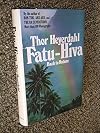
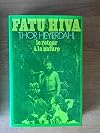
Fatu-Hiva: Back to Nature
by Thor Heyerdahl
On This Page
Description
The story of Heyerdahl and his wife's first Pacific adventure in 1936. Fatu-Hiva lay outside the shipping lanes; there were no white inhabitants and no contact with the outside world.Tags
Recommendations


























Member Recommendations


Member Reviews
My husband spotted a copy of this in a used book store, and picked it up upon noticing that it is actually autographed by Thor Heyerdahl himself, 1974! Heyerdahl was the instigator of the famed Kon-Tiki expedition in which he and others successfully navigated a raft from South America to Polynesia, to prove that Polynesia could have been first populated by indigenous Americans.
This book is about events pre-dating Kon-Tiki, when a coming-of-age young Norwegian named Thor decides he's fed up with civilization - but unlike most teenagers, gathers the wherewithal to do something about it. He convinces his university professors and parents to aid him in a trek to an isolated part of the world where he can live "in nature" in as primitive show more conditions as possible. Against all odds, he also manages to find a girlfriend eager to go with him! Thus after completing their university studies, newlyweds Thor and Liv set out for the tiny spot on the map which they decided was destined to become their own island paradise; that spot was Fatu-Hiva, an island in the French Marquesas group.
And the craziest thing is, they do find their paradise; it's just not a permanent situation. They are troubled by mud, mosquitoes, tropical diseases, and other people. But through it all were blissful days upon days where they traipsed through their longed-for garden of Eden.
They seem to find an extended period of peace and nirvana on the far side of the island, living alongside a longtime hermit and his pre-teen adopted daughter, far away from the other islanders, by the shore where the mosquitoes are few. The idyll is eventually destroyed, however... no spoilers, but it seems hell is indeed other people. That, and demon drink.
There are many pages where Thor just goes on about the beauty of nature around them, which can get a bit monotonous. His philosophy tends towards the simplistic - civilization bad, white man bad, state of nature perfect, etc. - especially towards the beginning of the story; and he tries to bend all his observations to his philosophy - diseases come from the white man, diseases would never happen when living correctly in a 'state of nature', for example. He seems to mature a bit over his long year on the island, however.
There is little to no sidelong mocking of the natives in this book... individuals and behaviors often get his scorn, but each islander is presented as a full human being, never a caricature. Indeed, Thor conveys his growing realization during the year that the islanders are people exactly like us, with every bit as much intelligence; he observes that we tend to think of illiterate people as childlike, which is a gross injustice and blindness. We are all human beings, doing everything we can put our minds to, given the resources before us.
But while it seemed to me that Thor was generally refreshingly respectful and equitable in his treatment of his fellow islanders, there was one exception where his behavior left me flabbergasted. He and Liv begin a collection of human skulls which they take from areas considered "tabu" by the natives. There are photos of Liv grinning happily while surrounded by human skulls. This seemed horribly disrespectful, not to mention ghoulish.
Liv was an absolute saint, by the way. By all accounts, she had all the eagerness for the adventure as did her husband; the book is by and large written in first person plural, not singular. It is Thor and Liv as a unit who discover, learn, enjoy, suffer together.
There are lots of amazing black-and-white photos throughout the book. I was truly astounded by them, for various reasons. a) Some of the photos have both Thor and Liv in them, in some remote situation - who took the picture?! b) How did they manage, through all their soggy trials and travails, to keep their camera and film with them, and dry enough to be functional? c) What faith did it take to keep taking pictures of things, with no ability - I presume! - to develop the film until if and when you or the camera made it back to civilization? I don't know, maybe there was a Foto-mat in nearby Tahiti where they were sending things.
I found myself thinking at the book's beginning, as the adventure first gets underway: but what about modern medicine? What about birth control? How will they keep healthy, and is Liv prepared to birth babies without assistance on an island? They never really address the latter, except one passing remark towards the end that Liv might "at any time" by "blessed" with a baby; so apparently no birth control. As for medicine, illnesses and injuries are dealt with as they came, and both heroes lived to tell their tales.
This book really did make me think about nature, civilization, and the commonness of human ingenuity. show less
This book is about events pre-dating Kon-Tiki, when a coming-of-age young Norwegian named Thor decides he's fed up with civilization - but unlike most teenagers, gathers the wherewithal to do something about it. He convinces his university professors and parents to aid him in a trek to an isolated part of the world where he can live "in nature" in as primitive show more conditions as possible. Against all odds, he also manages to find a girlfriend eager to go with him! Thus after completing their university studies, newlyweds Thor and Liv set out for the tiny spot on the map which they decided was destined to become their own island paradise; that spot was Fatu-Hiva, an island in the French Marquesas group.
And the craziest thing is, they do find their paradise; it's just not a permanent situation. They are troubled by mud, mosquitoes, tropical diseases, and other people. But through it all were blissful days upon days where they traipsed through their longed-for garden of Eden.
They seem to find an extended period of peace and nirvana on the far side of the island, living alongside a longtime hermit and his pre-teen adopted daughter, far away from the other islanders, by the shore where the mosquitoes are few. The idyll is eventually destroyed, however... no spoilers, but it seems hell is indeed other people. That, and demon drink.
There are many pages where Thor just goes on about the beauty of nature around them, which can get a bit monotonous. His philosophy tends towards the simplistic - civilization bad, white man bad, state of nature perfect, etc. - especially towards the beginning of the story; and he tries to bend all his observations to his philosophy - diseases come from the white man, diseases would never happen when living correctly in a 'state of nature', for example. He seems to mature a bit over his long year on the island, however.
There is little to no sidelong mocking of the natives in this book... individuals and behaviors often get his scorn, but each islander is presented as a full human being, never a caricature. Indeed, Thor conveys his growing realization during the year that the islanders are people exactly like us, with every bit as much intelligence; he observes that we tend to think of illiterate people as childlike, which is a gross injustice and blindness. We are all human beings, doing everything we can put our minds to, given the resources before us.
But while it seemed to me that Thor was generally refreshingly respectful and equitable in his treatment of his fellow islanders, there was one exception where his behavior left me flabbergasted. He and Liv begin a collection of human skulls which they take from areas considered "tabu" by the natives. There are photos of Liv grinning happily while surrounded by human skulls. This seemed horribly disrespectful, not to mention ghoulish.
Liv was an absolute saint, by the way. By all accounts, she had all the eagerness for the adventure as did her husband; the book is by and large written in first person plural, not singular. It is Thor and Liv as a unit who discover, learn, enjoy, suffer together.
There are lots of amazing black-and-white photos throughout the book. I was truly astounded by them, for various reasons. a) Some of the photos have both Thor and Liv in them, in some remote situation - who took the picture?! b) How did they manage, through all their soggy trials and travails, to keep their camera and film with them, and dry enough to be functional? c) What faith did it take to keep taking pictures of things, with no ability - I presume! - to develop the film until if and when you or the camera made it back to civilization? I don't know, maybe there was a Foto-mat in nearby Tahiti where they were sending things.
I found myself thinking at the book's beginning, as the adventure first gets underway: but what about modern medicine? What about birth control? How will they keep healthy, and is Liv prepared to birth babies without assistance on an island? They never really address the latter, except one passing remark towards the end that Liv might "at any time" by "blessed" with a baby; so apparently no birth control. As for medicine, illnesses and injuries are dealt with as they came, and both heroes lived to tell their tales.
This book really did make me think about nature, civilization, and the commonness of human ingenuity. show less
Thor Heyerdahl's memoir of he and his wife's first adventure living "back to nature" on the Pacific island of Fatu-Hiva. Pretty interesting description of what it was like at the time (ca. 1930s), but a little ethnocentric. Towards the end of the book he starts talking about his theories about how the Pacific Islands were populated by Peruvians. Recent DNA evidence disputes his theories, but it's still interesting.
I love going on adventures with Heyerdahl. Whether sailing the seas in a tiny craft or living as a primitive on an isolated island, his boyish enthusiasm, eager can-do attitude are infectious. This is a recounting of his first adventure when he was 22 and his wife was 20. They wanted to "escape" civilization and they thought the best way to do that would be to go live on an island in the Marquesas island group near Tahiti. For almost a year they lived there with nothing except a machete and a cooking pot among the few islanders.
Or did they? They found that they needed a bit more equipment than those two items. Also, they needed the beneficence of the people already living there. When they lost that, their time on the island was ended. show more All was not the primitive paradise they imagined. They discovered that civilization has its positives as well.
A grand adventure worth the telling, I'm glad they lived through it. I suppose I should add that this was when Heyerdahl discovered his passion for the origins of the peoples of Polynesia, but he will tell you all about it if you read this book. show less
Or did they? They found that they needed a bit more equipment than those two items. Also, they needed the beneficence of the people already living there. When they lost that, their time on the island was ended. show more All was not the primitive paradise they imagined. They discovered that civilization has its positives as well.
A grand adventure worth the telling, I'm glad they lived through it. I suppose I should add that this was when Heyerdahl discovered his passion for the origins of the peoples of Polynesia, but he will tell you all about it if you read this book. show less
Great account of newlyweds who live for about a year on a Pacific island with some environmental and philosophical musings. Ancient Polynesians almost certainly mostly came from the Americas. Tiki is name for God in both places for one thing. The original time for the adventure was in the thirties, but the author rewrote the account in the seventies. Worth reading.
This is the story of the author's first experience of fieldwork, when he lived with his wife for a year on a remote Polynesian island where they wanted to get "back to nature." The author begins to develop the theory that would dominate his career and research, that Polynesia was first settled by Native Americans. The two have some wonderful experiences, but while H. continually writes about how he finds his Polynesian neighbors on the island to be intelligent and in every way like himself, his field work involves collecting skulls and other bones from "taboo" sites. He stores these human remains in burlap bags under his bed and apparently doesn't understand why the people in the neighborhood resent this behavior, nor why, having shared show more their own provisions with him and helped him learn how to find food, they should expect him to share his own canned and other provisions with them. Could be used as a study of the anthropologist (which H. denies he is, claiming he is a geographer)0. show less
Read during Spring 2007
I just loved this. Esp. after a few dissapointing noves,l it was a lovely change of pace. I liked it so much I ordered a copy of Kon-Tiki from Powells. Heyerdahl and his wife Liv spent about a year living 'back to nature' on the island of Fatu-Hiva in the Marqueseas Islands. It was both wonderful and terrible for them and set Heyetdahl on his future path of discovering the origions of the people of Polynesia. As well as describing their lives, it is also full of his reflections on the people and fauna of the islands, as well as the value of simplicity in life. Highly enjoyable.
I just loved this. Esp. after a few dissapointing noves,l it was a lovely change of pace. I liked it so much I ordered a copy of Kon-Tiki from Powells. Heyerdahl and his wife Liv spent about a year living 'back to nature' on the island of Fatu-Hiva in the Marqueseas Islands. It was both wonderful and terrible for them and set Heyetdahl on his future path of discovering the origions of the people of Polynesia. As well as describing their lives, it is also full of his reflections on the people and fauna of the islands, as well as the value of simplicity in life. Highly enjoyable.
About the year the author spent on a remote island in the Marquesas, with his new wife. They wanted to escape modern civilization and live purely as a part of nature- no modern conveniences, little clothing, eating off the land, etc. For a while they found paradise on Fatu-Hiva, living on a plot of land in the jungle that used to be the cultivated garden of an island king. At first their time on the island was blissful, they reveled in the natural beauty and fresh fruit, collected specimens of local insects and archeological finds for Thor's studies back home and learned about the island's cultural history from the locals.
But the blissful period did not last long. Bugs ate their house, mosquitoes drove them crazy, and sores in their show more legs got infected and threatened never to heal. They had to escape to a nearby island where a doctor lived to get treatment, but determined to come back. Their second stay on the island was shorter; misunderstandings with the locals plus their dread of communicable diseases rampant in the village (elephantiasis and leprosy) drove them to try living in the highlands (where there was little food) then later to cross the island to the sparsely populated east side, where they lived with an old man, the last surviving cannibal (fascinating chapter!) Eventually things went wrong there, too, and they ended up staying on a small isolated beach in a cave while waiting for a ship to pick them up off the island for good.
Fatu-Hiva: Back to Nature is full of adventure, musings on the nature of man, descriptions of the island's wild beauty, speculations into the origins of its inhabitants, and thoughts on environmental issues. In the end, the Heyerdahls realized they could not live apart from civilization, and the fire was sparked to set Thor on his next set of adventures. Wonderful read.
from the Dogear Diary show less
But the blissful period did not last long. Bugs ate their house, mosquitoes drove them crazy, and sores in their show more legs got infected and threatened never to heal. They had to escape to a nearby island where a doctor lived to get treatment, but determined to come back. Their second stay on the island was shorter; misunderstandings with the locals plus their dread of communicable diseases rampant in the village (elephantiasis and leprosy) drove them to try living in the highlands (where there was little food) then later to cross the island to the sparsely populated east side, where they lived with an old man, the last surviving cannibal (fascinating chapter!) Eventually things went wrong there, too, and they ended up staying on a small isolated beach in a cave while waiting for a ship to pick them up off the island for good.
Fatu-Hiva: Back to Nature is full of adventure, musings on the nature of man, descriptions of the island's wild beauty, speculations into the origins of its inhabitants, and thoughts on environmental issues. In the end, the Heyerdahls realized they could not live apart from civilization, and the fire was sparked to set Thor on his next set of adventures. Wonderful read.
from the Dogear Diary show less
Members
- Recently Added By
Author Information

56+ Works 8,287 Members
"This is an enthralling book," Hamilton Lasso wrote in The New Yorker of Kon-Tiki (1948), "and I don't think I can be very far off in calling it the most absorbing sea tale of our time." Heyerdahl, a Norwegian ethnologist, conceived the theory---not then accepted by other scientists---that Polynesia may have been originally settled by people who show more crossed the 4,100 miles of ocean from Peru in rafts made of balsa logs. Kon-Tiki is the story of how he and five others built the raft, as people of the Stone Age could build it, and traveled in it from Peru to a small island east of Tahiti---a "most fascinating description of intelligent courage." Heyerdahl believes that he has at last solved the problem of how natives raised the great statues on Easter Island and has written a most absorbing account of it in Aku-Aku (1958). He has adduced further corroboration of his theory from the findings in The Archaeology of Easter Island (1961). In the spring of 1969, Heyerdahl was engaged in a new experiment---planning to cross the Atlantic from Morocco to Yucatan in a 12-ton papyrus boat that he and others built themselves in the manner of the ancient Egyptians. In spite of general skepticism as to whether the boat, called the Ra, could make the journey without sinking when it became thoroughly water-soaked, Heyerdahl and six others set out in full confidence. They hoped to demonstrate that Egyptians might have made the journey in this manner 4,000 or 5,000 years ago and thus were the precursors of the Incas and Mayas. In July 1969, however, they were forced to abandon their attempt 600 miles short of their goal, near the Virgin Islands, after a series of storms had crippled the Ra. They left it drifting in the hope that it might reach Barbados on its own. Their second attempt, in Ra II, was successful. A subsequent journey in the reed-ship Tigris in 1977--78 was meant to show that such craft could maneuver against the wind and thus complete round-trip journeys through the ancient world via the Persian Gulf and Arabian Sea. Political conflicts in the region, however, led Heyerdahl and his crew to burn the Tigris in protest. (Bowker Author Biography) show less
Series
Belongs to Publisher Series
Common Knowledge
- Canonical title
- Fatu-Hiva: Back to Nature
- Original title
- Fatu Hiva : back to nature
- People/Characters*
- Thor Heyerdahl
*Some information comes from Common Knowledge in other languages. Click "Edit" for more information.
Classifications
- Genres
- Anthropology, Travel, Nonfiction, General Nonfiction, Biography & Memoir, Science & Nature
- DDC/MDS
- 919.6 — History & geography Geography & travel Geography of and travel in Australasia, Pacific Ocean islands, Atlantic Ocean islands, Arctic islands, Antarctica and on extraterrestrial worlds Polynesia
- LCC
- DU701 .F3 .H47 — History of Europe, Asia, Africa and Oceania Oceania (South Seas) History of Oceania (South Seas) Smaller island groups
Statistics
- Members
- 500
- Popularity
- 60,035
- Reviews
- 13
- Rating
- (3.97)
- Languages
- 14 — Czech, Danish, Dutch, English, Estonian, Finnish, French, German, Hungarian, Norwegian (Bokmål), Norwegian, Polish, Spanish, Swedish
- Media
- Paper
- ISBNs
- 21
- ASINs
- 17