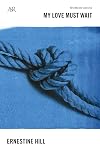
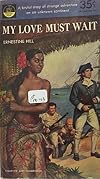
My Love Must Wait
by Ernestine Hill
On This Page
Description
Romance passion lusty adventure, the story of Matthew Flinders navigator explorer and lover.Tags
Recommendations











Member Reviews
Ernestine Hill was a mid-century Australian author who has become – not exactly forgotten, but certainly not much known outside her home country, and little enough read even there. She was mostly a journalist-cum-travel-writer, but she also wrote this one novel, a labour of love, which tells the eventful and ultimately sad life story of Matthew Flinders.
Flinders was the last of the great maritime explorers, and probably the most brilliant navigator and cartographer of all of them. He was the one who proved that the fledgling European colonies known as New Holland and New South Wales were not points on an archipelago, but did indeed represent one single enormous land continent, which Flinders dubbed ‘Australia’. (Hence why nowadays show more ninety percent of Australian towns seem to be built around a main road called Flinders Street.)
He survived shipwreck, unfriendly natives, struggles with stiff English authorities, and a six-year imprisonment by the French on the island formerly known as Île-de-France (now Mauritius), but Ernestine Hill also uncovered, beneath these better-known facts, an affecting love story between Flinders and his wife Ann, who didn't see him for nine years, and then only far too briefly.
Unfortunately it was this subplot that gave the book its not-very-appropriate and rather Mills-&-Booney title. This is not really a love story overall, it's a biographical novelisation in the grand old style – I was about to write ‘the kind of thing no one writes anymore’, but it actually reminded me of nothing so much as Hilary Mantel's historical novels. Hill shares Mantel's rigidly faithful approach to her source material, and every vessel, headland and minor midshipman in this book turns out really to have existed; even the incidental dialogue is based on reams of letters, journals and logbooks.
Although the book as a whole sometimes feels too long, the writing is curt and imaginative, much better than for some reason I was expecting. Islets are ‘annotated, every one, with the bright green asterisk of the coco-nut palm’, trees ‘creep away from the wind like bent and wizened beggars’, forbidding cliffs are ‘a vizor on the face of nature’, myriads of South Sea islands swim into view ‘as though God had suddenly split his world into kaleidoscopic fragments’. There is an efficiency to the prose that put me in mind of Flinders's own approving thoughts while reading William Dampier's memoirs: ‘He would sink a fleet and sack a city in a sentence, to devote two pages, with illustrations in the margin, to a catfish, a catamaran, or the sapadillo-tree.’
Mind you, sometimes she does become more voluble. She is particularly good on the romantic but thankless precariousness of a life in the navy:
How many had he known…shabby lieutenants on a few pounds a week fighting for their lives all their lives in the war and on the waves in rotten ships…ambassadors to the foreigner and the cannibal, trading for wheat, gold, pearls, pepper, territory…diplomats, chancellors and high financiers to the feathered savage, walking encyclopaedias of world-wide knowledge, vegetable, animal and mineral […] homeless men, nameless men, their wave-washed journals the first pages in the chronicles of empire, their future at worst a watery grave, at best an old age of cards, prating to their families on Navy half-pay…and here he was aspiring to be one of them. Why? ‘I gave my heart to know wisdom.’
Occasional passages are lightly overwritten, but it's always good fun:
Scarred and tattooed sailors of the Seven Seas, with evil, mottled faces thronged the taverns to fight by day and lust by night where harlots writhed their polished bodies, whirling in veils of flame, to the obscene screaming of the Congo pipes and fandango of tambourines. The West Indies were a painted veil of cruelty and greed. Here faith was blasphemy, the sea polluted with filth, and God and man defiled.
I hadn't realised Flinders was from Lincolnshire, a part of England I love and where I lived for many years, so I was secretly thrilled to read the lavish descriptions of his childhood in a little village just outside Boston. In a final chapter that is really a kind of afterword, Hill writes movingly of the strange coincidence that Matthew Flinders and the Pilgrim Fathers both set off from the same obscure place, linking this tiny corner of the Fenlands with both Australia and America: ‘The square tower of Boston Stump looked down on the little ships that sailed to great beginnings; that low coast of East Anglia has mothered two great nations.’
Angus & Robertson have been printing this book continuously since 1941, so you'd think they'd have had time to correct the text by now – yet there are still far too many typos, misspellings and misprints in this edition. On the credit side, it does come with a very good introduction from Debra Adelaide. If you have a holiday hankering for sea stories, historical fiction, tragic love stories or obscure Australiana, this one will certainly tick your boxes, weigh your anchors, barbie your shrimps and shiver your timbers. show less
Flinders was the last of the great maritime explorers, and probably the most brilliant navigator and cartographer of all of them. He was the one who proved that the fledgling European colonies known as New Holland and New South Wales were not points on an archipelago, but did indeed represent one single enormous land continent, which Flinders dubbed ‘Australia’. (Hence why nowadays show more ninety percent of Australian towns seem to be built around a main road called Flinders Street.)
He survived shipwreck, unfriendly natives, struggles with stiff English authorities, and a six-year imprisonment by the French on the island formerly known as Île-de-France (now Mauritius), but Ernestine Hill also uncovered, beneath these better-known facts, an affecting love story between Flinders and his wife Ann, who didn't see him for nine years, and then only far too briefly.
Unfortunately it was this subplot that gave the book its not-very-appropriate and rather Mills-&-Booney title. This is not really a love story overall, it's a biographical novelisation in the grand old style – I was about to write ‘the kind of thing no one writes anymore’, but it actually reminded me of nothing so much as Hilary Mantel's historical novels. Hill shares Mantel's rigidly faithful approach to her source material, and every vessel, headland and minor midshipman in this book turns out really to have existed; even the incidental dialogue is based on reams of letters, journals and logbooks.
Although the book as a whole sometimes feels too long, the writing is curt and imaginative, much better than for some reason I was expecting. Islets are ‘annotated, every one, with the bright green asterisk of the coco-nut palm’, trees ‘creep away from the wind like bent and wizened beggars’, forbidding cliffs are ‘a vizor on the face of nature’, myriads of South Sea islands swim into view ‘as though God had suddenly split his world into kaleidoscopic fragments’. There is an efficiency to the prose that put me in mind of Flinders's own approving thoughts while reading William Dampier's memoirs: ‘He would sink a fleet and sack a city in a sentence, to devote two pages, with illustrations in the margin, to a catfish, a catamaran, or the sapadillo-tree.’
Mind you, sometimes she does become more voluble. She is particularly good on the romantic but thankless precariousness of a life in the navy:
How many had he known…shabby lieutenants on a few pounds a week fighting for their lives all their lives in the war and on the waves in rotten ships…ambassadors to the foreigner and the cannibal, trading for wheat, gold, pearls, pepper, territory…diplomats, chancellors and high financiers to the feathered savage, walking encyclopaedias of world-wide knowledge, vegetable, animal and mineral […] homeless men, nameless men, their wave-washed journals the first pages in the chronicles of empire, their future at worst a watery grave, at best an old age of cards, prating to their families on Navy half-pay…and here he was aspiring to be one of them. Why? ‘I gave my heart to know wisdom.’
Occasional passages are lightly overwritten, but it's always good fun:
Scarred and tattooed sailors of the Seven Seas, with evil, mottled faces thronged the taverns to fight by day and lust by night where harlots writhed their polished bodies, whirling in veils of flame, to the obscene screaming of the Congo pipes and fandango of tambourines. The West Indies were a painted veil of cruelty and greed. Here faith was blasphemy, the sea polluted with filth, and God and man defiled.
I hadn't realised Flinders was from Lincolnshire, a part of England I love and where I lived for many years, so I was secretly thrilled to read the lavish descriptions of his childhood in a little village just outside Boston. In a final chapter that is really a kind of afterword, Hill writes movingly of the strange coincidence that Matthew Flinders and the Pilgrim Fathers both set off from the same obscure place, linking this tiny corner of the Fenlands with both Australia and America: ‘The square tower of Boston Stump looked down on the little ships that sailed to great beginnings; that low coast of East Anglia has mothered two great nations.’
Angus & Robertson have been printing this book continuously since 1941, so you'd think they'd have had time to correct the text by now – yet there are still far too many typos, misspellings and misprints in this edition. On the credit side, it does come with a very good introduction from Debra Adelaide. If you have a holiday hankering for sea stories, historical fiction, tragic love stories or obscure Australiana, this one will certainly tick your boxes, weigh your anchors, barbie your shrimps and shiver your timbers. show less
Ratings
Members
- Recently Added By
Author Information
8+ Works 271 Members
Series
Belongs to Publisher Series
Common Knowledge
- Original publication date
- 1941
- Important places
- Mauritius
Classifications
Statistics
- Members
- 76
- Popularity
- 414,441
- Reviews
- 1
- Rating
- (3.57)
- Languages
- English
- Media
- Paper, Ebook
- ISBNs
- 8
- ASINs
- 8