On This Page
Description
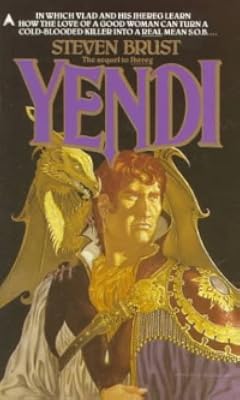
In which Vlad Taltos and his Jhereg learn how the love of a good woman can turn a cold-blooded killer into a real mean SOB.... Vlad tells the story of his early days in the House Jhereg, how he found himself in a Jhereg war, and how he fell in love with the wonderful woman, Yendi, who killed him.Tags
Recommendations











Member Reviews
I freely admit that I don't know whether this second book was written before or after the first's publication date, but it certainly falls five years before the main action of the previous novel.
Why does this matter? I don't mind having that tantalizing clue of having died years ago in the first novel being expanded into it's own interesting tale, but something has been itching under my skin as I read Yendi.
It didn't feel as polished as the previous novel. I kept picking up on clues that felt like this was the first tale, not the second. It was straightforward, following action after action, reversal after reversal. The previous novel jumped through time with important scenes and barrelling through ten years giving us the weight of show more great things and interesting stories untold, letting our imaginations do most of the work and driving us into some seriously important Work without stalling. This second novel compressed the time involved to just a few months, keeping things simple if not uncomplicated.
So why do I feel like this one could have really been the first novel of Mr. Brust? Because he didn't use all of the excellent tools of his writing that were at his disposal.
Don't get me wrong. This was a great mob-boss turf-war novel set among half-dragons and an unfortunate Easterner (read human) interloper in a big city. It also catapulted his love-interest to the forefront, and despite being such a whirlwind romance, I was charmed. Cawti was fully in the driver's seat, whether she was literally killing or loving Vlad. I rooted for both of them. What can I say? It was hopelessly romantic. Thank goodness for revivication. It's what turns any would be tragedy into high comedy.
One thing Steven Brust does fantastic in both novels is the near breakneck speed he can turn any desperate situation into a natural tragedy following from unintended consequences of character's actions.
In the first book, neither Vlad nor us knew what his casting of the second dragon invitation would do. My heart was in my throat when I, like Vlad, believed that he had just severed the connection with his best friend in order to save his life. The situation was a bit twisted in this novel after I was invited to see Cawti's world through Vlad's eyes after Vlad's assassination had been accomplished. Love at first sight for both of them at the moments of both their deaths... so fucked up, and so damn beautiful. So yes, I say again, thank god for revivication and the kindness of fucking powerful dragon hosts at Castle Black.
I really liked the novel's twisty plot turns, the love story, and the quick battles for supremacy. It might not have been as good as the first, but I still really enjoyed it.
I'm still curious to see all the places this series will go. Thank god I've got twelve more to go! show less
Why does this matter? I don't mind having that tantalizing clue of having died years ago in the first novel being expanded into it's own interesting tale, but something has been itching under my skin as I read Yendi.
It didn't feel as polished as the previous novel. I kept picking up on clues that felt like this was the first tale, not the second. It was straightforward, following action after action, reversal after reversal. The previous novel jumped through time with important scenes and barrelling through ten years giving us the weight of show more great things and interesting stories untold, letting our imaginations do most of the work and driving us into some seriously important Work without stalling. This second novel compressed the time involved to just a few months, keeping things simple if not uncomplicated.
So why do I feel like this one could have really been the first novel of Mr. Brust? Because he didn't use all of the excellent tools of his writing that were at his disposal.
Don't get me wrong. This was a great mob-boss turf-war novel set among half-dragons and an unfortunate Easterner (read human) interloper in a big city. It also catapulted his love-interest to the forefront, and despite being such a whirlwind romance, I was charmed. Cawti was fully in the driver's seat, whether she was literally killing or loving Vlad. I rooted for both of them. What can I say? It was hopelessly romantic. Thank goodness for revivication. It's what turns any would be tragedy into high comedy.
One thing Steven Brust does fantastic in both novels is the near breakneck speed he can turn any desperate situation into a natural tragedy following from unintended consequences of character's actions.
I really liked the novel's twisty plot turns, the love story, and the quick battles for supremacy. It might not have been as good as the first, but I still really enjoyed it.
I'm still curious to see all the places this series will go. Thank god I've got twelve more to go! show less
This is 1/2 of an interesting book and 1/2 of a terrible one. The street level mob war in the first half of the book was highly entertaining, if not pretty shoddily written. It is certainly not Elmore Leonard, but no one can disagree with throwing someone out a second story window.
But once it gets into the Magic Elves with Cosmic Pokey Sticks who Cannot be Killed Politics, it becomes unbelievably dull. What was a pretty good grimy crime novel turns into mostly people sitting at dinner chattering about Thrones and Empires and all this nonsense. Why is this small town hood with his hood girlfriend sitting at dinner with The Great and the Mighty to talk about Empire Succession when really he should be sniping other mobsters? I couldn't show more figure it out.
I can't rate this book highly. I've read a million mob books and really, what I want out of a mob book is the mob. It was definitely an interesting idea with a lack of execution. show less
But once it gets into the Magic Elves with Cosmic Pokey Sticks who Cannot be Killed Politics, it becomes unbelievably dull. What was a pretty good grimy crime novel turns into mostly people sitting at dinner chattering about Thrones and Empires and all this nonsense. Why is this small town hood with his hood girlfriend sitting at dinner with The Great and the Mighty to talk about Empire Succession when really he should be sniping other mobsters? I couldn't show more figure it out.
I can't rate this book highly. I've read a million mob books and really, what I want out of a mob book is the mob. It was definitely an interesting idea with a lack of execution. show less
A fun multilayered fantasy story in an interesting setting. The are moments, particularly in the last third of the book, where the political complexities become almost impossible to follow, and not so much because they are complicated but because of how they are being untangled, but it all sort of makes sense in the end. The main character, Vlad, is a lovable sort of underdog. Even though he's the boss of his own mob territory he spends most of the time hobnobbing with some of the most powerful people in his nation, and sometimes this results in the other characters doing a lot of the work for him, but he turns around and pays it all back by figuring out the central question of the plot.
Ultimately, although there is some fun gang war show more violence, a whirlwind romance that I didn't quite believe, and a pile of lore to digest if you're into that sort of thing, the book is actually structured more like a mystery, where the climax depends on Vlad figuring out whodunit and why. The first book in the series was structured on a similar vein, so if you liked that one this offers more of the same, although I did find the plot of the first book more more tight and the characters a little more believable in Jhereg. show less
Ultimately, although there is some fun gang war show more violence, a whirlwind romance that I didn't quite believe, and a pile of lore to digest if you're into that sort of thing, the book is actually structured more like a mystery, where the climax depends on Vlad figuring out whodunit and why. The first book in the series was structured on a similar vein, so if you liked that one this offers more of the same, although I did find the plot of the first book more more tight and the characters a little more believable in Jhereg. show less
Thank goodness I knew beforehand that the Vlad Taltos books aren't written in order of the timeline, or else I would have been really confused. This is the second book in the series to be published, but actually takes place before the first book, to the time when Vlad first meets his wife Cawti.
I really liked Cawti's character in Jhereg, and I was excited to find out she was going to have a much bigger role in this novel, based on its synopsis. So I was slightly let down when a third of the book breezed by and she still hadn't shown up; I think I was waiting with bated breath the whole time for that to happen. Eventually, amidst the Jhereg war that Vlad has started with rival Laris, she does make her appearance along with her show more partner-in-crime Norathar.
It was the high point for me, even though from the previous book we were told Vlad met Cawti while the latter was trying to assassinate him, so I knew what to expect. Despite that, it didn't diminish the scene in any way. A quote Vlad made from Jhereg still resonates with me, about how couples typically fall in love first then get married and spend the rest of their lives trying to kill each other, while with the two of them had it the other way around. I still chuckle when I think of it.
Still, the process of the two of them falling in love was really awkward, but somehow due to the book's style I suspect it was meant to be. It happened so quickly, with hardly any build up at all -- it seemed to me Vlad and Cawti literally jumped into bed after "Hello". Readers looking for elements of romance would be sorely disappointed, but then again Vlad doesn't seem like the type to be sentimental!
The story of the Jhereg war that started all this was very entertaining, at least, though there's a lot more the mystery angle in this book than the last. The breakneck pace of these novels means that sometimes the clues and the conclusions they lead to are sometimes hard to follow, especially since there are so much history and so many names thrown around. I think Yendi would have been more suspenseful if it hadn't been a "prequel" and we didn't already know how certain events played out, but this was another good read all in all, fast and fun. show less
I really liked Cawti's character in Jhereg, and I was excited to find out she was going to have a much bigger role in this novel, based on its synopsis. So I was slightly let down when a third of the book breezed by and she still hadn't shown up; I think I was waiting with bated breath the whole time for that to happen. Eventually, amidst the Jhereg war that Vlad has started with rival Laris, she does make her appearance along with her show more partner-in-crime Norathar.
It was the high point for me, even though from the previous book we were told Vlad met Cawti while the latter was trying to assassinate him, so I knew what to expect. Despite that, it didn't diminish the scene in any way. A quote Vlad made from Jhereg still resonates with me, about how couples typically fall in love first then get married and spend the rest of their lives trying to kill each other, while with the two of them had it the other way around. I still chuckle when I think of it.
Still, the process of the two of them falling in love was really awkward, but somehow due to the book's style I suspect it was meant to be. It happened so quickly, with hardly any build up at all -- it seemed to me Vlad and Cawti literally jumped into bed after "Hello". Readers looking for elements of romance would be sorely disappointed, but then again Vlad doesn't seem like the type to be sentimental!
The story of the Jhereg war that started all this was very entertaining, at least, though there's a lot more the mystery angle in this book than the last. The breakneck pace of these novels means that sometimes the clues and the conclusions they lead to are sometimes hard to follow, especially since there are so much history and so many names thrown around. I think Yendi would have been more suspenseful if it hadn't been a "prequel" and we didn't already know how certain events played out, but this was another good read all in all, fast and fun. show less
Though the cover blurb says "sequel to Jhereg" it's actually a prequel. I would never have been able to tell from his relationships with the various Dragaeran lords and ladies and references to past events, but the lack of a wife stood out. In fact, this is where he meets Cawti. It's a rough first date, since she assassinates him. This is time filler at best. The Sopranos meets fantasy, as the plot is primarily a turf war, plus a little detection on Vlad's part as he unravels a centuries old political dirty deed.
OK for fans of the series and of casual fantasy adventure.
OK for fans of the series and of casual fantasy adventure.
Originally posted at Fantasy Literature: http://www.fantasyliterature.com/reviews/yendi/
Loveable assassin Vlad Taltos is back in Yendi, the second in Steven Brustƒ??s VLAD TALTOS series. Yendi is actually a prequel to the first novel, Jhereg which introduced us to Vlad, his wife Cawti, his familiar, and several of his friends and enemies. Vlad is a new mob boss who is trying to protect his territory from the encroachment of neighboring mob bosses. When one of them sets up a racket in VladÂ??s territory, Vlad has to take him on. As usual, heÂ??ll need all his wits and all his friends just to stay alive.
In Yendi we learn a little more about the Dragaeran Empire, the Dragon Lords, and the activities of Vlad and the other bosses, but show more for some readers the most significant event is the story of how Vlad met Cawti, how she killed him, and how they fell in love. I was looking forward to this story, but it was a disappointment. The romance was dull and not very believable because of how instantaneous it was. Another complaint I have is the same thing I complained about in my review of the first book, Jhereg: Vlad solves crimes or mysteries by using convoluted suppositions that just happen to be right and thereÂ??s no way the reader could have figured out what was going on. This is disappointing because IÂ??ve learned that itÂ??s not much use to try to use my brain to remember clues or reason out a conclusion Â?? IÂ??ll never work it out on my own.
This sense of feeling slightly lost is part of Steven BrustÂ??s unique style. He drops you right into his complex world, but only gives cursory explanations of the characters, politics and history as he goes along. Generally I like this technique because it doesnÂ??t interrupt the plot, but there were several times while reading Yendi that I wasnÂ??t certain that I understood the implications or all the nuances of what was happening. I was reading the audio version, so IÂ??m not sure if I missed a glossary in the back, but fortunately there are plenty of resources on the internet for those seeking to study more of BrustÂ??s world.
Even though I donÂ??t fully understand BrustÂ??s world yet, I like it. I like BrustÂ??s sense of humor (very dry) and I like Vlad Taltos and his turf war. IÂ??m going to keep reading this series for these reasons and because I have friends whose opinions I trust who love this series. I expect that the more I learn, the more IÂ??ll like it, too.
I read the audio version which was recently produced by Audible Frontiers and read by Bernard Setaro Clark who is excellent in every way. Yendi is less than 7 hours long. show less
Loveable assassin Vlad Taltos is back in Yendi, the second in Steven Brustƒ??s VLAD TALTOS series. Yendi is actually a prequel to the first novel, Jhereg which introduced us to Vlad, his wife Cawti, his familiar, and several of his friends and enemies. Vlad is a new mob boss who is trying to protect his territory from the encroachment of neighboring mob bosses. When one of them sets up a racket in VladÂ??s territory, Vlad has to take him on. As usual, heÂ??ll need all his wits and all his friends just to stay alive.
In Yendi we learn a little more about the Dragaeran Empire, the Dragon Lords, and the activities of Vlad and the other bosses, but show more for some readers the most significant event is the story of how Vlad met Cawti, how she killed him, and how they fell in love. I was looking forward to this story, but it was a disappointment. The romance was dull and not very believable because of how instantaneous it was. Another complaint I have is the same thing I complained about in my review of the first book, Jhereg: Vlad solves crimes or mysteries by using convoluted suppositions that just happen to be right and thereÂ??s no way the reader could have figured out what was going on. This is disappointing because IÂ??ve learned that itÂ??s not much use to try to use my brain to remember clues or reason out a conclusion Â?? IÂ??ll never work it out on my own.
This sense of feeling slightly lost is part of Steven BrustÂ??s unique style. He drops you right into his complex world, but only gives cursory explanations of the characters, politics and history as he goes along. Generally I like this technique because it doesnÂ??t interrupt the plot, but there were several times while reading Yendi that I wasnÂ??t certain that I understood the implications or all the nuances of what was happening. I was reading the audio version, so IÂ??m not sure if I missed a glossary in the back, but fortunately there are plenty of resources on the internet for those seeking to study more of BrustÂ??s world.
Even though I donÂ??t fully understand BrustÂ??s world yet, I like it. I like BrustÂ??s sense of humor (very dry) and I like Vlad Taltos and his turf war. IÂ??m going to keep reading this series for these reasons and because I have friends whose opinions I trust who love this series. I expect that the more I learn, the more IÂ??ll like it, too.
I read the audio version which was recently produced by Audible Frontiers and read by Bernard Setaro Clark who is excellent in every way. Yendi is less than 7 hours long. show less
In Wikipedia it mentions that this is Steven Brust's least favorite of his books. So far, having read two books total, it's my least favorite as well. Let's see if that lasts when I read his others. Really, to read that he thinks it's his weakest book makes me feel better, because I was discouraged when I read it. His first book, Jhereg, is so concisely done; the plotting is admirable. Yendi simply does not live up to the same standard.
There are way too many characters, especially at the beginning. I'm expected to care about people who die, about whom I've barely read anything. If I'm not invested in their character yet, will it affect me when they die? Nope.
All in all, the plotting seemed a jumble, with much of it unnecessary. The show more connect-the-dots was nowhere as clear and logical. And the interesting House of Yendi got a two-dimensional character as their spotlight; the villainess who is of course outwardly rude - because we're supposed to dislike her, right? Except that's likely not what a Yendi would want to happen, if they wanted to achieve their ends.
Ah, well. I feel like the House of Yendi got cheated its interesting spotlight with this mashed-together story. I never cared about most of the characters (though something in me really likes Aliera and Sethra).
Also, romance is not Steven Brust's strength. Yeah, whatever; Cawti and Vlad fall in love. Oook. I'm gonna nod and go along, but man. Whatever.
I gave it two and a half stars because there was a bit of history that was interesting in it, and that was the book's main appeal. Otherwise it would only get 1 1/2 or 2 stars. show less
There are way too many characters, especially at the beginning. I'm expected to care about people who die, about whom I've barely read anything. If I'm not invested in their character yet, will it affect me when they die? Nope.
All in all, the plotting seemed a jumble, with much of it unnecessary. The show more connect-the-dots was nowhere as clear and logical. And the interesting House of Yendi got a two-dimensional character as their spotlight; the villainess who is of course outwardly rude - because we're supposed to dislike her, right? Except that's likely not what a Yendi would want to happen, if they wanted to achieve their ends.
Ah, well. I feel like the House of Yendi got cheated its interesting spotlight with this mashed-together story. I never cared about most of the characters (though something in me really likes Aliera and Sethra).
Also, romance is not Steven Brust's strength. Yeah, whatever; Cawti and Vlad fall in love. Oook. I'm gonna nod and go along, but man. Whatever.
I gave it two and a half stars because there was a bit of history that was interesting in it, and that was the book's main appeal. Otherwise it would only get 1 1/2 or 2 stars. show less
Members
- Recently Added By
Lists

What Makes This Book So Great
102 works; 16 members

Books Read in 2013
1,630 works; 51 members
Talk Discussions
Past Discussions
Jhereg by Steven Brust: Fantasy February Group Read in 75 Books Challenge for 2013 (June 2013)
Author Information

72+ Works 35,644 Members
Steven Karl Zoltan Brust is a writer and musician. He was born on November 23, 1955. Brust has worked as a systems programmer for a computer company and played guitar, drums, and banjo in such bands as Cats Laughing, Morrigan, and Boiled in Lead. Brust writes science fiction, including the Vlad Taltos series, The Pheonix Guards, 500 Years After, show more and Brokedown Palace. He has written "choose-your-own-adventure" books for Tor and published several short stories in a series. Brust also released a solo album, A Rose for Iconoclastes, on the SteelDragon label. (Bowker Author Biography) show less
Some Editions
Series

Dragaera: Vlad Taltos: Publication Order
17 works (2)

Dragaera: Vlad Taltos: Chronological Order
17 works (2)

Dragaera
25 works

Dragaera: Vlad Taltos: Wheel Order
16 works (13)
Belongs to Publisher Series
Sündmuste horisont (56)
Gallimard, Folio SF (304)
Work Relationships
Common Knowledge
- Canonical title
- Yendi
- Original publication date
- 1984
- People/Characters
- Vlad Taltos; Laris; Morrolan e'Drien; Aliera e'Kieron; Cawti (the Dagger of the Jhereg); Norathar (the Sword of the Jhereg) (show all 10); Sethra the Younger; Sethra Lavode; Sorceress in Green; Teldra
- Dedication
- This is for Reen and Corwin and Aliera and Carolyn and for my father-in-law Bill
- First words
- When I was young, I was taught that every citizen of the Dragaeran Empire was born into one of the seventeen Great Houses, each named for an animal.
- Last words
- (Click to show. Warning: May contain spoilers.)Life is like that, sometimes.
- Blurbers
- Zelazny, Roger
Classifications
Statistics
- Members
- 1,498
- Popularity
- 15,481
- Reviews
- 27
- Rating
- (3.84)
- Languages
- 10 — Czech, Dutch, English, Estonian, French, German, Hebrew, Polish, Spanish, Turkish
- Media
- Paper, Audiobook
- ISBNs
- 15
- ASINs
- 3