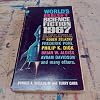
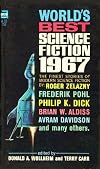
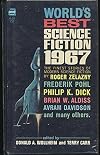
World's Best Science Fiction: 1967
by Donald A. Wollheim (Editor), Terry Carr (Editor)
World's Best SF (1967)
On This Page
Tags
Recommendations






Member Reviews
Another World’s Best SF collection that does not disappoint! I think the last sentence of the last story, “For a Breath I Tarry,” will stay with me for a very long time. My thoughts about the others:
“We Can Remember It for You, Wholesale”: As you know, this is the story the movie Total Recall is based on. However, I hadn’t previously read it. In hindsight, its inclusion in this book is justified. I can well imagine how it caught the eye of the filmmaker. Of course the movie is much more action-y, but the short story is worth reading for the very details in which it differs from the film.
“ Light of Other Days”: Everything I’ve tried to write about this story betrays the impact of the ending. Suffice to say, I liked show more it.
“The Keys to December”: In the far future, people are sometimes engineered to conform to a particular planet if the parents are poor enough to sell their offspring to a developer. A group of youngsters are suddenly planetless when the one they were bound for is unexpectedly destroyed. They buy a new planet and begin to conform it to their needs, raising the question of whether they are playing god to its current inhabitants which might or might not be sentient. This is very emotional and far-reaching.
“Nine Hundred Grandmothers”: Our narrator is on a foreign world and discovers the inhabitants might have a very valuable secret. This is another one I don’t want to spoil for you at all, but it was very thought-provoking. Although, the ending isn’t as much of a pay-off as I would have liked.
“Bircher”: In a future in which surveillance robots are everywhere and crimes are very, very few, an “unsolvable” murder lands in the lap of the chief of police. This futuristic murder mystery is captivating and also made me think that time is not too far off. Whether that is a positive thing or not is probably a valid question although I’m not sure Walde meant to raise it.
“Behold the Man”: Michael Moorcock is a genius. His protagonist, Karl Glogauer, goes back in time to witness the life of Jesus with some pretty disastrous (If you happen to be a Christian) results. If you’re not a Christian, you might find it as hilarious and probable as I did.
“Bumberboom”: I did not understand this story at all. I read the first few pages without retaining any of it. I think most of the problem was the language, both of the narration and the dialogue. I skipped the rest because after reading through those pages again, I still didn’t know what they were talking about and also my head hurt.
“Day Million”: I just read this story in a “Best of Frederik Pohl” anthology. Here’s what I had to say then: How much will human beings differ from us in the far, far future? Here is one imagining. -- This was very short and quite poetic.
“The Wings of a Bat”: A team of folks goes back to the Cretaceous Era for an undisclosed cause. The team doctor has a fear of Pterodactyls, but when a sick baby pterodon is placed on his desk, he has no choice but to treat it. This was similar to most any adopted-wild-animal story except with an SF twist.
“Amen and Out”: This is another one that’s hard to explain without revealing things that one doesn’t know until the end. It is also another one where the future might not be too far off from now, particularly as regards the “portable shrines.” I’m not sure what to think about the whole thing because it seemed to be making two different comments about humanity. I’m also pretty sure they conflict.
“For a Breath I Tarry” is, again, the last story and very memorable. The world is devoid of humans but being rebuilt by robots. One robot takes it into his circuits to try to understand humanity. The result is a revelation. Loved, loved, loved it.
On the whole, this collection seems to have fewer stories, but most were longer than one expects from a short story anthology. A couple could probably be called novellas. I think any SF fan could find something he or she liked, which is probably good. I recommend this. show less
“We Can Remember It for You, Wholesale”: As you know, this is the story the movie Total Recall is based on. However, I hadn’t previously read it. In hindsight, its inclusion in this book is justified. I can well imagine how it caught the eye of the filmmaker. Of course the movie is much more action-y, but the short story is worth reading for the very details in which it differs from the film.
“ Light of Other Days”: Everything I’ve tried to write about this story betrays the impact of the ending. Suffice to say, I liked show more it.
“The Keys to December”: In the far future, people are sometimes engineered to conform to a particular planet if the parents are poor enough to sell their offspring to a developer. A group of youngsters are suddenly planetless when the one they were bound for is unexpectedly destroyed. They buy a new planet and begin to conform it to their needs, raising the question of whether they are playing god to its current inhabitants which might or might not be sentient. This is very emotional and far-reaching.
“Nine Hundred Grandmothers”: Our narrator is on a foreign world and discovers the inhabitants might have a very valuable secret. This is another one I don’t want to spoil for you at all, but it was very thought-provoking. Although, the ending isn’t as much of a pay-off as I would have liked.
“Bircher”: In a future in which surveillance robots are everywhere and crimes are very, very few, an “unsolvable” murder lands in the lap of the chief of police. This futuristic murder mystery is captivating and also made me think that time is not too far off. Whether that is a positive thing or not is probably a valid question although I’m not sure Walde meant to raise it.
“Behold the Man”: Michael Moorcock is a genius. His protagonist, Karl Glogauer, goes back in time to witness the life of Jesus with some pretty disastrous (If you happen to be a Christian) results. If you’re not a Christian, you might find it as hilarious and probable as I did.
“Bumberboom”: I did not understand this story at all. I read the first few pages without retaining any of it. I think most of the problem was the language, both of the narration and the dialogue. I skipped the rest because after reading through those pages again, I still didn’t know what they were talking about and also my head hurt.
“Day Million”: I just read this story in a “Best of Frederik Pohl” anthology. Here’s what I had to say then: How much will human beings differ from us in the far, far future? Here is one imagining. -- This was very short and quite poetic.
“The Wings of a Bat”: A team of folks goes back to the Cretaceous Era for an undisclosed cause. The team doctor has a fear of Pterodactyls, but when a sick baby pterodon is placed on his desk, he has no choice but to treat it. This was similar to most any adopted-wild-animal story except with an SF twist.
“Amen and Out”: This is another one that’s hard to explain without revealing things that one doesn’t know until the end. It is also another one where the future might not be too far off from now, particularly as regards the “portable shrines.” I’m not sure what to think about the whole thing because it seemed to be making two different comments about humanity. I’m also pretty sure they conflict.
“For a Breath I Tarry” is, again, the last story and very memorable. The world is devoid of humans but being rebuilt by robots. One robot takes it into his circuits to try to understand humanity. The result is a revelation. Loved, loved, loved it.
On the whole, this collection seems to have fewer stories, but most were longer than one expects from a short story anthology. A couple could probably be called novellas. I think any SF fan could find something he or she liked, which is probably good. I recommend this. show less
Published originally as World's Best Science Fiction 1967
Now, it's not actually on openlibrary yet. But I expect it will be, so this is the best tag for it.
Ratings
Members
- Recently Added By
Author Information


All Editions
Some Editions
Series

Belongs to Publisher Series
ハヤカワ文庫 SF (299)
Work Relationships
Contains
Common Knowledge
- Canonical title
- World's Best Science Fiction: 1967
- Original publication date
- 1967
- Disambiguation notice
- Variant Title: "World's Best Science Fiction: Third Series"
Classifications
Statistics
- Members
- 133
- Popularity
- 245,569
- Reviews
- 3
- Rating
- (4.08)
- Languages
- English, Japanese
- Media
- Paper
- ISBNs
- 2
- ASINs
- 7