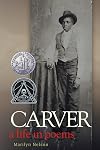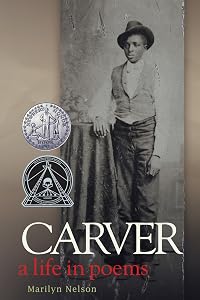
Carver: A Life in Poems
by Marilyn Nelson
On This Page
Description
A collection of poems that combine to provide a portrait of the life of nineteenth-century African-American botanist and inventor George Washington Carver.Tags
Recommendations






Member Reviews
I don’t know if Nelson invented the format but for me it was a revelation.
Arranged chronologically as signposts in Carver's life, nevertheless each of Nelson's poems stands alone. The opening verses, for example, relay the musings of a mercenary hunting a missing woman, Mary, and Mary’s infant son. The mercenary finds the boy, but not Mary, and is rewarded. That boy is Carver, and the mercenary’s tale of triumph and reward serves as Carver’s “origin story”. (We never hear from the mercenary again.) Nelson builds up a picture of Carver from many such poems: singular, isolated, viewed over distance. Carver is revealed to be amiable, curious, generous, and accomplished, but always a person apart.
Nelson in her verse observes show more Carver's personal qualities, evoking images and tones, avoiding Biblical inventory of ancestral history, Homeric tallies of the dead and their deeds. Seemingly recognizing that most readers will be almost wholly unfamiliar with Carver's biography, however, she appends relevant documentary detail in occasional footnotes: bulleted almanac entries with the necessary detail for a fuller appreciation of a given poem. Not all poems need them; in one instance, a photograph explains an obscure reference. It was not wholly clear to me, in that first poem, what tale the mercenary was telling, or the significance of his hiring, until the poem’s footnote was read, but the story was in the poem, not the footnote.
Typically Nelson's poems assume the perspective of someone not among Carver’s intimates. In this way the poems mimic the position of the book’s readers: outside looking in on a life, telling a story from what little can be known without having participated. There are several exceptions: perhaps three (of almost 60 poems). One is narrated by Carver, "My beloved friend", reading as though we've opened a letter intended for someone else. Another appears to quote from a different letter, then proceeds to observe the letterwriter without comment. "Last Talk with Jim Hardwick" is subtitled “a found poem”; whether wholly invented or taken from a diary, however, is unclear.
I opened this book knowing no more than I learned in primary school: Carver was a black scientist who found countless uses for the humble peanut. Having read it, somehow I know Carver as a person brimming over with talent and insight, a man of science and of spiritual visions, all of this tempered by his gentle demeanor. I am all the better for meeting him. show less
Arranged chronologically as signposts in Carver's life, nevertheless each of Nelson's poems stands alone. The opening verses, for example, relay the musings of a mercenary hunting a missing woman, Mary, and Mary’s infant son. The mercenary finds the boy, but not Mary, and is rewarded. That boy is Carver, and the mercenary’s tale of triumph and reward serves as Carver’s “origin story”. (We never hear from the mercenary again.) Nelson builds up a picture of Carver from many such poems: singular, isolated, viewed over distance. Carver is revealed to be amiable, curious, generous, and accomplished, but always a person apart.
Nelson in her verse observes show more Carver's personal qualities, evoking images and tones, avoiding Biblical inventory of ancestral history, Homeric tallies of the dead and their deeds. Seemingly recognizing that most readers will be almost wholly unfamiliar with Carver's biography, however, she appends relevant documentary detail in occasional footnotes: bulleted almanac entries with the necessary detail for a fuller appreciation of a given poem. Not all poems need them; in one instance, a photograph explains an obscure reference. It was not wholly clear to me, in that first poem, what tale the mercenary was telling, or the significance of his hiring, until the poem’s footnote was read, but the story was in the poem, not the footnote.
Typically Nelson's poems assume the perspective of someone not among Carver’s intimates. In this way the poems mimic the position of the book’s readers: outside looking in on a life, telling a story from what little can be known without having participated. There are several exceptions: perhaps three (of almost 60 poems). One is narrated by Carver, "My beloved friend", reading as though we've opened a letter intended for someone else. Another appears to quote from a different letter, then proceeds to observe the letterwriter without comment. "Last Talk with Jim Hardwick" is subtitled “a found poem”; whether wholly invented or taken from a diary, however, is unclear.
I opened this book knowing no more than I learned in primary school: Carver was a black scientist who found countless uses for the humble peanut. Having read it, somehow I know Carver as a person brimming over with talent and insight, a man of science and of spiritual visions, all of this tempered by his gentle demeanor. I am all the better for meeting him. show less
Read for Newbery club in Children's Books group. I've got to admit, I struggled. I'm sure I don't understand half of what Nelson was sharing. I don't know how most teens would do any better. The photos do help.
But! It's absolutely worth trying to read. So much can be learned just from the lines in which even a naive reader can see grace and power. I think it's better if read along with a traditional biography. I looked at Nelson's acknowledgements page and figured out that I probably should try to find [b:Carver: A Great Soul|1482618|Carver A Great Soul|Peter D. Burchard|https://i.gr-assets.com/images/S/compressed.photo.goodreads.com/books/1400886355l/1482618._SY75_.jpg|1473744] by [a:Peter D. Burchard|693866|Peter D. show more Burchard|https://s.gr-assets.com/assets/nophoto/user/u_50x66-632230dc9882b4352d753eedf9396530.png].
The book makes it plain just how much we lost by not recognizing and supporting his genius. For example, how much better a world would we live in if we used peanuts for plastics, instead of petroleum?!
#OwnVoices show less
But! It's absolutely worth trying to read. So much can be learned just from the lines in which even a naive reader can see grace and power. I think it's better if read along with a traditional biography. I looked at Nelson's acknowledgements page and figured out that I probably should try to find [b:Carver: A Great Soul|1482618|Carver A Great Soul|Peter D. Burchard|https://i.gr-assets.com/images/S/compressed.photo.goodreads.com/books/1400886355l/1482618._SY75_.jpg|1473744] by [a:Peter D. Burchard|693866|Peter D. show more Burchard|https://s.gr-assets.com/assets/nophoto/user/u_50x66-632230dc9882b4352d753eedf9396530.png].
The book makes it plain just how much we lost by not recognizing and supporting his genius. For example, how much better a world would we live in if we used peanuts for plastics, instead of petroleum?!
#OwnVoices show less
This book of poems imagines various moments of George Washington Carver's life (and the lives of people he came into contact with), some pivotal, some quiet and contemplative. Many of the poems include short biographical footnotes—useful for signposting major events of his life. A traditional biography would be preferable for those wanting more details about Carver's life, but by the end of this book, I felt as though I truly knew him.
I found this book exceptionally moving and beautiful. Like a good biography should, it imparts the spirit of Carver, making him feel real and close and beautiful. The telling of his life in poems seems to be an appropriate way to honor the life of a creative, spiritual scientist. I lingered over this book, reading a poem our two at a time to make it last.
Normally, poetry really isn't my thing, but I am glad I decided to read it. I really enjoyed it. In fact the glimpses in Carver's life, had me looking up for information on the inspirational scientist. I especially liked the pictures at the end of each poem. Plus, if the reader is confused by a poem there was almost always a short synopsis of the event in Carver's life.
This is a biography of George Washington Carver, told as a series of poems from a variety of different perspectives. Or, to be more accurate, it's a hagiography. Did George Washington Carver ever do anything wrong? Apparently not. I don't know enough about the man to say if that's true or not, but it doesn't make for interesting reading to learn about how right Carver was about everything time and again. I'm surprised that the man didn't solve racism with his bare hands after he invented peanut butter. The poems are pretty typical free verse for the most part; nothing really caught my attention.
George Washington Carver comes alive in these poems. Nelson sets the poems in the chronological order of Carver's life. Most of the narrative poems are short yet paint powerful, word-picture descriptions of Carver. Nelson accompanies her poems with photographs of Carver, his family and friends and gives brief descriptions of the important events in his life. By the end of the book, the reader feels as if s/he has walked with Carver through the major events of his life and has shared in his hunger, sadness, joy and accomplishments. The poems alternately bring laughter and tears as they portray the life of this great man. One even forgets that the poems are modern; they seem to have been written by Carver and those who knew him best. This show more book is a must for any library's poetry collection, regardless of whether the collection is for children, young adults or adults. 2001, Front Street, $16.95. Ages 9 up
"J. B. Petty, Ph.D." (Children's Literature) show less
"J. B. Petty, Ph.D." (Children's Literature) show less
Members
- Recently Added By
Lists

Historical Fiction Books
99 works; 5 members
1800s: America
23 works; 4 members

Connecticut Book Awards 2002-2011 and 2017+
71 works; 1 member

Mensa for Kids Excellence in Reading Award Program (Nonfiction)
54 works; 4 members

Newbery Honor Books By year - II - 1981-2035
143 works; 4 members

Beautiful Feet Books
304 works; 7 members

Books Read in 2024
4,727 works; 128 members
Author Information

31+ Works 2,629 Members
Marilyn Nelson is the author of numerous books, including The Cachoeira Tales and Other Poems, The Fields of Praise, and Magnificat. Her honors include three National Book Award Finalist medals, the Frost Medal, the Poets' Prize, and the Boston Globe/Hornbook Award. Nelson is an emeritus professor at the University of Connecticut, the former poet show more laureate of Connecticut, and founder and director of Soul Mountain Retreat. show less
Awards and Honors
Awards
Distinctions
Work Relationships
Is contained in
Common Knowledge
- Original title
- Carver: A Life in Poems
- Original publication date
- 2001
- People/Characters
- George Washington Carver
Classifications
Statistics
- Members
- 708
- Popularity
- 40,277
- Reviews
- 20
- Rating
- (4.01)
- Languages
- English
- Media
- Paper, Audiobook, Ebook
- ISBNs
- 9
- ASINs
- 2