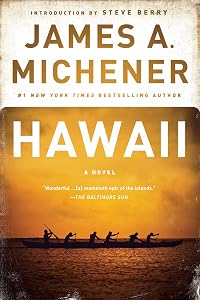
Hawaii
by James A. Michener
On This Page
Description
This epic novel traces the origins and history of the islands of Hawaii, from their volcanic birth, through the first arrivals of humans from Polynesia, followed by European sailors and missionaries, then Chinese and Japanese laborers, to the modern blending of cultures.Tags
Recommendations









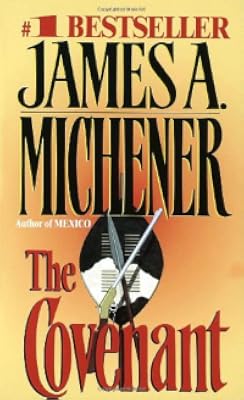


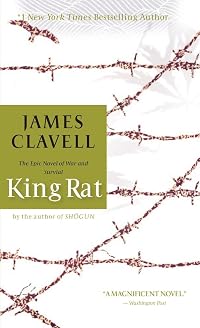
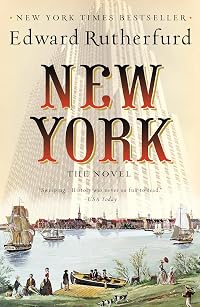

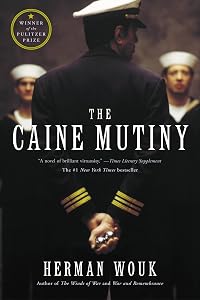















Member Recommendations


Member Reviews
My first Michener experience at the tender age of 12. I will never forget the opening scenes of Hawaii. Michener is a painter of words, I felt the explosions of the Earth as the volcanoes erupted, saw the multiplicity of the colors when the lava flowed into the sea. And that was just the first chapter!
Long before social justice was trendy, Michener took on issues of religious oppression, sexual slavery, and so many more while weaving a thousand page plus plot that kept you inextricably linked to the very end. Hawaii is one of Michener's best!
Long before social justice was trendy, Michener took on issues of religious oppression, sexual slavery, and so many more while weaving a thousand page plus plot that kept you inextricably linked to the very end. Hawaii is one of Michener's best!
If you aren't familiar with James Michener's historical fiction, I'd say this is the book to start with. It was his first big success, and it's the first to feature his winning format of selecting a geographic area, and following it from prehistory into present day. It was first published in 1959, the same year Hawaii became a state, so I'm not sure whether any of its initial popularity might be attributed to the heightened public interest around Hawaii at the time. No matter; the novel is well done, and has certainly stood the test of time. Reading it, one gets a sense of Michener's attachment to the place. He served in the Navy during World War II, and was mainly stationed around Hawaii and the South Pacific (the theme of several show more other of his works). The entire first third or so of the book explores how Polynesians fleeing brutal tribal warfare in Bora Bora first colonized the islands about eight hundred years ago. The technical details of how such a long journey might have been possible with extant technology were fleshed out about by Norwegian anthropologist Thor Heyerdahl, when he crossed the Pacific in his famous traditionally-built Polynesian raft, the "Kon Tiki" in 1947, about ten years before Michener started writing Hawaii.
So, there is a lot of interesting historical context for this novel, but it is not a dry or academic work at all. Michener populates Hawaii with sympathetic and relatable characters from all walks of life, and from a variety of cultural backgrounds. Not to gush, but creating so many diverse characters well must be not only difficult, but it must involve quite a bit of background research. Consider trying to deliver a convincing eighty year-old Tahitian tribal leader in the 9th century! How about the believeable Captain of a New England whaler in the early 1800's, or a Japanese picture bride from the 1880's. There are several dozen such diverse characters in this novel, and each one feels real. It's a true testiment to Michener's skill as an author.
Another challenge Michener deftly handles is the weaving of his fictional players into known historical events. Lesser works of historical fiction tend to thrust their characters into the thick of the action (Forrest Gump being probably the most egregious offender), which usually feels inauthentic at best, and more often downright forced. Michener's characters usually experience history the way most of us are used to: as an observer who is not on center stage of the action, but who witnesses history-in-the-making from the sidelines, and who is likely to be touched the events in his own personal way. (where were you on 9/11?) The attack on Pearl Harbor is a good example of this. Hawaii covers the event through the lives of a Japanese-American family who live on the other side of Oahu. They don't witness the action directly, but hear about it on the radio, and are both horrified by the violence of war, and also worried sick about what repercussions they might personally suffer in its wake. The older generation is conflicted by feelings of concern for their loved ones back in Japan, and feelings of outraged patriotism for their new homeland, which has provided them with so much opportunity. One old patriarch aches with guilt at his hertiage, but also still harbors a completely understandable continued pride in Japan's many cultural and historic achievements. I can absolutely believe there were people just so affected by Pearl Harbor in real life. Michener has a very honest and human way of looking at these people and events, and I can imagine that this was bringing something new to the table when it was written, less than twenty years after the actual attack. Such nuanced handling of complex situations makes Hawaii a very satisfying read. It also highlights, by contrast, why the Ben Affleck film Pearl Harbor was such a turd.
Ugh. Look at that smug doofus- has he been in anything worth seeing, since Good Will Hunting?
Really the only thing I didn't care for in this novel was the character of Captain Hoxworth - the philandering, aggressive sea Captain who strikes it rich in the "Sandwhich Isles" (as Hawaii was known in his time). This is a complaint I have with a lot of Michener novels: he writes asshole characters just a bit too sympathetically. Hoxworth is an opportunist privateer, who fucks a slew of native girls, without a thought for his devoted wife back home. I get that a lot of people like this existed, and they have their place in the telling of history. I also get Michener's point (I think) that it was the uncommonly adventurous types who often played a vital role pioneering new trade routes and developing commerce in remote areas. His infidelity and general douchebaggery may be the downside of the same character traits which were otherwise laudable (i.e. the whole swashbucking alpha-male thing). I just get annoyed with Michener's overly-adoring treatment of such characters. Capt Hoxworth is a dick, and no amount of pioneering spirit will change that for me. Michener is willing to exuse more bad behavior in his alpha males than I am, and since this is my review, dammit, that knocks one star off!
Hoxworth aside, Hawaii is a wonderful novel, immensely satisfying to read, and when you finish, you'll find you know much more about Hawaii than most of the tourists who have lounged the beaches of Waikiki. show less
So, there is a lot of interesting historical context for this novel, but it is not a dry or academic work at all. Michener populates Hawaii with sympathetic and relatable characters from all walks of life, and from a variety of cultural backgrounds. Not to gush, but creating so many diverse characters well must be not only difficult, but it must involve quite a bit of background research. Consider trying to deliver a convincing eighty year-old Tahitian tribal leader in the 9th century! How about the believeable Captain of a New England whaler in the early 1800's, or a Japanese picture bride from the 1880's. There are several dozen such diverse characters in this novel, and each one feels real. It's a true testiment to Michener's skill as an author.
Another challenge Michener deftly handles is the weaving of his fictional players into known historical events. Lesser works of historical fiction tend to thrust their characters into the thick of the action (Forrest Gump being probably the most egregious offender), which usually feels inauthentic at best, and more often downright forced. Michener's characters usually experience history the way most of us are used to: as an observer who is not on center stage of the action, but who witnesses history-in-the-making from the sidelines, and who is likely to be touched the events in his own personal way. (where were you on 9/11?) The attack on Pearl Harbor is a good example of this. Hawaii covers the event through the lives of a Japanese-American family who live on the other side of Oahu. They don't witness the action directly, but hear about it on the radio, and are both horrified by the violence of war, and also worried sick about what repercussions they might personally suffer in its wake. The older generation is conflicted by feelings of concern for their loved ones back in Japan, and feelings of outraged patriotism for their new homeland, which has provided them with so much opportunity. One old patriarch aches with guilt at his hertiage, but also still harbors a completely understandable continued pride in Japan's many cultural and historic achievements. I can absolutely believe there were people just so affected by Pearl Harbor in real life. Michener has a very honest and human way of looking at these people and events, and I can imagine that this was bringing something new to the table when it was written, less than twenty years after the actual attack. Such nuanced handling of complex situations makes Hawaii a very satisfying read. It also highlights, by contrast, why the Ben Affleck film Pearl Harbor was such a turd.
Ugh. Look at that smug doofus- has he been in anything worth seeing, since Good Will Hunting?
Really the only thing I didn't care for in this novel was the character of Captain Hoxworth - the philandering, aggressive sea Captain who strikes it rich in the "Sandwhich Isles" (as Hawaii was known in his time). This is a complaint I have with a lot of Michener novels: he writes asshole characters just a bit too sympathetically. Hoxworth is an opportunist privateer, who fucks a slew of native girls, without a thought for his devoted wife back home. I get that a lot of people like this existed, and they have their place in the telling of history. I also get Michener's point (I think) that it was the uncommonly adventurous types who often played a vital role pioneering new trade routes and developing commerce in remote areas. His infidelity and general douchebaggery may be the downside of the same character traits which were otherwise laudable (i.e. the whole swashbucking alpha-male thing). I just get annoyed with Michener's overly-adoring treatment of such characters. Capt Hoxworth is a dick, and no amount of pioneering spirit will change that for me. Michener is willing to exuse more bad behavior in his alpha males than I am, and since this is my review, dammit, that knocks one star off!
Hoxworth aside, Hawaii is a wonderful novel, immensely satisfying to read, and when you finish, you'll find you know much more about Hawaii than most of the tourists who have lounged the beaches of Waikiki. show less
What an epic! This told the story of Hawaii from its formation by volcanoes to settlement by the people of Bora Bora and Tahiti through Statehood in 1959. I learned so much history. I was surprised at the hatred the Chinese had for the Japanese and visa versa. Both groups and the whites had the same hatred for the native Hawaiians. I was also surprised to learn that the genealogical history of the Hawaiians was only about 20% Hawaiian and the rest Chinese, Japanese and the descendants of missionaries as many of the native Hawaiians were killed off by measles or influenza. Very informative chapters on the Molokkai leper colony, too. A tad boring near the end with the politics of statehood. This rounded out the story for me as I had show more visited Hawaii in 2017. Great read! I used both audio and paperback for this read. 936 pages show less
This is the second Michener novel I've read, after "The Source." And I'm still not sure what to think of him. I've never read novels like his. They truly are history as fiction, and like history - there is no plot. A character we've been reading out suddenly dies. A tsunami sweeps in out of nowhere, a side character is swept away into the ocean, and we hear no more about it. But you know, that's how real life is. The problem is that it's not how stories are usually told. If anything, this is the biography about Hawaii, and the people are just the various factors that affect the life of Hawaii. Perhaps the central plot is about whether or not Hawaii will become a state, but even that comes and goes. I had to laugh when I watched one show more BookTube review promise not to reveal any spoilers, because it would be impossible to "spoil" this book. There is literally no plot, central conflict or main characters.
I do love history, and this is a very interesting way to tell the history of a place. Michener has a whole host of characters that he invented but are very true to history: Hawaiians, white missionaries and traders, Chinese and Japanese workers. No one is a true villain or hero, they all have their good aspects and their bad aspects. And if the characters are sometimes stereotypes, that is just as much true of the white characters as the rest. But this is also frustrating as a reader. Does Michener agree with what the missionaries did, or is he critical of them? I suppose in the spirit of Herodotus, by not making his views clear Michener is trying to leave it up to the reader. But I find myself wanting Michener to take some kind of position. Instead, he seems to be presenting every person and every situation from every angle.
While Michener might be considered a decent storyteller, he is not a good writer. Descriptions and dialogue can be very flat, almost as if this was the first draft of him trying to get the broad strokes down, but he never went back to refine it and make it readable. Listen to this bizarrely stilted fight scene:
"With a deceptive lunge to the right, followed by a snakelike twist to the left, Hoxworth **brought his powerful right fist into the policeman's face**.... The surprised policeman staggered backward and fell onto the deck, whereupon Hoxworth began kicking viciously at his face, but **remembering from the pain in his bare feet as they crashed into the man's head, that he wore no shoes,** he quickly grabbed a belaying pin and started to thrash the fallen islander.... Hoxworth continued hammering him until **sounds from other parts of the deck called him to activity there.**" The parts offset by the asterisks are so awkward and distancing, they pull you right out of the action.
Or how about this dialogue. Whip ran off to California with his wife Iliki's sister Nancy, and here they are breaking up:
[Whip] therefore decided to return to Hawaii, but Nancy Janders said, "I wouldn't, Whip."
"Why not?"
"Well, Iliki's there. That'll be embarassing for you. And I certainly can't go back with you."
"I don't think you should," Whip said coldly, and a few days later he added, "You ought to be looking for a man for yourself, Nance."
'You through with me?" Nancy asked.
"No place for you in Hawaii," he said truthfully. "How you fixed for money?"
"The family sends me my share," she assured him.
"Nance," he said in his most friendly manner, "I sure hope you have a wonderful life from here on out. Now you better get some clothes on."
---And that's literally the end of that little episode. Not all the dialogue is that bad, but a lot of it is.
So, I can't really recommend Michener if you're looking for a good and entertaining book to read. But if you love history, and want to explore the places he writes about, I do think he's worth checking out. He has certainly done his research, and his information is reliable as far as I can tell. He always has respect for his subjects, and if sometimes he slides into stereotypes and generalizations, he also writes some fascinating and sympathetic characters. His relative neutrality on issues is both admirable and frustrating. I can truly say I have never read any books quite like his, and I do fully intend to read more of his books. show less
I do love history, and this is a very interesting way to tell the history of a place. Michener has a whole host of characters that he invented but are very true to history: Hawaiians, white missionaries and traders, Chinese and Japanese workers. No one is a true villain or hero, they all have their good aspects and their bad aspects. And if the characters are sometimes stereotypes, that is just as much true of the white characters as the rest. But this is also frustrating as a reader. Does Michener agree with what the missionaries did, or is he critical of them? I suppose in the spirit of Herodotus, by not making his views clear Michener is trying to leave it up to the reader. But I find myself wanting Michener to take some kind of position. Instead, he seems to be presenting every person and every situation from every angle.
While Michener might be considered a decent storyteller, he is not a good writer. Descriptions and dialogue can be very flat, almost as if this was the first draft of him trying to get the broad strokes down, but he never went back to refine it and make it readable. Listen to this bizarrely stilted fight scene:
"With a deceptive lunge to the right, followed by a snakelike twist to the left, Hoxworth **brought his powerful right fist into the policeman's face**.... The surprised policeman staggered backward and fell onto the deck, whereupon Hoxworth began kicking viciously at his face, but **remembering from the pain in his bare feet as they crashed into the man's head, that he wore no shoes,** he quickly grabbed a belaying pin and started to thrash the fallen islander.... Hoxworth continued hammering him until **sounds from other parts of the deck called him to activity there.**" The parts offset by the asterisks are so awkward and distancing, they pull you right out of the action.
Or how about this dialogue. Whip ran off to California with his wife Iliki's sister Nancy, and here they are breaking up:
[Whip] therefore decided to return to Hawaii, but Nancy Janders said, "I wouldn't, Whip."
"Why not?"
"Well, Iliki's there. That'll be embarassing for you. And I certainly can't go back with you."
"I don't think you should," Whip said coldly, and a few days later he added, "You ought to be looking for a man for yourself, Nance."
'You through with me?" Nancy asked.
"No place for you in Hawaii," he said truthfully. "How you fixed for money?"
"The family sends me my share," she assured him.
"Nance," he said in his most friendly manner, "I sure hope you have a wonderful life from here on out. Now you better get some clothes on."
---And that's literally the end of that little episode. Not all the dialogue is that bad, but a lot of it is.
So, I can't really recommend Michener if you're looking for a good and entertaining book to read. But if you love history, and want to explore the places he writes about, I do think he's worth checking out. He has certainly done his research, and his information is reliable as far as I can tell. He always has respect for his subjects, and if sometimes he slides into stereotypes and generalizations, he also writes some fascinating and sympathetic characters. His relative neutrality on issues is both admirable and frustrating. I can truly say I have never read any books quite like his, and I do fully intend to read more of his books. show less
A vital book for almost 1000 pages. Then, the last part kicks in. The "current" story is lacking, when compared to the rest. Michener was so caught up in contemporary Hawaiian and American politics that he allowed the epic sweep of his novel to dwindle into a preachy sermon on the brotherhood of man, while focusing on his devotion to the Japanese in the Islands. This book deserves a more memorable ending.
Yet the novel is a great work of historical fiction. A few notations:
* Michener makes great use of James Frazer's The Golden Bough, a mammoth study of worldwide religions, myths, and social institutions--although I would assume, like most of us, he probably made most use of the abridged edition, which nonetheless reaches to nearly 900 show more pages (much like a Michener novel). What is really important, here, is the research and application of the tabu themes which drive through the heart of Hawaii. For as one ruling elite loses its mana and fades from history, a new one (the missionaries and their descendants) arises in the old one's place. The interwoven politics and incest of the ruling alii nui are their fatal flaws. But the missionaries down through the next 130 years make the very same mistakes, become a stifling inbred clique that is eclipsed by the rising generation of Chinese and, especially, Japanese who will seize power in the 1950s.
* Abner Hale brings both sides of the missionary impact on Hawaii to light. On the one hand, he provides for a stern system of law or order designed to protect the native Hawaiians from the American whalers, who rape, pillage, and destroy everything they come in contact with. This same fanaticism, his belief system, however, also serves to destroy the native culture and separate Abner from everyone he cares about, from the alii nui, Malama, to Abner's wife, Jerusha, and their children, from his fellow missionaries to the native people he cares about, Keoki, Noelani, and Iliki. At the end, Abner is left a lonely man, barely tolerated by those around him.
* I would say that Michener's descriptions of combat were the weakest aspect of the novel but for the fact that just a while later arise the descriptions of people singing and playing music. Describing music on the written page is a futile task at best; with Michener, it is a calamity far exceeding the simplistic images of battle and war. At least I remember the war passages, the several pages devoted to describing music are an utter blank.
* With a publication date of 1959, Hawaii's writing probably was not influenced by the 1959 film, Ben Hur. Still, the description of life in the leper colony sure does seem similar to the scenes of Ben Hur's family's banishment to a Roman era Judean leper colony. Probably a coincidence, I'm sure. Or maybe a Jungian moment of the collective unconscious arising to produce the same images for two disparate projects.
I like Michener. I like this novel. It is the natural outgrowth of his two earlier books on the Pacific, Tales of the South Pacific and Return to Paradise, especially the latter, where he first experimented with the type of geographic preface that also constitutes the first chapter of Hawaii.
I doubt Michener has any peers but James Clavell. show less
Yet the novel is a great work of historical fiction. A few notations:
* Michener makes great use of James Frazer's The Golden Bough, a mammoth study of worldwide religions, myths, and social institutions--although I would assume, like most of us, he probably made most use of the abridged edition, which nonetheless reaches to nearly 900 show more pages (much like a Michener novel). What is really important, here, is the research and application of the tabu themes which drive through the heart of Hawaii. For as one ruling elite loses its mana and fades from history, a new one (the missionaries and their descendants) arises in the old one's place. The interwoven politics and incest of the ruling alii nui are their fatal flaws. But the missionaries down through the next 130 years make the very same mistakes, become a stifling inbred clique that is eclipsed by the rising generation of Chinese and, especially, Japanese who will seize power in the 1950s.
* Abner Hale brings both sides of the missionary impact on Hawaii to light. On the one hand, he provides for a stern system of law or order designed to protect the native Hawaiians from the American whalers, who rape, pillage, and destroy everything they come in contact with. This same fanaticism, his belief system, however, also serves to destroy the native culture and separate Abner from everyone he cares about, from the alii nui, Malama, to Abner's wife, Jerusha, and their children, from his fellow missionaries to the native people he cares about, Keoki, Noelani, and Iliki. At the end, Abner is left a lonely man, barely tolerated by those around him.
* I would say that Michener's descriptions of combat were the weakest aspect of the novel but for the fact that just a while later arise the descriptions of people singing and playing music. Describing music on the written page is a futile task at best; with Michener, it is a calamity far exceeding the simplistic images of battle and war. At least I remember the war passages, the several pages devoted to describing music are an utter blank.
* With a publication date of 1959, Hawaii's writing probably was not influenced by the 1959 film, Ben Hur. Still, the description of life in the leper colony sure does seem similar to the scenes of Ben Hur's family's banishment to a Roman era Judean leper colony. Probably a coincidence, I'm sure. Or maybe a Jungian moment of the collective unconscious arising to produce the same images for two disparate projects.
I like Michener. I like this novel. It is the natural outgrowth of his two earlier books on the Pacific, Tales of the South Pacific and Return to Paradise, especially the latter, where he first experimented with the type of geographic preface that also constitutes the first chapter of Hawaii.
I doubt Michener has any peers but James Clavell. show less
I was a little bit afraid of this thick book at first, but it turned out to be very interesting and beautifully written from the very first pages throughout. It’s a historical fiction novel based on the history of the islands of Hawaii. From the geological formation of the islands, through arrival of first peoples across the Pacific from Bora Bora, the huge changes that the American missionaries brought with them, up till the demographic and political changes of the 19th and 20th century. Truly beautiful story, interesting even though not always very likeable characters - all in all really enjoyed all 900-plus pages of this book. Would highly recommend to anyone planning to visit the islands - it certainly helped me understand and show more appreciate this area much better ahead of my upcoming trip. show less
This book made me realize that the 1950s is my favorite literary decade. Recommended by my mother, who read it in high school, this was a dense, interesting saga. My father in law called it trashy, Steve Barry (who wrote the intro) called it proto-YA. It’s got the baggage you’d expect. I followed it up by reading the Wikipedia article on Hawaii.
Other reviews will have better details, so I’ll just say that I would have liked more of the novel to be about early Hawaii after the Polynesians arrived, and something about the Portuguese and Filipino populations.
If you like long, epic historic family sagas, you know what you’re signing up for in terms of 1950s terminology and stereotypes about colonialism and non-white people show more (Michener does an admirable job, considering his time), and you’re in the mood for a ~1000 page book, this one is for you. show less
Other reviews will have better details, so I’ll just say that I would have liked more of the novel to be about early Hawaii after the Polynesians arrived, and something about the Portuguese and Filipino populations.
If you like long, epic historic family sagas, you know what you’re signing up for in terms of 1950s terminology and stereotypes about colonialism and non-white people show more (Michener does an admirable job, considering his time), and you’re in the mood for a ~1000 page book, this one is for you. show less
Members
- Recently Added By
Lists

Best Historical Fiction
620 works; 257 members

Historical Fiction
889 works; 89 members

Best Books About Journeys and Quests
117 works; 30 members

1950s
340 works; 22 members

Native American / Indigenous Literature
172 works; 99 members

Books Set on Islands
190 works; 24 members

I Can't Finish This Book
189 works; 22 members
discontinued
24 works; 4 members

Publisher's Weekly Bestsellers - Part II - 1940 - 1979
355 works; 5 members

Carole's List
445 works; 13 members

History in the long view
55 works; 3 members

Fiction about missionaries
34 works; 5 members

Blue Pyramid 1,276 Best Books of All Time
1,248 works; 32 members

Time-Sweep Novels
28 works; 3 members

Fiction Books Worthy of Reading Again
37 works; 1 member

Books With Place Names in the Title
215 works; 10 members

Fiction With Familiar Settings
280 works; 93 members
Author Information

207+ Works 49,304 Members
James A. Michener, 1907 - 1997 James Albert Michener was born on February 3, 1907 in Doylestown, Pa. He earned an A.B. from Swarthmore College, an A.M. from Colorado State College of Education, and an M.A. from Harvard University. He taught for many years and was an editor for Macmillan Publishing Company. His first book, "Tales of the South show more Pacific," derived from Michener's service in the Pacific in World War II, won the 1947 Pulitzer Prize for Fiction and was the basis for the Rodgers and Hammerstein Broadway musical South Pacific, which won the 1950 Pulitzer Prize for Drama. Michener completed close to 40 novels. Some other epic works include "Hawaii," "Centennial," "Space," and "Caribbean." He also wrote a significant amount of nonfiction including his autobiography "The World Is My Home." Among his many other honors, James Michener received the Presidential Medal of Freedom in 1977. He was married to Patti Koon in 1935; they divorced in 1948. He married Vange Nord in 1948 (divorced 1955) and Mari Yoriko Sabusawa in 1955 (deceased 1994). He died in 1997 in Austin, Texas. (Bowker Author Biography) show less
Some Editions
Awards and Honors
Distinctions
Series
Belongs to Publisher Series
Bantam Books (8)
Work Relationships
Is contained in
Contains
Has the adaptation
Is abridged in
De verkeerde diagnose; Met de westenwind naar Hawaii, Zuster Luc; Wie doet me wat by Reader's Digest
Reader's Digest Condensed Books: Hawaii • Surface at the Pole • Pioneer Go Home • The Lovely Ambition • Village of Stars by Reader's Digest
Reader's Digest Condensed Books: Trustee from the Toolroom • The Leopard • The Triumph of Surgery • Hawaii by Reader's Digest
O Cardeal; A Cidade Que Recusou Morrer; Vento Oeste Para o Havaí; O Caçador de Cavalos by Reader's Digest
Is a supplement to
Has as a supplement
Has as a student's study guide
Common Knowledge
- Canonical title*
- Hawaii
- Original title
- Hawaii
- Original publication date
- 1959
- People/Characters
- Abner Hale; Jerusha Bromley; Jerusha Hale; Captain Rafer Hoxworth; Dr. John Whipple; Charles Bromley (show all 10); Malama Kanakoa - the Ali'i Nui; Noelani; Kelolo; Keoki
- Important places
- Hawai'i, USA; Bora Bora, French Polynesia
- Related movies
- Hawaii (1966 | IMDb); The Hawaiians (1970 | IMDb)
- First words
- Millions upon millions of years ago, when the continents were already formed and the principal features of the earth had been decided, there existed, then as now, one aspect of the world that dwarfed all others.
- Last words
- (Click to show. Warning: May contain spoilers.)So at the age of fifty-six I, Hoxworth Hale, have discovered that I, too, am one of those Golden Men who see both the West and the East, who cherish the glowing past and who apprehend the obscure future; and the things I have written of in this memoir are very close to my heart.
- Original language
- English
- Canonical DDC/MDS
- 813.54
- Canonical LCC
- PS3525.I19
*Some information comes from Common Knowledge in other languages. Click "Edit" for more information.
Classifications
Statistics
- Members
- 4,107
- Popularity
- 3,759
- Reviews
- 64
- Rating
- (4.02)
- Languages
- 10 — Danish, Dutch, English, Finnish, French, German, Korean, Portuguese, Spanish, Swedish
- Media
- Paper, Audiobook, Ebook
- ISBNs
- 50
- UPCs
- 2
- ASINs
- 53