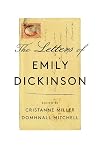
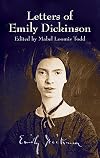
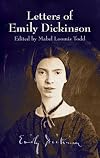
Letters of Emily Dickinson
by Emily Dickinson 
On This Page
Description
"The Letters of Emily Dickinson collects, redates, and recontextualizes all of the poet's extant letters, including dozens newly discovered or never before anthologized. Insightful annotations emphasize not the reclusive poet of myth but rather an artist firmly embedded in the political and literary currents of her time"--Tags
Recommendations








Member Reviews
Behold, unwrap the highest genius. Like Keats alone among poets, Dickinson's letters exhibit that genius. In fact, she compares winter to, " Keats's bird, 'who hops and hops in little journeys.'" Andrew Marvell's letters, for instance, are humdrum affairs mostly written in his public voice as parliamentary representative. ED writes with her poet's ear, "Friends are gems--infrequent" (II.352, 1859). Or, check this sentiment which would compound among moderns (even inaugural poets): "I have heard many notedly Bad readers, and a fine one would be almost a fairy surprise" (II.345, Jan '59).
Her verses punctuate her letters, letters which are often as epigrammatic as her verse; in her last year, "Fear makes us all martial." Apply that to the show more gun promoters today.
One two month visit to the UK for research, I would read a paragraph in Gilbert White every day, as a Naturalist's Bible. Decades earlier, I did the same with Dickinson's letters. One can open them at random, and find within a page or two something unprecedented and yet familiar, like this today.
After telling Loo (L Norcross) about the vegetable she sent, to be eaten with mustard, she observes:
"I enjoy much with a precious fly, during sister's absence, not one of your blue monsters, but a timid creature, that hops from pane to pane of her white house, so very cheerfully, and hums and thrums, a sort of speck piano."
Then she adds, almost as surprisingly, "Tell Vinnie I'll kill him the day she comes, for I sha'n't need him any more, and she don't mind flies" we'd say, she Does mind them (II.353).
There are revelations about her famous personal avoidance of others; from the friends/gems letter to Loo, she confides, "For you remember, dear, you are one of the ones from whom I do not run away! I keep an ottoman in my heart exclusively for you." And she reveals with profundity some of her avoidance: "My own words so burn and chill me that the temperature of other minds is too new an awe" (to Chickering, 1883).
Her epistolary attentions range far, including of course, her assessment of the form in which she writes," A letter always seemed to me like Immortality, for is it not the mind alone, without corporeal friend?" (1882).
And she even appears to have said, like the Reformation martyrs, her own last words, but in a letter: "Little Cousins, Called back."
Here she immortalizes a book title (by one Conway) she had read, so her last words are also a literary allusion. show less
Her verses punctuate her letters, letters which are often as epigrammatic as her verse; in her last year, "Fear makes us all martial." Apply that to the show more gun promoters today.
One two month visit to the UK for research, I would read a paragraph in Gilbert White every day, as a Naturalist's Bible. Decades earlier, I did the same with Dickinson's letters. One can open them at random, and find within a page or two something unprecedented and yet familiar, like this today.
After telling Loo (L Norcross) about the vegetable she sent, to be eaten with mustard, she observes:
"I enjoy much with a precious fly, during sister's absence, not one of your blue monsters, but a timid creature, that hops from pane to pane of her white house, so very cheerfully, and hums and thrums, a sort of speck piano."
Then she adds, almost as surprisingly, "Tell Vinnie I'll kill him the day she comes, for I sha'n't need him any more, and she don't mind flies" we'd say, she Does mind them (II.353).
There are revelations about her famous personal avoidance of others; from the friends/gems letter to Loo, she confides, "For you remember, dear, you are one of the ones from whom I do not run away! I keep an ottoman in my heart exclusively for you." And she reveals with profundity some of her avoidance: "My own words so burn and chill me that the temperature of other minds is too new an awe" (to Chickering, 1883).
Her epistolary attentions range far, including of course, her assessment of the form in which she writes," A letter always seemed to me like Immortality, for is it not the mind alone, without corporeal friend?" (1882).
And she even appears to have said, like the Reformation martyrs, her own last words, but in a letter: "Little Cousins, Called back."
Here she immortalizes a book title (by one Conway) she had read, so her last words are also a literary allusion. show less
Ratings
Members
- Recently Added By
Lists

Works cited in Palimpsest: A History of the Written Word by Matthew Battles
79 works; 2 members

Epistolary Non-Fiction (Letters and Correspondence)
99 works; 5 members

In Our Time books
4,934 works; 2 members
Author Information

537+ Works 29,999 Members
Emily Dickinson was born in Amherst, Massachusetts on December 10, 1830. Although one of America's most acclaimed poets, the bulk of her work was not published until well after her death on May 15, 1886. The few poems published in her lifetime were not received with any great fanfare. After her death, Dickinson's sister Lavinia found over 1,700 show more poems Emily had written and stashed away in a drawer -- the accumulation of a life's obsession with words. Critics have agreed that Dickinson's poetry was well ahead of its time. Today she is considered one of the best poets of the English language. Except for a year spent at Mount Holyoke Female Seminary in South Hadley, Dickinson spent her entire life in the family home in Amherst, Massachusetts. She never married and began to withdraw from society, eventually becoming a recluse. Dickinson's poetry engages the reader and requires his or her participation. Full of highly charged metaphors, her free verse and choice of words are best understood when read aloud. Dickinson's punctuation and capitalization, not orthodox by Victorian standards and called "spasmodic" by her critics, give greater emphasis to her meanings. (Bowker Author Biography) show less
Emily Dickinson has a Legacy Library. Legacy libraries are the personal libraries of famous readers, entered by LibraryThing members from the Legacy Libraries group.
Some Editions
Awards and Honors
Distinctions
Notable Lists
Series
Belongs to Publisher Series
Classifications
Statistics
- Members
- 209
- Popularity
- 155,979
- Reviews
- 1
- Rating
- (4.46)
- Languages
- English
- Media
- Paper, Ebook
- ISBNs
- 14
- UPCs
- 1
- ASINs
- 12