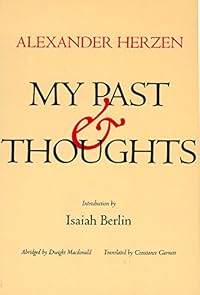
My Past and Thoughts {single volume, abridged}
by Alexander Herzen
On This Page
Description
Alexander Herzen's own brilliance and the extraordinary circumstances of his life combine to place his memoirs among the greatest works of the modern era. Born in 1812, the illegitimate son of a wealthy Russian landowner, he became one of the most important revolutionary and intellectual figures of his time: as theorist, polemicist, propagandist, and political actor. Fifty years after his death, Lenin revered him as the father of Russian revolutionary socialism. Tolstoy said he had never met show more another man "with so rare a combination of scintillating brilliance and depth." His monumental autobiography is an unparalleled record of his--and his century's--remarkable life. Herzen's story of his privileged childhood among the Russian aristocracy is lit with the insight of a great novelist. With a trained historian's sense of the interaction of people and events, he limns the grand line of revolutionary development from the earliest stirrings of Russian radicalism throughthe tumultuous ideological debates of the international. His close friends and enemies--Marx, Wagner, Mill, Bakunin, Garibaldi, Kropotkin--are brought brilliantly alive. Dwight Macdonald's knowledgeable and fluent abridgment makes this great work readily available to the modern reader. show lessTags
Recommendations




















Member Reviews
Beyond doubt, the most beloved literary monument among all genres in my library. Going through this 700 page abridgement from the original four tomes can only leave you with the desire to read the original Constance Garnett translation of complete four volumes. Its so unfortunate that Dwight MacDonald decided not to include that long essay, 'A Family Drama' in this abridgement for editorial reasons.
Its very hard that something socio-politically meaningful and interesting can be uttered about Herzen's memoirs by a South-East Asian reader in 21st century. However, from the perspective of an ardent lover of Russian literary tradition and an admirer of that peculiar milieu, Herzen, at times, comes out as deeply disquieted, hot and bothered show more reactionary; at other times he is a genius social critic, questioning reactionary zealousness and republicanism with the equal force. But overall, his characterization of bourgeois mentality is the strongest part of contemporary interest that protrudes out of the narrative, with capability to even hook a reader who is not that much aware of Turgenev's Bazarov — the superfluous man —, Bakunin, Belinsky, or even Mazzini or Garibaldi.
The whole Western-Europe of middle of 19th century comes alive in these memoirs and at times, stares at your face not letting you blink your eyes. There are passages which have unsurpassable literary force in whole classic modern literature; for instance, the angst laden ones such as,
have the kind of old school nihilistic tinge, which Herzen characterized more fully in his famous letters to Turgenev and the essay titled, The Superfluous and the Jaundiced (1860). However, its in the later years when Herzen developed, and displayed, his true literary and critical acumen beyond just the art of blending the personal with the historical. His musings on relationship between art and bourgeois life are so confounding, as well as accurate that one is forced to pause, reflect and perspire in the process. Here is a passage:
And with such kind of incessant, untiring, almost magnetic prose, he continues to take notes around the dying old world and its emerging new forms. As he himself says in a rejoinder to one of his critical interlocutors, he has no solutions to speak of. He was like a man sitting beside a patient on his death bed describing him his disease.
As Isaiah Berlin observes elsewhere, the chief reason for these memoirs being a supreme masterpiece is that the writer does not commit himself to any single thesis with a clear purpose, rejecting all general solutions of his time, may it be the optimism of Bakunin or Marx, or pessimism of Burckhardt or Tocqueville; thereby grasping,
Its very hard that something socio-politically meaningful and interesting can be uttered about Herzen's memoirs by a South-East Asian reader in 21st century. However, from the perspective of an ardent lover of Russian literary tradition and an admirer of that peculiar milieu, Herzen, at times, comes out as deeply disquieted, hot and bothered show more reactionary; at other times he is a genius social critic, questioning reactionary zealousness and republicanism with the equal force. But overall, his characterization of bourgeois mentality is the strongest part of contemporary interest that protrudes out of the narrative, with capability to even hook a reader who is not that much aware of Turgenev's Bazarov — the superfluous man —, Bakunin, Belinsky, or even Mazzini or Garibaldi.
The whole Western-Europe of middle of 19th century comes alive in these memoirs and at times, stares at your face not letting you blink your eyes. There are passages which have unsurpassable literary force in whole classic modern literature; for instance, the angst laden ones such as,
All Italy was awakening before my eyes! I saw the King of Naples tamed and the Pope humbly asking the alms of people's love - the whirlwind, which set everything in movement carried me, too, off my feet; all Europe took up its bed and walked - in fit of somnambulism which we took for awakening. When I came to myself, it had all vanished; la Sonnambula, frightened by the police, had fallen from the roof; friends were scattered or were furiously slaughtering one another...And I found myself alone, utterly alone, among graves and cradles - their guardian, defender, avenger, and I could do nothing because I tried to do more than was usual.
have the kind of old school nihilistic tinge, which Herzen characterized more fully in his famous letters to Turgenev and the essay titled, The Superfluous and the Jaundiced (1860). However, its in the later years when Herzen developed, and displayed, his true literary and critical acumen beyond just the art of blending the personal with the historical. His musings on relationship between art and bourgeois life are so confounding, as well as accurate that one is forced to pause, reflect and perspire in the process. Here is a passage:
Decorum, that is the real word. The petit bourgeois has two talents and he has the same ones, Moderation and Punctuality. The life of middle class is full of small defects and small virtues; it is self-restrained, often niggardly, and shuns what is extreme and what is superfluous. The garden is transformed into a kitchen garden; the thatched cottage into a little country-town house with an escutcheon painted on the shutters; but everyday they drink tea and eat meat in it. It is an immense step forward, but not at all artistic. Art is more at home with poverty and luxury than with crude prosperity or with comfort when it is an end in itself; if it comes to that, it is more at home with a harlot selling herself than with the respectable woman selling at three times the cost of the work of the starving seamstress. Art is not at ease in the stiff, over-neat thrifty house of the petit bourgeois, and in his house is bound to be such; art feels instinctively that in that life it is reduced to the level of external decoration such as wall paper and furniture, to the level of hurdy-gurdy; if the hurdy-gurdy man is a nuisance he is kicked out, if they want to listen they give him a halfpenny and that's that. Art which is pre-eminently elegance of proportion cannot endure the yard-measure; a life self-satisfied with its narrow mediocrity is stigmatised in the eyes of art by the worst of blots — vulgarity.
But that does not in the least prevents the whole cultured world from passing into petit bourgeois, and the vanguard has arrived their already. Petit bourgeois is the ideal to which Europe is striving, and rising from every point on the ground. It is the 'chicken in the cabbage soup,' about which Henri Quatre dreamt. A little house with little windows looking into the street, a school for the son, a dress for the daughter, a servant for the hard work—all that makes up indeed a haven of refuge—Havre de Grace!...
Bourgeoisie, the last word of civilisation, founded on the despotism of property, is the 'democratisation' of aristocracy, the 'aristocratisation' of democracy. In this environment Almaviva is the equal of Figaro—from below everything is straining up into bourgeoisie, from above everything is sinking down into it through the impossibility of maintaining itself. The American States present the spectacle of one class—the middle class—with nothing below it and nothing above it, the petit bourgeois manners and morals have remained. The German peasant is the petit bourgeois of agriculture; the working man of every country is petit bourgeois of future. Italy, the most poetical land in Europe, was not able to hold out, but at once forsook her fanatical lover, Mazzini, and betrayed her husband, the Hercules Garibaldi, as soon as Cavour, the petit bourgeois of genius, the little fat man in spectacles, offered to keep her as his mistress.
And with such kind of incessant, untiring, almost magnetic prose, he continues to take notes around the dying old world and its emerging new forms. As he himself says in a rejoinder to one of his critical interlocutors, he has no solutions to speak of. He was like a man sitting beside a patient on his death bed describing him his disease.
As Isaiah Berlin observes elsewhere, the chief reason for these memoirs being a supreme masterpiece is that the writer does not commit himself to any single thesis with a clear purpose, rejecting all general solutions of his time, may it be the optimism of Bakunin or Marx, or pessimism of Burckhardt or Tocqueville; thereby grasping,
...as very few thinkers have ever done, the crucial distinction between words that are about words, and words that are about persons or things in the real world. Nevertheless, it is as a writer that he survives. His autobiography is one of the great monuments to Russian literary and psychological genius, worthy to stand beside the great novels of Turgenev and Tolstoy.show less
Read some of this in Russian in the 70s. Must review my notes before reviewing …Do recall his imprisonment in the 1830's, and Paris around the 1848 revolution. Peasants were placed under police instead of Gogol's assessors: police who were "predatory, carnivorous, corrupt" (223, '82 ed). After reviewing, some notes here.
On Proudhon bringing out Voix du Peuple from prison: Few subscribers, but up to 60,000 in street sales, 30 times more expensive the next day. Fines questioned, for ex for an account of Lord Alton-Shée,
"Why, are you not a Catholic?" Alt-Sh, "No! And what's more, I am not a Christian at all, and maybe not a deist."
AH: "Men have grown no wiser since the days of Socrates, no wiser since the days of Galileo; they have show more only become more petty." (425)
Later, in England which disliked foreigners, he recalls Roman revolutionaries calling Russian women, honoring stranieri onto the balconi. England ignored Robert Owen's discovery of behaviorism, not spanking,
over genes.
And AH regrets the destruction of Owen's town, New Lanark, Scotland. The Quakers were horrified little Scots boys wore no trousers.AH blames the Quaker takeover for the new model town's failure, starting in schools: children should not be taught to sing and dance, while for Owen singing and movement were important in education.
When the Quakers "entered on managing New Lanark, they began by lowering pay an increasing work hours"[as Gov Romney did in MA Comm Colleges--more classes than H.S.-- so I retired early]. "New Lanark collapsed." [So has my comm coll, but since all of US ed has, like idiot-politician producing Princeton, Yale Law and Harvard Biz, no-one notices.]
These, just tidbits from a wealth of international and inter-cultural chapters. "The English and the French are full of prejudices, while a German is free from them; but both the French and the English are more consistent in their lives--the rule they follow is perhaps absurd, but it is what they have accepted"(376).
In Paris at the American ambassador Buchanan's--a "diplomatic dinner to the enemies of all existing governments"--Mazzini, Kossuth, Garibaldi, Worcell, the Englishman Wolmsley M.P., Herzen, a few others, and the host Buchanan (479). "The sly old man Buchanan, who was then already dreaming, in spite of his seventy years, of the presidency, and therefore was constantly talking of the happiness of retirement.." cautiously forbid discussing the future white republic. One proposed singing the Marseilleise in chorus, but only Worcell knew the tune properly, with his "extinction" of voice, and Mazzini knew it slightly. So the American Mrs Saunder (wife of the chef) played it on the guitar.
Meanwhile her spouse poured out teacups of Bourbon concoction, AH said, "I am a Russian, and even so I scorched my palate; Punch in Kentucky must be made from red pepper with an infusion of oil of vitriol...I was the only one who held out my empty cup and asked for more. The chemical affinity with alcohol raised me terribly high in the consul's eyes." "'Yes, yes,' he said:'it's only in America and Russia that people know how to drink'"(481).
Thanks to Ryan Diezi, I have some Herzen in Russian,
Когда священник начал мне давать уроки, он был удивлен не только общим
знанием евангелия, но тем, что я приводил тексты буквально. "Но господь бог, - говорил он, - раскрыв ум, не раскрыл еще сердца". И мой теолог, пожимая плечами, удивлялся моей "двойственности", однако же был доволен мною, думая, что у Терновского сумею держать ответ.
Вскоре религия другого рода овладела моей душой. [But I'm unsure what it was, this "other religion" that took over his thoughts. show less
On Proudhon bringing out Voix du Peuple from prison: Few subscribers, but up to 60,000 in street sales, 30 times more expensive the next day. Fines questioned, for ex for an account of Lord Alton-Shée,
"Why, are you not a Catholic?" Alt-Sh, "No! And what's more, I am not a Christian at all, and maybe not a deist."
AH: "Men have grown no wiser since the days of Socrates, no wiser since the days of Galileo; they have show more only become more petty." (425)
Later, in England which disliked foreigners, he recalls Roman revolutionaries calling Russian women, honoring stranieri onto the balconi. England ignored Robert Owen's discovery of behaviorism, not spanking,
over genes.
And AH regrets the destruction of Owen's town, New Lanark, Scotland. The Quakers were horrified little Scots boys wore no trousers.AH blames the Quaker takeover for the new model town's failure, starting in schools: children should not be taught to sing and dance, while for Owen singing and movement were important in education.
When the Quakers "entered on managing New Lanark, they began by lowering pay an increasing work hours"[as Gov Romney did in MA Comm Colleges--more classes than H.S.-- so I retired early]. "New Lanark collapsed." [So has my comm coll, but since all of US ed has, like idiot-politician producing Princeton, Yale Law and Harvard Biz, no-one notices.]
These, just tidbits from a wealth of international and inter-cultural chapters. "The English and the French are full of prejudices, while a German is free from them; but both the French and the English are more consistent in their lives--the rule they follow is perhaps absurd, but it is what they have accepted"(376).
In Paris at the American ambassador Buchanan's--a "diplomatic dinner to the enemies of all existing governments"--Mazzini, Kossuth, Garibaldi, Worcell, the Englishman Wolmsley M.P., Herzen, a few others, and the host Buchanan (479). "The sly old man Buchanan, who was then already dreaming, in spite of his seventy years, of the presidency, and therefore was constantly talking of the happiness of retirement.." cautiously forbid discussing the future white republic. One proposed singing the Marseilleise in chorus, but only Worcell knew the tune properly, with his "extinction" of voice, and Mazzini knew it slightly. So the American Mrs Saunder (wife of the chef) played it on the guitar.
Meanwhile her spouse poured out teacups of Bourbon concoction, AH said, "I am a Russian, and even so I scorched my palate; Punch in Kentucky must be made from red pepper with an infusion of oil of vitriol...I was the only one who held out my empty cup and asked for more. The chemical affinity with alcohol raised me terribly high in the consul's eyes." "'Yes, yes,' he said:'it's only in America and Russia that people know how to drink'"(481).
Thanks to Ryan Diezi, I have some Herzen in Russian,
Когда священник начал мне давать уроки, он был удивлен не только общим
знанием евангелия, но тем, что я приводил тексты буквально. "Но господь бог, - говорил он, - раскрыв ум, не раскрыл еще сердца". И мой теолог, пожимая плечами, удивлялся моей "двойственности", однако же был доволен мною, думая, что у Терновского сумею держать ответ.
Вскоре религия другого рода овладела моей душой. [But I'm unsure what it was, this "other religion" that took over his thoughts. show less
Ratings
Members
- Recently Added By
Author Information

89+ Works 949 Members
Herzen's primary importance in literature is his role in Russia's political and intellectual history. During the 1830s, with his friend N. Ogaryov, he became the center of a university circle whose members were developing utopian socialist theory. During the 1840s he helped shape the ideas of Russian Westernism. However, he also wrote fiction. His show more novel Who Is to Blame? (1847) presents a woman caught between two men. All three are unable to find a place for themselves in Russian society and, in line with Herzen's ideas about individual dignity and freedom, are responsible for their own unhappiness. After leaving Russia in 1847, Herzen became active in European revolutionary movements. Their failure produced From the Other Shore (1855), a collection of essays and dialogues on historical subjects. But his masterpiece is his memoirs, My Past and Thoughts; a unique combination of reminiscences, analyses, and anecdotes on which he worked from 1852 until 1868. Yet another achievement was The Bell (Kolokol), a weekly publication that Herzen produced for a decade and that had an enormous influence on both government and society in Russia from 1857 to 1861. Like many radical thinkers of the time (Vissarion Belinsky, Nikolay Chernyshevsky, and others), Herzen combined political and literary interests. Unlike them, however, he never lost his sensitivity of feeling and style, directing his irony at his allies as well as his adversaries. In this he was exceptional in Russian nineteenth-century letters. (Bowker Author Biography) show less
Work Relationships
Is an abridged version of
Common Knowledge
- Canonical title
- My Past and Thoughts {single volume, abridged}
- Original title
- My Past and Thoughts (authorized Constance Garnett translation abridged by Dwight McDonald) (authorized Constance Garnett translation abridged by Dwight McDonald)
- Disambiguation notice
- This is the single-volume abridged edition of the four-volume work. DO NOT combine with individual volumes that are part of the larger work or with the entire set.
Classifications
- Genres
- Nonfiction, History, Biography & Memoir, General Nonfiction
- DDC/MDS
- 947.070924 — History & geography History of Europe Eastern European Counties and Russia Russian & Slavic History by Period Paul I - Nicholas I 1796-1855
- LCC
- DK209.6 .H4 .A35 — History of Europe, Asia, Africa and Oceania Russia. Soviet Union. Former Soviet Republics – Poland History of Russia. Soviet Union. Former Soviet Republics History
- BISAC
Statistics
- Members
- 224
- Popularity
- 144,975
- Reviews
- 2
- Rating
- (4.44)
- Languages
- English, Russian
- Media
- Paper
- ISBNs
- 6