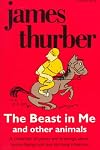
The Beast in Me and Other Animals
by James Thurber
On This Page
Description
The twentieth-century American artist and writer uses cartoons and stories to parody the shortcomings of modern man.Tags
Recommendations






















Member Reviews
One of the best books by James Thurber, who has to my mind become one of the great undervalued writers of 20th century America. He is perhaps best known now for his cartoons, of which several of the most famous (including "All right, have it your way -- you heard a seal bark") are in this book. But he was also a masterful writer of short stories, humorous sketches, and essays on a wide range of topics. This book includes several of each, including the series of five essays on soap opera he wrote for the New Yorker in the late 1940's. Thurber's writing is as supple and spare as his cartoons, and his humor profound.
It's amazing how timeless most of this collection of Thurber pieces is--a longish, five chapter essay on radio soap operas, despite referring to long gone serials, is quite interesting and informed by irony, and even a collection of "Talk of the Town" bits written by Thurber in the 1920s and 1930s stand on their own, although I had to google "Ely Culbertson" to really understand the two pieces about contract bridge games.
A collection of the cartoons, and short pieces mostly from the New Yorker by the American literary figure. Some of the Cartoons are classics ("Touche", and "This is the present Mrs. Hampshire!" This is material he wrote prior to 1948, and many of the pieces are journalism rather than entertainment. There s his long history of radio soap operas and the history of the evolution of the crossword puzzle.
Because I am a Thurber completist, it was an extra pleasure to find out I hadn't already read all the good stuff!
If you love James Thurber, you will love this book.
hardback
Orange Penguin..
Members
- Recently Added By
Author Information

136+ Works 18,329 Members
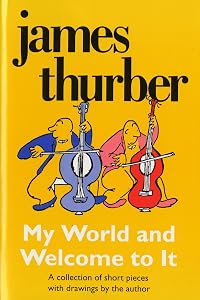
Born in Columbus, Ohio, Thurber was blinded in one eye in a childhood accident. He attended Ohio State University but left without earning a degree. In 1925 he moved to New York City, where he joined the staff of the New Yorker in 1927 at the urging of his friend E. B. White. For the rest of his lifetime, Thurber contributed to the magazine his show more highly individual pieces and those strange, wry, and disturbing pen-and-ink drawings of "huge, resigned dogs, the determined and sometimes frightening women, the globular men who try so hard to think so unsuccessfully." The period from 1925, when the New Yorker was founded, until the death of its creator-editor, Harold Ross, in 1951, was described by Thurber in delicious and absorbing detail in The Years with Ross (1959). Of his two great talents, Thurber preferred to think of himself primarily as a writer, illustrating his own books. He published "fables" in the style of Aesop (see Vol. 2) and La Fontaine (see Vol. 2)---usually with a "barbed tip of contemporary significance"---children's books, several plays (two Broadway hits, one successful musical revue), and endless satires and parodies in short stories or full-length works. "The Secret Life of Walter Mitty," included in My World---and Welcome to It (1942), is probably his best-known story and continues to be frequently anthologized. T. S. Eliot described Thurber's work as "a form of humor which is also a way of saying something serious." (Bowker Author Biography) show less
Awards and Honors
Distinctions
Common Knowledge
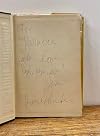
- Dedication
- FOR
RONNIE
and
JANEY WILLIAMS
in memory of
the serene hours at
Felicity Hall
Classifications
Statistics
- Members
- 355
- Popularity
- 89,283
- Reviews
- 8
- Rating
- (4.03)
- Languages
- English
- Media
- Paper
- ISBNs
- 4
- ASINs
- 22