Theory of Film
by Siegfried Kracauer
On This Page
Description
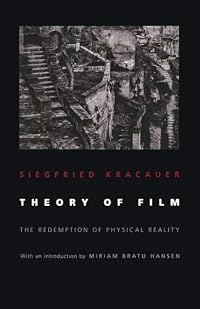
Siegfried Kracauer's classic study, originally published in 1960, explores the distinctive qualities of the cinematic medium. The book takes its place alongside works in classical film theory by such figures as Béla Balázs, Rudolf Arnheim, and André Bazin, among others, and has met with much critical dispute. In this new edition, Miriam Bratu Hansen, examining the book in the context of Kracauer's extensive film criticism from the 1920s, provides a framework for appreciating the show more significance of Theory of Film for contemporary film theory. show lessTags
Recommendations











Member Reviews
Kracauer's quasi-philosophical investigation of the meaning of cinema was published almost at the half way mark (1960) between the age of Melies and Lumiere and that of the MCU Universe and Bullet Train.
Naturally it suffers from looking back over seventy years without benefit of the subsequent sixty. Cinema morphs with technology in a way that does not apply to Literature. This matters a great deal. Nevertheless the book still stands as a relatively early attempt to 'understand' Film.
Kracauer's core thesis (although the book is also valuable for many specific insights) is that cinema is closely linked to physical reality although I would dispute the thesis myself. This is also where he is at his most obscure.
It is the insights that show more require our attention because they do what good philosophy should do - not allow us to close the book having found some secret about reality but rather driving us to question further and develop our own answers.
For example, he refers to the universality of film - how an audience in (say) New York can 'see' persons and events in Tokyo or Bombay. This raises interesting questions about the role of film in constructing global culture and the role of propaganda in the struggle to control the planet.
He usefully makes clear the line that separates the cinematic from the theatrical and literary. Although we may enjoy a film version of Shaw or Austen, such a film version cannot be called cinematic unless it is cinematic, making use of the unique character of the medium.
Then there is the difference between stage acting (projection in real space and time to an audience in position and busy suspending disbelief through the magic of words) and film acting where the camera is said to 'love' the actor. The audience identifies with fluid movement and small gestures.
Watch Lilian Gish as a nineteen year old in her first film ('An Unseen Enemy', 1912) and you see the very origins of the concept of 'star'. She shines. We do not suspend belief when we watch a film, we believe something entirely new in an oneiric experience.
This might be why the surrealists played so assiduously with film but Kracauer has another solid insight for us - that extending Art into film is not cinematic, it is just the use of another medium for the sake of Art.
He deals with experimental film (and its obverse, documentary) at length. He dismisses much of it as uncinematic although I would suggest that experiments can become profoundly cinematic in the hands of Rene Clair, Maya Deren, Kenneth Anger or Curtis Harrington.
If the book has a fault (perhaps a forgivable one in the light of the high seriousness of mid-twentieth century intellectual life) it is that Kracauer has a tendency to put cinema into far too tight a strait-jacket, to move towards the 'canonical' thinking that might ossify an art.
It never gets that bad both because Kracauer does not become overly prescriptive and because we know now that cinema would continue to develop along lines that Kracauer could not possibly have anticipated - the French New Wave, Tarantino, CGI, whatever.
If he does show a sense of disapproval, it perhaps appears in his resistance to the leaching of Art into cinema. He emphasises the materiality of cinema and the fact that it cannot reproduce concept and thought processes as the novel has done.
Instinctively this is right as we have all seen a favourite book mangled by film makers, a great film based on a book looking less impressive after reading the novel, great films made from very bad books and films strangled into dullness by verbiage thanks to literary scriptwriters.
However, I kept finding myself disputing his thesis of materiality which seemed to depend a great deal on his constant references back to the then-fashionable Italian Neo-Realists and to a clear prejudice in favour of the documentary.
First, film's oneiric quality (which he very much acknowledges) does not require the dream to be cast in surrealist terms but allows the film itself to be the dream. This capacity for becoming the dream has been enhanced in recent decades by new technologies such as CGI and in animation.
Second, the alleged material reality in the cinematic (as in the photographic) is illusory since the selection of images means the de-selection of everything not included in the presentation of reality and the abandonment of all the other senses and personal movement that we use to navigate reality.
When we live in the world, we select but from a much wider range of possible sensory choices. We create our own reality from immediate material reality. In cinema and photography, someone creates a limited reality for us to lose ourselves in - a willing restriction of choice.
This focusing of perception on sound and vision without smell, touch, taste or prioperception or the ability to walk away (to sit 'entranced') means that the link to material reality is like that we have in dreams - it seems real while we are in the state of entrancement.
Most of us will have had the sensation of leaving a cinema (the television screen or tablet is less able to do this) and found that the film has taken a while to leave us, that it leaches into reality much like the experience of waking from a particularly intense dream and still half-thinking we are in it.
Film 'uses' material reality but is not material reality other than the technology required to get the image into our eyes and the sound into our ears. It merely purports to be material reality which is why we should continue to distrust news footage and documentaries. They are selective artefacts.
The implications of film as vector for dream-like acceptance of invented realities and its effect on human culture has still barely been analysed, perhaps because much of the relevant intelligentsia is closely involved in its production and the recipients do not care.
Reading Kracauer and earlier theorists, you become increasingly aware that humanity has become increasingly inoculated to the 'magic' of film as merely film and has learned to lose itself into the dramatic and fantastic yet increasingly to become doubtful of the allegedly factual.
Film is unique whether as news footage or 'cinema' because nothing but film presents us with an apparent reality in movement away from the source of that reality. There is, of course, recorded music and words where we have to fill in any imagery ourselves but photography is still.
Theatre and opera or masque unless filmed might be 'oneiric' with suspension of disbelief but it is bound by physicality in itself and it requires a ritual more complex than buying a ticket and sitting in a dark room where you can walk in and out any time you want. At home, there is no ritual.
It has also become the 'art' that can express the lives of the marginal and the different to the largest number of people in the shortest amount of time alongside the mass news media. Without either, high art expressions of meaning are highly restricted in their reach to elites.
Which raises interesting questions about propaganda which Kracauer seems not to grasp or want to grasp. Exactly how much is film an intrinsically exploitative or intrinsically liberatory medium? The skills of the film maker are, in themselves, no more ethically grounded than the atomic scientist's.
This, of course, applies to all arts and literature. It takes us back to the theatrical where Kracauer points out Olivier's genius in thinking cinematically in order to enfold his theatrical versions of Hamlet and Henry V and yet these are essentially theatrical not cinematic experiences.
The film musical becomes a type case in the intrinsic creative absurdity of the cinematic, episodes of realism along usually hackneyed lines being interposed episodically (episodes are seen by Kracauer as essential to film story-telling) with 'numbers' being actually cinematic.
He has an extensive section on the use of sound in cinema which is still useful if perhaps one of the more obscurely philosophical sections. And, yes, the book can be a dry read at times so that the insights are fought hard for if worthwhile.
Overall one gets the sense of an intellectual trying to (at least partly) academicize something almost too slippery ever to be analysed in such terms. The thinking is sound but you get the impression that, at any moment, a new 'fact' (a new film) might unravel any proposition he might make.
Cinema is an art but not part of Art. It works because it follows its own material nature (the underpinning technology) and creates a bond between its producer and its audience based on a shared understanding about the material reality that the producer uses to reach the audience.
The 'chase' is an example. The 'chase' is cinematic since no other art form can present rapid movement over time and space. It may be a spool of film or pixels 'in reality' but, in the author's time, the chase was only possible by putting a camera on a vehicle in the real world and editing.
Sixty years on, the 'chase' is still cinematic but it is manufactured in the editing suite from a combination of live action (often actors with a green screen) and CGI. Bullet Train is one long invention of material reality through the digital. Kracauer's material reality is no longer central.
What we are probably seeing in this book is an early attempt to create a tradition, a route to a canon, at a time when film needed to be presented as an art to be respectable (rather than as a global business sensitive to popular culture).
To a great extent, this does take place - the Nouvelle Vague needed Hitchcock to feel real, Tarantino needed the Hollywood of the 1960s and 1970s to create his 'ouevre' as an 'auteur' - but the 'art form' (like comic books) is vastly bigger than canonical thinking can now permit.
Rather than an accepted 'tradition' (which was still conceptually possible to imagine in 1960), cinema is now a huge and growing pool of eclectic items from which each generation of film-makers can pick and choose whatever will 'sell' as bridge between their creativity and the public. Times change. show less
Naturally it suffers from looking back over seventy years without benefit of the subsequent sixty. Cinema morphs with technology in a way that does not apply to Literature. This matters a great deal. Nevertheless the book still stands as a relatively early attempt to 'understand' Film.
Kracauer's core thesis (although the book is also valuable for many specific insights) is that cinema is closely linked to physical reality although I would dispute the thesis myself. This is also where he is at his most obscure.
It is the insights that show more require our attention because they do what good philosophy should do - not allow us to close the book having found some secret about reality but rather driving us to question further and develop our own answers.
For example, he refers to the universality of film - how an audience in (say) New York can 'see' persons and events in Tokyo or Bombay. This raises interesting questions about the role of film in constructing global culture and the role of propaganda in the struggle to control the planet.
He usefully makes clear the line that separates the cinematic from the theatrical and literary. Although we may enjoy a film version of Shaw or Austen, such a film version cannot be called cinematic unless it is cinematic, making use of the unique character of the medium.
Then there is the difference between stage acting (projection in real space and time to an audience in position and busy suspending disbelief through the magic of words) and film acting where the camera is said to 'love' the actor. The audience identifies with fluid movement and small gestures.
Watch Lilian Gish as a nineteen year old in her first film ('An Unseen Enemy', 1912) and you see the very origins of the concept of 'star'. She shines. We do not suspend belief when we watch a film, we believe something entirely new in an oneiric experience.
This might be why the surrealists played so assiduously with film but Kracauer has another solid insight for us - that extending Art into film is not cinematic, it is just the use of another medium for the sake of Art.
He deals with experimental film (and its obverse, documentary) at length. He dismisses much of it as uncinematic although I would suggest that experiments can become profoundly cinematic in the hands of Rene Clair, Maya Deren, Kenneth Anger or Curtis Harrington.
If the book has a fault (perhaps a forgivable one in the light of the high seriousness of mid-twentieth century intellectual life) it is that Kracauer has a tendency to put cinema into far too tight a strait-jacket, to move towards the 'canonical' thinking that might ossify an art.
It never gets that bad both because Kracauer does not become overly prescriptive and because we know now that cinema would continue to develop along lines that Kracauer could not possibly have anticipated - the French New Wave, Tarantino, CGI, whatever.
If he does show a sense of disapproval, it perhaps appears in his resistance to the leaching of Art into cinema. He emphasises the materiality of cinema and the fact that it cannot reproduce concept and thought processes as the novel has done.
Instinctively this is right as we have all seen a favourite book mangled by film makers, a great film based on a book looking less impressive after reading the novel, great films made from very bad books and films strangled into dullness by verbiage thanks to literary scriptwriters.
However, I kept finding myself disputing his thesis of materiality which seemed to depend a great deal on his constant references back to the then-fashionable Italian Neo-Realists and to a clear prejudice in favour of the documentary.
First, film's oneiric quality (which he very much acknowledges) does not require the dream to be cast in surrealist terms but allows the film itself to be the dream. This capacity for becoming the dream has been enhanced in recent decades by new technologies such as CGI and in animation.
Second, the alleged material reality in the cinematic (as in the photographic) is illusory since the selection of images means the de-selection of everything not included in the presentation of reality and the abandonment of all the other senses and personal movement that we use to navigate reality.
When we live in the world, we select but from a much wider range of possible sensory choices. We create our own reality from immediate material reality. In cinema and photography, someone creates a limited reality for us to lose ourselves in - a willing restriction of choice.
This focusing of perception on sound and vision without smell, touch, taste or prioperception or the ability to walk away (to sit 'entranced') means that the link to material reality is like that we have in dreams - it seems real while we are in the state of entrancement.
Most of us will have had the sensation of leaving a cinema (the television screen or tablet is less able to do this) and found that the film has taken a while to leave us, that it leaches into reality much like the experience of waking from a particularly intense dream and still half-thinking we are in it.
Film 'uses' material reality but is not material reality other than the technology required to get the image into our eyes and the sound into our ears. It merely purports to be material reality which is why we should continue to distrust news footage and documentaries. They are selective artefacts.
The implications of film as vector for dream-like acceptance of invented realities and its effect on human culture has still barely been analysed, perhaps because much of the relevant intelligentsia is closely involved in its production and the recipients do not care.
Reading Kracauer and earlier theorists, you become increasingly aware that humanity has become increasingly inoculated to the 'magic' of film as merely film and has learned to lose itself into the dramatic and fantastic yet increasingly to become doubtful of the allegedly factual.
Film is unique whether as news footage or 'cinema' because nothing but film presents us with an apparent reality in movement away from the source of that reality. There is, of course, recorded music and words where we have to fill in any imagery ourselves but photography is still.
Theatre and opera or masque unless filmed might be 'oneiric' with suspension of disbelief but it is bound by physicality in itself and it requires a ritual more complex than buying a ticket and sitting in a dark room where you can walk in and out any time you want. At home, there is no ritual.
It has also become the 'art' that can express the lives of the marginal and the different to the largest number of people in the shortest amount of time alongside the mass news media. Without either, high art expressions of meaning are highly restricted in their reach to elites.
Which raises interesting questions about propaganda which Kracauer seems not to grasp or want to grasp. Exactly how much is film an intrinsically exploitative or intrinsically liberatory medium? The skills of the film maker are, in themselves, no more ethically grounded than the atomic scientist's.
This, of course, applies to all arts and literature. It takes us back to the theatrical where Kracauer points out Olivier's genius in thinking cinematically in order to enfold his theatrical versions of Hamlet and Henry V and yet these are essentially theatrical not cinematic experiences.
The film musical becomes a type case in the intrinsic creative absurdity of the cinematic, episodes of realism along usually hackneyed lines being interposed episodically (episodes are seen by Kracauer as essential to film story-telling) with 'numbers' being actually cinematic.
He has an extensive section on the use of sound in cinema which is still useful if perhaps one of the more obscurely philosophical sections. And, yes, the book can be a dry read at times so that the insights are fought hard for if worthwhile.
Overall one gets the sense of an intellectual trying to (at least partly) academicize something almost too slippery ever to be analysed in such terms. The thinking is sound but you get the impression that, at any moment, a new 'fact' (a new film) might unravel any proposition he might make.
Cinema is an art but not part of Art. It works because it follows its own material nature (the underpinning technology) and creates a bond between its producer and its audience based on a shared understanding about the material reality that the producer uses to reach the audience.
The 'chase' is an example. The 'chase' is cinematic since no other art form can present rapid movement over time and space. It may be a spool of film or pixels 'in reality' but, in the author's time, the chase was only possible by putting a camera on a vehicle in the real world and editing.
Sixty years on, the 'chase' is still cinematic but it is manufactured in the editing suite from a combination of live action (often actors with a green screen) and CGI. Bullet Train is one long invention of material reality through the digital. Kracauer's material reality is no longer central.
What we are probably seeing in this book is an early attempt to create a tradition, a route to a canon, at a time when film needed to be presented as an art to be respectable (rather than as a global business sensitive to popular culture).
To a great extent, this does take place - the Nouvelle Vague needed Hitchcock to feel real, Tarantino needed the Hollywood of the 1960s and 1970s to create his 'ouevre' as an 'auteur' - but the 'art form' (like comic books) is vastly bigger than canonical thinking can now permit.
Rather than an accepted 'tradition' (which was still conceptually possible to imagine in 1960), cinema is now a huge and growing pool of eclectic items from which each generation of film-makers can pick and choose whatever will 'sell' as bridge between their creativity and the public. Times change. show less
Ratings
Members
- Recently Added By
Author Information

63+ Works 1,564 Members
Series
Belongs to Publisher Series
Common Knowledge
- Original title
- Theory of Film
Classifications
- Genres
- Nonfiction, General Nonfiction, Philosophy
- DDC/MDS
- 791.43 — Arts & recreation Recreation, sports, and performing arts Movies, TV, Video Motion pictures, radio, television, podcasting Motion pictures
- LCC
- PN1994 .K7 — Language and Literature Literature (General) Literature (General) Drama Motion pictures
- BISAC
Statistics
- Members
- 265
- Popularity
- 121,645
- Reviews
- 1
- Rating
- (3.79)
- Languages
- 7 — English, French, German, Hungarian, Italian, Polish, Spanish
- Media
- Paper, Ebook
- ISBNs
- 14
- ASINs
- 4