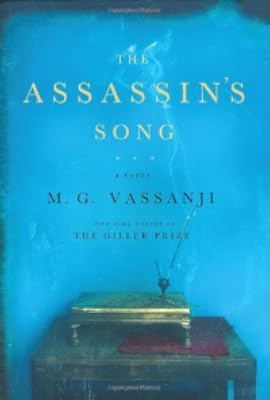
The Assassin's Song
by M. G. Vassanji
On This Page
Description
In the aftermath of the brutal violence that gripped western India in 2002, Karsan Dargawalla, heir to Pirbaag -- the shrine of a mysterious, medieval sufi -- begins to tell the story of his family. His tale opens in the 1960s: young Karsan is next in line after his father to assume lordship of the shrine, but he longs to be "just ordinary." Despite his father's pleas, Karsan leaves home behind for Harvard, and, eventually, marriage and a career. Not until tragedy strikes, both in Karsan's show more adopted home in Canada and in Pirbaag, is he drawn back across thirty years of separation and silence to discover what, if anything, is left for him in India. show lessTags
Recommendations























Member Reviews
The Assassin's Song by M G Vassanji was beautiful, sad, touching, and full of yearning. It was brought to life by narrator Firdous Bamji. All this while giving a history lesson. I learned much more about the Pakistan-Indian conflict than watching the nightly news.
Karsan is heir to position of saheb, but he feels it is too restrictive and almost impulsively goes to America to study. Essentially he tries to run away from his identity. And this is what I liked about the story -- it examines identity, and asks how much of it do we shape ourselves, and how much are we shaped by our ancestry, our heritage, our family, and our destiny? What does it mean to escape from the familial expectations; can we escape? The answers suggested here are not going to be the right answers for everyone, but it was good to walk with Karsan through his journey.
A confusing start, perhaps because I am so unfamiliar with the Indian and religious terms. But I was able to understand the general idea of the intro and soon show more picked up on the intertwining stories and the larger narrative. The book gives me an entirely different perspective of India than I have from reading books by Rohinton Mistry. show less
A confusing start, perhaps because I am so unfamiliar with the Indian and religious terms. But I was able to understand the general idea of the intro and soon show more picked up on the intertwining stories and the larger narrative. The book gives me an entirely different perspective of India than I have from reading books by Rohinton Mistry. show less
The Assassin’s Song, by M.G. Vassanji comes with an impressive list of literary accolades, having been shortlisted for the Giller and the GG. Yet, for my part, there is a definite lack of simpatico or connection with Vassanji’s tale.
The novel is set in India from Partition to the devastating religious violence of the early 21st century, following the timeless theme of father/son tension and sibling disharmony. There is a rich vein of material here to mine, and mine it Vassanji does. Yet there is a distinct distance to how Vassanji relates his story, a lack of emotional involvement that cools the narrative and shutters the reader.
For the first third of the novel Vassanji spends considerable time setting the stage for the emotional show more impact of the denouement, offering up endless, almost jejune details regarding the protagonist’s, Karson Dargawalla, life as the next embodiment of the sufi mystic and demi-god who resides in the temple Karson’s father keeps, Pirbaag. From there we shift to the middle third in which Karson escapes to Harvard, and a renunciation of his birthright.
Throughout this interminable backstory, Vassanji does little to draw in the reader, either by way of contextual clues as to language or cultural nuances, or by way of emotional investment. Karson’s father remains an aloof, unapproachable academic, his mother a frustrated, secretive if dutiful stereotype, and his brother an unknown, albeit cute, almost throw-away character. There are other characters who walk on and off-stage, uttering lines and sagacities, conveniently thrown in to move Karsan through the story-arc.
It is not until the final third of the novel, Vassanji employs any emotional investment to draw in the reader. By then, for this reader, it’s too little too late. That Karsan’s brother is most likely a terrorist responsible for the devastation of Pirbaag, and the death of his own father, is almost a shrug. That Karsan submits, in the end, to destiny and the continuation of chicanery and religious charlatanism, seems contrived and cardboard.
It is a competent novel. But it is a disappointing read. In the end, all I can offer is this: Vassanji is no Rohinton Mistry. show less
The novel is set in India from Partition to the devastating religious violence of the early 21st century, following the timeless theme of father/son tension and sibling disharmony. There is a rich vein of material here to mine, and mine it Vassanji does. Yet there is a distinct distance to how Vassanji relates his story, a lack of emotional involvement that cools the narrative and shutters the reader.
For the first third of the novel Vassanji spends considerable time setting the stage for the emotional show more impact of the denouement, offering up endless, almost jejune details regarding the protagonist’s, Karson Dargawalla, life as the next embodiment of the sufi mystic and demi-god who resides in the temple Karson’s father keeps, Pirbaag. From there we shift to the middle third in which Karson escapes to Harvard, and a renunciation of his birthright.
Throughout this interminable backstory, Vassanji does little to draw in the reader, either by way of contextual clues as to language or cultural nuances, or by way of emotional investment. Karson’s father remains an aloof, unapproachable academic, his mother a frustrated, secretive if dutiful stereotype, and his brother an unknown, albeit cute, almost throw-away character. There are other characters who walk on and off-stage, uttering lines and sagacities, conveniently thrown in to move Karsan through the story-arc.
It is not until the final third of the novel, Vassanji employs any emotional investment to draw in the reader. By then, for this reader, it’s too little too late. That Karsan’s brother is most likely a terrorist responsible for the devastation of Pirbaag, and the death of his own father, is almost a shrug. That Karsan submits, in the end, to destiny and the continuation of chicanery and religious charlatanism, seems contrived and cardboard.
It is a competent novel. But it is a disappointing read. In the end, all I can offer is this: Vassanji is no Rohinton Mistry. show less
The tale of individuation has been told and told, but feeding the soil of this novel's garden of narratives is the less often explored, living history of saints and sahebs. "The Assassin's Song" dips into the colorful chronicles of a centuries-old lineage, seemingly in hopes of bringing up some fresh insight on the relevance of history to destiny. But the author unfortunately nurses the pedestrian neuroses of the humble, likable hero and leaves it to the end to toss off a disappointingly crisp nod to the alluring origins of the title's namesake, arguably the book's most interesting character. It's a novel that requires patience, empathy, and curiosity and offers no special facility with language--no delicious poetics or rhythm to show more inspire the reader's own momentum. And so one is left with the slow growth of an unwitting hero and the gradual decline of one of Southeast Asia's rich religious traditions and most fascinating periods of history into awkward plot devices. Recommended only for India buffs. show less
The Assassin’s Song tells the story of Karsan Dargawalla. Beginning with his childhood in rural India, Karsan becomes aware of his destiny to succeed his father as the spiritual leader of their community and the protector of The Shrine of the Wanderer – servicing all who come there to worship. However, Karsan begins to discover there is a much more exciting world beyond their home and – on a whim – applies and is accepted to study half a world away at Harvard University. What ensues is Karsan’s coming-of-age in a foreign land, but not without the constant tug of his family, his heritage and many tragedies trying to pull him back.
Vassanji’s writing is beautiful – almost lyrical – throughout the novel. However he relies show more far too much on lyrical verse early in the book and the story evolves very slowly. Near the middle of the story, as Karsan is making his decision to leave his home, the story starts to pick up the pace and becomes a very interesting tale of his coming of age, successes and some rather humorous failures. The really draws us into Karsan’s life and makes the early parts of the story worth reading through. However, just when the story gains momentum, it flounders. Karsan becomes lost, but the story seems to get lost as well, failing to provide the ready much to cling onto. The last third of the book seems to really wander. Karsan’s brother is reintroduced near the end, but nothing about him or his relationship with Karsan is developed and we are left with a lot of new questions that are never answered. In the end, Karsan seems more an uninterested observer of his life rather than a participant in it.
The Assassin’s Song had some interesting moments along the way and Vassanji’s writing is beautiful by its own right, but unless you are looking to immerse yourself in Indian culture, there won’t be much of a story to hold your interest. show less
Vassanji’s writing is beautiful – almost lyrical – throughout the novel. However he relies show more far too much on lyrical verse early in the book and the story evolves very slowly. Near the middle of the story, as Karsan is making his decision to leave his home, the story starts to pick up the pace and becomes a very interesting tale of his coming of age, successes and some rather humorous failures. The really draws us into Karsan’s life and makes the early parts of the story worth reading through. However, just when the story gains momentum, it flounders. Karsan becomes lost, but the story seems to get lost as well, failing to provide the ready much to cling onto. The last third of the book seems to really wander. Karsan’s brother is reintroduced near the end, but nothing about him or his relationship with Karsan is developed and we are left with a lot of new questions that are never answered. In the end, Karsan seems more an uninterested observer of his life rather than a participant in it.
The Assassin’s Song had some interesting moments along the way and Vassanji’s writing is beautiful by its own right, but unless you are looking to immerse yourself in Indian culture, there won’t be much of a story to hold your interest. show less
I had a publishers ARC of this soon-to-be published novel and it's incredible. It follows of the life of Kirsan Dargawalla from northern India where he is next-in-line to become the lord of a local Sufi shrine. Despite his legacy, he longs for an ordinary life, and emigrates to the States where he goes to Harvard and embarks on an academic life. He is continously haunted by his heritage and when he returns India, after some personal setbacks, he begins to discover what, if anything, is left for him there.
Vassenji has written several novels and books of short stories and has twice won the prestigious Giller Prize. But I think this novel might be a break through for him and open him up to an even wider audience.
Vassenji has written several novels and books of short stories and has twice won the prestigious Giller Prize. But I think this novel might be a break through for him and open him up to an even wider audience.
This could have been a good book but there were so many foreign words (in some cases 1 per sentence) (Hindu) that one could not get in the context of the story and so many characters that I could not keep track of that I did not finish this book. There were no helps in this book as in family tree, Hindu religious organization, or even a map. I read 50% of the book and decided life is too short to struggle this much with fiction. Read 180/336 pages. DNF
Members
- Recently Added By
Author Information

26+ Works 2,163 Members
M.G. Vassanji was born in Kenya and raised in Tanzania. Before coming to Canada in 1978, he attended M.I.T., and later was writer in residence at the University of Iowa. Vassanji is the author of four acclaimed novels: The Gunny Sack (1989), which won a regional Commonwealth Prize; No New Land (1991); The Book of Secrets (1994), which won the very show more first Giller Prize; and Amriika (1999). He was awarded the Harbourfront Festival Prize in 1994 in recognition of his achievement in and contribution to the world of letters, and was in the same year chosen as one of twelve Canadians on Macleans Honour Roll. show less
Awards and Honors
Common Knowledge
- People/Characters
- Karsan, Premji, Mansour
- Important places
- India; Harvard University, Cambridge, Massachusetts, USA; British Columbia, Canada
Classifications
Statistics
- Members
- 307
- Popularity
- 104,181
- Reviews
- 10
- Rating
- (3.55)
- Languages
- English
- Media
- Paper, Audiobook, Ebook
- ISBNs
- 16
- ASINs
- 4